
A diagnostic enzyme reagent that performs well on one analyzer does not automatically perform well on another. Instrument platforms differ in reaction volume, sample-to-reagent ratio, dispensing sequence, mixing efficiency, incubation time, reaction temperature, measurement wavelength, optical path length, kinetic reading interval, and data-processing algorithms. Each of these variables can shift reaction kinetics, blank level, calibration behavior, and linearity. Reagent adaptation is therefore a chemistry-and-instrument engineering exercise: the reagent and the assay parameters must be optimized together for the target platform, not simply copied from an existing application sheet.
As part of our Diagnostic Enzyme Assay Development and Troubleshooting Services, Creative Enzymes provides an instrument platform adaptation service for diagnostic enzyme reagents. We support transfers from an existing analyzer to a new platform, adaptations to open-channel chemistry analyzers, and OEM reagent programs in which a reagent must perform reliably across several instruments with different physical and optical configurations.
| Item | Summary |
|---|---|
| Starting Point | An enzyme reagent with established performance on one platform that must run on a different analyzer, or a reagent being developed for multiple target instruments. |
| Core Work | Compatibility assessment, instrument parameter optimization, formulation adaptation, and cross-platform comparative testing. |
| Primary Output | Recommended instrument settings, optimized volumes and timing, adapted formulation where required, and cross-platform comparison data. |
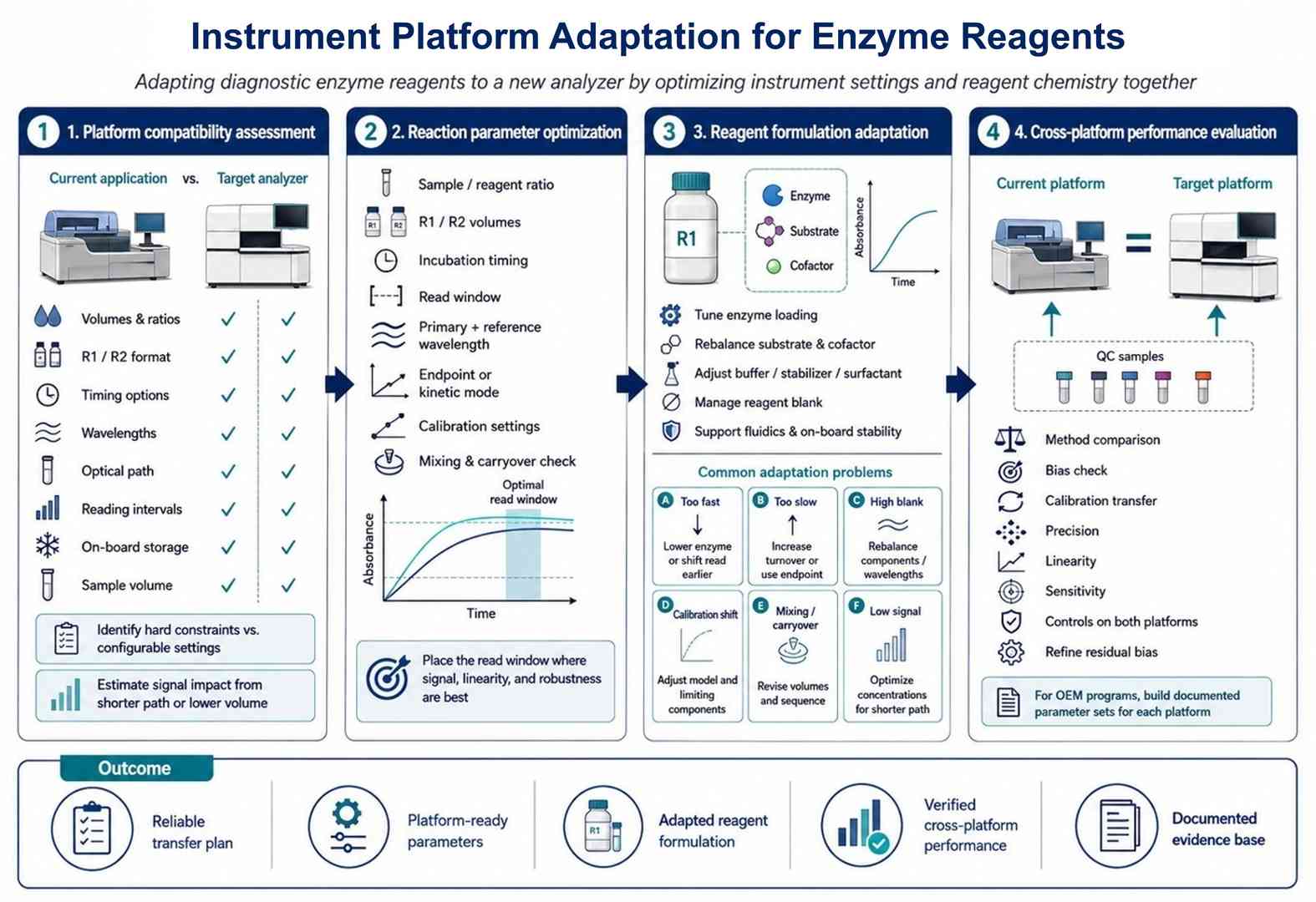
Adaptation begins with a structured comparison of the existing reagent protocol and the target instrument's specifications. We review the current application—volumes, ratios, timing, wavelengths, and calculation settings—against what the new platform physically permits: available reaction volume range, configurable sample and reagent volumes, reagent-channel configuration (single reagent, R1/R2, or multi-reagent), incubation timing options, measurement wavelengths and optical path length, kinetic reading intervals, and on-board reagent storage conditions. This review identifies hard constraints, such as a fixed minimum reaction volume or a limited wavelength set, and soft constraints, such as timing configurations that are possible but suboptimal for the reaction kinetics.
Sample volume requirements and on-board reagent stability considerations are assessed at the same stage, since both affect the final application design. Where the target platform imposes a substantially shorter optical path or smaller reaction volume, the expected signal change is estimated early so that the adaptation strategy can account for it rather than discovering the deficit during comparative testing. The outcome of this stage is a clear picture of which parameters can simply be reconfigured on the new instrument and which require changes to the reagent itself—a distinction that largely determines the cost and duration of the adaptation.
Within the platform's configurable space, the assay parameters are optimized for the target instrument. This includes the R1/R2 configuration and reagent volumes, sample volume and sample-to-reagent ratio, incubation timing, and the position and duration of the reading window. Primary and secondary wavelengths are selected to maximize analytical signal while minimizing matrix and reagent-blank contributions, using a bichromatic configuration where the instrument supports it. The choice between endpoint and kinetic measurement is revisited for the new platform, since the available reading intervals and timing may favor a different strategy than the original application.
Reaction direction, calculation settings, and calibration parameters—including calibration frequency, fitting model, and acceptable curve criteria—are configured to match the platform's data-processing logic. Carryover behavior and mixing efficiency are also examined at this stage, since both can distort results in ways that mimic a chemistry problem while originating entirely in the instrument's liquid handling. Throughout this stage, the objective is to place the measurement window where the reaction provides the best combination of signal magnitude, linearity, and robustness on this specific instrument, rather than reproducing the original timing by default.
Parameter optimization alone is sometimes insufficient, particularly when the platform changes the sample-to-reagent ratio, reaction volume, or incubation time substantially. In these cases, the formulation itself is adapted: enzyme concentrations are adjusted to tune the reaction rate into the instrument's reading window; substrate and cofactor levels are rebalanced for the new ratio and timing; buffer, stabilizer, and surfactant systems are reviewed for compatibility with the platform's fluidics, cuvette materials, and on-board storage conditions; and the reagent blank is managed so that the net low-level signal remains adequate under the new optical conditions.
| Common Adaptation Problem | Typical Resolution Path |
|---|---|
| Reaction too fast for the reading window | Reduce enzyme loading, adjust ratio or timing, or shift the read window earlier. |
| Reaction too slow for required throughput | Increase turnover, optimize cofactors, or move to an endpoint strategy. |
| Excessive reagent blank on the new platform | Rebalance components, revise wavelengths, or improve raw-material purity. |
| Calibration shift or platform-specific non-linearity | Adjust calibration model and parameters; rebalance limiting components. |
| Inadequate mixing, carryover, or volume incompatibility | Revise volumes and dispensing sequence; adapt formulation viscosity and surfactants. |
| Low absorbance change due to shorter optical path | Rebalance concentrations, adapt formulation, or apply signal optimization strategies. |
Migrating a reagent to a new analyzer?
Discuss your adaptation project with our team
The adapted application is verified through structured cross-platform comparison. Method-comparison testing against the reference platform quantifies bias and establishes whether results are equivalent within accepted limits. Calibration transfer is assessed to determine whether the existing calibration system carries over or requires platform-specific adjustment. Precision, linearity, and sensitivity are compared between platforms, and reference or control samples are tested on both instruments to confirm that the adapted application reproduces the established performance. Where residual platform-dependent bias is observed, we investigate whether it originates in remaining parameter differences, formulation behavior, or the platform's calculation algorithm, and refine the application accordingly. For OEM programs, the same evaluation framework is extended across each target platform, so that platform-specific parameter sets rest on a common, documented evidence base and performance claims remain consistent between instruments.

Typical deliverables include recommended instrument settings, optimized reagent and sample volumes, reaction timing parameters, the recommended wavelength configuration, an adapted reagent formulation where required, cross-platform comparison data, and an instrument adaptation report documenting the work in a form suitable for application-note development.
Supported scenarios include open-channel chemistry analyzers, automated and semi-automated clinical chemistry analyzers, benchtop biochemical platforms, custom diagnostic instruments, assay migration between instrument platforms, and OEM reagent adaptation programs in which consistent performance across multiple platforms is a commercial requirement.
Q1. Do you need physical access to the target instrument?
Q2. Can the same formulation serve multiple platforms?
Q3. How much bias between platforms is acceptable?
Q4. The reagent loses sensitivity on a lower-volume platform. What can be done?
Q5. Can you prepare the final application sheet for the target analyzer?
Creative Enzymes treats instrument adaptation as an integrated reagent-and-platform optimization, grounded in enzyme kinetics and analytical chemistry rather than trial-and-error parameter changes. Because our team develops the underlying reagent chemistry as well as the instrument application, adjustments at both levels are coordinated within a single project rather than negotiated between separate vendors. The result is an application that performs by design on the target instrument, with the comparative data to demonstrate it and the documentation to support your application notes, technical files, and customer-facing performance claims.
Adapt your diagnostic enzyme reagent to the target instrument platform—contact our business development team today!
