
Isothermal nucleic acid amplification and CRISPR-based detection are reshaping molecular assay development because they can reduce dependence on conventional thermal cycling while preserving sequence-directed recognition. Their apparent simplicity can be misleading. A constant-temperature reaction still requires coordinated enzymes, primers or guide RNAs, sample preparation, reporter chemistry, contamination controls, temperature management, and a result rule that remains valid in the intended device and specimen.
The Isothermal Amplification and CRISPR Diagnostics Resources knowledge center explains these systems from the viewpoint of assay architecture rather than platform labels. It compares LAMP, recombinase polymerase amplification (RPA), helicase-dependent amplification (HDA), and rolling-circle amplification (RCA); examines RT-LAMP and RPA reagent systems; connects amplification to Cas12 or Cas13 detection; and addresses dry reagents, paper formats, contamination prevention, smartphones, and field deployment.
These guides are intended for molecular diagnostic developers, reagent scientists, POCT engineers, quality teams, and technical buyers. They describe research and development principles, not universal formulas or clinical claims. Analytical and clinical performance must be established for the defined target, sample, workflow, user, instrument, and jurisdiction.
Creative Enzymes provides molecular diagnostic raw materials and development support that can be matched to the reaction mechanism and product format:
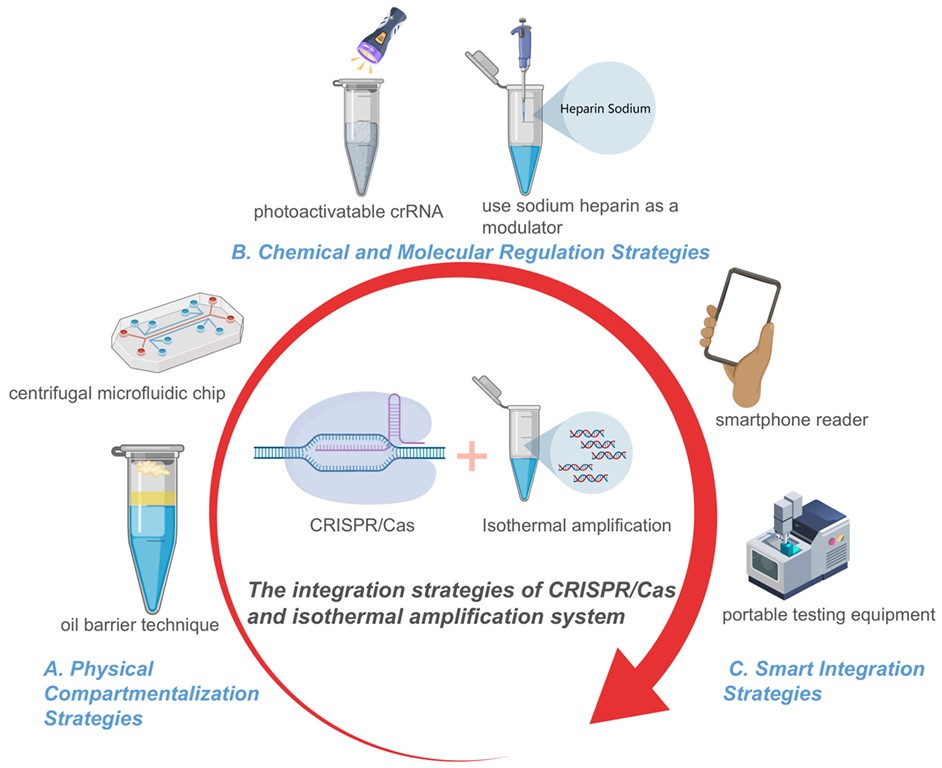 Figure 1. The combined strategy of CRISPR/Cas and isothermal amplification system. (A) Physical Compartmentalization Strategies: Oil barrier technique, centrifugal microfluidic chip. (B) Chemical and Molecular Regulation Strategies: photoactivatable crRNA, use sodium heparin as a modulator. (C) Smart Integration Strategies: smartphone reader, Portable testing equipment. (Yong et al., 2026)
Thermal cycling separates denaturation, annealing, and extension in time. Isothermal methods replace thermal denaturation with another biochemical strategy. LAMP creates self-priming stem-loop intermediates; RPA uses recombinase-mediated primer invasion and strand-displacing synthesis; HDA uses helicase to open duplex DNA; and RCA repeatedly copies a circular template. Each approach has a different enzyme network, primer topology, background route, and preferred product length.
The operating temperature is only one design variable. A useful assay must also tolerate setup time, heater variation, sample-derived inhibitors, reagent storage, vessel surfaces, and readout chemistry. A method that amplifies purified template rapidly may perform poorly after crude lysis, drying, transfer to paper, or integration with a CRISPR reporter.
| Platform | Biochemical principle | Typical strengths | Important development risks |
|---|---|---|---|
| LAMP | Four core primers create stem-loop products that support strand-displacing synthesis; loop primers may accelerate amplification | High product yield, several detection options, established use in constant-temperature workflows | Complex primer interactions, late no-template amplification, high carryover burden, colorimetric buffer sensitivity |
| RPA-type amplification | Recombinase-primer complexes invade duplex DNA, single-strand binding proteins stabilize the displaced strand, and a polymerase extends the primer | Low operating temperature, rapid reactions, compatibility with compact heaters and lateral-flow concepts | Multi-protein balance, pre-run activity, primer/probe background, crowding effects, component access and licensing |
| HDA | Helicase separates duplex DNA while polymerase extends primers at a constant temperature | Two-primer concept and direct mechanistic replacement of heat denaturation | Helicase-polymerase synchronization, ATP balance, duplex structure, amplicon length, and enzyme-temperature compatibility |
| RCA | A strand-displacing polymerase repeatedly copies a circular template, often after target-dependent ligation | Long repeated products, localized amplification, padlock-probe specificity, surface compatibility | Circularization efficiency, linear-probe background, nonspecific priming, long reaction time, and viscous products |
CRISPR diagnostics add a programmable recognition layer. In many Cas12 systems, a Cas12-crRNA complex recognizes a complementary DNA activator and then cleaves single-stranded DNA reporters in trans. Cas13 systems recognize RNA and cleave single-stranded RNA reporters. The reporter can be fluorescent, colorimetric, electrochemical, or connected to lateral flow.
CRISPR recognition can improve sequence discrimination and provide a convenient signal-amplification mechanism, but it does not automatically eliminate upstream amplification. Many reported workflows use LAMP, RPA, or another preamplification step because direct Cas reporter turnover may not provide the required analytical sensitivity for low-copy samples. The amplification product, guide, protospacer-adjacent motif requirements where applicable, reporter, and result threshold must be designed as one signal path.
A two-step workflow performs amplification first and transfers product into a CRISPR detection reaction. It allows each module to use a favorable buffer and temperature, but opening the amplification vessel increases contamination risk. A one-pot workflow keeps the modules within one closed container. This may reduce handling, yet the enzymes can compete for magnesium, nucleotides, target intermediates, or operating conditions.
| Architecture | Main advantage | Main challenge | Useful controls |
|---|---|---|---|
| Sequential, open transfer | Independent optimization of amplification and Cas detection | Amplicon release into the workspace | Transfer blanks, spatial workflow controls, sealed downstream readout where possible |
| Sequential, sealed or physically separated | Temporal separation without opening | Reliable release, mixing, or phase transition | Compartment-release control, mixing control, module-specific positive controls |
| Fully homogeneous one-pot | Minimal steps and compact device integration | Shared-buffer compromise and premature reporter activation | Amplification-only, Cas-only, guide-minus, reporter-minus, and time-course controls |
Amplification chemistry cannot be evaluated independently of the specimen. Saliva, swab eluate, blood, plasma, urine, plant material, food extracts, and environmental samples differ in nuclease activity, pH, salts, proteins, polysaccharides, cells, and inhibitory compounds. Simplifying extraction can shorten time to result, but it may also reduce target recovery or increase inhibitor load.
A useful development sequence first establishes the amplification mechanism with clean template, then introduces representative purified nucleic acid, extraction-buffer carryover, and finally the intended crude or minimally processed matrix. Matched target spikes before and after sample preparation help distinguish poor release from amplification inhibition. The site's Direct PCR and Extraction-Free Enzyme System Development framework can support this interface even when the final amplification mode is isothermal.
Intercalating fluorescence reports double-stranded product but does not prove identity. pH indicators can provide a simple visual endpoint, yet starting pH, sample buffering, carbon dioxide exposure, and reagent aging influence color. Turbidity and metal-ion indicators respond to amplification-associated chemistry rather than sequence. CRISPR reporters add sequence-directed activation but can still show background cleavage, optical artifacts, or nonspecific upstream amplification.
A valid result rule should define the read time, signal threshold, control requirements, and treatment of late or ambiguous reactions. Time to positive can be useful for development, but it is not automatically an absolute copy-number measurement. Low-copy stochastic sampling, matrix variation, heater gradients, and reagent lots can broaden the distribution.
Lyophilization or air drying can reduce cold-chain dependence, but a stable liquid master mix is not automatically a stable dry product. Enzymes, guide RNAs, reporters, primers, salts, detergents, and color indicators may respond differently to freezing, drying, residual moisture, oxygen, and rehydration. The final package, desiccant, seal, and use simulation are part of the stability system.
Paper and porous materials introduce adsorption, evaporation, nonuniform flow, background fluorescence, and local concentration gradients. Smartphone readers add camera, exposure, white-balance, illumination, focus, and software-version variables. Field deployment therefore requires co-development of chemistry, consumable, reader, instructions, controls, data handling, and environmental claims.
| Resource | What the resource covers |
|---|---|
| Isothermal Amplification Methods: LAMP, RPA, HDA and RCA Compared | A mechanism-based comparison of enzyme modules, primer architectures, temperatures, product forms, detection options, and failure modes. |
| LAMP vs RPA: How to Choose for Point-of-Care Diagnostics | A product-requirement decision guide covering heaters, primer complexity, speed, background, matrix tolerance, readout, supply, licensing, and dry-format needs. |
| RT-LAMP Enzyme System Guide | How reverse transcription, strand-displacing polymerization, primer networks, buffers, detection chemistry, and RNA controls work together. |
| RPA Reagent System Guide for Molecular POCT | Functional roles of recombinase, loading factors, single-strand binding protein, polymerase, ATP system, crowding chemistry, probes, and activation control. |
| One-Pot Isothermal Amplification and CRISPR Detection Guide | Homogeneous, compartmentalized, and timed-release designs that reconcile enzyme compatibility and closed-tube handling. |
| Cas12 and Cas13 Enzymes for CRISPR Diagnostics | Target type, guide design, activator requirements, trans-cleavage reporters, enzyme QC, specificity, and platform-selection considerations. |
| CRISPR Diagnostics Workflow: From Target Design to Signal Readout | A stage-gated development workflow from sequence definition and amplification design through controls, analytical evaluation, and transfer. |
| Paper-Based and Low-Resource Molecular Diagnostics Guide | Porous substrates, fluidics, reagent storage, visual readouts, field conditions, user steps, biosafety, and fit-for-context evaluation. |
| Lyophilized RT-LAMP Formulation Literature Review | What published studies show about protectants, freezing, drying, residual moisture, packaging, reconstitution, and the limits of accelerated stability. |
| Contamination Control in LAMP, RPA and CRISPR Assays | Separation of carryover, reagent contamination, nonspecific amplification, and reporter background, with preventive and investigative controls. |
| Smartphone and Field-Deployable Molecular Diagnostics Trends | Optical readers, image normalization, connectivity, offline algorithms, device variation, cybersecurity, usability, and emerging integration trends. |
Teams choosing a platform can begin with the four-method comparison and the LAMP-versus-RPA decision guide. Developers with an established platform can move directly to the RT-LAMP, RPA, Cas12/Cas13, or one-pot guides. Product teams planning decentralized use should also review the paper-based, lyophilization, contamination-control, and smartphone articles before freezing the chemistry.
The strongest development programs connect all layers: target diversity, sample preparation, enzyme mechanism, oligonucleotide design, detection, device, manufacturing, stability, controls, and result interpretation. Optimizing only the fastest amplification curve can create a narrow laboratory demonstration rather than a reliable diagnostic workflow.
