
Cold Chain vs Ambient Storage for Diagnostic Enzymes provides a lifecycle comparison of refrigerated, frozen, and ambient enzyme-reagent strategies that includes biochemical risk, distribution control, packaging burden, field use, energy dependence, and cost. It is written for product strategists, formulation and supply-chain teams, global-health developers, procurement groups, and assay scientists. The central concern is choosing a storage model from the actual temperature distribution and product configuration rather than assuming ambient is always simpler or refrigeration always safer.
For this topic, stability must be evaluated across start with distribution reality, include package and shipping burden, and choose by total risk. Enzyme-centered measurements explain only part of the system: cofactors, substrates, reporters, contact materials, packaging, specimens, timing, and user operations may follow different failure routes. A formulation with excellent fresh activity can therefore have a poor practical margin.
This resource is a development framework for product strategists, formulation and supply-chain teams, global-health developers, procurement groups, and assay scientists; it is not a universal formula or an automatic storage claim. Study conditions, methods, limits, and conclusions must correspond to choosing a storage model from the actual temperature distribution and product configuration rather than assuming ambient is always simpler or refrigeration always safer, using the intended reagent configuration and an explicitly defined assay and use environment.
Readers applying this guide may also use the following Creative Enzymes product and service categories as starting points for raw-material selection, formulation development, and verification:
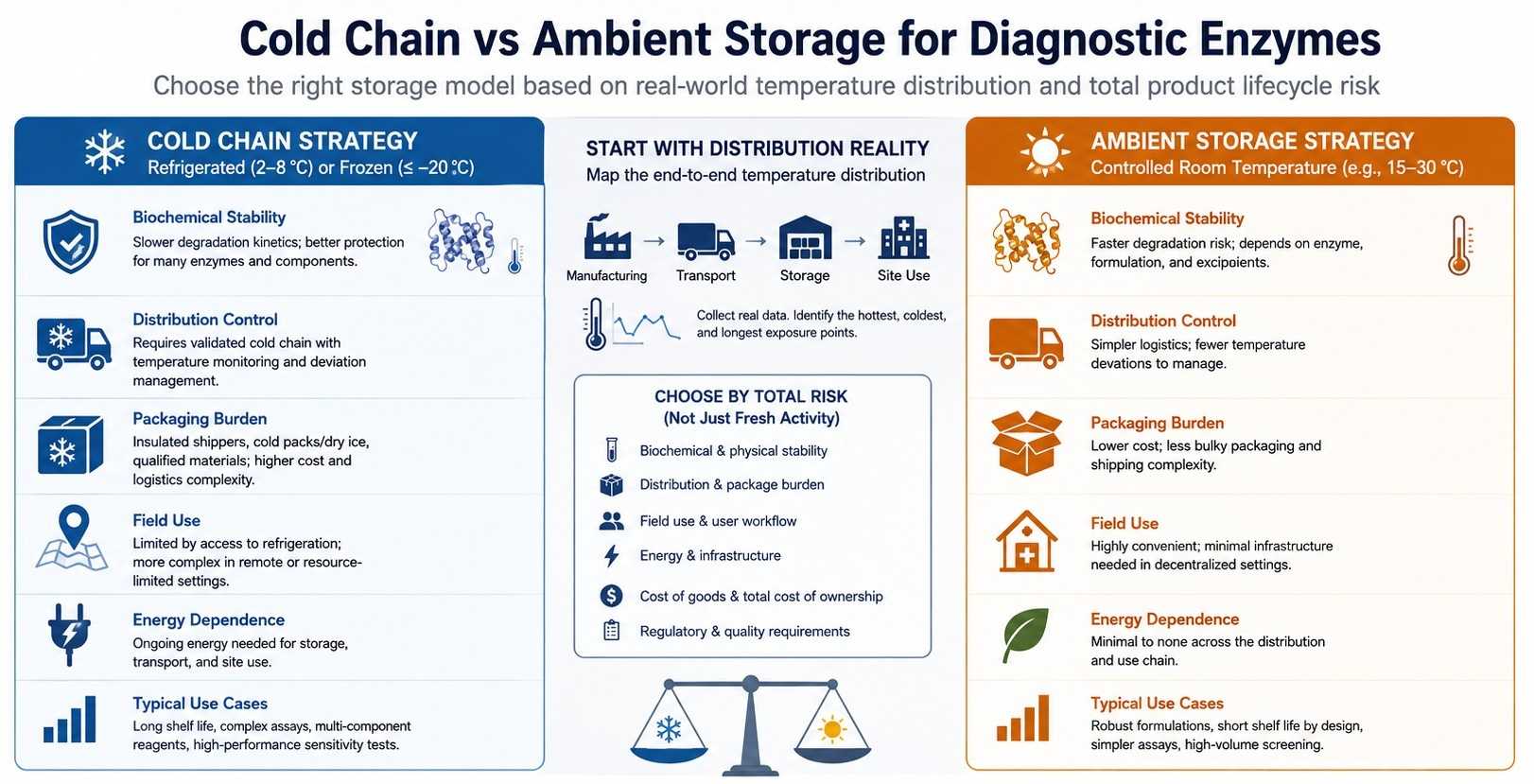
The technical starting point is straightforward: Cold-chain labels depend on qualified lanes, monitored storage, receiving practices, backup power, and user compliance; ambient labels still require a numerical range. The principal development risk is that Warehouses, vehicles, clinics, homes, and field sites can exceed a moderate ambient label, especially in hot climates or direct sunlight. Evidence should therefore be collected deliberately: Map lane temperatures, seasonal extremes, customs delays, and last-mile handling.
A storage-strategy comparison should use common decision criteria: assay performance, real-time evidence, lane reliability, package burden, user steps, cost per test, failure disposition, and access in the intended geography. This exposes trade-offs that are hidden when refrigerated and ambient candidates are evaluated in separate programs.
At this stage, Cooling often slows chemistry and microbial growth but may promote precipitation, cold denaturation, phase separation, or condensation; freezing creates separate stresses. A misleading result can arise because Ambient dry storage reduces aqueous degradation but introduces moisture, oxygen, light, and glass-transition concerns. A defensible experiment should address the issue directly: Use stress studies that represent each candidate physical state.
A storage-strategy comparison should use common decision criteria: assay performance, real-time evidence, lane reliability, package burden, user steps, cost per test, failure disposition, and access in the intended geography. This exposes trade-offs that are hidden when refrigerated and ambient candidates are evaluated in separate programs.
The governing consideration is that A refrigerated liquid may need insulated shippers, monitors, and expedited lanes; a dry product may need high-barrier foil, desiccant, or individually sealed units. The practical hazard is that Lower thermal burden can be replaced by packaging complexity, longer cycle time, or greater waste. The most useful confirmation is to Compare total cost, material availability, package size, disposal, and manufacturing throughput.
A storage-strategy comparison should use common decision criteria: assay performance, real-time evidence, lane reliability, package burden, user steps, cost per test, failure disposition, and access in the intended geography. This exposes trade-offs that are hidden when refrigerated and ambient candidates are evaluated in separate programs.
A robust approach recognizes that Frozen concentrates require controlled thawing; refrigerated multidose bottles need recapping; ambient dried units require rehydration or sample-triggered dissolution. Development can fail when A storage-stable format can still create dose error, incomplete dissolution, contamination, or longer turnaround. To reduce that uncertainty, Test users under intended skill, equipment, humidity, lighting, and time constraints.
A storage-strategy comparison should use common decision criteria: assay performance, real-time evidence, lane reliability, package burden, user steps, cost per test, failure disposition, and access in the intended geography. This exposes trade-offs that are hidden when refrigerated and ambient candidates are evaluated in separate programs.
The process question is whether Room temperature and cold chain are not single conditions; spikes, subzero exposure, cycling, and prolonged moderate warming can differ. One concern is that A mean kinetic model may not address phase changes, moisture ingress, freezing, or seal damage. The decision should be supported by this action: Create excursion studies from recorded profiles and define cumulative or discard rules.
A storage-strategy comparison should use common decision criteria: assay performance, real-time evidence, lane reliability, package burden, user steps, cost per test, failure disposition, and access in the intended geography. This exposes trade-offs that are hidden when refrigerated and ambient candidates are evaluated in separate programs.
The final design must account for the fact that The best model balances stability, access, distribution reliability, cost, environmental burden, and user success; hybrid designs may allocate components differently. The claim becomes vulnerable if Broad ambient claims without representative real-time evidence transfer risk to clinics and distributors. The appropriate evidence is to Use a scored target product profile and confirm final packaging across relevant lanes.
A storage-strategy comparison should use common decision criteria: assay performance, real-time evidence, lane reliability, package burden, user steps, cost per test, failure disposition, and access in the intended geography. This exposes trade-offs that are hidden when refrigerated and ambient candidates are evaluated in separate programs.
| Variable | Question to answer | Development implication |
|---|---|---|
| Labeled range | What numerical temperatures define storage? | Avoid vague cold or ambient language. |
| Distribution lane | Where do longest delays occur? | Use route and season data. |
| Excursions | Are deviations cumulative? | Develop disposition rules. |
| Power dependence | Can storage survive outages? | Assess backup and recovery. |
| Humidity | Will dried product see moisture? | Select barrier and desiccant. |
| Freeze exposure | Can refrigerated product freeze accidentally? | Challenge partial and complete freezing. |
| Package mass | What packaging is required per test? | Include logistics and disposal. |
| Reconstitution | Does dry format add error? | Test realistic users. |
| Monitoring | Which indicators or loggers are needed? | Match monitoring to sensitivity. |
| Regional variation | Can one claim cover all markets? | Bracket climate and infrastructure. |
| Sustainability | What energy and material burdens result? | Evaluate the full system. |
| Continuity | Are qualified lanes and materials redundant? | Plan alternatives. |
The matrix should be converted into a protocol with named methods, sample numbers, lots, controls, timepoints, and acceptance rules. Not every variable needs an independent full-factor study, but an omitted variable should be omitted because the risk is understood—not because it is difficult to measure.
Cold-chain and ambient claims should be compared using numerical ranges and actual distribution profiles. Neither label guarantees robustness. Report the package, season or lane challenge, excursions, humidity, user preparation, and failure rule. Real-time evidence in relevant climates remains necessary when accelerated studies were used to choose the format.
Combine stability trends with shipping excursions, logger records, package condition, distribution deviations, and site feedback. Trend direction can be informative before a specification is crossed, but method noise, sampling, and environmental records must be considered before assigning cause.
