
Liquid vs Dried Diagnostic Reagents: Development Trade-Offs provides a format-selection guide comparing liquid, frozen, lyophilized, foam-dried, air-dried, and dried-film presentations across chemistry, manufacturing, device integration, usability, stability, and cost. It is written for assay architects, operations teams, POCT developers, product managers, and technical sourcing specialists. The central concern is selecting physical presentation at system level and recognizing when hybrid architecture is more reliable than forcing every component into one state.
For this topic, stability must be evaluated across compare starting-state advantages, account for manufacturing, and consider hybrid architectures. Enzyme-centered measurements explain only part of the system: cofactors, substrates, reporters, contact materials, packaging, specimens, timing, and user operations may follow different failure routes. A formulation with excellent fresh activity can therefore have a poor practical margin.
This resource is a development framework for assay architects, operations teams, POCT developers, product managers, and technical sourcing specialists; it is not a universal formula or an automatic storage claim. Study conditions, methods, limits, and conclusions must correspond to selecting physical presentation at system level and recognizing when hybrid architecture is more reliable than forcing every component into one state, using the intended reagent configuration and an explicitly defined assay and use environment.
Readers applying this guide may also use the following Creative Enzymes product and service categories as starting points for raw-material selection, formulation development, and verification:
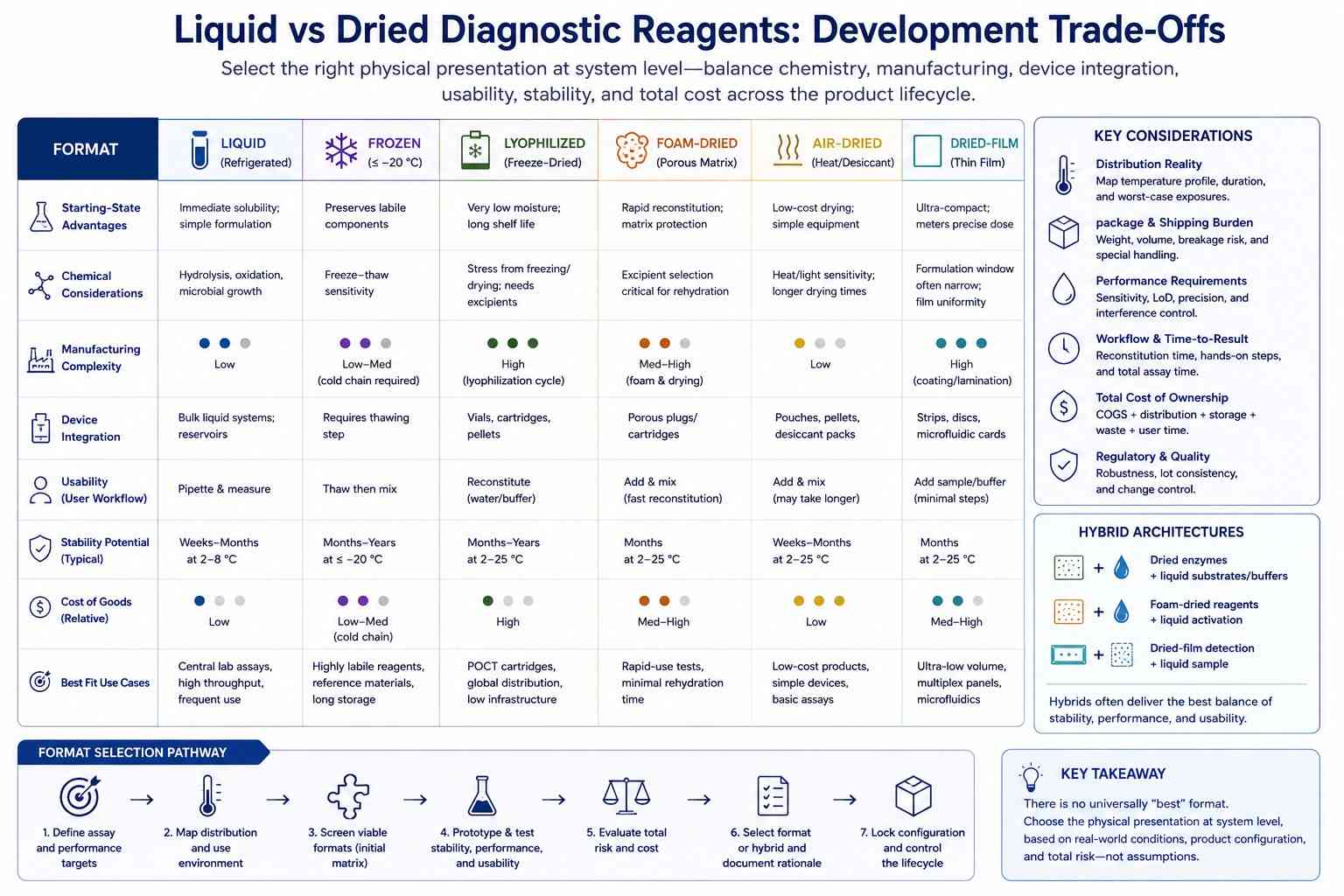
The governing consideration is that Liquids avoid reconstitution and enable immediate mixing, but aqueous degradation, microbial control, shipping weight, leakage, and cold chain can limit them. The practical hazard is that Dried formats reduce water-mediated reactions and pre-meter ingredients, yet add process stress, moisture sensitivity, dissolution, and specialized manufacture. The most useful confirmation is to Evaluate the whole requirement rather than treating dried as synonymous with stable.
When selecting liquid or dried presentation, test comparable delivered doses in the intended workflow. Include manufacture, transport, activation, mixing, device contact, time to result, wasted tests, and disposal. The comparison should allow a hybrid design to win when separation of incompatible components creates a safer operating margin.
A robust approach recognizes that Enzyme, substrate, cofactor, antibody, nucleic acid, chromogen, salt, and preservative may not share an optimal state or compartment. Development can fail when Co-drying reactive components can create background; all-liquid systems can be short-lived; separation improves stability but adds fluidics. To reduce that uncertainty, Map compatibility to decide what is combined, separated, or sample-activated.
When selecting liquid or dried presentation, test comparable delivered doses in the intended workflow. Include manufacture, transport, activation, mixing, device contact, time to result, wasted tests, and disposal. The comparison should allow a hybrid design to win when separation of incompatible components creates a safer operating margin.
The process question is whether Liquid filling requires uniformity, bioburden control, volume accuracy, and closure integrity; drying adds cycle development, loading effects, endpoint control, and moisture packaging. One concern is that A laboratory pellet may be difficult to produce at throughput with acceptable yield and unit uniformity. The decision should be supported by this action: Include equipment, cycle time, inspection, release, rework, and scale-up in the business case.
When selecting liquid or dried presentation, test comparable delivered doses in the intended workflow. Include manufacture, transport, activation, mixing, device contact, time to result, wasted tests, and disposal. The comparison should allow a hybrid design to win when separation of incompatible components creates a safer operating margin.
The final design must account for the fact that Liquid packs need seals, pumps, valves, blisters, or reservoirs; dried reagents need reliable wetting and transport from deposition sites. The claim becomes vulnerable if Porous media and microchannels can adsorb enzyme or create gradients during rehydration. The appropriate evidence is to Test representative cartridge materials and flow paths early.
When selecting liquid or dried presentation, test comparable delivered doses in the intended workflow. Include manufacture, transport, activation, mixing, device contact, time to result, wasted tests, and disposal. The comparison should allow a hybrid design to win when separation of incompatible components creates a safer operating margin.
The technical starting point is straightforward: Liquids can require refrigeration and accurate dispensing; dried systems depend on diluent volume, puncture, mixing, and waiting. The principal development risk is that Incomplete dissolution may be mistaken for device failure and visible cake defects can influence confidence. Evidence should therefore be collected deliberately: Simulate rushed, interrupted, and low-resource workflows.
When selecting liquid or dried presentation, test comparable delivered doses in the intended workflow. Include manufacture, transport, activation, mixing, device contact, time to result, wasted tests, and disposal. The comparison should allow a hybrid design to win when separation of incompatible components creates a safer operating margin.
At this stage, A dried enzyme with liquid substrate, a buffer blister that rehydrates a pellet, or separately dried zones can allocate problems intelligently. A misleading result can arise because Hybrids add interfaces and assembly steps, so benefit must outweigh complexity. A defensible experiment should address the issue directly: Compare architectures using common performance, reliability, manufacturing, and cost criteria.
When selecting liquid or dried presentation, test comparable delivered doses in the intended workflow. Include manufacture, transport, activation, mixing, device contact, time to result, wasted tests, and disposal. The comparison should allow a hybrid design to win when separation of incompatible components creates a safer operating margin.
| Variable | Question to answer | Development implication |
|---|---|---|
| Aqueous degradation | Which reactions accelerate in liquid? | Measure activity and background. |
| Drying stress | Can enzyme survive the process? | Screen formulation and process together. |
| Activation | How is reaction started? | Control timing and local concentration. |
| Dose accuracy | Is reagent metered as liquid or solid? | Assess uniformity. |
| Dissolution | Does dried dose rehydrate completely? | Measure time and spatial uniformity. |
| Cold chain | What infrastructure does liquid need? | Include lane reliability. |
| Moisture barrier | What does dry format need? | Model ingress and opening. |
| Throughput | Can manufacturing meet demand? | Include cycle and yield. |
| Device materials | Will either state interact with surfaces? | Run contact studies. |
| User steps | Which minimizes consequential error? | Test instructions. |
| Waste | How much packaging remains? | Compare per-test burden. |
| Hybrid option | Can incompatible components be separated? | Balance stability and complexity. |
The matrix should be converted into a protocol with named methods, sample numbers, lots, controls, timepoints, and acceptance rules. Not every variable needs an independent full-factor study, but an omitted variable should be omitted because the risk is understood—not because it is difficult to measure.
Liquid-versus-dried conclusions should not compare an optimized liquid with an early dry prototype, or vice versa. Use the same delivered activity target and assay panel, then report differences in manufacture, packaging, shipping, activation, device function, user burden, stability evidence, and cost. The decision is architectural rather than cosmetic.
Compare trends by format and component, since the first limiting reagent may differ between liquid, fully dried, and hybrid designs. Trend direction can be informative before a specification is crossed, but method noise, sampling, and environmental records must be considered before assigning cause.
