
A companion diagnostic and its corresponding therapy are operationally separate products, yet their evidence is interdependent. The drug program defines the treatment hypothesis and clinical population; the diagnostic defines how that population is identified. If assay development lags, changes late, or measures a different biomarker interpretation than the trial used, both programs can face enrollment delays, bridging burdens, and uncertain labeling.
Co-development aligns therapeutic, biomarker, assay, regulatory, clinical, manufacturing, and commercialization decisions from the beginning. This article explains why synchronization matters, where programs commonly diverge, and how enzyme and reagent controls support a reliable transition from exploratory testing to an approved treatment-linked assay.
The central question is whether a defined biomarker result identifies patients for whom a therapy is safe and effective. The therapy’s mechanism supports the hypothesis, but the diagnostic result operationalizes it. Biomarker definition, specimen, cutoff, test failure rules, and timing must therefore agree with the clinical protocol and proposed labels.
A biomarker may begin as an exploratory variable and later become an enrollment requirement. That transition changes the assay’s role. Research-use performance may be adequate for hypothesis generation but not for treatment selection. Co-development recognizes this shift early enough to establish design controls, representative specimens, locked algorithms, critical-reagent supply, and regulatory interactions before pivotal evidence depends on the test.
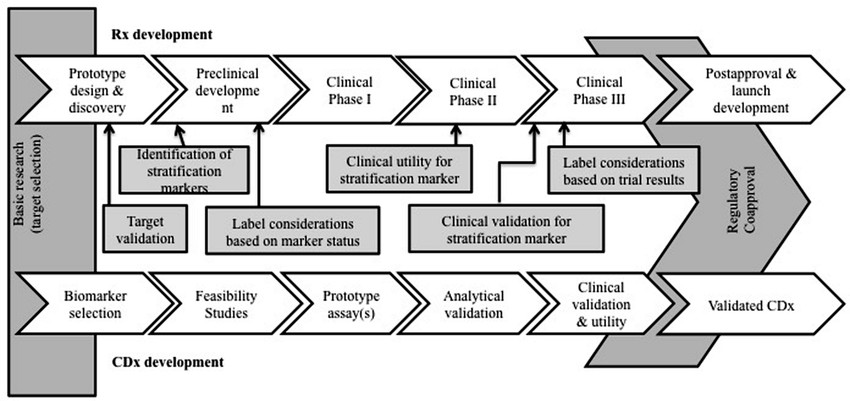
Figure 1. Companion diagnostic development and regulation concomitant with drug therapy development and regulation. (Luo et al., 2016)
| Workstream | Drug program question | Diagnostic dependency |
|---|---|---|
| Target and biomarker | Which biology predicts benefit or risk? | Analyte, method, specimen, and decision rule |
| Clinical strategy | Who enters or is stratified in the trial? | Enrollment test availability, turnaround, invalid handling |
| Evidence plan | Which endpoints support the therapy claim? | Analytical validity and clinical performance of the test |
| Regulatory | What are submission and review milestones? | Coordinated interactions, modules, labeling, and responses |
| Manufacturing | When are clinical and commercial lots needed? | Controlled enzyme/reagent supply and comparability |
| Launch | Where and when will therapy be available? | Laboratory access, training, logistics, reimbursement readiness |
| Lifecycle | How will new claims or populations be added? | Change control, bridging, new specimens, platforms, or cutoffs |
A joint plan identifies owners, interfaces, evidence dependencies, decision gates, and fallback paths. It should cover biomarker assay evolution, clinical sample access, regulatory meetings, investigational testing, diagnostic validation, manufacturing scale-up, submission timing, and launch readiness.
Dependencies should be explicit. For example, cutoff selection may require clinical outcomes; pivotal enrollment may require a locked assay; commercial transfer may require sufficient retained specimens for bridging. Drug–diagnostic co-development support is designed around these connected milestones.
Early assays often change as biomarker knowledge improves. Primers, antibodies, enzyme mixes, platforms, software, specimen requirements, and cutoffs may evolve. Change is expected, but uncontrolled change makes it difficult to connect trial results to the final commercial test. Each version should be documented with its samples, performance, algorithm, and role in clinical decisions.
A fit-for-purpose research assay can support discovery. Before an assay determines trial enrollment or treatment assignment, the team should define analytical acceptance criteria, training, quality controls, invalid-result procedures, and change governance. The goal is not premature freezing; it is preserving traceability and scheduling necessary bridging while specimens and clinical data are still available.
Turnaround time, tissue sufficiency, screen-failure rate, and invalid results affect recruitment and site performance.
Sites need clear specimen, result, retest, and conflict-handling instructions that match the protocol.
Consent, chain of custody, quality, storage, and outcome linkage preserve material for cutoff work and bridging.
Prevalence estimates should come from representative populations and the intended assay where possible. A lower-than-expected positivity rate can expand screening needs; a high invalid rate can bias enrollment. Central versus local testing changes logistics and variability. Trial simulations using realistic prevalence, sample failure, and turnaround assumptions help expose bottlenecks before activation.
Critical enzymes may influence sensitivity, specificity, stability, or lot consistency. A clinical program should not depend on poorly characterized or non-scalable material. Specifications need to connect identity, purity, activity, contaminants, formulation, storage, and functional performance to the assay. Supplier changes, process changes, and formulation changes require notification and risk-based bridging.
CDx assay transfer and manufacturability assessment can reveal scale-up risks, while enzyme scale-up and technology transfer supports commercial readiness. Stability planning should include clinical-trial duration, shipping, laboratory storage, on-board use, and launch inventory—not only an initial feasibility window.
Regulators evaluate the therapeutic and diagnostic evidence in relation to each other. The intended-use population, biomarker definition, specimen, cutoff, and limitations should be consistent across protocol, statistical plan, diagnostic submission, drug submission, and proposed labeling. Teams should plan coordinated questions and avoid assuming that conclusions reached for one product automatically settle the other.
When the clinical trial used a test different from the final CDx, bridging may address analytical agreement and the likely clinical impact of discordance. The required evidence depends on the nature of the differences and available samples. Early agency interaction is especially important for novel analytes, composite algorithms, limited specimens, decentralized testing, or development paths that cannot launch the diagnostic at the same time as the therapy.
Late platform changes create bridging work; unclear biomarker definitions create data inconsistencies; limited tissue prevents repeat testing; underdeveloped reagents create lot drift; and separate timelines can leave an effective therapy without a ready test. These problems are connected and should be managed in one risk register.
Useful controls include a cross-functional governance group, common terminology, versioned assay specifications, a decision log, reserved specimens, backup supply, predefined change thresholds, and integrated milestone reviews. Biomarker assay feasibility and prototype development can test assumptions early, while CDx technical documentation and regulatory support helps preserve traceability as the program matures.
Whatever platform or specimen is selected, development should begin with a written link between intended use and analytical requirements. Define the patient population, biomarker, specimen, treatment decision, reportable result, turnaround expectation, and use environment. Then identify the failure modes that could change classification: target loss, nonspecific signal, amplification bias, reagent drift, interference, software error, or an invalid result that delays therapy. This risk map determines which enzyme attributes and assay controls deserve the most attention.
Feasibility experiments should include representative clinical material as early as possible. Purified templates and synthetic controls are valuable for isolating variables, but they do not reproduce fixation damage, low tumor fraction, endogenous inhibitors, sample heterogeneity, or extraction carryover. A staged study can begin with controlled materials, add individual challenges, and then confirm performance in specimens spanning the intended range. Samples near the cutoff are especially informative because small shifts in recovery, background, or signal can change the treatment category.
Critical enzymes should be specified by more than catalog activity. Identity, purity, concentration, specific activity, contaminating nuclease or protease limits, formulation, storage, and functional performance may all be relevant. The release method should use conditions that predict performance in the diagnostic reaction. When the vendor activity assay and CDx chemistry differ substantially, an assay-level incoming or bridging test can provide a more direct control. Multiple lots should be evaluated before pivotal use so the acceptance range reflects manufacturing variation rather than one favored batch.
Robustness studies intentionally vary parameters that will move in practice: reaction time and temperature, pipetting, sample input, operator, instrument, reagent lot, shipping excursion, and storage duration. Interference studies should use justified concentrations and combinations of endogenous substances, collection additives, medications, and process residuals. Controls must fail when the vulnerable step fails; an abundant control target may remain positive even when a low-copy clinical target is lost.
Finally, document changes across the full measurement system. A new enzyme lot, buffer, primer pool, conjugation process, extraction kit, instrument, or software version can alter analytical performance even if the intended use is unchanged. Risk-based comparability should focus on the attributes most likely to affect the cutoff and claimed range. Preserving retained samples, reference materials, version history, and a predefined bridging strategy makes lifecycle improvements possible without breaking the connection to the clinical evidence.
These questions keep development centered on the treatment decision rather than isolated technical metrics. They also create a common language for biomarker, clinical, regulatory, quality, manufacturing, and supplier teams.
Drug–diagnostic co-development matters because a biomarker-guided therapy can succeed only if the right patient is identified with a reliable, available test. Joint planning preserves the link between biology, clinical evidence, assay performance, manufacturing, and labeling. It also gives teams time to solve reagent, specimen, bridging, and access problems before they become critical-path launch risks.
Creative Enzymes supports diagnostic enzyme selection, engineering, formulation, conjugation, analytical evaluation, and scale-up for molecular and immunoassay CDx workflows.
