
Paper-based and low-resource molecular diagnostics aim to move nucleic acid testing closer to the point of need while reducing dependence on centralized instruments, refrigeration, and highly trained operators. Paper can store dry reagents, meter or transport fluids, filter particulates, define reaction zones, and support visual readouts. Those functions are valuable, but they also introduce adsorption, evaporation, uneven flow, and manufacturing variation that do not exist in a well-mixed laboratory tube.
A low-resource format should be designed from its use environment rather than by transferring a successful benchtop assay onto paper. Sample collection, biosafety, power, temperature, humidity, waste, user instructions, invalid-result handling, data reporting, and supply chain are part of the analytical system.
Resource limitations differ among rural clinics, mobile laboratories, community programs, farms, food-production sites, border screening, and environmental surveillance. One setting may have reliable electricity but no cold chain; another may have limited pipetting, poor connectivity, high humidity, or difficult waste disposal. A target product profile should state these conditions explicitly.
Important context variables include:
| Paper or porous component | Possible role | Design concern |
|---|---|---|
| Sample pad | Collects and conditions liquid sample | Variable volume, target retention, matrix binding, biosafety |
| Porous reaction zone | Stores dry enzymes and supports amplification | Nonuniform rehydration, evaporation, enzyme adsorption, heat transfer |
| Capillary channel | Moves fluid without a pump | Flow variation, blocked pores, reagent washout, timing |
| Membrane capture zone | Provides lateral-flow or localized signal | Label release, capture capacity, nonspecific binding, hook effects |
| Foldable or layered card | Sequences sample, wash, amplification, and detection steps | Alignment, sealing, user operation, cross-zone leakage |
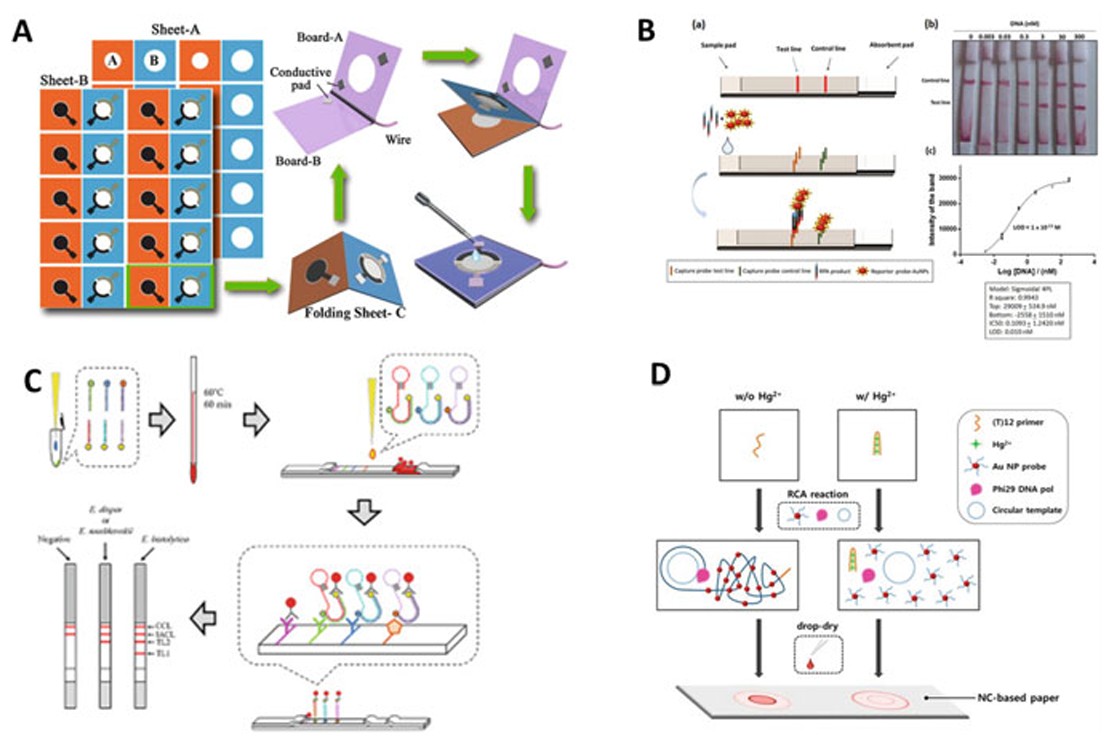 Figure 1. Paper-based detection of nucleic acid. A Fabrication and electrochemical detection process with folded paper-based DNA sensor device; B RPA-based Nucleic Acid Lateral-Flow ImmunoAssay (NALFIA); C LAMP-based NALFIA; D Paper-based detection of RCA amplicons. (Batule et al., 2021)
LAMP can generate high product yield and supports colorimetric or fluorescence endpoints, but its multiple primers and high carryover burden require controlled storage and closed handling. RPA can operate at lower temperature and may pair readily with lateral flow, yet the multi-protein formulation, activation, and crowding system can be sensitive to drying and uneven rehydration. RCA can support localized amplification on surfaces but may require circularization and longer incubation.
Reaction volume and local concentration change as liquid moves through paper. A nominal tube formulation may become concentrated near a drying front or diluted during wash-through. Testing must use the final geometry and fluid sequence; material compatibility cannot be established with extracts alone.
Crude samples may contain cells, mucin, blood components, proteins, salts, food particles, soil-derived inhibitors, nucleases, and microorganisms. Paper can filter large particles, but filtration can also retain the target. Chemical lysis can simplify release while adding detergents or salts that inhibit enzymes. Heat treatment can reduce nuclease or infectious risk but requires controlled time and temperature.
Target added before preparation, target added after preparation, and endogenous positive samples answer different questions. Recovery should be measured through the complete device, including the fraction of sample that reaches the reaction zone. A large input volume is not useful if most target remains at the collection pad.
Enzymes and oligonucleotides may adsorb to cellulose, glass fiber, nitrocellulose, polymers, or adhesives. Drying can create local pH and salt gradients. Protective sugars, polymers, proteins, surfactants, and antioxidants may improve recovery, but they can also slow wetting or interfere with amplification and signal.
Stability studies should use the final paper grade, printing or dispensing method, drying process, package, desiccant, and seal. Residual moisture and humidity exposure are often more important than nominal storage temperature. Open-pouch or field-use simulation should be separated from unopened shelf-life.
Isothermal does not mean temperature-free. Resistive heaters, phase-change materials, chemical heaters, insulated enclosures, body-worn concepts, or solar-supported devices may provide incubation. Each has warm-up, uniformity, overshoot, and environmental limitations.
A temperature indicator can show exposure but does not prove that every reaction zone experienced the same profile. Device mapping should include edge and center positions, low battery, cold start, high ambient temperature, and operator opening. Reaction chemistry should be optimized across the supported thermal range rather than a single benchtop set point.
| Readout | Low-resource opportunity | Failure risk |
|---|---|---|
| Colorimetric reaction | Direct visual endpoint with minimal hardware | Lighting, color vision, sample color, pH, humidity, ambiguous thresholds |
| Lateral flow | Familiar line-based interpretation | Transfer contamination, incomplete flow, hook effects, weak control line |
| Fluorescence | Higher sensitivity and closed detection | Reader power, optical alignment, paper autofluorescence, photobleaching |
| Smartphone imaging | Image capture, analysis, records, connectivity | Camera variation, exposure, white balance, software, privacy, network dependence |
A low-resource assay needs visible or machine-readable controls that challenge sample flow, reagent rehydration, amplification, and detection. One control line may not cover every stage. Internal controls can compete with low target; external controls may not experience the same sample path.
The device should define invalid conditions such as incomplete sample migration, missing control signal, heater failure, ambiguous color, expired reagent, or software error. Instructions must explain the next action without requiring the user to infer whether a faint or partial signal is valid.
Sample inactivation, leak prevention, sharp-free collection, post-test containment, and waste disposal should match the target and setting. Opening a high-yield amplification zone for lateral-flow transfer can release amplicons even when the original specimen has been inactivated. Sealed transfer or integrated capture reduces this risk.
Laboratory and field biosafety require protocol-driven risk assessment. A paper device does not make infectious specimens or amplification products inherently safe. Local regulations and disposal infrastructure should be incorporated into design inputs.
A field-relevant evaluation should include:
WHO's ASSURED and later REASSURED concepts emphasize affordability, sensitivity, specificity, user-friendliness, rapid and robust operation, equipment needs, deliverability, connectivity, and real-time collection. These are product goals, not substitutes for analytical and clinical validation.
Low reagent volume does not guarantee an affordable test. Cost includes collection materials, extraction or lysis, enzymes, labeled oligonucleotides, paper conversion, heater or reader, packaging, desiccant, controls, shipping, training, repeat tests, waste, and quality assurance. A reusable reader lowers per-test cost only when utilization, maintenance, and replacement are realistic.
Supply risk can concentrate in one membrane grade, labeled reporter, specialized enzyme, foil laminate, or custom plastic. Early bills of materials should identify single-source and long-lead components. Alternatives must be tested in the complete device because paper wicking, adsorption, optical background, and dry stability can change even when the replacement has a similar specification.
Instructions cannot compensate indefinitely for a fragile reaction. If a visual color requires exact timing, the device should provide a timer or terminate the reaction. If sample volume is critical, a metering feature is more reliable than asking an untrained user to estimate a drop. Controls and invalid states should be readable under expected lighting and by users with common color-vision limitations.
Formative usability studies conducted before design freeze can reveal misunderstood symbols, unsafe opening, missed mixing, delayed reading, and waste-handling errors. These observations may require changes to reagent activation, device geometry, or signal—not only revised wording.
