
Open-Vial and On-Board Stability in IVD Reagents provides a use-condition framework for reagents exposed to repeated opening, aspiration, instrument residence, warming and cooling, evaporation, light, mixing, and cumulative contamination risk after first access. It is written for IVD system developers, analyzer engineers, stability teams, laboratory workflow specialists, and quality personnel. The central concern is how open-vial and onboard claims differ from sealed shelf life and how simulated-use studies reproduce cumulative instrument and operator stresses.
For this topic, stability must be evaluated across define the in-use clock, account for evaporation and drift, and interpret reported-result drift. Enzyme-centered measurements explain only part of the system: cofactors, substrates, reporters, contact materials, packaging, specimens, timing, and user operations may follow different failure routes. A formulation with excellent fresh activity can therefore have a poor practical margin.
This resource is a development framework for IVD system developers, analyzer engineers, stability teams, laboratory workflow specialists, and quality personnel; it is not a universal formula or an automatic storage claim. Study conditions, methods, limits, and conclusions must correspond to how open-vial and onboard claims differ from sealed shelf life and how simulated-use studies reproduce cumulative instrument and operator stresses, using the intended reagent configuration and an explicitly defined assay and use environment.
Readers applying this guide may also use the following Creative Enzymes product and service categories as starting points for raw-material selection, formulation development, and verification:
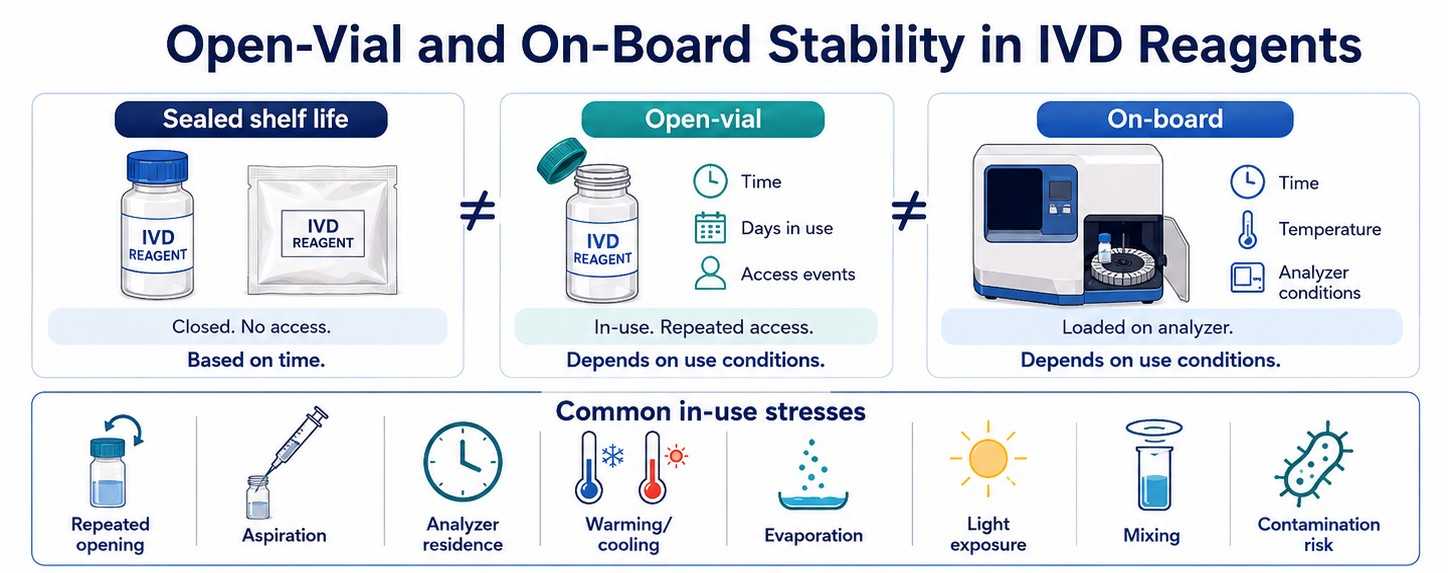
The final design must account for the fact that An open-vial claim may begin when a cap or seal is removed, while an onboard claim may begin at loading, puncture, warming, or connection to fluidics. The claim becomes vulnerable if Calendar time can hide aspirations, cap openings, thermal cycles, mixing operations, and idle periods that drive change. The appropriate evidence is to Write the claim with maximum elapsed time, use frequency, storage between runs, and discard rule.
For in-use studies, simulate the chronology of a real reagent pack. Include opening or puncture, scheduled aspirations, low-volume conditions, deck residence, refrigeration intervals, mixing, recalibration, and return to storage. Sampling only at the beginning and end may miss transient drift or position-dependent failure.
The technical starting point is straightforward: A reagent may spend part of each day at analyzer temperature and the remainder refrigerated, or stay onboard continuously under illumination and vibration. The principal development risk is that One uninterrupted warm hold may not reproduce repeated condensation, oxygen renewal, resuspension, or interface formation. Evidence should therefore be collected deliberately: Build a schedule from representative and worst-reasonable workflows, including weekends and low-throughput days.
For in-use studies, simulate the chronology of a real reagent pack. Include opening or puncture, scheduled aspirations, low-volume conditions, deck residence, refrigeration intervals, mixing, recalibration, and return to storage. Sampling only at the beginning and end may miss transient drift or position-dependent failure.
At this stage, Repeated opening, imperfect caps, warm decks, and low fill volumes can concentrate enzyme, salt, substrate, preservative, or chromogen. A misleading result can arise because The assay may drift even when enzyme is chemically stable because calibration slope, viscosity, blank, or reaction stoichiometry changes. A defensible experiment should address the issue directly: Track mass or volume, concentration markers, and function across pack positions and residual volumes.
For in-use studies, simulate the chronology of a real reagent pack. Include opening or puncture, scheduled aspirations, low-volume conditions, deck residence, refrigeration intervals, mixing, recalibration, and return to storage. Sampling only at the beginning and end may miss transient drift or position-dependent failure.
The governing consideration is that Probe contact, dead volume, foaming, bubbles, carryover, partial mixing, sedimentation, and adsorption create position-dependent behavior. The practical hazard is that A bench aliquot does not reproduce punctured septa, repeated pipetting, reagent wells, tubing, or the last usable tests. The most useful confirmation is to Run the actual analyzer or a justified simulator with realistic aspiration counts.
For in-use studies, simulate the chronology of a real reagent pack. Include opening or puncture, scheduled aspirations, low-volume conditions, deck residence, refrigeration intervals, mixing, recalibration, and return to storage. Sampling only at the beginning and end may miss transient drift or position-dependent failure.
A robust approach recognizes that Once accessed, liquids may encounter environmental organisms or cross-contamination; preservatives must work without inhibiting the reaction. Development can fail when Growth, precipitate, or particles can alter optical blanks, clog probes, consume substrate, or shift pH before obvious turbidity. To reduce that uncertainty, Set handling controls and perform risk-based preservative, particulate, and microbiological evaluation.
For in-use studies, simulate the chronology of a real reagent pack. Include opening or puncture, scheduled aspirations, low-volume conditions, deck residence, refrigeration intervals, mixing, recalibration, and return to storage. Sampling only at the beginning and end may miss transient drift or position-dependent failure.
The process question is whether Open-vial studies should include calibration, control recovery, precision, measuring interval, blanks, and samples near decision points. One concern is that A high control can conceal low-end loss, while recalibration can mask deterioration if the claim assumes a particular calibration frequency. The decision should be supported by this action: Analyze results using proposed calibration and quality-control rules.
For in-use studies, simulate the chronology of a real reagent pack. Include opening or puncture, scheduled aspirations, low-volume conditions, deck residence, refrigeration intervals, mixing, recalibration, and return to storage. Sampling only at the beginning and end may miss transient drift or position-dependent failure.
| Variable | Question to answer | Development implication |
|---|---|---|
| Start event | What starts the stability clock? | Define opening, puncture, loading, or warming. |
| Use frequency | How many aspirations and openings occur? | Model high and low throughput. |
| Thermal profile | Does the pack cycle between deck and refrigerator? | Record cumulative time and transitions. |
| Residual volume | Is the last portion more exposed? | Test beginning, middle, and end. |
| Evaporation | Can water loss alter composition? | Monitor mass and functional drift. |
| Mixing | Is resuspension automatic or manual? | Simulate actual energy and frequency. |
| Light | Are chromogens or cofactors exposed? | Challenge analyzer and ambient light. |
| Probe interaction | Can aspiration cause foam or adsorption? | Use representative fluidics. |
| Calibration | Does recalibration conceal change? | Follow the proposed schedule. |
| Microbial control | Is repeated access compatible with preservation? | Evaluate preservative function. |
| Instrument variability | Do deck conditions differ by model or position? | Bracket supported configurations. |
| Interruption | What follows power loss or delayed refrigeration? | Define recovery and discard rules. |
The matrix should be converted into a protocol with named methods, sample numbers, lots, controls, timepoints, and acceptance rules. Not every variable needs an independent full-factor study, but an omitted variable should be omitted because the risk is understood—not because it is difficult to measure.
Open-vial and onboard conclusions must include the simulated pattern of use. Elapsed days without aspiration count, deck temperature, residual volume, recapping, mixing, and calibration history are incomplete. Interpret beginning-, middle-, and end-of-pack behavior, because evaporation and fluidic effects can become strongest after most tests have been consumed.
Examine residual-volume effects, daily thermal cycles, aspiration count, calibrations, blanks, and controls for a coherent in-use pattern. Trend direction can be informative before a specification is crossed, but method noise, sampling, and environmental records must be considered before assigning cause.
