
LAMP and recombinase polymerase amplification (RPA) are prominent candidates for point-of-care molecular testing because both can amplify nucleic acids at a constant temperature. The best choice is not determined by which platform has the lowest nominal temperature or shortest published reaction. It depends on the complete product requirement: sample preparation, analytical target, heater, readout, reagent format, user workflow, contamination strategy, supply chain, and interpretation rule.
This guide compares the two platforms as development systems. “RPA” is used here for the biochemical method family; access to specific proprietary formulations, components, claims, or licenses should be assessed independently by the product developer and qualified counsel.
Before comparing chemistries, define the environment in which the result must be produced:
LAMP uses four core primers—and frequently two loop primers—to build stem-loop structures that sustain rapid strand-displacing synthesis. RPA uses recombinase-primer complexes to invade duplex DNA, a single-strand binding protein to stabilize the displaced strand, and a strand-displacing polymerase to extend the primers. These mechanisms determine component count, primer design, setup behavior, and product structure.
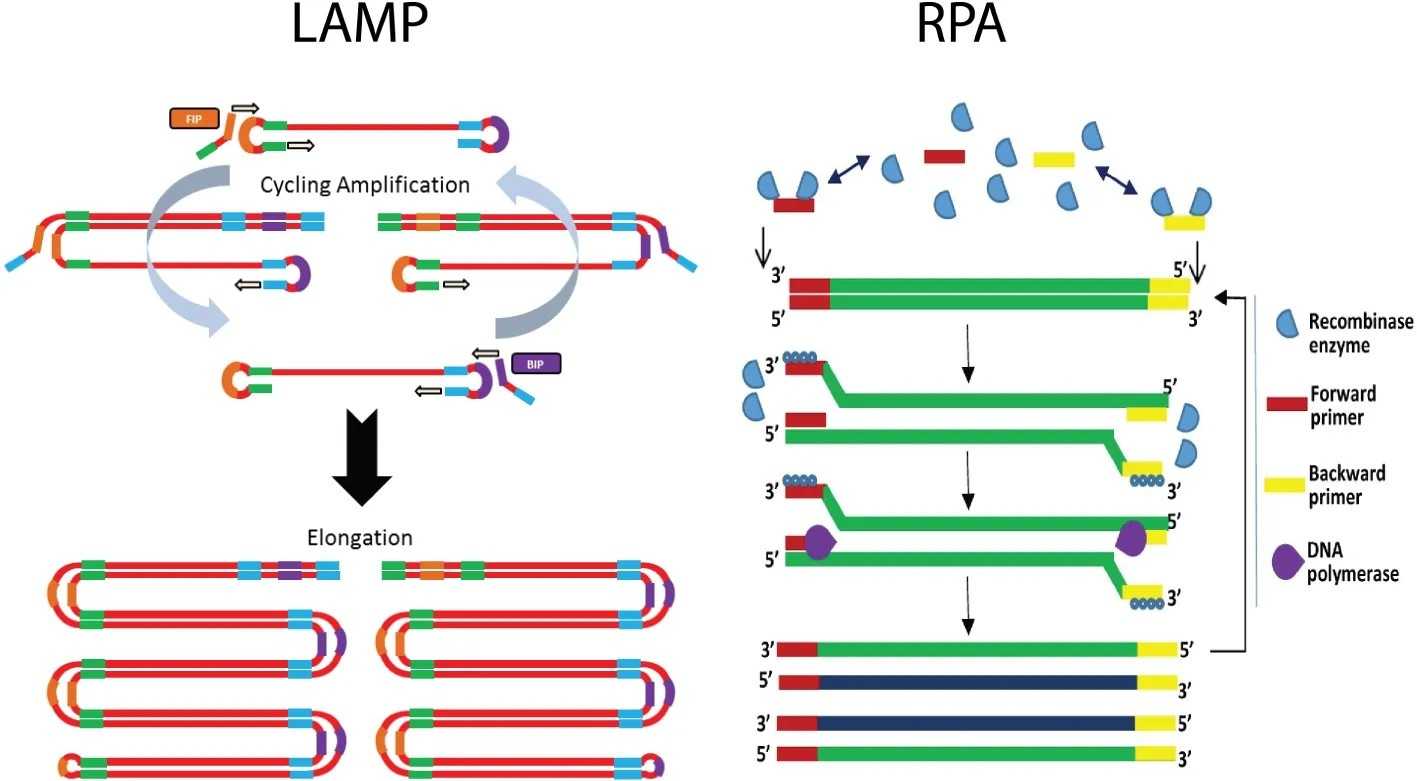 Figure 1. Schematic illustration of the working principle of isothermal amplification methods LAMP and RPA. (Venbrux et al., 2023)
| Product question | LAMP considerations | RPA considerations |
|---|---|---|
| How simple is temperature control? | Typically needs a moderate and reasonably uniform incubation temperature | Often operates at lower temperature, but reaction rate and background can still be temperature-sensitive |
| How complex is oligonucleotide design? | Multiple primers recognize several target regions; strong coverage but more interaction risk | Usually two amplification primers, with additional probe design when sequence-specific detection is used |
| What is the main setup risk? | Primer-driven background and product carryover, especially during extended incubation | Activity during setup, magnesium-start variation, mixing, crowding, and multi-protein ratio effects |
| What readouts are convenient? | Intercalating fluorescence, pH color, turbidity, metal indicators, lateral flow, or coupled CRISPR detection | Fluorescent cleavage probes, lateral flow, endpoint fluorescence, electrochemical, or CRISPR-coupled readout |
| How difficult is dry formulation? | Enzyme, primer network, indicator, pH, and rehydration must be preserved | Multiple proteins, ATP system, crowding agents, activation salts, and probe components must remain balanced |
| What may constrain sourcing? | Polymerase and RT source, primer manufacturing, detection chemistry | Access to the complete recombinase system, accessory proteins, formulation knowledge, and licensing |
RPA's lower operating temperature can enable body-heat concepts, simple resistive heaters, or chemically heated devices. However, “low temperature” does not mean “temperature independent.” Rate, nonspecific extension, probe cleavage, and run-to-run variability can change across a modest temperature range. Heater uniformity and warm-up behavior still require study.
LAMP commonly operates at a higher moderate temperature that may improve access through some target structures and supports robust strand displacement. Its heater can remain simpler than a thermocycler, but condensation, evaporation, well-to-well gradients, and temperature overshoot affect performance. The decision should be based on the validated device profile rather than nominal set point.
LAMP's multiple recognition regions can provide strong target logic, yet conserved regions must be available across the entire primer footprint. A single variant can affect one priming step disproportionately. Because primer-primer and hairpin combinations increase rapidly, several independent LAMP primer families should be tested experimentally.
RPA uses a simpler primer pair in many formats, which may ease redesign for variable targets. Nevertheless, long RPA primers and low-temperature binding can permit unexpected interactions. A sequence-specific probe or downstream CRISPR step can improve identity confirmation, but each adds its own accessible target region and compatibility constraints.
Published “minutes to result” values are not directly comparable. Template units, extraction, target sequence, reaction volume, fluorescence threshold, endpoint definition, and replicate number may differ. At low copy number, random sampling broadens time to positive. An extended run can recover late positives while also admitting nonspecific amplification.
The important metric is the specific-result window: representative positives meet the predefined rule before no-template controls, matrix blanks, and non-targets become unacceptable. Developers should compare distributions across target levels, devices, users, lots, and environmental conditions, not only the earliest positive trace.
Both platforms require a reverse-transcription route for RNA targets. RT-LAMP may use a dedicated reverse transcriptase alongside a strand-displacing polymerase or exploit polymerase-associated RT activity where appropriately characterized. RT-RPA introduces RT into an already multi-protein network. In either case, fewer enzymes are not automatically better if RNA structure or shared-buffer compromise reduces detection.
Matched RNA and DNA templates, no-RT controls where interpretable, RNase-aware process controls, and target spikes before versus after preparation help locate the limiting stage. RNA storage and sample release may dominate the assay even when amplification is strong.
LAMP is well known for visual pH indicators, but sample pH and buffer capacity can create false or ambiguous color calls. RPA is often paired with fluorescent probes or lateral flow; probe cleavage and labeled-product formation must be shown to be target dependent. Neither a color change nor a strip line proves correct amplification by itself.
When a smartphone is used, illumination, white balance, camera processing, and tube geometry become part of the measurement procedure. Sequence-specific CRISPR detection can be added to either platform, but one-pot compatibility should be demonstrated rather than assumed.
Claims of inhibitor tolerance are enzyme-, formulation-, and matrix-specific. A reaction that tolerates one transport medium may fail with another due to guanidinium salts, detergents, mucin, heme, pH, or nuclease activity. Higher sample input increases target copies and inhibitors simultaneously.
A matched dilution and spike design can reveal whether poor performance reflects release, degradation, or reaction inhibition. Platform selection should include the intended sample-preparation method from an early stage. A clean-template winner can lose after integration with a crude specimen.
LAMP can be built around a comparatively small enzyme set, but the primer mixture is complex and pH-color formulations have low buffer-capacity requirements. RPA requires stable balance among several proteins, cofactors, crowding agents, and activation components. In both systems, stock-buffer glycerol and salts affect concentration and drying.
Dry-format comparison should include post-drying target kinetics, negative-control behavior, reconstitution time, residual moisture, package barrier, transport stress, and real-time stability. The Lyophilized and Ambient-Stable Diagnostic Reagent Development platform can support product-format translation after a scientifically defined liquid baseline is established.
A fair comparison uses the same target panel, concentration units, sample preparation, matrix sources, read-time limit, device constraints, and decision criteria. Each platform should enter with multiple primer families rather than one design. The study should include no-template controls, near neighbors, matrix blanks, low-copy replicates, temperature range, setup hold, reagent-lot variation, and the intended readout.
The selection report should state not only which platform performed better, but why: signal separation, operating range, hardware fit, component availability, dry-format risk, or workflow simplicity. Unresolved legal or supply questions should remain separate from the biochemical conclusion.
