
Recombinase polymerase amplification is often described as a two-primer reaction that runs near body temperature. In practice, RPA is a coordinated multi-protein and cofactor system. Recombinase loading, homology search, strand invasion, single-strand stabilization, polymerase extension, ATP turnover, crowding, magnesium activation, and probe chemistry must remain synchronized within a short reaction window.
For molecular point-of-care testing, this biochemical network must also tolerate simplified sample preparation, compact heaters, small volumes, dry storage, rapid user setup, and an endpoint that can be interpreted without exposing the workspace to amplicons. This guide focuses on those reagent-system interfaces rather than presenting a universal formulation.
| Module | Primary function | Development risk |
|---|---|---|
| Recombinase and loading system | Forms primer nucleoprotein filaments and supports homology search | Incorrect protein or ATP balance can reduce invasion or increase background |
| Single-strand binding protein | Stabilizes displaced target strand and limits reannealing | Insufficient or excessive loading can alter access and polymerase progression |
| Strand-displacing polymerase | Extends the invaded primer without thermal denaturation | Mismatch extension, inhibitor sensitivity, processivity, and storage-buffer effects |
| Energy and crowding system | Supports recombinase cycling and macromolecular assembly | ATP depletion, magnesium competition, viscosity, mixing, and dry-format complexity |
| Probe or reporter module | Creates fluorescent, lateral-flow, electrochemical, or downstream CRISPR signal | Probe cleavage background, label interactions, product transfer, and result threshold |
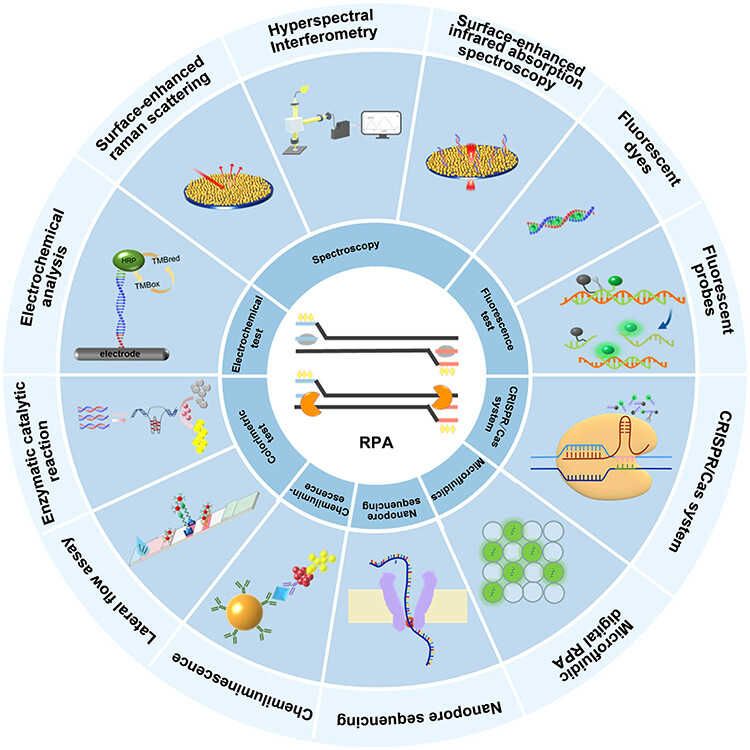 Figure 1. Principles of RPA biosensors for various signal conversions. (Feng et al., 2023)
Recombinase must assemble on primers while avoiding indiscriminate sequestration of oligonucleotides or template. Accessory loading functions and ATP turnover regulate the active filament. The complex searches duplex DNA for homology and promotes strand invasion. This step is sensitive to primer length, sequence composition, secondary structure, target topology, temperature, salt, crowding, and protein ratios.
A primer pair that performs well in PCR cannot be assumed to work in RPA because the access mechanism is different. Multiple primer candidates should be tested against target levels, no-template controls, near neighbors, and the intended matrix. Sequence specificity is created by the complete system, not recombinase recognition alone.
Once a primer invades the duplex, the displaced strand can reanneal or form secondary structures. Single-strand binding proteins stabilize the open complex and support extension. Their concentration interacts with template concentration, recombinase, primer, polymerase, and salt. More is not always better: excess binding protein can change viscosity, compete for nucleic-acid surfaces, or alter downstream probe access.
Candidate concentrations should be evaluated in a matrix rather than one at a time. Reaction-curve variation, not just final signal, can reveal unstable assembly or incomplete mixing.
The polymerase must extend at the selected low temperature and displace downstream strands. Supplier activity units are often assigned in unrelated buffers and cannot be substituted directly. Functional screening should normalize the role within the complete RPA system and examine target response, negative background, temperature, inhibitors, and lot behavior.
Important polymerase questions include:
Magnesium participates in polymerase catalysis and ATP-dependent recombinase chemistry. Many RPA workflows introduce a magnesium salt as a final activation step. Incomplete mixing can produce well-to-well or strip-to-strip variability, while premature contact can start the reaction during setup. A POCT design must control not only concentration but also activation timing and mixing geometry.
ATP and regeneration components support recombinase turnover. Crowding agents can promote macromolecular interactions but also increase viscosity and complicate dispensing, rehydration, and lateral-flow transfer. These variables should be studied with pre-run hold, temperature ramp, and device mixing, not only in a manually mixed bench tube.
RPA primers are often longer than conventional PCR primers. Candidate design should consider target conservation, homologs, repeats, complementarity, secondary structure, and 3′-end specificity. Experimental screening remains essential because recombinase-mediated access and low-temperature hybridization are not fully captured by PCR-oriented design rules.
Fluorescent exo-style probes, lateral-flow probes, labeled primers, and downstream CRISPR detection create different product and enzyme requirements. Probe cleavage must depend on the intended target-associated structure. Probe-minus, nuclease-minus, target-minus, and labeled-oligonucleotide controls help separate amplification from reporter background.
RT-RPA introduces reverse transcription before or during recombinase amplification. A dedicated RT must work at the low operating temperature and within the shared salt, magnesium, crowding, and protein environment. RNA secondary structure can be more difficult to resolve at low temperature, making target-region choice critical.
Matched RNA and DNA templates determine whether the RT step is limiting. Process controls should enter before sample preparation when the workflow claims extraction or lysis performance. An internal amplification control can reveal gross inhibition, but it must not consume the same limited reaction resources so strongly that it changes target sensitivity.
RPA can tolerate selected inhibitors, but tolerance is not universal. Transport media, heme, mucin, salts, detergents, chaotropes, proteins, nucleases, and sample pH can affect the multi-protein system. Increasing sample input may add target and inhibitors at the same time.
A useful study compares target added before preparation, target added after preparation, and clean-template controls across sample volumes. This separates release and preservation from amplification inhibition. The final matrix must be tested in the intended consumable because adsorption and small reaction volume can change the effective concentrations.
| Readout | Advantages | Critical integration questions |
|---|---|---|
| Real-time fluorescence | Supports kinetic development and closed-tube detection | Probe background, reader optics, threshold, baseline, temperature coupling |
| Lateral flow | Simple visual endpoint and familiar consumable | Label architecture, strip dilution, hook effects, transfer opening, invalid-line logic |
| CRISPR reporter | Programmable second recognition layer | Activator design, guide accessibility, one-pot compatibility, reporter kinetics |
| Electrochemical | Compact quantitative reader potential | Electrode fouling, reporter transport, sample conductivity, calibration |
Drying must preserve several proteins and the energy system in correct functional balance. A formulation may retain total endpoint signal while developing slower kinetics or higher background. Protective excipients, component partitioning, residual moisture, rehydration order, and package barrier should be evaluated together.
Manufacturing controls include enzyme identity and functional activity, protein ratio, bulk hold, oligonucleotide concentration, magnesium segregation, dispense accuracy, drying profile, package seal, and lot bridging. The development output should define which components may be combined and which require physical separation until use.
| Observation | Priority hypotheses | Useful experiment |
|---|---|---|
| Wide time-to-signal distribution | Low-copy sampling, incomplete mixing, magnesium start, temperature gradient, protein-ratio sensitivity | High-copy control across mixing and activation sequences |
| Signal during setup | Pre-run activity, warm environment, premature magnesium contact | Controlled setup-hold and staged activation study |
| Clean template works, crude sample fails | Inhibition, nuclease damage, poor release, adsorption | Pre- versus post-preparation spikes and sample-volume series |
| Lateral-flow line appears in NTC | Labeled-primer interaction, probe cleavage, nonspecific product, strip artifact | Probe/primer omission and orthogonal product confirmation |
Individual protein activity is useful for manufacturing control, but RPA release also needs a system-level view. A functional panel can include a moderate positive, a low positive near the intended analytical boundary, an NTC, and a non-target. Kinetic metrics may include time to signal, endpoint window, replicate dispersion, and invalid rate. Acceptance criteria should be established from capable lots and intended performance rather than copied from a research protocol.
Recombinase, binding protein, and polymerase activities may compensate for one another within a narrow test. Component-specific methods remain valuable for detecting drift that the final reaction initially masks. Trending raw-material and finished-reagent results together provides earlier warning of ratio changes.
RPA-type chemistry can depend on specialized proteins, formulations, probes, and intellectual-property access. Technical feasibility should document the exact components and sequence elements used, while commercial and legal teams assess supply terms and freedom to operate. A laboratory result cannot establish a licensing position.
A second source should be compared by function rather than nominal units. Enzyme concentration, storage salts, glycerol, purity, accessory activity, and contaminating nucleic acids can differ. Replacement studies should remap ratios, activation, target and background kinetics, sample tolerance, drying recovery, and stability. The site's Second-Source Diagnostic Enzyme Development and Equivalency Study can support structured replacement programs.
