
Enzyme stability is not a fixed property printed on a raw-material certificate. It emerges from the interaction among protein structure, formulation, physical state, manufacturing process, package, distribution history, instrument, specimen, and user workflow. A diagnostic reagent can retain measurable catalytic activity yet lose assay sensitivity, calibration stability, blank control, reconstitution uniformity, or compatibility with a point-of-care cartridge.
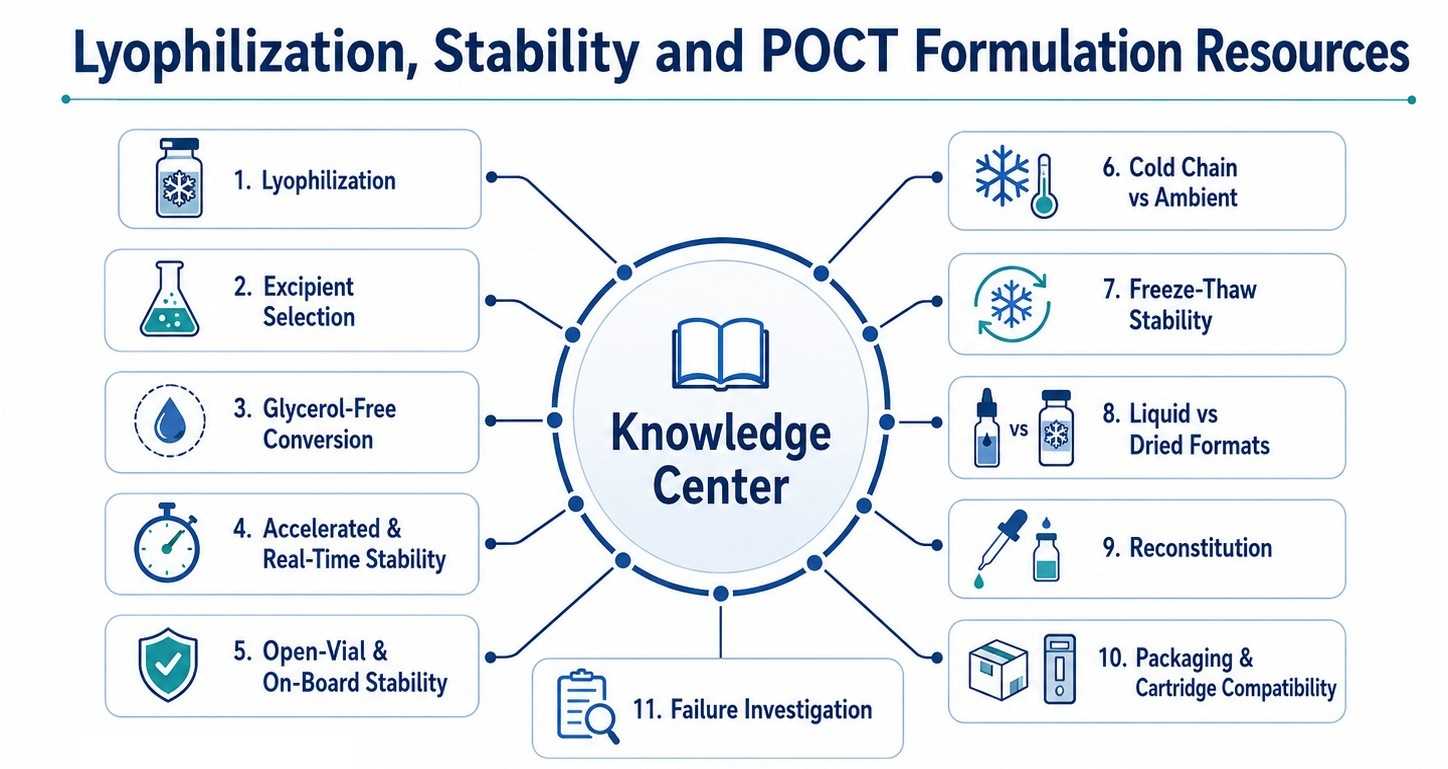
The Lyophilization, Stability and POCT Formulation Resources knowledge center connects these layers. It covers formulation of freeze-dried enzymes, excipient selection, glycerol-free conversion, real-time and accelerated studies, open-vial and onboard use, cold-chain decisions, freeze-thaw exposure, liquid-versus-dried formats, reconstitution, cartridge compatibility, moisture-protective packaging, and failure investigation.
These resources are written for diagnostic enzyme manufacturers, IVD reagent developers, POCT engineers, quality and regulatory teams, operations groups, and technical buyers. They provide scientific and development frameworks rather than universal recipes or shelf-life promises. Every storage or use claim must be supported for the defined formulation, manufacturing process, final package, assay, device, and intended conditions.
Creative Enzymes offers product categories and development services that can support different stages of a formulation and stability program:
| Level | Question | Why it is not sufficient alone |
|---|---|---|
| Enzyme-centered stability | Does the enzyme retain concentration, structure, catalytic activity, and acceptable aggregation or particle behavior? | A purified-substrate method may not reveal cofactor decay, reporter background, matrix sensitivity, device adsorption, or calibration drift. |
| Formulated-reagent stability | Does the complete liquid or dried reagent retain reaction kinetics, blanks, controls, linearity, and relevant low-end performance? | Bench testing may omit the final package, transport profile, instrument residence, sample delivery, and repeated access. |
| Product-system stability | Does the final packaged test perform throughout storage, shipping, opening, onboard residence, reconstitution, and use? | A passing product result may not identify which component is degrading or provide enough understanding for future changes. |
A mature program connects all three. Enzyme-specific methods help localize cause; complete-reagent methods show whether chemistry remains balanced; final-system testing demonstrates whether the marketed configuration still meets its intended analytical requirements. The required balance depends on development phase and risk.
Freeze-drying removes water through freezing, primary drying, and secondary drying. During freezing, ice excludes most solutes into a smaller unfrozen fraction. This can increase local protein, salt, buffer, surfactant, substrate, and cofactor concentrations and may shift pH or induce crystallization. Ice-liquid and air-liquid interfaces add structural stress. Primary drying must remove ice without exceeding product limits associated with collapse or eutectic behavior, while secondary drying reduces more strongly associated water.
The resulting solid is not chemically inactive. Residual water, molecular mobility, glass transition, oxygen, light, crystallization, and package ingress influence change during storage. Excess moisture may accelerate degradation, but the lowest achievable moisture is not automatically best: over-drying can harm some proteins or slow rehydration. Moisture results must be interpreted with formulation, physical state, package, and functional performance.
Buffers, sugars, polyols, salts, amino acids, polymers, surfactants, carrier proteins, chelators, antioxidants, preservatives, and cofactors can all affect stability. Their effects depend on concentration, impurity profile, enzyme mechanism, storage state, and downstream detection. A chelator that limits metal-catalyzed oxidation may inhibit a metalloenzyme; an antioxidant may consume a peroxide signal; a carrier protein may reduce adsorption but increase blank or raw-material variability.
Screening should begin with plausible failure mechanisms and an intended-use composition. Fresh activity, stressed activity, complete-assay response, blank, low-positive recovery, physical observations, and manufacturability should be considered together. One-variable-at-a-time experiments are easy to interpret but can miss interactions; designed experiments can reveal interactions but require meaningful factor ranges and confirmatory conditions.
Shelf life in an unopened package, shipping tolerance, temporary temperature excursion, opened-vial life, onboard stability, reconstituted stability, and freeze-thaw resistance are different claims. They have different starting events, container states, temperature and humidity profiles, mechanical exposures, contamination risks, and user actions. A single long warm hold cannot automatically support all of them.
Accelerated and forced-degradation studies are useful for ranking candidates, identifying sensitive endpoints, and investigating mechanisms. They do not automatically predict real-time shelf life. Extrapolation is especially uncertain when a physical transition, precipitation, seal failure, moisture uptake, microbial growth, or change in degradation mechanism occurs. Representative lots in final packaging should continue on real-time studies through and preferably beyond the proposed claim.
Point-of-care cartridges expose small reagent quantities to large surface-to-volume ratios, molded polymers, elastomers, adhesives, foils, membranes, coatings, vents, heaters, optical windows, and fluidic structures. Adsorption can remove enzyme without chemical degradation. Extractable substances can inhibit reactions or increase background. A moving wetting front can create transient local concentrations very different from those in a mixed tube.
Reagent and cartridge development should therefore proceed together. Contact maps, adsorption studies, dried-spot recovery, flow visualization, heater mapping, optical blanks, seal integrity, evaporation challenges, and tolerance studies help translate bench chemistry into a manufacturable disposable. Production material lots and tooling variation should be introduced before design freeze.
| Resource | What the resource covers |
|---|---|
| Lyophilized Enzyme Formulation Guide | A stepwise framework for converting a functional liquid enzyme reagent into a reproducible freeze-dried presentation without treating cake appearance as a substitute for biochemical performance. The page also identifies decision points, evidence limits, and practical controls for protein conformation, freeze concentration, drying-cycle limits, residual moisture, reconstitution, final-package stability, and assay-level recovery. |
| Excipient Selection for Diagnostic Enzyme Stabilization | A mechanism-led approach to choosing buffers, sugars, polyols, salts, polymers, surfactants, antioxidants, chelators, preservatives, and carrier proteins for liquid or dried diagnostic enzyme systems. The page also identifies decision points, evidence limits, and practical controls for how excipient function changes with physical state, enzyme mechanism, detection chemistry, matrix, manufacturing process, and intended storage. |
| Glycerol-Free Conversion Guide for Diagnostic Enzymes | A comparability-focused guide to removing or reducing glycerol from enzyme stocks intended for lyophilization, dry strips, cartridges, high-concentration blends, or low-volume automated dispensing. The page also identifies decision points, evidence limits, and practical controls for why glycerol is present, how its removal changes protein and process behavior, and how to demonstrate functional equivalence after buffer exchange. |
| Accelerated and Real-Time Stability Testing for Diagnostic Reagents | A study-design guide that separates exploratory stress testing, accelerated stability, real-time shelf-life evidence, transport simulation, and in-use claims for ivd reagents. The page also identifies decision points, evidence limits, and practical controls for protocol architecture, lot selection, timepoints, acceptance criteria, statistical interpretation, extrapolation limits, excursions, and change control. |
| Open-Vial and On-Board Stability in IVD Reagents | A use-condition framework for reagents exposed to repeated opening, aspiration, instrument residence, warming and cooling, evaporation, light, mixing, and cumulative contamination risk after first access. The page also identifies decision points, evidence limits, and practical controls for how open-vial and onboard claims differ from sealed shelf life and how simulated-use studies reproduce cumulative instrument and operator stresses. |
| Cold Chain vs Ambient Storage for Diagnostic Enzymes | A lifecycle comparison of refrigerated, frozen, and ambient enzyme-reagent strategies that includes biochemical risk, distribution control, packaging burden, field use, energy dependence, and cost. The page also identifies decision points, evidence limits, and practical controls for choosing a storage model from the actual temperature distribution and product configuration rather than assuming ambient is always simpler or refrigeration always safer. |
| Freeze-Thaw Stability of Diagnostic Enzymes | An experimental guide to stresses created by ice formation, freeze concentration, cold surfaces, thawing gradients, repeated cycling, partial freezing, and post-thaw handling. The page also identifies decision points, evidence limits, and practical controls for studies that specify rate, temperature, container, fill, hold, thaw method, mixing, and endpoints instead of reporting only a cycle count. |
| Liquid vs Dried Diagnostic Reagents: Development Trade-Offs | A format-selection guide comparing liquid, frozen, lyophilized, foam-dried, air-dried, and dried-film presentations across chemistry, manufacturing, device integration, usability, stability, and cost. The page also identifies decision points, evidence limits, and practical controls for selecting physical presentation at system level and recognizing when hybrid architecture is more reliable than forcing every component into one state. |
| Reconstitution and Activity Recovery of Lyophilized Enzymes | A practical analysis of wetting, dissolution, concentration uniformity, mixing, diluent composition, recovery kinetics, activity measurement, and user or instrument error after a dried enzyme is rehydrated. The page also identifies decision points, evidence limits, and practical controls for treating reconstitution as a controlled product operation rather than assuming that adding water returns the pre-dry state immediately. |
| POCT Cartridge Compatibility for Enzyme Reagents | A device-integration guide covering adsorption, extractables, capillary flow, seals, valves, membranes, dried-reagent placement, thermal gradients, bubbles, evaporation, optical backgrounds, and manufacturing tolerances. The page also identifies decision points, evidence limits, and practical controls for co-developing enzyme chemistry and consumable architecture because a reagent qualified in a tube may behave differently after contact with the final cartridge. |
| Packaging, Desiccants and Moisture Control for Dried Enzyme Reagents | A package-system guide linking water-vapor barrier, seal integrity, headspace, desiccant capacity, humidity indicators, opening patterns, transport damage, and residual moisture to dry-reagent performance. The page also identifies decision points, evidence limits, and practical controls for treating the pouch, vial, closure, desiccant, secondary pack, and opening instructions as functional parts of the formulation. |
| Enzyme Formulation Failure Analysis Guide | A root-cause framework for unexpected activity loss, aggregation, precipitation, rising blank, calibration drift, inconsistent recovery, moisture sensitivity, device incompatibility, and lot-dependent diagnostic performance. The page also identifies decision points, evidence limits, and practical controls for preserving evidence, defining the failure precisely, separating enzyme damage from system effects, testing competing hypotheses, and converting conclusions into preventive controls. |
Teams beginning with a liquid enzyme can first review excipient selection, glycerol-free conversion, freeze-thaw stability, and the liquid-versus-dried comparison. Programs committed to a dried format should combine the lyophilized formulation, reconstitution, packaging, and moisture-control guides. POCT teams should add cartridge compatibility and onboard-use studies before fixing the reagent and consumable architecture.
When an unexpected result appears, the failure-analysis guide provides a route from precise problem definition to orthogonal confirmation, component substitution, hypothesis testing, and corrective action. Stability evidence should be treated as a living body of knowledge that informs raw-material specifications, process ranges, package controls, instructions, post-change bridging, and ongoing monitoring.
Changing enzyme source, excipient grade, container material, fill volume, drying cycle, desiccant, seal, device geometry, or instructions can change stability. A risk assessment should identify which claims and endpoints are affected and define focused comparability or renewed studies.
