
POCT Cartridge Compatibility for Enzyme Reagents provides a device-integration guide covering adsorption, extractables, capillary flow, seals, valves, membranes, dried-reagent placement, thermal gradients, bubbles, evaporation, optical backgrounds, and manufacturing tolerances. It is written for POCT assay developers, cartridge engineers, material scientists, enzyme formulators, and design-transfer teams. The central concern is co-developing enzyme chemistry and consumable architecture because a reagent qualified in a tube may behave differently after contact with the final cartridge.
For this topic, stability must be evaluated across map every contact material, engineer rehydration and flow, and transfer with tolerance studies. Enzyme-centered measurements explain only part of the system: cofactors, substrates, reporters, contact materials, packaging, specimens, timing, and user operations may follow different failure routes. A formulation with excellent fresh activity can therefore have a poor practical margin.
This resource is a development framework for POCT assay developers, cartridge engineers, material scientists, enzyme formulators, and design-transfer teams; it is not a universal formula or an automatic storage claim. Study conditions, methods, limits, and conclusions must correspond to co-developing enzyme chemistry and consumable architecture because a reagent qualified in a tube may behave differently after contact with the final cartridge, using the intended reagent configuration and an explicitly defined assay and use environment.
Readers applying this guide may also use the following Creative Enzymes product and service categories as starting points for raw-material selection, formulation development, and verification:
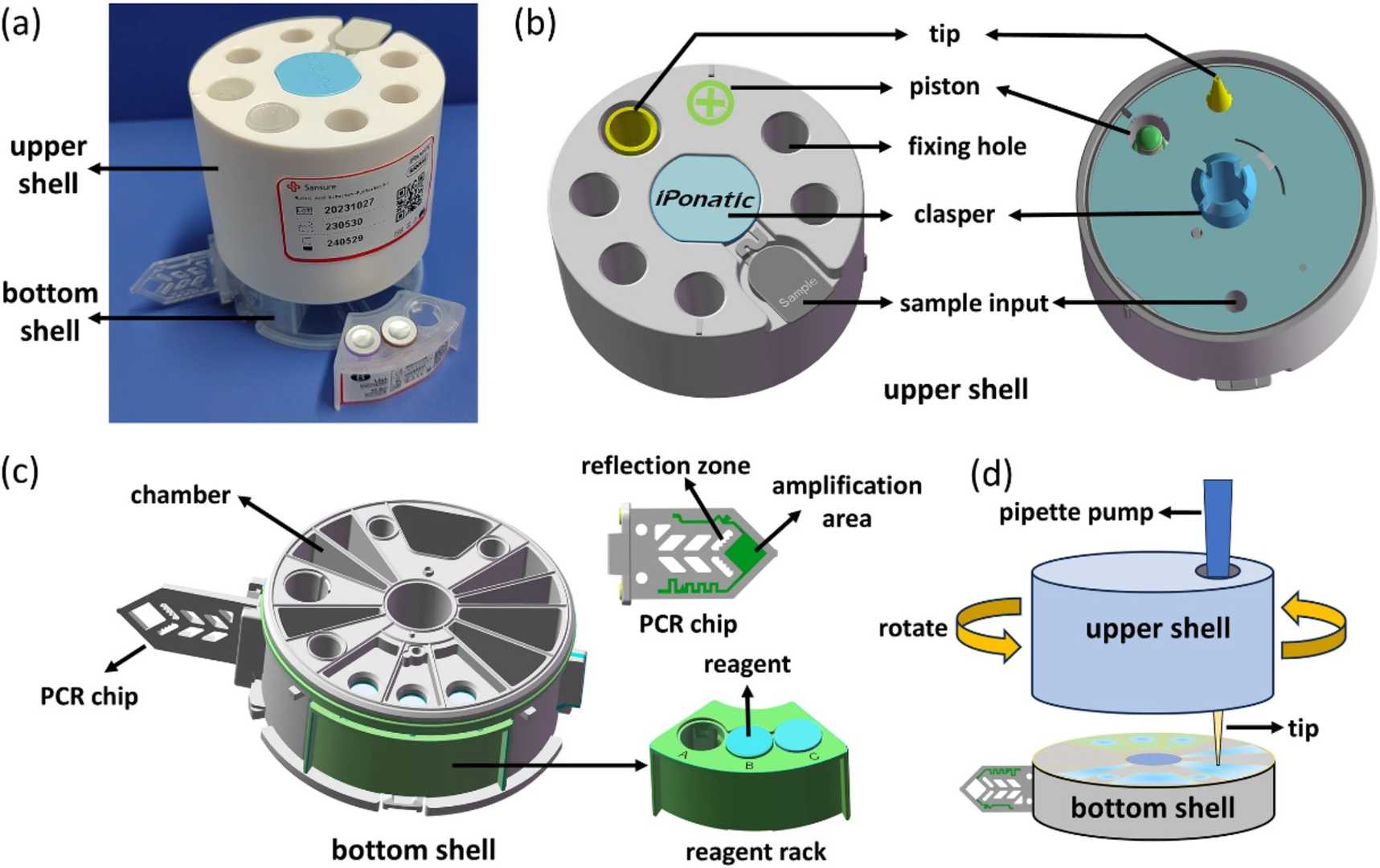 Figure 1. Structure of the cartridge. (a) The overall image of the cartridge. (b) The top view and bottom view of the upper shell. (c) The schematic diagram of the lower shell. (d) The schematic diagram of liquid transfer. (Xie et al., 2025)
The process question is whether Enzyme reagents can contact molded polymers, elastomers, adhesives, foils, membranes, glass fibers, coatings, lubricants, inks, and tubing from manufacture through use. One concern is that Short bench exposure may miss cumulative adsorption, leachables, curing residues, plasticizers, or hydrophobic interactions that appear after storage. The decision should be supported by this action: Create a contact map with time, temperature, surface-to-volume ratio, and reagent state for each material.
Cartridge integration requires paired chemistry and engineering evidence. Test blank and active cartridges, aged and fresh materials, multiple cavities or membrane lots, and relevant samples. Track where activity is lost spatially. A surface rinse, alternative material, or changed deposition position can discriminate adsorption from enzyme degradation.
The final design must account for the fact that Low enzyme loads are vulnerable to nonspecific binding, especially in high-area microchannels and porous substrates. Surfactants or blocking agents can help but may change wetting, valves, bubbles, or downstream detection. The claim becomes vulnerable if Apparent low activity can arise from incomplete elution rather than molecular degradation. The appropriate evidence is to Measure mass or activity before contact, after contact, and in retained surface rinses where feasible.
Cartridge integration requires paired chemistry and engineering evidence. Test blank and active cartridges, aged and fresh materials, multiple cavities or membrane lots, and relevant samples. Track where activity is lost spatially. A surface rinse, alternative material, or changed deposition position can discriminate adsorption from enzyme degradation.
The technical starting point is straightforward: A dried spot receives a moving wetting front, not necessarily instantaneous bulk mixing. Local concentrations can briefly exceed nominal values and salts or polymers dissolve at different rates. The principal development risk is that Channel geometry, capillary pressure, membrane lot, sample viscosity, hematocrit, and ambient humidity affect delivery. Evidence should therefore be collected deliberately: Visualize flow and test spatial uniformity with the actual dried formulation and sample types.
Cartridge integration requires paired chemistry and engineering evidence. Test blank and active cartridges, aged and fresh materials, multiple cavities or membrane lots, and relevant samples. Track where activity is lost spatially. A surface rinse, alternative material, or changed deposition position can discriminate adsorption from enzyme degradation.
At this stage, Cartridge heaters can have gradients, ramp delays, and contact variability; optics can see polymer autofluorescence, scattering, bubbles, or condensation. A misleading result can arise because A reaction optimized in a uniformly heated tube may have slower kinetics or position effects in a disposable. A defensible experiment should address the issue directly: Map temperature at the reaction zone and measure background using production-representative materials.
Cartridge integration requires paired chemistry and engineering evidence. Test blank and active cartridges, aged and fresh materials, multiple cavities or membrane lots, and relevant samples. Track where activity is lost spatially. A surface rinse, alternative material, or changed deposition position can discriminate adsorption from enzyme degradation.
The governing consideration is that Foil seals, frangible elements, vents, blister liquids, and pressure-driven valves influence evaporation, oxygen, moisture, opening force, and fluid timing. The practical hazard is that Package integrity can deteriorate during thermal cycling or transport, and tiny leaks can age a dried reagent without obvious failure. The most useful confirmation is to Link seal and barrier tests to functional performance after storage and shipping simulation.
Cartridge integration requires paired chemistry and engineering evidence. Test blank and active cartridges, aged and fresh materials, multiple cavities or membrane lots, and relevant samples. Track where activity is lost spatially. A surface rinse, alternative material, or changed deposition position can discriminate adsorption from enzyme degradation.
A robust approach recognizes that Tooling cavities, membrane dimensions, adhesive placement, dispense position, dried mass, and heater contact vary in production. Development can fail when A prototype assembled by experts can occupy a narrow optimum that does not survive scale-up. To reduce that uncertainty, Use engineering lots and designed variation to set cartridge and reagent specifications together.
Cartridge integration requires paired chemistry and engineering evidence. Test blank and active cartridges, aged and fresh materials, multiple cavities or membrane lots, and relevant samples. Track where activity is lost spatially. A surface rinse, alternative material, or changed deposition position can discriminate adsorption from enzyme degradation.
| Variable | Question to answer | Development implication |
|---|---|---|
| Polymer surface | Does enzyme adsorb or denature? | Use representative molded material. |
| Adhesive | Can uncured or extractable species inhibit reaction? | Test aged assembled parts. |
| Membrane lot | Does flow or binding vary? | Qualify functional ranges. |
| Surface-to-volume ratio | Is microscale loss greater than tube results? | Scale contact studies appropriately. |
| Dried spot position | Does the wetting front capture all reagent? | Map dissolution and transport. |
| Bubble formation | Can surfactant or geometry trap gas? | Challenge fill and temperature. |
| Evaporation | Does venting concentrate reagent? | Measure under intended timing. |
| Heating | Are ramp and gradients controlled? | Map device temperatures. |
| Optical background | Do materials alter signal or color? | Use blank cartridges and aged parts. |
| Seal integrity | Can moisture or oxygen enter? | Pair barrier and functional tests. |
| Manufacturing tolerance | Which dimensions affect chemistry? | Run designed variation. |
| Sample variability | Do viscosity and hematocrit change delivery? | Use representative matrices. |
The matrix should be converted into a protocol with named methods, sample numbers, lots, controls, timepoints, and acceptance rules. Not every variable needs an independent full-factor study, but an omitted variable should be omitted because the risk is understood—not because it is difficult to measure.
Cartridge compatibility is demonstrated in the assembled consumable, not inferred from polymer names. Surface treatment, molding, adhesive cure, geometry, aged materials, membrane lot, and heater contact can alter behavior. Link material and fluidic observations to blank, kinetics, recovery, and reported-result performance across engineering lots.
Trend by material lot, cavity, instrument, cartridge position, and sample type to distinguish chemical drift from engineering variability. Trend direction can be informative before a specification is crossed, but method noise, sampling, and environmental records must be considered before assigning cause.
