
A CRISPR diagnostic assay is a chain of linked decisions: intended use, target sequence, sample preparation, amplification, Cas enzyme, guide RNA, reporter, device, controls, analysis, and manufacturing. Optimizing these parts independently can create an assay that performs well in a clean benchtop experiment but fails when the final specimen, workflow, or reagent format is introduced.
This guide presents a stage-gated workflow. The aim is to preserve evidence about why each design choice was made and to expose failure mechanisms before the composition is frozen.
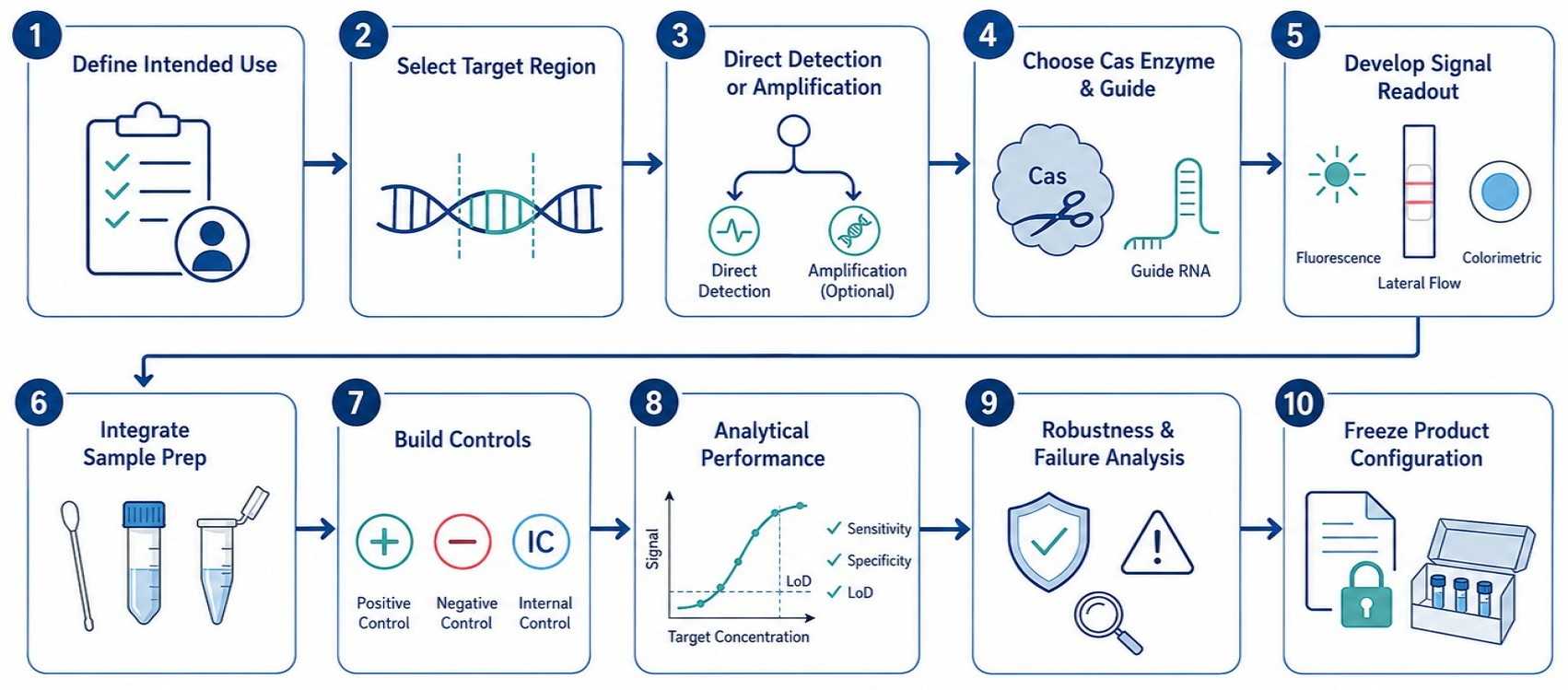 Figure 1. CRISPR diagnostics workflow.
The target is not merely a sequence. Define the organism, gene, transcript, variant, or biomarker state; the specimen and collection method; the target concentration range; the intended user; and how the result will be acted upon. A qualitative endpoint, genotype call, multiplex panel, and semi-quantitative trend need different evidence.
The initial requirement should specify:
Sequence databases should be curated for relevant geography, time period, subtypes, and near neighbors. Alignments reveal conserved regions and discriminatory variants. Host homology, repeats, secondary structure, and co-infection targets should be considered. Database predictions are then tested with physical materials because sequence availability and metadata are imperfect.
A target region must accommodate both amplification primers and the Cas guide. For Cas12, an appropriate PAM may be required in the amplified target; for Cas13, transcript sequence and guide-accessible RNA structure matter. Primer tails can introduce required handles but must be assessed as potential background activators.
Direct detection minimizes steps but requires enough target and reporter turnover. Preamplification increases sensitivity and can create a controlled Cas activator, but it introduces primer background, carryover, and additional enzymes. LAMP, RPA, PCR, RCA, NASBA-type systems, and transcription modules provide different product structures and temperatures.
The amplification method should be selected from the complete workflow. If one-pot operation is required, enzyme compatibility and timing matter from the beginning. If two-step transfer is acceptable, contamination controls and closed handling become primary design inputs.
| Decision | Evidence needed |
|---|---|
| Cas12 or Cas13 family | Target nucleic acid, reporter type, upstream product, temperature, target constraints |
| Ortholog or engineered variant | PAM/flanking requirement, mismatch response, trans-cleavage, buffer and temperature profile |
| Guide sequence | Coverage, near-neighbor discrimination, structure, guide stability, experimental guide panel |
| Enzyme-guide ratio | Signal rate, blank, target range, cost, and stability |
| Reporter | Cleavage preference, label chemistry, optical or strip response, matrix background |
Multiple guides should be screened because predicted complementarity does not capture enzyme-specific activation and mismatch tolerance completely. Guides can also be combined, but multiplexing may increase signal, competition, and false activation simultaneously.
Fluorophore-quencher reporters support sensitive closed-tube detection and kinetic analysis. Lateral flow can provide a familiar visual endpoint but requires a carefully designed reporter and strip architecture. Electrochemical, chemiluminescent, colorimetric, and nanoparticle-based systems can reduce optical hardware or improve portability, yet each adds surface, mediator, or matrix effects.
The result rule should be defined before final optimization. Thresholds, read time, control validity, ambiguous-zone treatment, image processing, and repeat criteria should not be chosen after seeing the final data set.
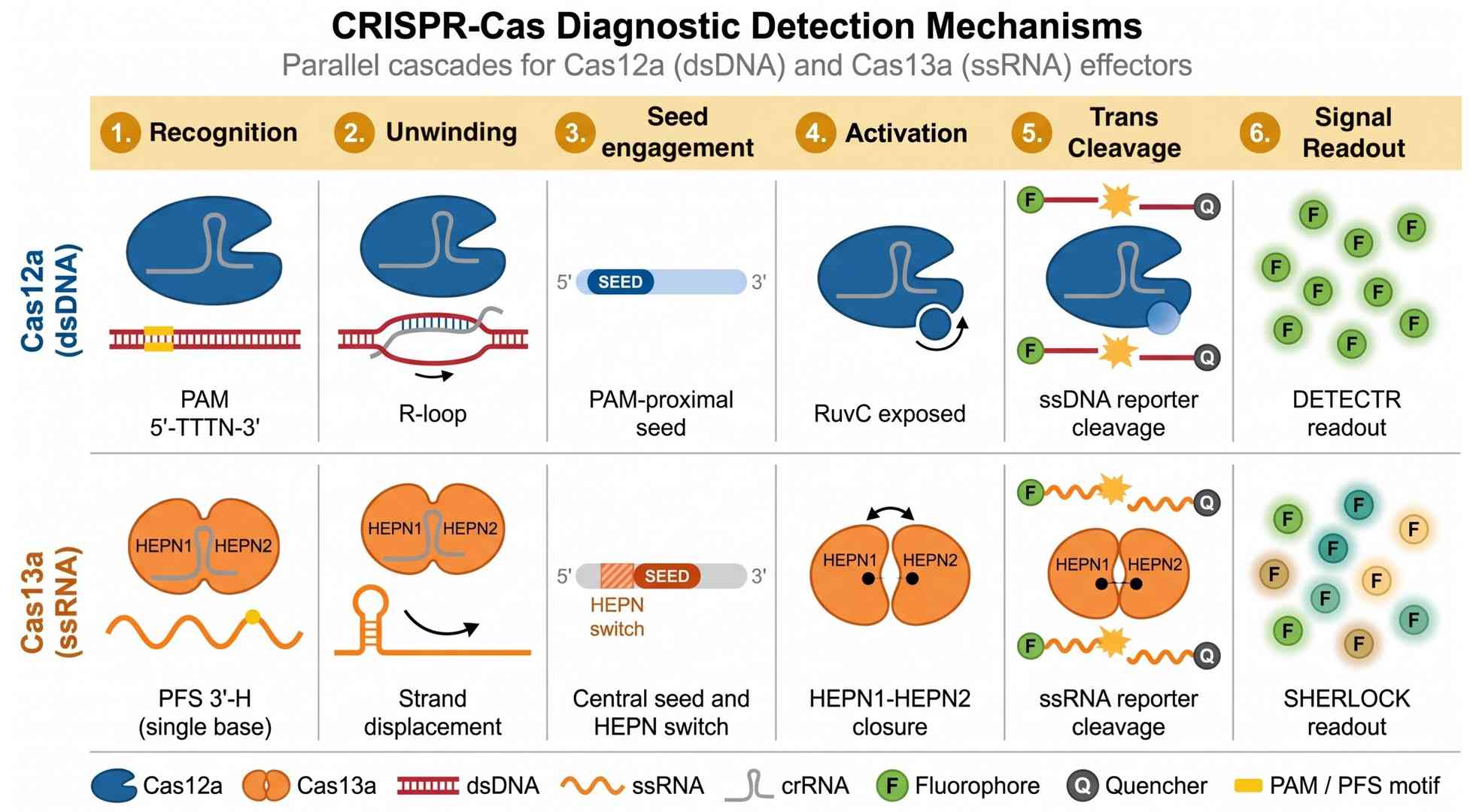 Figure 2. CRISPR-Cas diagnostic detection mechanisms. (Walflor and Medeiros, 2026)
Sample processing controls target release, preservation, concentration, and inhibitor carryover. Heat lysis can inactivate some nucleases but fragment targets or change sample chemistry. Chemical lysis can introduce detergents, salts, or reducing agents. Extraction improves purity but adds equipment and user steps.
Spikes before and after preparation distinguish recovery from reaction inhibition. Endogenous positive material is preferable when available because synthetic targets may not reproduce encapsidation, cellular association, fragmentation, or matrix binding. The site's Nucleic Acid Extraction Enzyme System Optimization and Extraction-Free Enzyme System Development services address this interface.
| Control class | Purpose | Example |
|---|---|---|
| Process control | Challenges preparation and amplification | Noncompetitive encapsulated nucleic acid added before processing |
| Amplification control | Detects gross reaction inhibition | Internal or parallel target with separate detection |
| Cas-module control | Confirms guide and reporter function | Synthetic activator added to a Cas-only reaction |
| Negative controls | Locate contamination and nonspecific signal | Reagent blank, matrix blank, NTC, non-targeting guide |
| Specificity controls | Challenge cross-reactivity | Near-neighbor organisms, homologs, variant panel |
Internal controls can compete with low-level target for primers, nucleotides, Cas enzyme, or reporter. Their concentration and interpretation must be optimized rather than added at the end.
Detection capability should be estimated with defined material, concentration assignment, replicate plan, and hit-rate analysis. Precision includes not only final signal but also categorical agreement, time to positive, and invalid rates. Inclusivity, exclusivity, interference, carryover, cross-contamination, sample stability, reagent stability, and method comparison should match intended use.
A low analytical detection limit obtained with purified synthetic target does not establish clinical sensitivity. Clinical performance depends on specimen collection, disease stage, target biology, population, and comparator. Claims should remain within the evidence generated.
Deliberate variation reveals operating range: temperature, time, volume, sample input, reagent concentration, setup hold, mixing, operator, device, lot, humidity, and transport. Failures should be decomposed by module. For example, a negative result can reflect poor release, amplification inhibition, guide mismatch, Cas inactivity, reporter degradation, or threshold error.
Reaction traces and module-specific controls make root-cause analysis faster than changing several components simultaneously. The Diagnostic Assay Failure Investigation and Root-Cause Analysis service can support complex systems.
The controlled configuration includes enzyme sources and lots, guide and primer sequences, stock buffers, reagent concentrations, order of addition, container, package, drying cycle, device settings, software, and result algorithm. A change in any of these may require bridging.
Transfer documentation should include preparation methods, acceptance tests, raw-material attributes, control expectations, analytical methods, known sensitivities, and unresolved risks. Activity specifications should use defined assay conditions and connect to finished-assay performance.
Adding guides does not automatically produce a multiplex result. If several Cas reactions cleave the same reporter, the assay may detect a combined panel without identifying the target. Target identity can be preserved through separate optical channels, spatial partitioning, orthogonal Cas-reporter preferences, barcoded reporters, or parallel wells. Each option affects device complexity and cross-talk.
Amplification competition should be characterized before Cas detection is blamed for unequal channels. Primer pairs can consume shared reagents or preferentially amplify one target. Singleplex baselines, pairwise combinations, full-panel target mixtures, and high-low imbalance samples reveal suppression. Internal controls should be included in the same competition studies.
Sequence databases change as new variants are reported, and reagent suppliers, oligonucleotide processes, phone software, cartridges, and algorithms may change. A surveillance plan should define when inclusivity and exclusivity analyses are repeated and which changes trigger laboratory bridging.
| Change | Potential impact | Typical bridge focus |
|---|---|---|
| New target variants | Primer or guide mismatch | In silico coverage followed by representative physical materials |
| Cas or polymerase lot/source | Activity, specificity, background, stability | Module tests plus finished-assay target/NTC panel |
| Reporter or oligonucleotide process | Purity, cleavage, optical response, primer interactions | Identity/purity and functional comparability |
| Device or software update | Temperature, acquisition, threshold, data transfer | Regression and representative user/device verification |
The development record should preserve sequence accession dates, alignment rules, primer and guide versions, raw-data files, analysis scripts, instrument settings, environmental conditions, lot identifiers, and reasons for rejected candidates. Negative results are valuable: they prevent future teams from repeating incompatible guide, buffer, or device combinations.
A technically promising assay is not transfer-ready until another trained team can reproduce preparation, run controls, analysis, and invalid-result logic. Controlled documentation is therefore part of assay design rather than a final administrative step.
