
Next-generation sequencing and PCR can both support companion diagnostics, but they optimize different parts of the testing problem. PCR provides focused detection of predefined targets with relatively simple data analysis and often faster turnaround. NGS examines many targets and variant classes in parallel, conserving tissue when several treatment hypotheses must be evaluated.
The choice is not “advanced” versus “traditional.” It is a fit between biomarker scope, specimen, allele fraction, clinical workflow, evidence, and lifecycle strategy. This guide compares NGS and PCR from sample input through enzyme chemistry, validation, interpretation, cost, and regulatory change control.
PCR is well suited to a limited set of known substitutions, insertions, deletions, methylation targets, or fusion transcripts when primers and probes can define the search space. NGS is advantageous when many genes, hotspots, copy-number changes, rearrangements, or genomic signatures may influence therapy. A focused NGS panel can sit between single-target PCR and broad comprehensive profiling.
A broad platform does not automatically deliver better clinical utility. Every reported target requires validation and interpretation. Conversely, a narrow test can miss alternative actionable alterations and may consume tissue through sequential testing. Map the treatment decision and likely future claims before selecting platform breadth.
| Dimension | PCR/qPCR | NGS |
|---|---|---|
| Target scope | One to dozens of predefined targets | Dozens to hundreds of genes or broader profiles |
| Variant discovery | Limited to assay design | Can detect multiple predefined and some unanticipated variants within validated scope |
| Input | Often low, assay dependent | Low-input possible but library complexity becomes critical |
| Typical workflow | Extraction, amplification, detection | Extraction, library preparation, sequencing, bioinformatics |
| Turnaround | Often shorter | Usually longer and more operationally complex |
| Data analysis | Thresholds, curves, target rules | Alignment, quality filters, calling, annotation, algorithms |
| Multiplex risk | Primer competition and fluorescence channels | Coverage imbalance, library bias, index and bioinformatics effects |
| Best fit | Rapid focused treatment decision | Broad profiling, tissue stewardship, multiple therapy associations |
PCR relies principally on a thermostable polymerase, with reverse transcriptase for RNA targets and optional carryover-control enzymes. NGS library preparation can add fragmentation, end repair, phosphorylation, A-tailing, adapter ligation, reverse transcription, and library amplification.
Each NGS step can lose molecules or introduce bias. PCR/qPCR premix development and NGS library-preparation development therefore address different system risks.
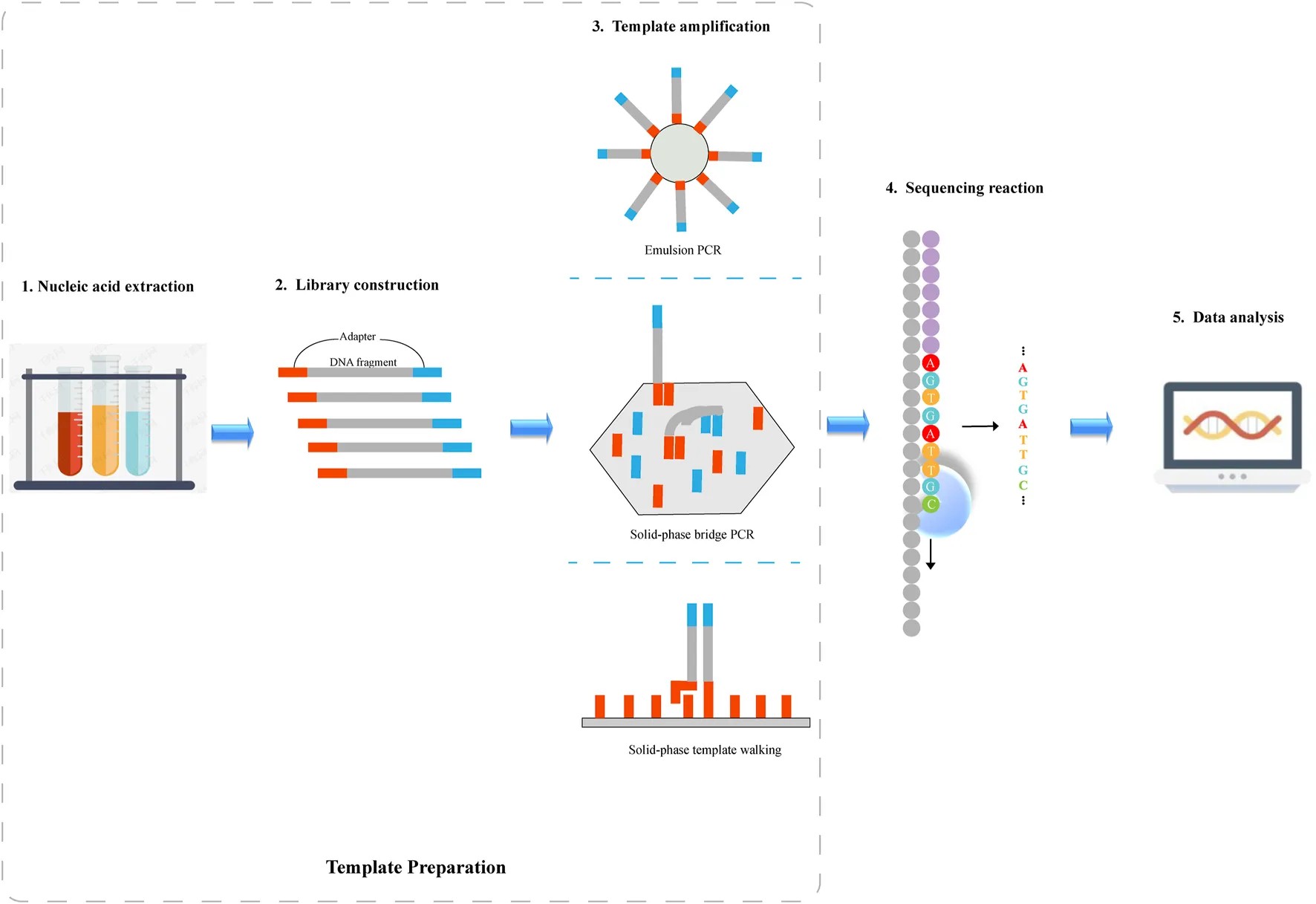
Figure 1. PCR emphasizes targeted amplification; NGS adds library construction, sequencing, and bioinformatics (Cheng et al., 2023).
A highly optimized allele-specific or digital PCR assay can achieve excellent sensitivity for a known variant. NGS can also detect low-frequency variants through deep coverage, unique molecular identifiers, duplex methods, and background models. But read depth is not the same as independent molecule count, and broad panels distribute sequencing capacity across many regions.
Limit of detection should be established for relevant variant types, sequence contexts, input amounts, tumor fractions, and specimen qualities. PCR inclusivity must cover intended alleles; NGS must cover its claimed reportable range and difficult regions. Both platforms can fail when too few target molecules enter the reaction, so sampling and extraction belong in the sensitivity claim.
Primer/probe cross-reactivity, nonspecific products, contamination, allele dropout, and threshold rules can create incorrect calls.
Damage, polymerase errors, strand bias, mapping artifacts, index effects, and variant-caller rules contribute to error.
Negative specimens, near-neighbor targets, orthogonal evidence, contamination monitoring, and near-cutoff precision are essential.
High-fidelity polymerase reduces one source of NGS error but cannot correct pre-existing DNA damage or mapping artifacts. Hot-start control improves PCR specificity but does not rescue a mismatched primer over an uncharacterized variant. Error mitigation needs chemistry, workflow, controls, and software together.
PCR workflows can be automated and rapid, making them attractive when one treatment decision is urgent. NGS may avoid repeated single-gene tests and preserve tissue when several biomarkers are relevant. The apparent tissue advantage depends on extraction, library input, repeat rates, and whether pathology requires separate sections.
Operational comparisons should include hands-on time, batching, run frequency, minimum economical batch size, failure and repeat rates, instrument capacity, bioinformatics review, and result communication. A rapid assay that runs daily may outperform a shorter bench protocol batched weekly. Instrument-platform adaptation can test whether reagent behavior remains stable across thermal, optical, and fluidic conditions.
PCR validation focuses on each claimed target, cross-reactivity, amplification efficiency, cutoff behavior, and instrument/reagent precision. NGS validation adds variant classes, representative genomic contexts, coverage and quality thresholds, bioinformatics, databases, and procedures for software updates. Larger panels create more combinations but do not require testing every possible variant identically; a justified representative strategy is essential.
The intended-use claim should define method, specimen, population, biomarker, and therapy relationship. Panel changes, reference-genome or database updates, altered callers, and new reportable targets need controlled assessment. PCR also requires change control for primer/probe sequences, enzyme mixes, thresholds, and instruments. Platform simplicity does not eliminate regulatory lifecycle obligations.
| Question | PCR may be favored when | NGS may be favored when |
|---|---|---|
| How many targets matter? | A small, stable set drives one decision | Many genes or variant classes inform several options |
| How urgent is the result? | Same-day or short turnaround is critical | Broader information justifies added time |
| How limited is tissue? | Very low input and one target | One library can replace sequential testing |
| What is the variant? | Predefined hotspot or transcript | Heterogeneous variants, fusions, CNVs, signatures |
| How mature is interpretation? | Simple prespecified positive/negative rule | Validated pipeline and expert review are available |
| Will claims expand? | Scope is unlikely to change | Platform expansion is part of lifecycle strategy |
Programs do not always need one platform. A rapid PCR test can support an urgent high-prevalence decision, with NGS reflex testing for negative or broader cases. Alternatively, NGS can serve as the primary profile and a targeted method can confirm technically challenging variants. The algorithm must define ordering, discordance, missing results, tissue allocation, and which result controls therapy selection.
When a CDx claim depends on a multi-test strategy, the complete pathway requires validation. A positive result from two methods may not have identical uncertainty, and a negative targeted test does not mean the broader profile is negative. Clinical sites need unambiguous instructions and compatible turnaround expectations.
The CDx technology platform and assay feasibility support can structure this comparison.
Whatever platform or specimen is selected, development should begin with a written link between intended use and analytical requirements. Define the patient population, biomarker, specimen, treatment decision, reportable result, turnaround expectation, and use environment. Then identify the failure modes that could change classification: target loss, nonspecific signal, amplification bias, reagent drift, interference, software error, or an invalid result that delays therapy. This risk map determines which enzyme attributes and assay controls deserve the most attention.
Feasibility experiments should include representative clinical material as early as possible. Purified templates and synthetic controls are valuable for isolating variables, but they do not reproduce fixation damage, low tumor fraction, endogenous inhibitors, sample heterogeneity, or extraction carryover. A staged study can begin with controlled materials, add individual challenges, and then confirm performance in specimens spanning the intended range. Samples near the cutoff are especially informative because small shifts in recovery, background, or signal can change the treatment category.
Critical enzymes should be specified by more than catalog activity. Identity, purity, concentration, specific activity, contaminating nuclease or protease limits, formulation, storage, and functional performance may all be relevant. The release method should use conditions that predict performance in the diagnostic reaction. When the vendor activity assay and CDx chemistry differ substantially, an assay-level incoming or bridging test can provide a more direct control. Multiple lots should be evaluated before pivotal use so the acceptance range reflects manufacturing variation rather than one favored batch.
Robustness studies intentionally vary parameters that will move in practice: reaction time and temperature, pipetting, sample input, operator, instrument, reagent lot, shipping excursion, and storage duration. Interference studies should use justified concentrations and combinations of endogenous substances, collection additives, medications, and process residuals. Controls must fail when the vulnerable step fails; an abundant control target may remain positive even when a low-copy clinical target is lost.
Finally, document changes across the full measurement system. A new enzyme lot, buffer, primer pool, conjugation process, extraction kit, instrument, or software version can alter analytical performance even if the intended use is unchanged. Risk-based comparability should focus on the attributes most likely to affect the cutoff and claimed range. Preserving retained samples, reference materials, version history, and a predefined bridging strategy makes lifecycle improvements possible without breaking the connection to the clinical evidence.
These questions keep development centered on the treatment decision rather than isolated technical metrics. They also create a common language for biomarker, clinical, regulatory, quality, manufacturing, and supplier teams.
PCR is often the strongest fit for rapid, focused detection of known targets; NGS is often the strongest fit for broad, multi-variant profiling and tissue stewardship. Neither advantage is absolute. The best CDx platform delivers the required biomarker information with controlled enzyme chemistry, representative validation, feasible operations, and a lifecycle plan aligned with the therapy.
Creative Enzymes supports diagnostic enzyme selection, engineering, formulation, conjugation, analytical evaluation, and scale-up for molecular and immunoassay CDx workflows.
