
Cas12 and Cas13 enzymes are central to many CRISPR diagnostic concepts because target recognition activates collateral, or trans-cleavage, of labeled reporter molecules. This converts programmable sequence recognition into an amplified optical, lateral-flow, electrochemical, or other measurable signal. Cas12 and Cas13 are not equivalent reporter enzymes: they differ in target nucleic acid, reporter substrate, guide architecture, target constraints, operating conditions, and potential upstream amplification routes.
Enzyme-family names are not complete specifications. Orthologs and engineered variants can differ substantially in temperature profile, PAM or flanking requirements, mismatch response, guide preference, trans-cleavage rate, storage behavior, and contaminants. Selection should be based on the final assay rather than on a generic “Cas12” or “Cas13” label.
| Feature | Cas12-family diagnostic use | Cas13-family diagnostic use |
|---|---|---|
| Primary programmed target | DNA for widely used Cas12 diagnostic systems | RNA |
| Common collateral reporter | Single-stranded DNA reporter | Single-stranded RNA reporter |
| Common upstream route | RPA, LAMP, PCR, RCA, or direct target where sensitivity permits | RPA plus transcription, RNA amplification, or direct RNA target where sensitivity permits |
| Target constraints | Ortholog-specific PAM requirements often apply to double-stranded DNA activation | Guide-target and ortholog-specific flanking or sequence preferences may apply |
| Important QC issue | ssDNase contamination can mimic trans-cleavage | RNase contamination can degrade guide, target, or reporter |
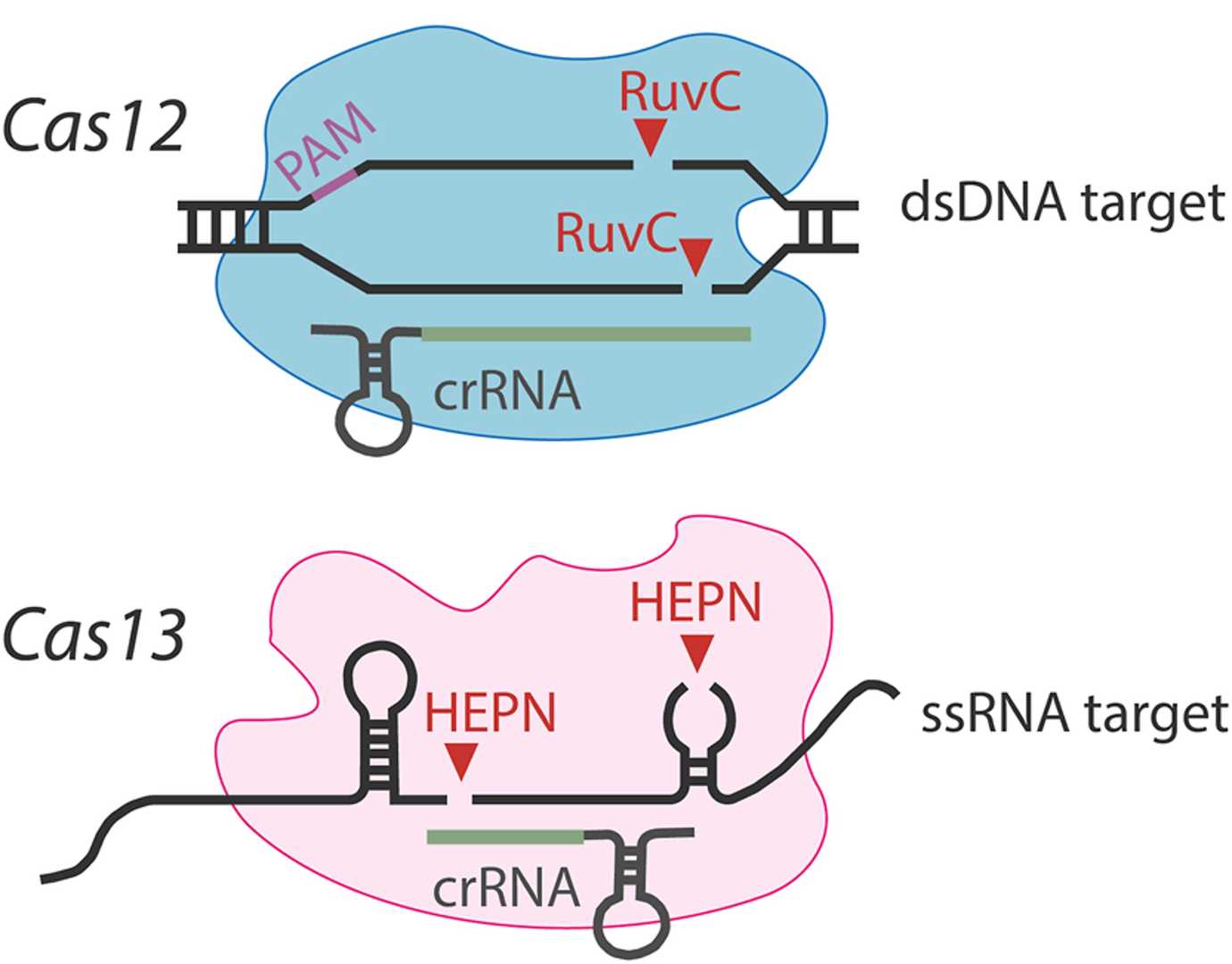 Figure 1. Diagrams of Cas12 and Cas13 nucleases. (Adapted from Chen et al., 2022)
A Cas12-crRNA complex recognizes a complementary target. For many Cas12 systems, binding to double-stranded DNA depends on an adjacent PAM defined by the ortholog. Target recognition and R-loop formation activate the nuclease, which can then cleave unrelated single-stranded DNA reporters repeatedly. A fluorophore-quencher ssDNA reporter becomes fluorescent after cleavage; alternatively, labeled reporters can be interpreted by lateral flow or other interfaces.
Single-stranded DNA activators may not have the same PAM dependence as double-stranded targets, but the actual amplification product and strand state must be considered. Guide design should therefore use the target presented to Cas, not only the original genomic sequence.
Cas13 enzymes are RNA-guided RNA-targeting nucleases. When the programmed RNA target is recognized, collateral cleavage of ssRNA reporters can generate signal. RNA targets may be detected after isothermal amplification and transcription, or directly when target abundance and assay kinetics are sufficient.
Cas13 workflows require exceptional RNase control. Trace RNase can cleave the reporter or degrade guide and target, producing either false signal or loss of sensitivity. Reporter sequence preferences and cleavage kinetics can vary among Cas13 orthologs, so reporter selection is part of enzyme optimization.
Guide design defines target recognition but is constrained by enzyme-specific architecture. The spacer must cover conserved intended targets while avoiding near neighbors and host sequences. Mismatch position matters: seed-like regions or other ortholog-dependent zones may contribute more strongly to discrimination than distal positions. A single mismatch rule should not be generalized across enzymes.
Guide development should include:
Reporter length, base composition, label pair, concentration, and surface context affect cleavage and signal. Too little reporter can limit dynamic range; too much can increase background, cost, and optical inner-filter effects. In lateral flow, reporter fragments must produce the intended test and control line behavior without hook or incomplete-migration artifacts.
Trans-cleavage kinetics should be measured over time across activator and enzyme concentrations. An endpoint may obscure a high initial blank or slow nonspecific cleavage. Signal saturation does not imply that target concentration can be quantified.
| Selection dimension | Questions for evaluation |
|---|---|
| Target compatibility | DNA or RNA? Double- or single-stranded activator? Required PAM or flanking sequence? |
| Temperature | Does activity overlap the amplification or device temperature? Is specificity preserved across the range? |
| Specificity | How do guide-target mismatches affect activation under final assay conditions? |
| Trans-cleavage | Which reporter chemistry gives acceptable rate, blank, and dynamic range? |
| Matrix tolerance | How do salts, transport media, sample proteins, nucleases, and extraction carryover affect the RNP? |
| Manufacturability | Purity, nucleic-acid contamination, concentration, storage buffer, drying, lot consistency, and supply? |
Upstream amplification can increase sensitivity but also changes the sequence entering the CRISPR module. Primer errors, nonspecific amplicons, or primer-derived tails may create activators. Conversely, an intended genomic target may become inaccessible because the amplicon lacks the correct strand state or target context.
The guide and amplification primers should be co-designed. Orthogonal amplicon confirmation and alternative primer sets help demonstrate that CRISPR signal originates from the intended product. The Cas layer should not be described as correcting all amplification specificity problems.
Direct CRISPR detection reduces components and contamination opportunities, but reporter turnover and target abundance may not support low-copy detection. Preamplification can improve analytical sensitivity but adds time, reagent complexity, and background. Signal-amplification cascades, multiple guides, digital partitioning, or concentrated sample input can support direct formats, but each requires its own validation.
Comparisons must use equivalent target units and sample processing. A direct assay tested on purified concentrated nucleic acid should not be presented as equivalent to a sample-to-answer assay on crude specimens.
A diagnostic-development enzyme specification may consider:
One activity value cannot describe all these properties. A functional trans-cleavage assay should define guide, activator, reporter, time, temperature, and unit calculation. Application testing remains necessary because the complete amplification and sample system can alter apparent activity.
Guide-minus, non-targeting guide, target-minus, enzyme-minus, reporter-only, and synthetic activator controls isolate the detection module. Amplification-only and product-identity controls isolate upstream behavior. For Cas13, RNase controls and guide integrity are especially important; for Cas12, unintended ssDNase contamination must be excluded.
A positive control should challenge the intended workflow without creating an excessive carryover source. Where possible, controls can use noncompetitive sequences recognized by a separate guide or encapsulated materials, but their commutability and competition must be assessed.
Cas orthologs differ in temperature profile. An enzyme selected for a standalone reaction at 37°C may lose activity or specificity when paired with a higher-temperature LAMP system. Conversely, lowering amplification temperature to accommodate Cas can slow polymerization or increase nonspecific primer binding. Temperature screens should measure programmed activation, no-target reporter cleavage, and amplification together.
Shared-buffer studies should examine free magnesium, salt, reducing agents, detergents, nucleotides, pyrophosphate, crowding agents, and sample carryover. An enzyme may retain cis target cleavage while its trans-cleavage signal becomes weak in the final formulation. Synthetic activator challenges allow this loss to be distinguished from failed amplification.
CRISPR assays are often proposed for single-nucleotide discrimination, but mismatch response depends on Cas variant, guide, position, neighboring sequence, target concentration, temperature, time, and reporter threshold. A mismatch that strongly reduces initial rate can still cross an endpoint threshold after extended incubation. Discrimination should therefore be defined at a valid read time and across the relevant concentration range.
| Challenge | Purpose |
|---|---|
| Perfect-match and single-mismatch synthetic activators | Measures Cas-guide discrimination independently of amplification |
| Full-length matched variant templates | Includes amplification and surrounding-sequence effects |
| Concentration crossover panel | Tests whether high non-target can mimic low target |
| Guide alternatives around the same variant | Identifies position- and context-dependent performance |
Claims should state which variants and concentrations were tested. In silico mismatch counts do not replace experimental cross-reactivity evidence.
