
LAMP, RPA, HDA, and RCA are often grouped together because they amplify nucleic acids without repeated high-temperature denaturation. That shared label does not make them interchangeable. Each method creates access to the template differently, uses a different enzyme network, produces a different amplification intermediate, and fails through different background mechanisms.
A useful comparison begins with the intended target and product rather than the published reaction time. The questions include whether the target is DNA or RNA, linear or circular, purified or crude; whether sequence variants must be distinguished; whether the device can hold a precise temperature; and whether the final signal is fluorescent, colorimetric, lateral-flow, electrochemical, localized, or CRISPR-coupled.
| Method | How duplex access or repeated synthesis is achieved | Core enzyme functions | Primer or probe architecture |
|---|---|---|---|
| LAMP | Inner and outer primers create stem-loop intermediates that self-prime and undergo strand displacement | Strand-displacing DNA polymerase; reverse transcriptase or polymerase-associated RT activity for RNA | Four core primers recognizing six regions; often two additional loop primers |
| RPA | Recombinase-primer filaments invade homologous duplex DNA and expose an extension site | Recombinase/loading function, single-strand binding protein, strand-displacing polymerase | Usually two primers; probe architecture may add cleavage or labeled capture logic |
| HDA | Helicase separates duplex strands continuously so primers can anneal and be extended | Helicase, polymerase, ATP/cofactor system, often single-strand stabilization | Generally two primers in a PCR-like arrangement |
| RCA | A processive polymerase repeatedly travels around a circular template | Strand-displacing polymerase; ligase and exonuclease steps when padlock probes are used | Primer on a natural or engineered circle; optional padlock probe and branching primers |
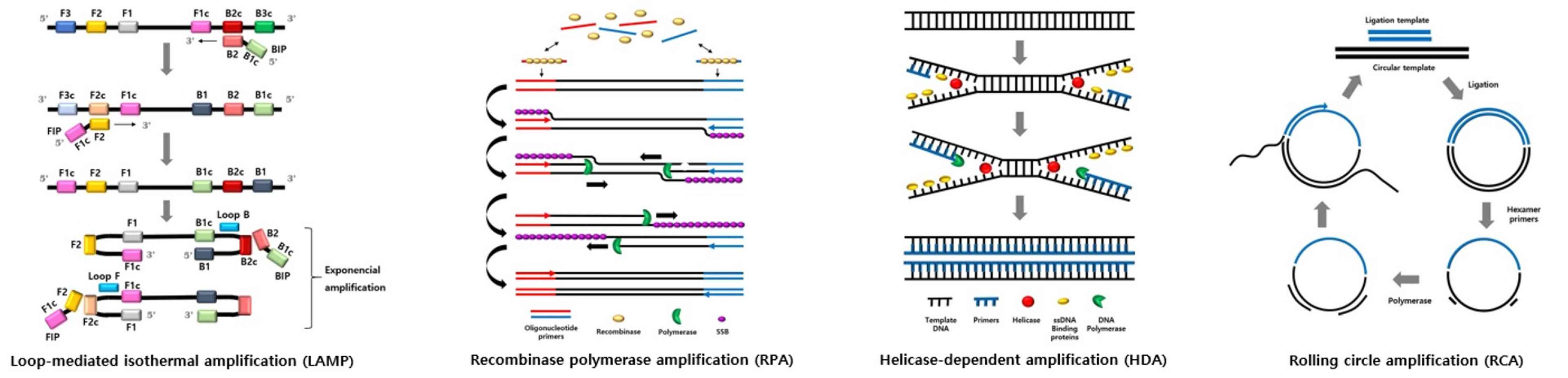 Figure 1. Schematic diagram of isothermal amplification techniques. (Adapted from Moon et al., 2022)
The foundational LAMP architecture uses F3, B3, FIP, and BIP primers. The inner primers contain two target-related regions and participate in creating dumbbell-like and stem-loop intermediates. Once established, these structures provide repeated self-priming sites. Loop primers can create additional initiation points and shorten time to signal.
This architecture can generate large amounts of DNA, which supports fluorescence, turbidity, pH color, metal indicators, or sequence-specific downstream detection. The same high yield increases carryover risk. Six-primer systems also create a large interaction space; a design that appears valid in silico may generate late background or lose inclusivity when target variation affects one of the recognition regions.
LAMP is particularly worth evaluating when:
RPA replaces heat denaturation with recombinase-mediated homology search. Primers are assembled into nucleoprotein complexes that invade duplex target DNA. A single-strand binding protein stabilizes the displaced strand, and a strand-displacing polymerase extends the primer. ATP regeneration, crowding agents, magnesium activation, and protein ratios help govern the reaction.
RPA-type systems can operate near body temperature and frequently generate signal rapidly. This is attractive for portable devices, but the low temperature also permits activity during setup. Primer interactions, uneven magnesium initiation, mixing, and pre-run hold can widen time-to-signal distributions. Published component concentrations should not be copied across enzyme sources because unit definitions, storage buffers, and accessory-protein activities differ.
HDA uses a helicase to perform the strand-separation role supplied by heating in PCR. Primers anneal to the exposed templates, and a polymerase extends them. The concept uses a relatively familiar two-primer design, but the enzyme choreography is demanding: helicase opening, single-strand stabilization, polymerase extension, ATP consumption, and duplex reformation must remain balanced.
Target GC content, secondary structure, product length, and temperature influence that balance. Increasing polymerase cannot compensate for inadequate helicase access, and excess helicase or accessory protein may alter specificity. HDA development therefore benefits from factorial titration of helicase, polymerase, ATP, magnesium, and primer concentration rather than single-variable optimization.
RCA differs most fundamentally from the other three methods because the polymerase repeatedly copies a circular template. Natural circles can be amplified directly, while padlock probes create target-dependent circles through hybridization and ligation. The long tandem-repeat product is well suited to localized detection, branched amplification, fluorescent probes, nanoparticles, and surface-based assays.
Specificity can be placed in the circularization step, including ligation across a variant position. However, unligated linear probes, nonspecific priming, primer-independent synthesis, and residual template can create background. Controls should compare circular and linear templates, include ligase-minus and primer-minus reactions, and verify that the observed product has the expected repeated structure.
| Decision factor | LAMP | RPA | HDA | RCA |
|---|---|---|---|---|
| Primer complexity | High | Moderate | Moderate | Low to high depending on circularization design |
| Typical product form | Concatemeric stem-loop mixture | Defined amplicon | Defined amplicon | Long tandem repeat |
| Temperature profile | Usually moderate-temperature incubation | Usually low-temperature incubation | Enzyme-dependent moderate range | Polymerase- and ligation-dependent |
| Primary background concern | Primer-driven amplification and carryover | Primer/probe activity during setup and nonspecific invasion/extension | Incomplete specificity during duplex opening and extension | Linear-probe or nonspecific-priming background |
| Distinctive opportunity | High-yield visual assays | Rapid, low-heater POCT | Two-primer enzymatic denaturation | Localized or variant-selective circular-probe detection |
The table supports early screening, not universal ranking. Reaction times and detection limits cannot be compared fairly when target sequences, input units, matrices, readouts, replicate numbers, and positivity rules differ. A focused head-to-head feasibility study should use matched target material, sample context, output requirement, and maximum valid run time.
RNA detection requires reverse transcription unless the amplification mechanism is intrinsically RNA-centered. RT-LAMP and RT-RPA add a dedicated reverse transcriptase or rely partly on polymerase-associated RT activity. HDA can also be coupled to RT, while padlock-assisted RCA may detect RNA after reverse transcription or through target-dependent probe circularization.
RNA structure, degradation, RNase contamination, and the compatibility of reverse transcription with the amplification buffer can dominate performance. Matched RNA and DNA templates help determine whether weak response originates in reverse transcription or downstream amplification. A DNA positive control alone cannot validate an RNA workflow.
All four methods can feed downstream sequence-specific detection, but the product geometry matters. A Cas12 guide requires an accessible DNA activator sequence and, for many double-stranded targets, a compatible PAM context. Cas13 detection may require an RNA product, which can be generated through transcription from an amplified DNA template. The amplification primers may need promoter or handle sequences, and these additions can alter background.
Two-step coupling gives each module its preferred conditions. One-pot coupling reduces handling but creates shared-buffer and timing constraints. The One-Pot Isothermal Amplification and CRISPR Detection Guide addresses these architectures in detail.
A defensible decision can be built through the following sequence:
Bulk isothermal reactions can show a relationship between target amount and time to signal, but amplification kinetics are influenced by stochastic initiation, primer interactions, matrix, and temperature. Quantitative claims require a defined calibration model and evidence that these influences remain controlled. Partitioned or digital formats can estimate concentration through positive-fraction statistics, but partition volume, occupancy, classification, and false-positive partitions become new measurement variables.
Multiplexing also affects each platform differently. LAMP primer count grows rapidly and can create cross-interactions. RPA and HDA require discrimination among products through probes, spatial separation, or downstream detection. RCA can localize different circular probes or barcodes, but ligation and priming background must be controlled for every channel. A platform that is best for one target is not automatically best for a panel.
A platform decision should be repeated with representative enzyme and oligonucleotide lots, the intended sample-preparation method, and the target device. The transfer package should define sequence versions, enzyme identity, functional concentrations, buffer composition, preparation order, activation, temperature profile, acquisition, controls, and invalid-run rules. This prevents a nominally identical method from changing when a receiving team substitutes activity units or stock solutions.
