
RT-LAMP is not simply LAMP with reverse transcriptase added. It is a coupled enzyme system in which RNA preservation, reverse transcription, strand-displacing DNA synthesis, a multi-primer network, and the detection chemistry must function in one temperature and buffer environment. Weakness in any stage can appear as slow amplification, missed low-level targets, variable time to positive, or late background.
This guide separates the functional modules so developers can identify the true limiting step. It applies to real-time fluorescence, visual color, turbidity, lateral-flow, and CRISPR-coupled RT-LAMP concepts, while recognizing that each readout creates different formulation and result-interpretation requirements.
The core LAMP primer set contains F3, B3, FIP, and BIP. FIP and BIP each combine two target-related regions. Initial extension and displacement create stem-loop templates, after which repeated priming and strand displacement produce a complex mixture of concatemeric products. Loop F and Loop B primers may accelerate the established reaction by adding extension sites.
For RNA targets, reverse transcription must create a cDNA intermediate accessible to the LAMP network. A dedicated reverse transcriptase may provide stronger structured-RNA performance, while some strand-displacing polymerases exhibit useful RT activity under defined conditions. The choice should be made by matched RNA and DNA experiments rather than by minimizing enzyme count.
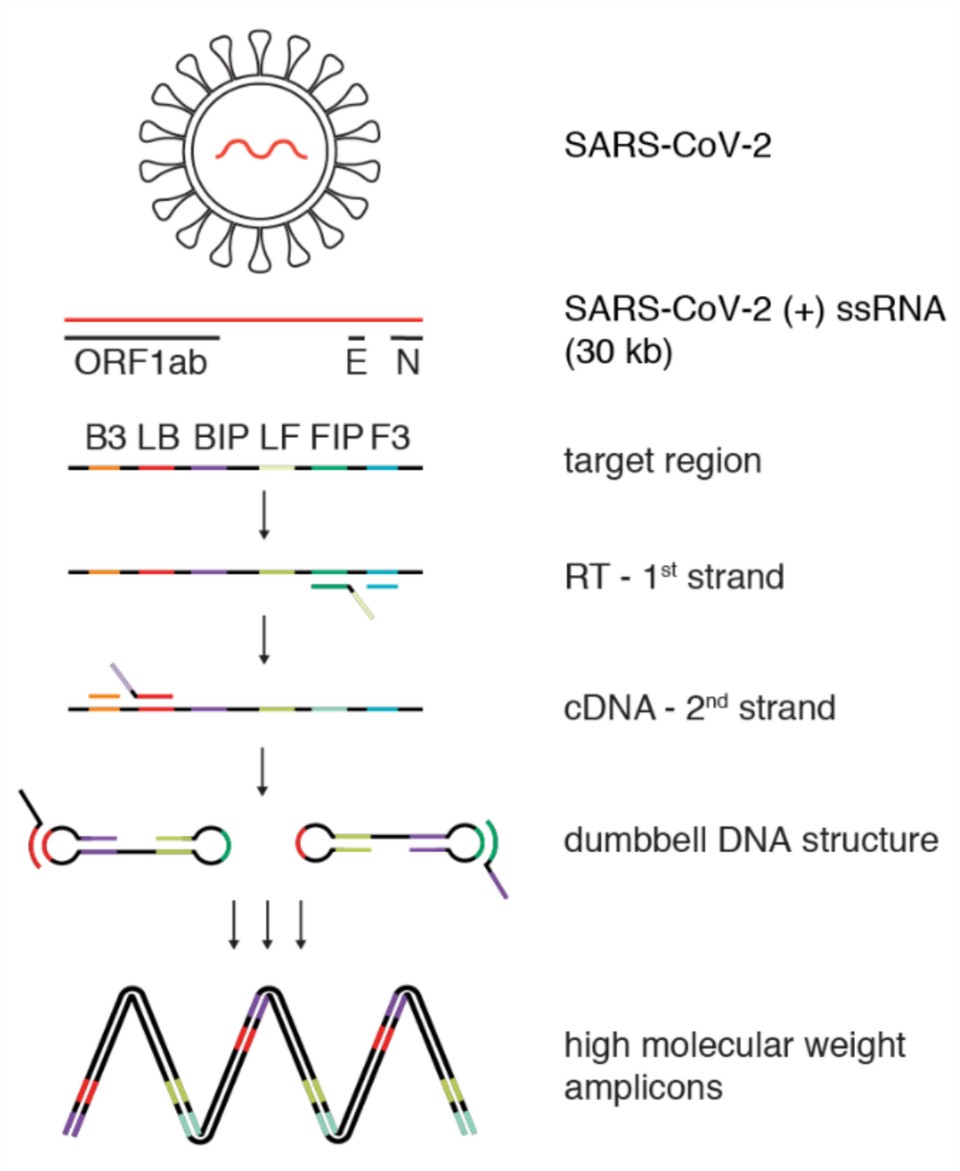 Figure 1. Schematics of RT-LAMP amplification, exemplified for SARS-CoV-2 detection.
| Module | Required function | Failure indicators | Discriminating controls |
|---|---|---|---|
| Reverse transcription | Copy structured RNA into amplification-competent cDNA | RNA weak while matched DNA amplifies normally | Matched RNA/DNA templates, RT-minus reaction, RT candidate comparison |
| Strand-displacing polymerization | Build stem-loop intermediates and amplify through structured products | Both RNA and DNA slow; high target required; incomplete product pattern | Polymerase titration, temperature profile, clean DNA template |
| Primer network | Recognize target regions and create the intended self-priming topology | Late NTCs, poor inclusivity, non-target amplification, wide kinetics | Primer-subset reactions, multiple families, near-neighbor panel, product identity |
| Detection | Translate product formation into a valid measurable signal | Amplification confirmed but endpoint ambiguous or matrix dependent | Parallel fluorescence and endpoint readout, reporter-only and matrix blanks |
A dedicated RT should retain sufficient activity at the LAMP incubation temperature, tolerate the shared magnesium and salt conditions, and copy the intended RNA structure efficiently. Thermostable RT activity can improve access to structured regions, but higher temperature must remain compatible with the LAMP polymerase, primers, and detection chemistry.
Polymerase-associated RT activity can simplify formulation, yet performance may depend strongly on target structure and RNA input. One-enzyme systems should be evaluated across several RNA targets and matrices before being generalized. Total RNA, synthetic transcripts, armored controls, and extracted clinical material can behave differently because of structure, carrier nucleic acid, integrity, and inhibitors.
The polymerase needs more than high activity in a supplier assay. It must initiate from the selected primers, displace downstream DNA, copy repetitive stem-loop intermediates, tolerate the selected dye or indicator, and preserve target-to-NTC separation through the maximum read time. Enzyme concentration should be selected from response curves rather than a single fast condition.
Relevant attributes include:
RT-LAMP primer design begins with sequence diversity. Reference sequences, circulating variants, subtype coverage, near neighbors, homologous host regions, and secondary structure should be reviewed before choosing target regions. Multiple independent primer families should be advanced because the full interaction network cannot be ranked reliably by a single in silico score.
Core primers should be screened before loop primers are added. Loop primers are useful only if they advance target detection more than they advance background. Primer ratios can influence initiation, product topology, and no-template amplification. A valid design is therefore a tested network, not a list of individually acceptable oligonucleotides.
Magnesium supports polymerization but also affects primer annealing, dNTP chemistry, pyrophosphate formation, indicators, and some nucleases. dNTP concentration influences product capacity and proton generation. Betaine and other osmolytes can alter secondary structure and enzyme behavior. Monovalent salts, reducing agents, detergents, carrier proteins, and stabilizers affect both enzyme modules.
A focused design-of-experiments approach is more informative than adjusting one variable indefinitely. Early screens can identify high-impact interactions among magnesium, dNTPs, polymerase, RT, primer ratio, and temperature. The selected condition should occupy a usable operating region rather than a narrow optimum.
| Readout | What it detects | Main formulation issue | Interpretation caution |
|---|---|---|---|
| Intercalating fluorescence | Accumulated double-stranded nucleic acid | Dye inhibition and optical background | Signal is not inherently sequence-specific |
| pH color | Net proton generation during nucleotide incorporation | Low buffer capacity, starting pH, sample pH, gas exposure | Color may reflect matrix chemistry rather than target alone |
| Turbidity or metal indicator | Pyrophosphate-associated ion changes | Magnesium balance and optical clarity | Endpoint timing and precipitate behavior can vary |
| Sequence-specific probe or CRISPR | Designed amplicon sequence | Probe accessibility, guide/PAM design, reporter and enzyme compatibility | Upstream nonspecific product and reporter background still require controls |
RT-LAMP can continue generating signal after the intended call time. The maximum valid incubation must therefore be predefined. Target concentration series, low-copy replicates, no-template controls, non-targets, matrix blanks, and process controls should be evaluated together. A condition is improved only when it increases useful separation rather than merely accelerating every trace.
Time to positive is influenced by target copies, sampling, reverse-transcription efficiency, primer initiation, temperature, threshold algorithm, and matrix. It should not be treated as an absolute viral-load or transcript-count result without a validated quantitative model.
A robust control set distinguishes RNA loss from amplification failure:
Amplicon carryover, reagent nucleic-acid contamination, and de novo primer-driven amplification require different responses. Closed-tube detection, unidirectional workflow, dedicated equipment, and compatible dUTP/UDG strategies can reduce carryover. They do not correct a primer network that produces a new nonspecific product in every reaction.
Product-identity checks, primer-subset experiments, fresh reagent replacement, spatial blank patterns, and module-minus controls help locate the source. The separate Contamination Control in LAMP, RPA and CRISPR Assays guide provides a structured investigation.
Crude matrices should be introduced with matched target spikes before and after preparation. A low signal may reflect target degradation or poor release rather than polymerase inhibition. pH-color RT-LAMP is especially sensitive to sample buffering and transport media.
For dry formulations, assess activity after freezing, primary and secondary drying, rehydration, and storage. Primer distribution, RT/polymerase balance, UDG activity, indicator state, residual moisture, container closure, and desiccant are all relevant. The Lyophilized RT-LAMP Formulation Literature Review summarizes published evidence and its limitations.
RT-LAMP performance can shift even when incoming enzymes meet their individual certificates. Activity methods may use different templates, temperatures, and buffers from the finished reaction. Primer purity, synthesis scale, salt form, and reconstitution can also affect the multi-primer network. Incoming controls should therefore connect raw-material tests with a representative functional assay.
| Material | Useful incoming attributes | Finished-assay bridge |
|---|---|---|
| Strand-displacing polymerase | Identity, concentration, defined activity, nuclease background, storage buffer | Target/NTC kinetics across low and high input |
| Reverse transcriptase | RT activity, RNase contamination, thermal profile, formulation | Matched RNA and DNA recovery |
| Primers | Identity, purity, concentration, mass or chromatographic profile | Primer-network kinetics and background |
| Indicator or reporter | Identity, optical properties, purity, storage | Blank, signal window, and endpoint interpretation |
Lot bridging should include independent preparations and the intended matrix where possible. A mean endpoint alone can miss slower reactions or a narrowing interval between weak positives and late negatives.
