
PCR, quantitative PCR, and next-generation sequencing are often described as instrument platforms, but their analytical performance begins with enzymes. Polymerases copy target sequences, reverse transcriptases convert RNA, ligases connect adapters, and end-repair enzymes prepare fragmented DNA for sequencing. Their activity, fidelity, specificity, and tolerance to clinical matrices influence sensitivity, bias, errors, and invalid results.
This article follows enzyme function through PCR, qPCR, and NGS workflows, compares their critical attributes, and explains how developers connect biochemical specifications to CDx performance. The focus is the complete reagent system: an excellent enzyme can still underperform when primers, buffers, specimen preparation, controls, or software are mismatched.
End-point PCR answers whether an amplified product is present after cycling. qPCR monitors fluorescence during amplification and can support qualitative or quantitative interpretation. NGS converts many nucleic-acid fragments into libraries, sequences them in parallel, and uses software to identify variants or signatures. The platforms share core enzymology but place different demands on it.
A targeted PCR assay may prioritize rapid, specific amplification of a small number of loci. qPCR also needs stable amplification efficiency and optical compatibility across the reportable range. NGS needs balanced library conversion, low sequence-dependent bias, sufficient complexity, and an error profile compatible with variant calling. Enzyme selection must therefore follow the assay claim rather than a generic label such as “high performance.”
| Stage | PCR/qPCR enzymes | NGS enzymes | Primary risk |
|---|---|---|---|
| Sample preparation | Proteases, nucleases, lytic enzymes | Proteases, nucleases, fragmentation enzymes | Loss, degradation, inhibitor carryover |
| RNA conversion | Reverse transcriptase, RNase inhibitor | Reverse transcriptase for RNA-seq or fusion panels | Transcript dropout and representation bias |
| Target amplification | Thermostable DNA polymerase | Polymerase for enrichment or cluster/template amplification | Off-target product, imbalance, introduced error |
| End preparation | Usually not required | Polymerase/exonuclease end repair and kinase reactions | Input loss and fragment bias |
| Adapter joining | Usually not required | DNA or RNA ligase | Adapter dimers, inefficient ligation |
| Contamination control | Uracil-DNA glycosylase in compatible systems | Workflow separation and controls; chemistry dependent | Carryover false positives |
| Signal generation | Probe cleavage or intercalating dye readout | Sequencing chemistry dependent | Low signal, cross-talk, base-call error |
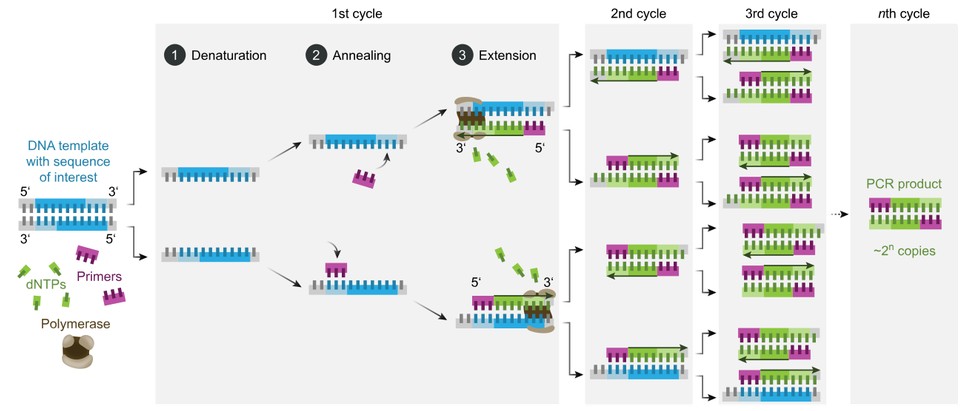
Hot-start polymerases suppress extension during setup and early heating, reducing primer-dimers and nonspecific products. This is valuable in multiplex CDx assays where many primers compete. Other relevant attributes include extension rate, processivity, GC tolerance, fidelity, probe compatibility, and resistance to extraction carryover.
Enzyme concentration should be optimized with magnesium, primers, probes, dNTPs, and cycle conditions. Increasing polymerase can recover weak signal but can also raise background or alter multiplex balance. Taq HS DNA Polymerase is a representative starting material; suitability must be verified in the final assay.
Fusion transcripts, splice variants, and expression signatures require RNA preservation and cDNA synthesis. Reverse transcriptase performance depends on RNA integrity, secondary structure, priming strategy, reaction temperature, transcript abundance, and inhibitors. High total cDNA yield does not prove unbiased representation of every target.
One-step RT-qPCR reduces transfers and contamination opportunities; two-step workflows allow flexible cDNA use but add handling. NGS RNA panels may require template switching, second-strand synthesis, or targeted enrichment. Representative degraded clinical RNA should be used to characterize dropout and 5′/3′ bias. AdvSTART Reverse Transcriptase and one-step RT-qPCR master-mix development are relevant starting points, but controls must distinguish extraction failure from reverse-transcription and amplification failure.
Convert heterogeneous DNA ends into ligation-compatible molecules. Incomplete reactions can reduce complexity or favor particular fragments.
Adds platform sequences and indexes. Efficiency, adapter dimers, input concentration, and ligase bias affect usable reads.
Raises library mass but can create duplicates, GC bias, allele imbalance, and polymerase errors if overcycled.
Low-input and cell-free DNA workflows have little material to lose, so stepwise yield and fragment-size behavior are important. Unique molecular identifiers can help distinguish original molecules from amplification copies, but they do not repair molecules lost before tagging. NGS library-preparation enzyme-system development and T4 DNA Ligase (Rapid) support evaluation of these steps.
Polymerase errors matter differently across platforms. A high-frequency target in qPCR is generally separated from background by target-specific probes and thresholds. Rare-variant NGS may interpret a small number of alternate reads, making the combined error from damage, end repair, amplification, sequencing, and software critical. Fidelity is therefore necessary but not sufficient.
Analytical sensitivity should be established with representative variants, sequence contexts, input amounts, specimen quality, and allele fractions. Coverage depth alone does not guarantee sensitivity if library complexity is low or amplification is biased. Negative samples and near-neighbor variants assess specificity. For PCR, inclusivity across intended variants and exclusivity against homologous sequences are equally important. For both platforms, limit-of-detection claims should incorporate the full sample-to-answer workflow and prespecified valid-run criteria.
Controls should reveal where a failure occurred. An extraction control challenges specimen processing; an amplification control tests the reaction; positive and negative controls monitor expected signal and contamination; NGS quality metrics assess library and sequencing adequacy. Controls that are too easy to amplify may remain positive when clinical targets fail.
Closed-tube qPCR reduces amplicon release. Compatible dUTP/uracil-DNA glycosylase systems can limit carryover from prior reactions, but workflow design and physical separation remain important. NGS requires index-quality control, sample identity safeguards, contamination estimates, and software monitoring. Any change to an enzyme, buffer, primer pool, library kit, sequencer, or algorithm should be assessed for effects on the complete measurement process.
The CDx enzyme portfolio and assay failure investigation can support selection or troubleshooting when the limiting step is uncertain.
Whatever platform or specimen is selected, development should begin with a written link between intended use and analytical requirements. Define the patient population, biomarker, specimen, treatment decision, reportable result, turnaround expectation, and use environment. Then identify the failure modes that could change classification: target loss, nonspecific signal, amplification bias, reagent drift, interference, software error, or an invalid result that delays therapy. This risk map determines which enzyme attributes and assay controls deserve the most attention.
Feasibility experiments should include representative clinical material as early as possible. Purified templates and synthetic controls are valuable for isolating variables, but they do not reproduce fixation damage, low tumor fraction, endogenous inhibitors, sample heterogeneity, or extraction carryover. A staged study can begin with controlled materials, add individual challenges, and then confirm performance in specimens spanning the intended range. Samples near the cutoff are especially informative because small shifts in recovery, background, or signal can change the treatment category.
Critical enzymes should be specified by more than catalog activity. Identity, purity, concentration, specific activity, contaminating nuclease or protease limits, formulation, storage, and functional performance may all be relevant. The release method should use conditions that predict performance in the diagnostic reaction. When the vendor activity assay and CDx chemistry differ substantially, an assay-level incoming or bridging test can provide a more direct control. Multiple lots should be evaluated before pivotal use so the acceptance range reflects manufacturing variation rather than one favored batch.
Robustness studies intentionally vary parameters that will move in practice: reaction time and temperature, pipetting, sample input, operator, instrument, reagent lot, shipping excursion, and storage duration. Interference studies should use justified concentrations and combinations of endogenous substances, collection additives, medications, and process residuals. Controls must fail when the vulnerable step fails; an abundant control target may remain positive even when a low-copy clinical target is lost.
Finally, document changes across the full measurement system. A new enzyme lot, buffer, primer pool, conjugation process, extraction kit, instrument, or software version can alter analytical performance even if the intended use is unchanged. Risk-based comparability should focus on the attributes most likely to affect the cutoff and claimed range. Preserving retained samples, reference materials, version history, and a predefined bridging strategy makes lifecycle improvements possible without breaking the connection to the clinical evidence.
These questions keep development centered on the treatment decision rather than isolated technical metrics. They also create a common language for biomarker, clinical, regulatory, quality, manufacturing, and supplier teams.
PCR, qPCR, and NGS depend on coordinated enzyme systems rather than isolated catalysts. PCR emphasizes targeted specificity, qPCR adds kinetic and optical consistency, and NGS adds multi-step library yield, bias, and error control. Connecting enzyme attributes to the intended specimen, cutoff, controls, and interpretation algorithm is the most reliable route to a robust molecular CDx.
Creative Enzymes supports diagnostic enzyme selection, engineering, formulation, conjugation, analytical evaluation, and scale-up for molecular and immunoassay CDx workflows.
