
Excipient Selection for Diagnostic Enzyme Stabilization provides a mechanism-led approach to choosing buffers, sugars, polyols, salts, polymers, surfactants, antioxidants, chelators, preservatives, and carrier proteins for liquid or dried diagnostic enzyme systems. It is written for enzyme formulators, clinical chemistry reagent developers, molecular diagnostic teams, and raw-material qualification groups. The central concern is how excipient function changes with physical state, enzyme mechanism, detection chemistry, matrix, manufacturing process, and intended storage.
For this topic, stability must be evaluated across begin with the failure mechanism, use sugars and polyols with a defined purpose, and design the screen for decisions. Enzyme-centered measurements explain only part of the system: cofactors, substrates, reporters, contact materials, packaging, specimens, timing, and user operations may follow different failure routes. A formulation with excellent fresh activity can therefore have a poor practical margin.
This resource is a development framework for enzyme formulators, clinical chemistry reagent developers, molecular diagnostic teams, and raw-material qualification groups; it is not a universal formula or an automatic storage claim. Study conditions, methods, limits, and conclusions must correspond to how excipient function changes with physical state, enzyme mechanism, detection chemistry, matrix, manufacturing process, and intended storage, using the intended reagent configuration and an explicitly defined assay and use environment.
Readers applying this guide may also use the following Creative Enzymes product and service categories as starting points for raw-material selection, formulation development, and verification:
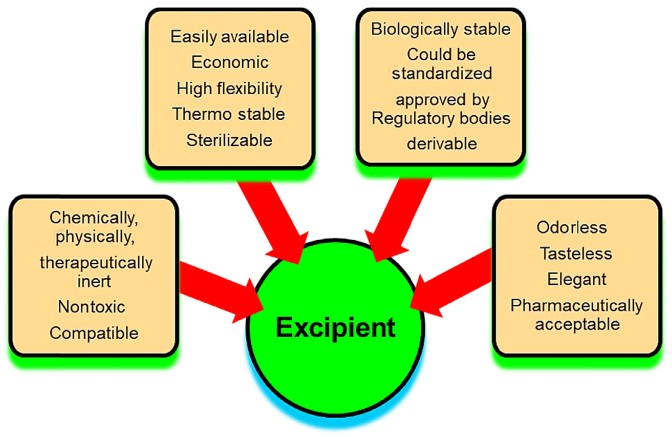 Figure 1. Ideal properties of excipients for a suitable dosage form. (Kar et al., 2019)
The governing consideration is that Excipient selection should respond to a plausible degradation route: unfolding, aggregation, adsorption, oxidation, deamidation, cofactor loss, microbial growth, precipitation, or dry-state mobility. The practical hazard is that A long list of ingredients is not automatically protective, and every added component creates concentration, purity, sourcing, analytical, and interference questions. The most useful confirmation is to Use forced-degradation and orthogonal readouts to distinguish what is failing before launching a broad screen.
For excipient work, begin with a small number of mechanistically distinct ingredients and include untreated and appropriate stress controls. Rank candidates with a weighted score for fresh function, stressed function, blank, physical quality, process feasibility, and downstream compatibility. An ingredient should advance because it resolves a defined risk.
A robust approach recognizes that The buffer sets pH but also contributes ionic strength, metal binding, temperature response, freeze concentration, and compatibility with substrates and indicators. Development can fail when Phosphate may crystallize during freezing; amine-containing buffers may participate in unwanted reactions; and strong buffering can suppress pH-based signal systems. To reduce that uncertainty, Screen pH across the enzyme stability window and then retest in the full assay, where sample and stock solutions change the final composition.
For excipient work, begin with a small number of mechanistically distinct ingredients and include untreated and appropriate stress controls. Rank candidates with a weighted score for fresh function, stressed function, blank, physical quality, process feasibility, and downstream compatibility. An ingredient should advance because it resolves a defined risk.
The process question is whether Trehalose and sucrose are common dry-state protectants, while glycerol and other polyols can stabilize liquid enzymes and suppress freezing damage. One concern is that High levels can increase viscosity, alter water activity, slow reconstitution, shift reaction rates, or interfere with membranes and fluidics. The decision should be supported by this action: Compare molar concentration, solid content, glass formation, crystallization tendency, and final assay exposure rather than ranking ingredients by reputation.
For excipient work, begin with a small number of mechanistically distinct ingredients and include untreated and appropriate stress controls. Rank candidates with a weighted score for fresh function, stressed function, blank, physical quality, process feasibility, and downstream compatibility. An ingredient should advance because it resolves a defined risk.
The final design must account for the fact that Enzymes can be lost at glass, plastic, air-liquid, ice-liquid, filtration, tubing, and membrane interfaces, particularly at low concentration. The claim becomes vulnerable if Nonionic surfactants, carrier macromolecules, and surface treatments may help, but they can create foam, extractables concerns, background, or lot variability. The appropriate evidence is to Use container-contact studies and mass-balance or recovery measurements to determine whether apparent instability is actually adsorption.
For excipient work, begin with a small number of mechanistically distinct ingredients and include untreated and appropriate stress controls. Rank candidates with a weighted score for fresh function, stressed function, blank, physical quality, process feasibility, and downstream compatibility. An ingredient should advance because it resolves a defined risk.
The technical starting point is straightforward: Oxidation-sensitive residues, flavins, NAD(P)-dependent systems, chromogens, and metal-dependent enzymes require different controls. The principal development risk is that Antioxidants can consume peroxide reporters; chelators can remove catalytic metal; and reducing agents can destabilize disulfide-rich proteins or react with labels. Evidence should therefore be collected deliberately: Challenge individual components and the complete signal chain so protection of the enzyme does not disable detection.
For excipient work, begin with a small number of mechanistically distinct ingredients and include untreated and appropriate stress controls. Rank candidates with a weighted score for fresh function, stressed function, blank, physical quality, process feasibility, and downstream compatibility. An ingredient should advance because it resolves a defined risk.
At this stage, Factorial or response-surface studies can reveal interactions that one-variable-at-a-time screens miss, but the design must include realistic concentration limits and manufacturable combinations. A misleading result can arise because Short thermal challenges are useful for down-selection, yet they may favor a formulation that fails under light, agitation, freezing, or long-term storage. A defensible experiment should address the issue directly: Advance candidates using a weighted endpoint set and confirm them under real-time and intended-use conditions.
For excipient work, begin with a small number of mechanistically distinct ingredients and include untreated and appropriate stress controls. Rank candidates with a weighted score for fresh function, stressed function, blank, physical quality, process feasibility, and downstream compatibility. An ingredient should advance because it resolves a defined risk.
| Variable | Question to answer | Development implication |
|---|---|---|
| pH range | Where are activity and structural stability both acceptable? | Define a compromise region rather than maximizing fresh activity. |
| Ionic strength | Does salt suppress aggregation or promote precipitation? | Study concentration and anion/cation identity separately. |
| Disaccharides | Do they preserve dry-state structure? | Confirm amorphous state and assay compatibility. |
| Polyols | Is liquid-state protection worth viscosity and downstream effects? | Measure pipetting, mixing, and cartridge flow. |
| Amino acids | Do they buffer, suppress aggregation, or crystallize? | Check pH, solids, and solid-state behavior. |
| Polymers | Do they provide bulk or crowding? | Test dissolution and reaction kinetics. |
| Surfactants | Is loss occurring at an interface? | Use the minimum effective level and monitor degradation products. |
| Carrier proteins | Do they reduce adsorption? | Assess purity, background, bioburden, and supply variability. |
| Chelators | Are trace metals harmful or required? | Balance oxidation control against metalloenzyme activity. |
| Preservatives | Is a multidose liquid format intended? | Verify enzyme, signal, specimen, and regulatory compatibility. |
| Cofactors | Are they more labile than the enzyme? | Track cofactor integrity and activity recovery separately. |
| Raw-material grade | Can impurity profiles affect the assay? | Set functional specifications and change notification. |
The matrix should be converted into a protocol with named methods, sample numbers, lots, controls, timepoints, and acceptance rules. Not every variable needs an independent full-factor study, but an omitted variable should be omitted because the risk is understood—not because it is difficult to measure.
An excipient should be described by the result demonstrated in the tested system, not by a universal label such as stabilizing. State its concentration, physical state, challenge, enzyme, matrix, and detection chemistry. A candidate that preserves purified activity but increases blank, viscosity, membrane retention, or lot sensitivity has not produced a net improvement.
Look for trade-offs among activity retention, physical state, blank, viscosity, dispensing, and final reaction rate rather than ranking one endpoint. Trend direction can be informative before a specification is crossed, but method noise, sampling, and environmental records must be considered before assigning cause.
