

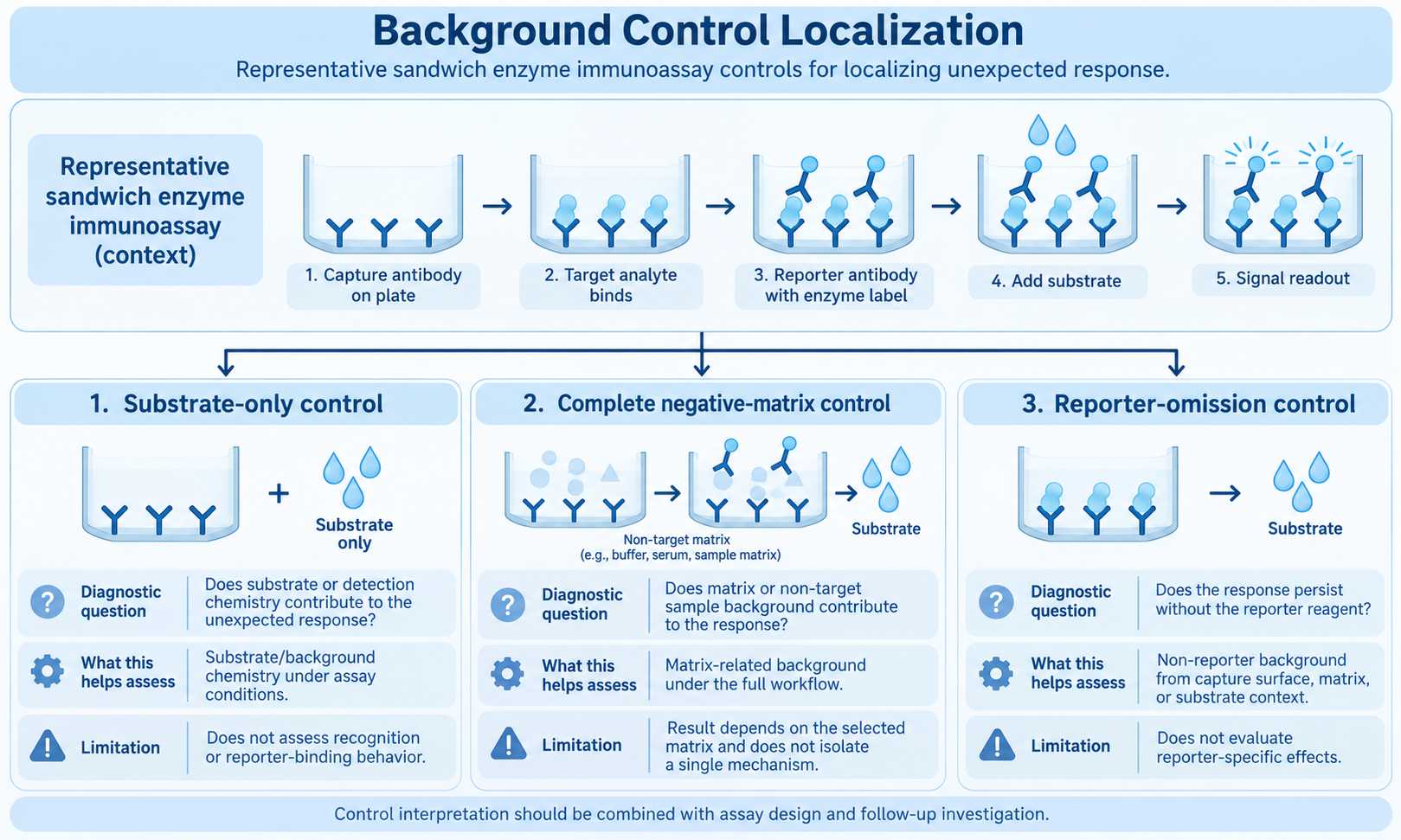
High background is an unexpected response in a control or sample that should produce a lower response under the defined assay conditions. Start by identifying which control is elevated. A substrate blank, a complete negative-matrix reaction and a reaction without the detection conjugate test different possible sources.
The objective is to remove unwanted signal while preserving target-dependent performance. Simply lowering every reading, subtracting a larger blank or increasing washing can make a run look cleaner without resolving the underlying problem.
Establish what should be low in this assay
Interpret the raw response in the context of the assay format. A zero-analyte reaction is usually expected to be low in a sandwich immunoassay, but it can give a high response in a competitive assay. The latter is not automatically background. Compare the observation with the expected reference response for that method.
Separate a high mean negative response from unusually variable negatives. A consistent offset and a few extreme wells can require different investigations. Review individual readings, replicate spread and the plate map before relying on a blank-subtracted result or a single signal-to-background ratio.
Confirm that the negative material is suitable. Buffer alone may not represent the matrix used for samples. Conversely, a nominally negative biological material may contain target or an interfering component. Document the basis for calling it negative and avoid treating its label as proof of the underlying chemistry.
Define the comparison before changing the procedure: the historical reference condition, the suspect condition, and the controls that will distinguish them. The control framework below is a practical investigation strategy; the required controls and acceptance limits remain specific to the assay.
Choose controls that isolate a useful question
| Control or comparison | What an elevated response suggests checking | What it does not establish |
|---|---|---|
| Substrate and reaction buffer without added enzyme label | Substrate handling, contamination, spontaneous response and reader baseline. | It does not identify a specific contaminant or explain antibody-dependent effects. |
| Complete assay with suitable negative matrix | Retained reporter, matrix interactions and the combined assay procedure. | It does not distinguish surface binding from sample-specific interference by itself. |
| Matched negative reaction without detection conjugate | Sample color or turbidity, endogenous activity, other reporting components and detection artifacts. | Omitting a reagent changes the reaction; this is a localization control, not an exact background subtraction. |
| Buffer negative compared with several suitable matrix negatives | Matrix-associated effects when buffer controls remain acceptable. | A matrix difference alone does not prove heterophilic antibodies or cross-reactivity. |
| Suspect material compared with an established reference preparation | A component-associated change under otherwise matched conditions. | A successful replacement does not reveal the molecular mechanism. |
Keep volumes, timing and reading conditions comparable wherever the diagnostic question allows. Replace an omitted reagent with a compatible vehicle when appropriate, and record the limitation if its removal changes the composition materially. Do not calculate independent contributions by subtracting these controls as though the assay were a simple sum of unrelated signals.
Begin with the control closest to the observed problem. If the substrate blank is already elevated, an extensive blocker screen is unlikely to be the first informative experiment. If that blank is acceptable but the complete negative reaction is high, investigate what the assay retains or introduces before substrate addition.
Investigate unwanted retention of the enzyme label
When the evidence points to retained reporter, compare the plate or solid phase, blocking condition, conjugate amount and wash procedure against the documented reference. The Assay Guidance Manual identifies these as relevant variables in immunoassay development. Select a small, interpretable set of comparisons rather than changing them all simultaneously.
Blocking is an interaction among the surface, blocker and assay reagents. Vogt and colleagues demonstrated different blocking behavior among proteins in a peroxidase-conjugate system, including differences between pretreatment and simultaneous incubation. That evidence supports testing blockers in their intended use; it does not establish one protein as the best choice for every assay.
Compare candidate blocking conditions with both negative and low-positive materials. A blocker that reduces an unwanted interaction may also alter access to a recognition site or change reagent behavior. Retain the current condition as a comparator and assess the complete assay before accepting a lower blank as an improvement.
If conjugate concentration changed, compare a defined range around the established condition. Record negative response and useful target response together. A lower conjugate amount that suppresses both may fail the assay's sensitivity or precision requirements even when the background appears attractive.
Review wash delivery and aspiration as well as the written number of cycles. Check that the intended solution reaches each position and is removed consistently. Compare the functioning reference procedure with the suspect one. Extra washing should be evaluated as a controlled change, since the required separation depends on the binding system and assay format.
Treat sample-specific elevations as a separate investigation
When routine negatives and reference materials remain acceptable but selected matrix samples show an unexpected response, avoid immediately reformulating the whole assay. Preserve the affected material where feasible and compare its behavior with suitable unaffected materials under the same procedure.
Potential explanations include recognition of a related substance, endogenous antibody interactions, sample-associated catalytic activity and optical contributions. These mechanisms require different follow-up comparisons. CLSI's public interference explanation distinguishes effects on reaction chemistry from effects on detection; a high final reading does not identify which occurred.
Boscato and Stuart showed that heterophilic antibodies can interact with reagent antibodies and distort two-site immunoassays. This supports investigating antibody-mediated interference when the pattern warrants it. It does not justify assigning that mechanism to every unusual sample or applying the study's frequency to another assay.
Use an appropriate combination of comparisons, such as alternative reagent architecture, compatible blocking treatment or a method suitable for checking the suspected cross-reactant. Include recovery controls for any treatment. Dilution or a response to blocking can support an investigation but should not be treated as definitive identification on its own.
CLSI's endogenous-antibody interference guidance treats identification, characterization and mitigation as distinct tasks. Document which of those tasks the available evidence actually supports. If a correction works only for selected materials, define that limitation rather than claiming that all matrix interference has been eliminated.
Use position and timing to separate shared faults from local ones
Place the raw negative responses on the actual run layout. Compare them with dispensing order, incubation order, wash channels and proximity to high-response wells. A positional association provides a testable lead; it should be reproduced with a deliberate layout or handling comparison before it is called a cause.
For example, move reference negatives to different positions while preserving the relevant processing order, or change that order while retaining their positions. These comparisons can help distinguish a location-associated effect from a time-associated effect. Record the intervention clearly enough that another operator can repeat it.
If an abnormal negative follows a high-response specimen or well, investigate liquid carryover and detection effects separately. An appropriate wash or dispensing comparison addresses transfer of material. A reader-specific check addresses whether the measured response depends on neighboring signals or acquisition settings. Do not assume that the same remedy tests both explanations.
For colorimetric assays, review the intended reading conditions and whether the negative material contributes color, turbidity or physical reading artifacts. For enzyme-mediated chemiluminescence, keep substrate addition and acquisition timing consistent. A change in the observation window can alter the measured response without establishing a change in unwanted binding.
Record instrument settings with the raw data. Changing gain, integration time or the reported blank correction can change the displayed background. Assess comparisons under matched settings or explain the normalization explicitly; a smaller displayed number alone is not evidence of cleaner chemistry.
Confirm lower background without losing useful discrimination
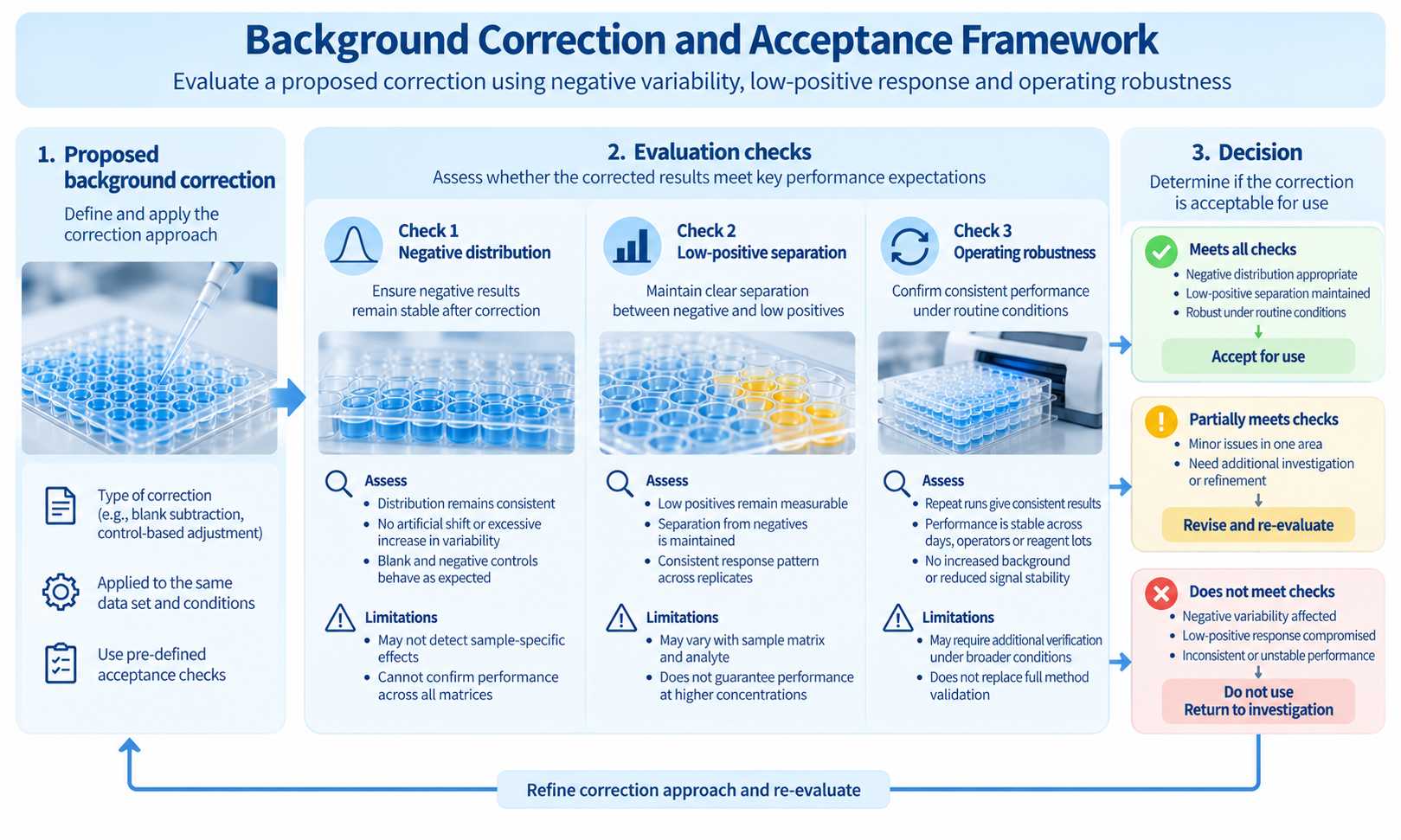
Set acceptance criteria before selecting the preferred correction. Examine the negative distribution, low-positive response, relevant reference range and repeatability together. The required degree of separation depends on the intended assay; there is no single blank value or signal-to-background ratio that establishes suitability across platforms.
Repeat the comparison with independent preparations or runs appropriate to the suspected failure. Include more than the one material that first revealed the problem. If the effect followed a specific matrix, reagent lot or handling condition, include that factor in the confirmation rather than validating only an easier buffer-based example.
Preserve the original and corrected raw results, component identities, procedure changes and unresolved observations. Distinguish a demonstrated correction from a proposed mechanism. It is acceptable to conclude that a controlled process change improves performance while a narrower molecular explanation remains unproven.
A defensible correction reduces the unwanted response or its variability while retaining the performance needed for the assay's intended use. It also defines the operating conditions under which that conclusion was tested, making the result usable for future transfer, monitoring and change control.
For weak target-dependent response, see Loss of Signal in ELISA and CLIA Assays. For broader blocker selection and interference mechanisms, see Blocking and Interference in Enzyme Immunoassays. Return to the Diagnostic Enzyme Troubleshooting Center to route a different failure pattern.
Sources and further reading
- Assay Guidance Manual. Immunoassay Methods. NCBI Bookshelf..
- Vogt RF Jr and colleagues. Quantitative differences among various proteins as blocking agents for ELISA microtiter plates. Journal of Immunological Methods. 1987;101:43-50..
- Boscato LM and Stuart MC. Heterophilic antibodies: a problem for all immunoassays. Clinical Chemistry. 1988;34:27-33..
- Clinical and Laboratory Standards Institute. Clinical Laboratory Testing Interference. June 3, 2019..
- Clinical and Laboratory Standards Institute. Immunoassay Interference by Endogenous Antibodies. I/LA30-A. Official public overview..