

An unexpected positive LAMP result can reflect contaminating target DNA, amplification of an unintended product or a change in the detection chemistry. These explanations require different checks. Begin with the negative-control pattern and establish what the readout actually measures before changing the primer set or enzyme.
Loop-mediated isothermal amplification (LAMP) uses strand-displacing synthesis and several primer-binding regions. Its intended specificity does not make every color change or increase in fluorescence proof of the intended target.
Separate amplification from target identification
Notomi and colleagues established the specialized primer architecture underlying LAMP. In practical assays, however, the signal may report total double-stranded DNA, reaction byproducts or a target-specific sequence interaction. Record which of these the current assay detects. A nonspecific detector can report an unintended amplification product even when the intended target is absent.
Define a false-positive observation relative to a known control or a justified reference classification. An unexpected sample result is not automatically false. For development work, document the basis for calling a material target-negative and distinguish that question from whether its LAMP signal meets the current decision rule.
Keep the raw observations, including initial color, fluorescence history where available, time of interpretation and control results. A photograph taken after an uncontrolled extended incubation cannot substitute for the prescribed endpoint. Record ambiguous responses instead of forcing them into a positive category.
Establish the run-validity rules before interpreting samples. A positive no-template control undermines the relevant run interpretation, but it does not by itself identify contamination as the cause. Primer-driven amplification or detection artifacts may produce the same initial observation.
Use the control pattern to choose the first investigation
| Pattern | Next comparison | Limit of the inference |
|---|---|---|
| No-template controls become positive with several sample groups | Compare fresh reagent aliquots and independently prepared controls in the established clean workflow. | Persistence can reflect contamination or intrinsic nonspecific amplification. |
| Extraction blanks are positive while reagent-only controls remain negative | Trace materials and handling shared by the extraction stage. | An extraction association does not identify the contaminated item. |
| Only selected target-negative matrices produce a color change | Compare initial color and an appropriate independent amplification readout. | Sample chemistry can affect the indicator without establishing DNA synthesis. |
| Negative reactions become positive only during prolonged observation | Compare product identity and the timing distributions of negative and low-positive materials. | Late timing alone does not prove nonspecific amplification. |
| A new primer preparation changes negative-control behavior | Compare reference and new primer preparations with the same remaining components. | A preparation effect may involve identity, concentration, contamination or primer interactions. |
Include controls that enter the workflow at different stages. A no-template control assesses the assembled reaction, while an extraction blank also experiences extraction materials and handling. A suitable negative matrix adds information about sample-dependent effects. None of these replaces the others, and a clean result from one control covers only the conditions it experienced.
Use enough independent negative reactions to investigate the observed pattern. Repeating one tube or rereading the same endpoint does not create an independent preparation. Select the extent of the investigation according to the frequency, consequences and suspected source of the failure.
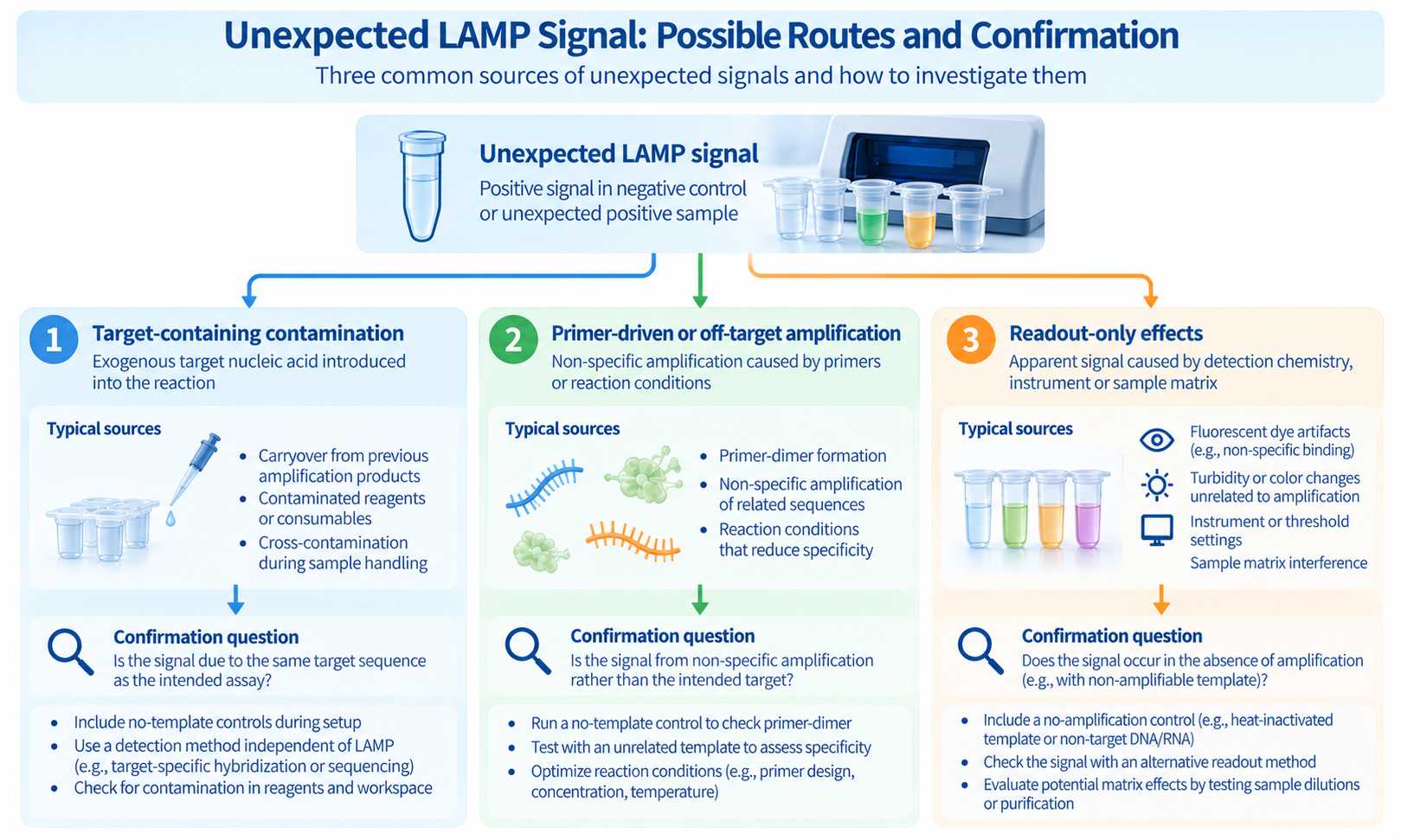
Investigate contamination without assuming every positive blank is carryover
LAMP products from earlier reactions are a possible source of unwanted target amplification. Review where completed reactions are handled, whether tubes are opened, and how materials move between preparation and analysis areas. Preserve separation of pre-amplification and post-amplification activities, and use the established cleaning and material-handling procedures.
A practical comparison uses independently prepared reagent aliquots and controls while tracking which items remain shared. If replacing several items at once clears the problem, the intervention may be useful but the specific source remains unresolved. Record that distinction rather than naming the enzyme or water as the confirmed contaminant.
Hsieh and colleagues demonstrated a compatible UDG-LAMP approach for carryover control. Incorporating dUTP into prior products enables uracil-DNA glycosylase (UDG) to act on that uracil-containing material in a subsequent reaction. The pretreatment and amplification conditions must be compatible with the selected enzyme system.
This strategy does not remove every source of DNA. Native target material or earlier products lacking uracil can escape that mechanism. It also does not prevent new nonspecific products from forming during the current reaction. Treat a dUTP/UDG change as an assay modification requiring confirmation of both contamination control and low-input detection.
When product identity must be examined after amplification, keep that work separated from clean preparation and use suitable containment. Prefer a validated closed-tube confirmation where it answers the question. An investigation should not create a new route for amplicon transfer into subsequent runs.
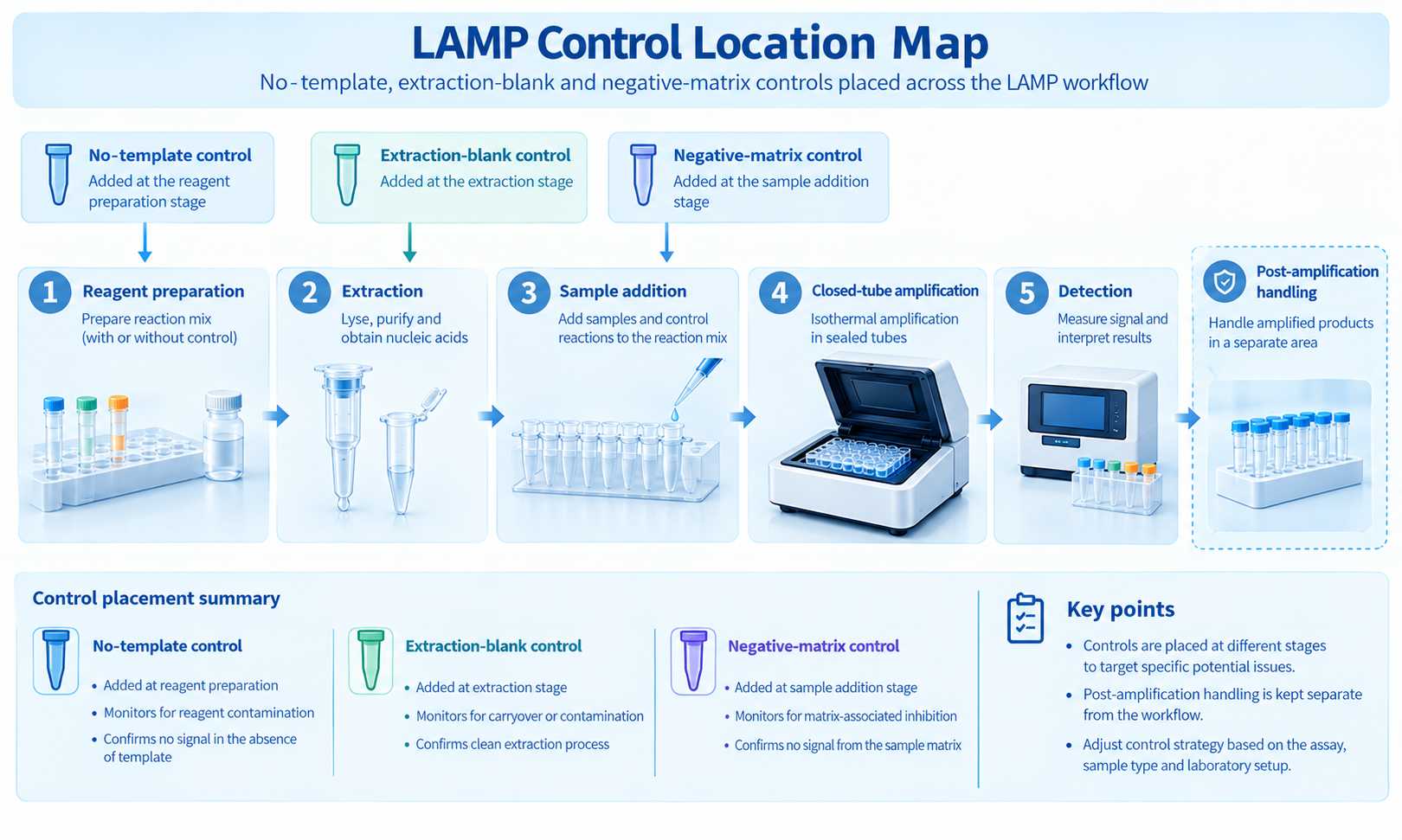
Determine whether the product belongs to the intended target
If the clean-workflow comparison does not explain the observation, investigate primer-dependent and off-target amplification. Review primer identity, preparation and the current reaction conditions against the established reference. A changed primer lot or setup delay is a testable lead, not evidence that a particular molecular mechanism has already been established.
Rolando and colleagues studied specific and nonspecific LAMP events using real-time kinetics, high-resolution melting and sequencing. Their findings support combining timing information with product characterization. A fast reaction is not automatically specific, and a delayed reaction is not automatically false.
Choose a product-identity check that can resolve the suspected alternative. A validated sequence-specific detector or sequence analysis can provide information that a general DNA-binding dye cannot. A characteristic ladder or melt profile can support the interpretation, but similar patterns do not establish sequence identity on their own.
Evaluate primer design and reaction changes with negative materials and low-positive targets together. Reducing one source of primer interaction can also change amplification initiation or target recognition. Compare independent preparations and retain the reference condition so that any gain in specificity can be weighed against detection losses.
Define the observation window using development evidence before applying it to an evaluation set. Shortening the window after seeing troublesome negatives can hide the problem while excluding slower true positives. If the positive and negative timing distributions overlap, a stronger identity check or assay redesign may be more informative than another arbitrary time cutoff.
Check whether the indicator changed for the expected reason
Tanner and colleagues demonstrated pH-sensitive detection of amplification in reactions with minimal buffering capacity. That mechanism measures a chemical consequence of synthesis; it does not read the target sequence. The initial sample composition therefore matters to the interpretation of a pH-dependent color.
The colorimetric RT-LAMP study on enhanced procedure controls examined sample-solution pH and buffering effects. For a suspect matrix, compare the starting appearance with the final observation and assess amplification through an appropriate independent method. An immediate sample-associated color shift deserves a different investigation from a time-dependent increase in DNA signal.
Strong buffering can also suppress the expected color transition despite amplification. Do not correct every uncertain color by changing the positivity threshold. Establish that the chosen sample input and preparation are compatible with the indicator, including the negative matrices expected in use.
General fluorescence and turbidity readouts likewise need an interpretation matched to their chemistry. Confirm that the detector responds to the intended reaction under the tested conditions. Where a sequence-specific detector is introduced, assess its own specificity and effect on assay performance rather than treating it as an automatic guarantee.
Standardize lighting, acquisition settings and reading time for visual comparisons. Store the decision rule with the raw observations. A more attractive image or a stronger final signal does not resolve whether the intended product was generated.
Confirm the correction with both negative and low-positive materials
Choose confirmation criteria before selecting the final condition. Evaluate the relevant negative controls, representative target-negative matrices and low-positive materials using the same planned interpretation window. Include independent preparation or run variation appropriate to the suspected failure.
If the proposed correction addresses contamination, demonstrate that the affected workflow remains controlled. If it addresses nonspecific amplification, examine product specificity and the negative reaction behavior. If it addresses detection chemistry, confirm that the readout remains reliable across the intended sample conditions.
Document unresolved results and stop routine interpretation when the run-validity requirements are not met. A clean no-template control alone does not establish sample-level specificity, and a successful low-positive control does not prove that every unexpected positive is genuine. The completed investigation should identify the demonstrated improvement, its evidence and the conditions under which it holds.
For the carryover-control mechanism, see Uracil-DNA Glycosylase and Carryover Contamination Prevention. For other reaction failures, use the Diagnostic Enzyme Troubleshooting Center.
Sources and further reading
- Notomi T and colleagues. Loop-mediated isothermal amplification of DNA. Nucleic Acids Research. 2000;28:e63. DOI: 10.1093/nar/28.12.e63.
- Rolando JC, Jue E, Barlow JT and Ismagilov RF. Real-time kinetics and high-resolution melt curves in single-molecule digital LAMP to differentiate and study specific and non-specific amplification. Analytical Chemistry. 2020..
- Hsieh K and colleagues. Simultaneous elimination of carryover contamination and detection of DNA with uracil-DNA-glycosylase-supplemented loop-mediated isothermal amplification (UDG-LAMP). Chemical Communications. 2014;50:3747-3749..
- Tanner NA, Zhang Y and Evans TC Jr. Visual detection of isothermal nucleic acid amplification using pH-sensitive dyes. BioTechniques. 2015;58:59-68..
- Raddatz BW and colleagues. Development of an optimized colorimetric RT-LAMP for SARS-CoV-2 assay with enhanced procedure controls for remote diagnostics. Scientific Reports. 2022;12:21424..