

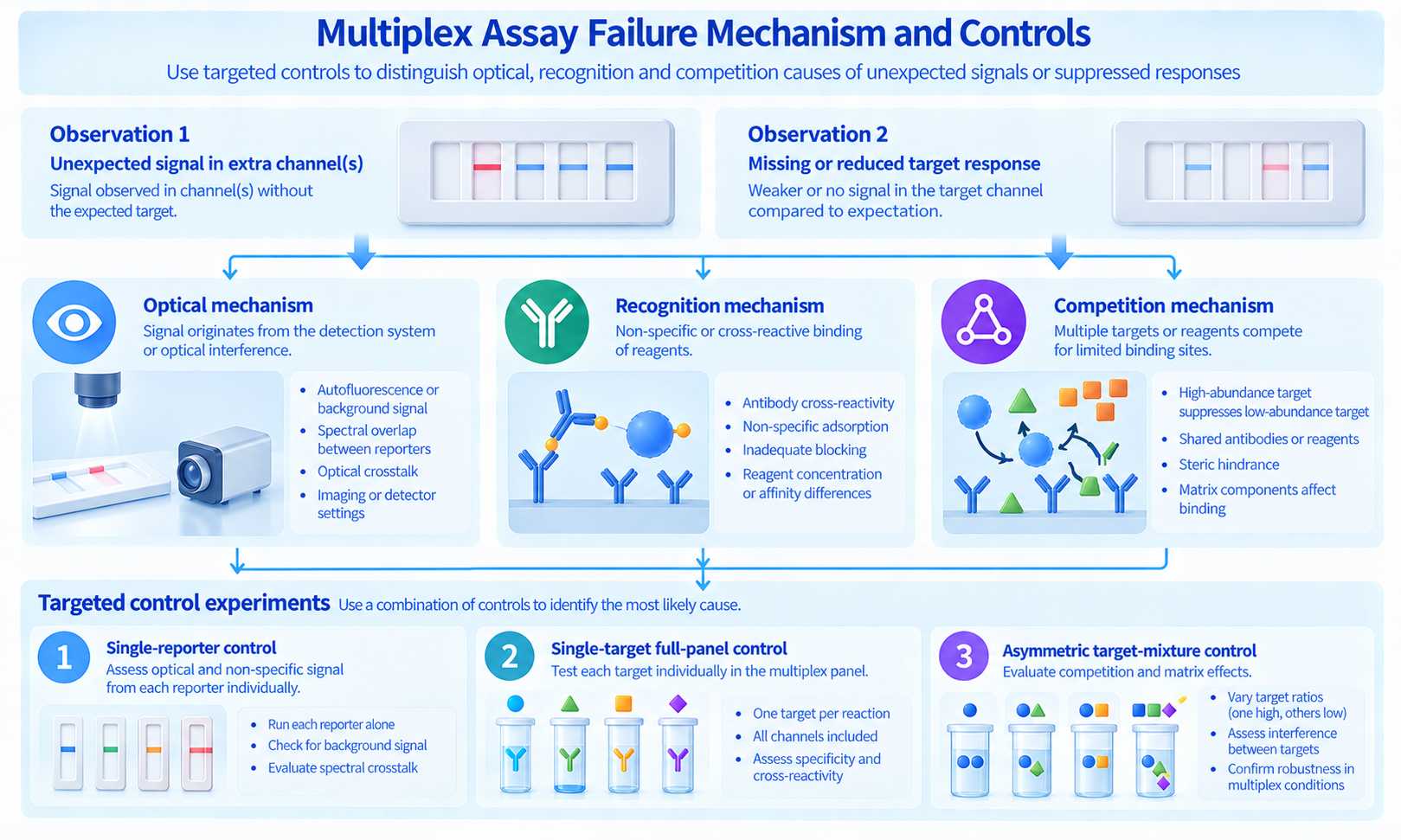
A multiplex assay can fail by reporting an extra target, losing a real target or changing its quantitative response. These outcomes may arise from optical spillover, unintended molecular interactions or competition within the reaction. They need different controls and different corrections.
Compare the failing multiplex condition with matched target and reagent combinations before adding more enzyme or changing the reporting threshold. A clean singleplex result is a useful baseline, but it does not establish that the target remains specific and detectable in the full panel.
Separate an extra signal from suppression of a real target
| Mechanism | What changes | Typical question to test |
|---|---|---|
| Optical cross-talk | Signal from one reporter contributes to another detection channel. | Can one reporter produce a response in the unintended channel without its target reaction? |
| Unintended recognition or amplification | A reagent responds to the wrong target or interacts with another panel reagent. | Which target-reagent combination produces the unintended response? |
| Reaction competition | One reaction or binding process reduces another target response. | Does a fixed low-level target deteriorate as another panel member increases? |
| Analysis artifact | Baseline, normalization, compensation or calling rules change the interpreted result. | Is the discrepancy present in raw data or introduced during processing? |
Cross-talk is used broadly in some assay literature. Here it is useful to identify optical spillover explicitly and reserve separate descriptions for biochemical interactions. A second positive channel and a delayed genuine target can coexist; do not force both observations into one explanation.
Record which target fails, whether its analyte is present, the other targets present, reporter assignment, raw signals and final calls. Include sample matrix and run position. A specimen-dependent inhibitor or contamination event may mimic a multiplex problem without being caused by interactions between panel members.
Begin with an observed difference under controlled conditions. If the target also fails alone in the same matrix and reagent system, investigate that baseline failure before attributing the problem to multiplexing. The Matrix Interference in Enzyme-Based Diagnostic Assays guide addresses a parallel branch of the investigation.
Use target and reagent omissions to ask different questions
Distinguish a singleplex reaction from a single-target specimen tested with all panel reagents. The former removes the other target-specific reagents as well as their targets. The latter preserves possible interactions among primers, probes or antibodies even though only one analyte is present. Comparing these conditions can reveal whether the reagent mixture itself contributes to the failure.
Run appropriate blank and single-target conditions through the complete readout. A blank can reveal contamination or reagent-associated background, but it cannot show how a strong genuine signal leaks into another channel. A single-target condition is necessary for that question, and a reporter-only control may further separate optics from chemistry.
For a large panel, use a planned set of pairwise and omission comparisons to narrow the interaction. Remove one reagent set or target at a time where feasible and keep volume and vehicle comparable. An omission changes the chemical environment, so recovery after removal is a lead rather than proof of one molecular mechanism.
Preserve the original full-panel failure as an anchor. Document the exact combination in every follow-up, including internal controls and common detection reagents. Otherwise a simplified experiment may appear successful only because it no longer contains the condition that caused the problem.
Keep sample handling, reaction timing and analysis settings aligned across comparisons. Use sufficient repeat measurements to separate an interaction from ordinary variability, particularly near the detection limit. An occasional low-level miss is not by itself evidence that a competing target caused the miss.
Test whether the signal is being assigned to the wrong channel
Use suitable single-reporter controls and examine all detection channels, including those whose targets are absent. Consider the reporter state, buffer, acquisition temperature and signal range relevant to the assay. A free dye preparation may not reproduce every property of a cleaved probe or an enzyme-generated fluorescent product.
Yun and colleagues evaluated individual dyes and mixtures when characterizing a multiplex PCR-chip detection system. The transferable principle is to assess channel behavior independently of target interpretation. The particular optical performance of their device is not a specification for another instrument.
Inspect raw and processed data. A weak channel that closely follows a strong channel may suggest spillover, but timing similarity alone is not proof. Review spectral calibration, compensation, detector saturation and baseline handling using compatible controls. An analysis change should have a documented rationale rather than simply remove an inconvenient positive call.
If a reporter reassignment or readout adjustment is investigated, verify its effects on both the strong and weak targets. Reducing the strongest signal may reduce spillover while compromising the target's useful range. Increasing a threshold can hide a false signal and also hide a true low-level response.
For spatial arrays or neighboring wells, distinguish channel spillover from light spreading between locations. Position-dependent controls can help evaluate that possibility. Optical corrections address detection behavior; they cannot repair a reaction in which the intended target was never captured or amplified.
Look for unintended interactions within the reagent mixture
In multiplex PCR, additional primers and probes introduce possible interactions that are absent in singleplex reactions. Compare target-specific reagents in controlled combinations and use an appropriate product-identity check when an unexpected amplification product is suspected. A fluorescent curve alone does not establish that the intended sequence was amplified.
Wei and colleagues showed that primer interactions impaired a multiplex PCR system in a plant-virus study. That evidence supports considering reagent interaction as a mechanism; it does not prescribe a clinical assay recipe. Sequence-based screening can prioritize candidates, but experimental behavior in the full reaction remains the relevant test.
In a multiplex sandwich immunoassay, investigate combinations of capture reagent, target and detection reagent. An antibody pair that performs well alone can interact with additional panel components. Use target omissions and detection-reagent omissions to identify which combination produces an inappropriate signal, while retaining matched negative controls.
Gilboa and colleagues reduced cross-reactivity in a multiplex digital immunoassay by separating capture and detection interactions through sequential processing. This is evidence that assay architecture can control an interaction. It does not mean that every multiplex assay needs sequential processing or that such a change has no effect on recovery, timing or workflow.
Correct the supported interaction at its source: reconsider the affected reagent pair, redesign a conflicting oligonucleotide set or investigate a different capture arrangement. Broad changes to enzyme or blocking concentration can mask the symptom while leaving specificity uncertain. Reassess the intended target as well as the false response.
Challenge unequal abundance instead of testing only balanced mixtures
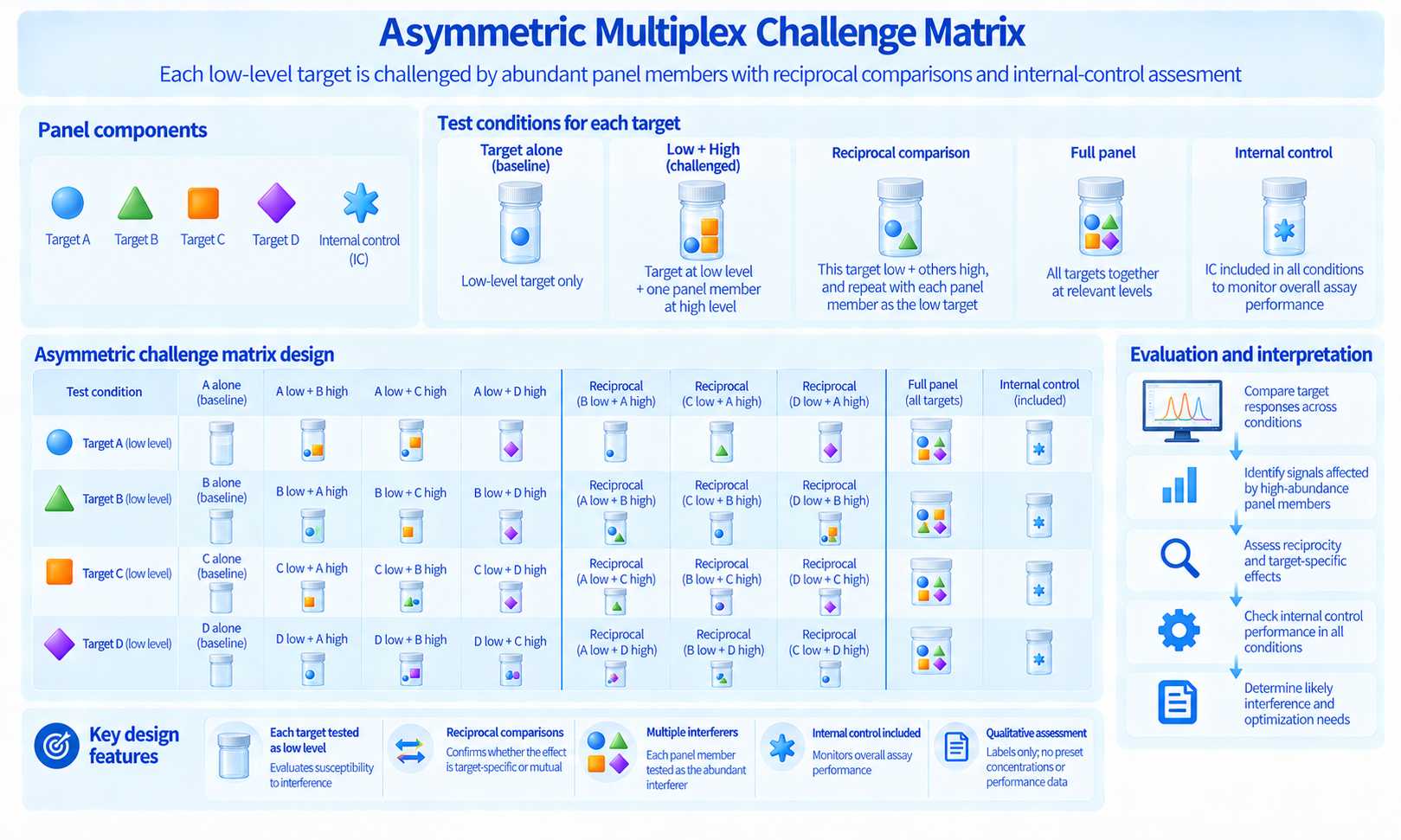
Hold one target at a defined low level and vary a second target over a relevant higher range. Compare the low-level response with its matched target-alone baseline. Then reverse the target roles. Competition can be asymmetric; a strong target may suppress a weak one even when the reciprocal combination behaves acceptably.
FDA's respiratory multiplex nucleic acid guidance explicitly discusses competitive interference testing with a low-level target and a high-level second target. Use this as a study-design principle within its stated assay context. Select concentrations and acceptance criteria for the actual panel rather than borrowing one universal abundance ratio.
Include the internal control in the interaction assessment. An abundant control can affect a low-level target, while an abundant specimen target can suppress the control. A passing control therefore does not prove acceptable performance for every target, and an absent control needs interpretation under the validated decision rules.
If suppression depends on the competing reaction, investigate the limiting process. Shared enzyme or reagent capacity is one possibility, but primer interactions, capture-site effects and detection saturation can produce superficially similar observations. Choose a follow-up that discriminates among them instead of automatically increasing enzyme concentration.
For qPCR, a targeted adjustment to primer balance or reaction composition may be appropriate after localization. The Multiplex qPCR Enzyme and Buffer Optimization Guide develops that optimization work. Confirm that a change improves the vulnerable target without creating unwanted amplification or degrading another panel member.
Confirm the correction in the complete panel
Return to the original failure condition and the full assay after each justified correction. Include target-negative material, individual targets and relevant mixed-target conditions across the intended response range. Pairwise success is useful evidence but may miss an interaction that requires several panel components.
Assess the endpoint the assay actually claims. A qualitative panel needs evidence for correct target calls, including vulnerable low-level combinations. A quantitative panel also needs acceptable response across its measuring range. Do not evaluate success only by making all channels equally bright or all amplification curves look alike.
CLSI MM17 addresses validation and verification of qualitative multiplex nucleic acid assays. Its scope reinforces the distinction between a component check and panel-level performance. A modification to compensation, reagents or calling rules should be assessed in the final configuration, with the relevant settings controlled.
Record the confirmed mechanism, evidence for the correction and remaining limitations. Stop claiming resolution if the low-level target still depends unpredictably on other panel members or if an unexplained extra signal remains. The Diagnostic Enzyme Troubleshooting Center provides related paths when the evidence instead points to a broader reagent or measurement problem.
Sources and further reading
- US Food and Drug Administration. Respiratory Viral Panel Multiplex Nucleic Acid Assay: Class II Special Controls Guidance. Guidance for Industry and FDA Staff. 2009..
- Clinical and Laboratory Standards Institute. MM17: Validation and Verification of Multiplex Nucleic Acid Assays. Second edition. Official public overview..
- Yun SH and colleagues. Cost-Effective Multiplex Fluorescence Detection System for PCR Chip. Sensors. 2021;21:6945..
- Wei T, Lu G and Clover G. Novel approaches to mitigate primer interaction and eliminate inhibitors in multiplex PCR, demonstrated using an assay for detection of three strawberry viruses. Journal of Virological Methods. 2008;151:132-139..
- Gilboa T and colleagues. Sequential Protein Capture in Multiplex Single Molecule Arrays: A Strategy for Eliminating Assay Cross-Reactivity. Advanced Healthcare Materials. 2021;10:e2001111. Online 2020..