

When an enzyme reagent performs poorly after lyophilization, first determine when the loss appears. Compare the formulated liquid, an appropriate freezing control, freshly dried material after reconstitution and material tested after storage. Check delivered concentration and dissolution before concluding that the enzyme has been irreversibly damaged.
Lyophilization, or freeze-drying, changes the environment of every component in a reagent system. A lower assay response can reflect enzyme damage, formulation effects, another sensitive component or incomplete delivery of the dried material into the reaction.
Make the liquid-to-dried comparison interpretable
Define the response that fell: enzyme activity, signal-to-background behavior, amplification performance, low-target recovery or repeatability. Preserve raw results and the associated reaction conditions. The endpoint must be relevant to the intended use; cake appearance alone cannot establish that a reagent still works.
Choose a liquid reference with a known handling history. Where the drying formulation adds excipients or changes buffer composition, include a formulated liquid control as well as the original liquid reagent. Otherwise, a difference caused before drying can be misattributed to the drying cycle.
Compare equal intended reaction inputs after accounting for fill volume, reconstitution volume and any subsequent dilution. If the liquid and dried preparations deliver different enzyme amounts or excipient concentrations, the comparison combines formulation and process effects. Correct that ambiguity before interpreting percent recovery.
For an activity assay, calculate recovery relative to a justified baseline measured under the same conditions. For a complete molecular or immunoassay reagent, retain the application endpoints as well. A component can retain measurable catalytic activity while the assembled assay loses sensitivity, specificity or useful signal separation.
Hammerling and colleagues found that complete RT-qPCR systems differed in their response to lyophilization and protective formulations. The relevant implication is to assess the actual assembled reagent. Survival of one enzyme in a separate buffer does not establish preservation of the full reaction mixture.
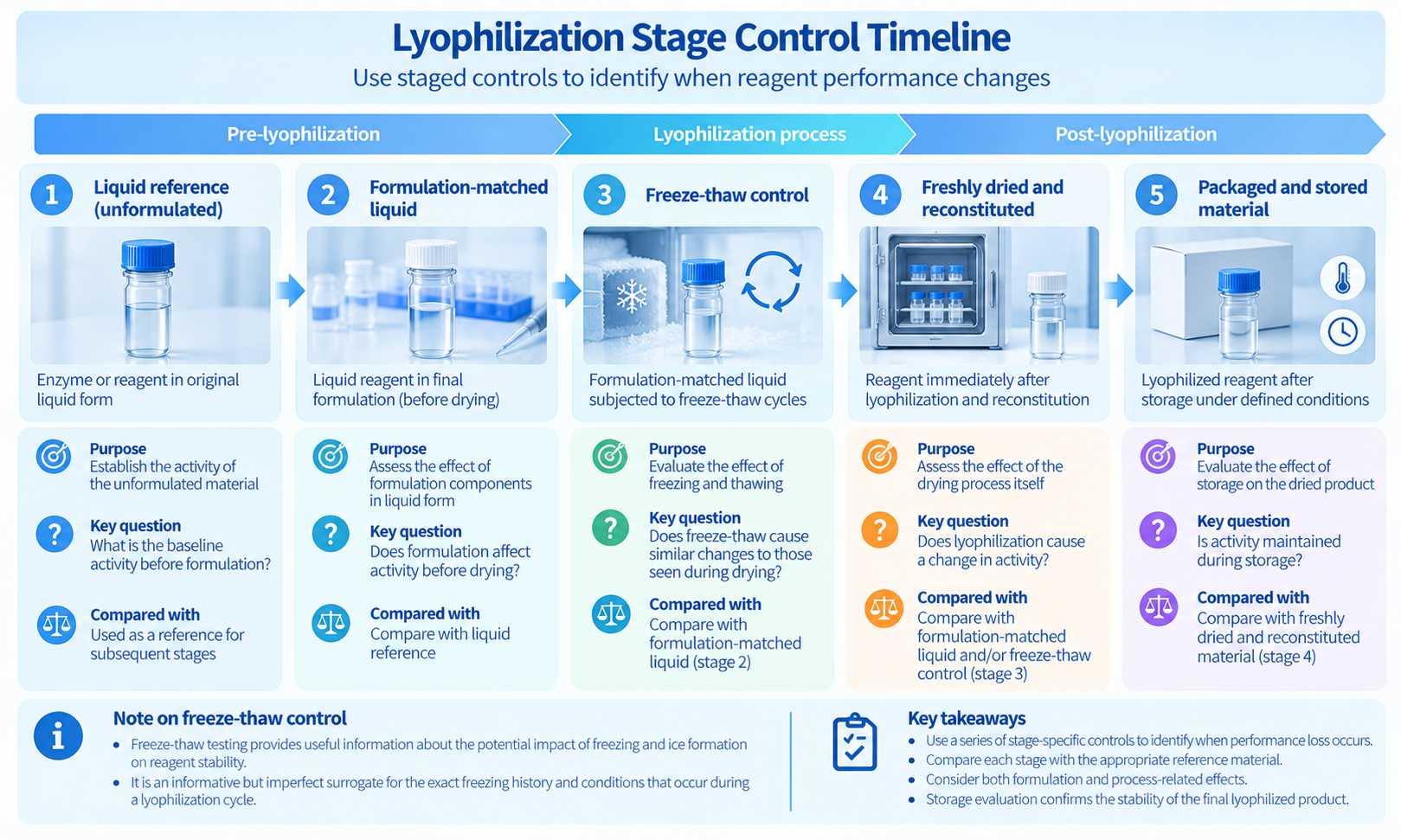
Find the earliest stage associated with the loss
| Comparison | Question answered | Important limitation |
|---|---|---|
| Original liquid versus formulated liquid | Did the pre-drying formulation or hold step change performance? | Match final reaction input so dilution is not confused with inhibition. |
| Formulated liquid versus a controlled freeze-thaw preparation | Does freezing-related exposure reproduce part of the loss? | A separate freeze-thaw cycle may not reproduce the actual drying cycle history. |
| Formulated liquid and freezing control versus freshly dried, reconstituted material | Is additional loss associated with drying and recovery into solution? | The result still includes reconstitution and any concentration error. |
| Freshly dried baseline versus packaged stored material | Does performance deteriorate after the initial process? | Storage, package exposure and test-day effects require appropriate controls. |
| Independent containers from different load positions | Is the effect uniform or associated with position or filling? | A positional pattern does not identify its thermal or formulation mechanism. |
These comparisons are an investigation framework, not a claim that each processing stress can be measured independently. Retain preparation records and use representative stage controls wherever feasible. If historical material is unavailable, state that the location of the loss remains less certain.
Pikal-Cleland and Carpenter compared freezing and drying effects in beta-galactosidase systems and found different recovery behavior for the proteins studied. Their results support separating these stresses experimentally. They also show why a successful freezing protectant or a satisfactory freeze-thaw result should not be assumed to establish protection against dehydration.
Rule out incomplete recovery into the reaction
Verify the specified diluent, volume, order of addition, mixing and time before use. Record whether all material becomes accessible to the liquid and whether visible particles, surface deposits or retained droplets remain. Compare the suspect procedure with the established reference using matched containers and inputs.
Check the final concentration calculation rather than assuming that adding the nominal fill volume reconstructs every intended reaction condition. Additional sample or buffer can change the final volume and composition. Conversely, incomplete recovery of the cake can reduce the delivered reagent amount even when the added liquid volume is correct.
A practical comparison separates dissolution time from post-reconstitution stability. Test whether a defined, compatible mixing or waiting condition improves the response, then determine whether the reconstituted material remains stable during the intended use interval. A later improvement can suggest a recovery problem, but it does not prove that all protein remains structurally unchanged.
Avoid vigorous or prolonged handling as an automatic remedy. Use conditions appropriate to the reagent and assess the complete assay. If a revised reconstitution procedure restores activity but increases variability or delays the intended workflow, it may require further development rather than immediate adoption.
For cartridges or small chambers, consider whether the liquid actually contacts and transfers the intended amount of dried material. Xu and colleagues evaluated dried PCR mixes in a microfluidic context, illustrating the need to assess the application format. A formulation that works after manual bench reconstitution may behave differently in the intended device.
Investigate the process stage supported by the evidence
If loss is already present in the formulated liquid, investigate composition and pre-drying hold conditions before redesigning the cycle. If freezing exposure reproduces the problem, examine the relevant buffer and formulation behavior. If a further loss appears only after drying, focus on the additional dehydration and recovery stresses while retaining the earlier controls.
In the beta-galactosidase study, buffer behavior during freezing contributed to instability, and the effects of dehydration differed between enzyme forms. Treat such mechanisms as plausible leads for a matching system, not as proof that every phosphate formulation will fail. A room-temperature pH measurement alone does not describe the entire freezing environment.
Pisano and colleagues investigated enzyme preservation in formulations with different water-binding and excipient behavior. Their findings support examining the physical state of the formulation alongside activity. A familiar excipient name is not enough to predict its protective effect in a new mixture or process.
Review the actual cycle record, load arrangement, fill consistency and container configuration against the successful reference. Shelf settings alone do not describe the complete product history. Where a position-related failure is observed, preserve the position map and compare physical and functional measurements from the relevant locations.
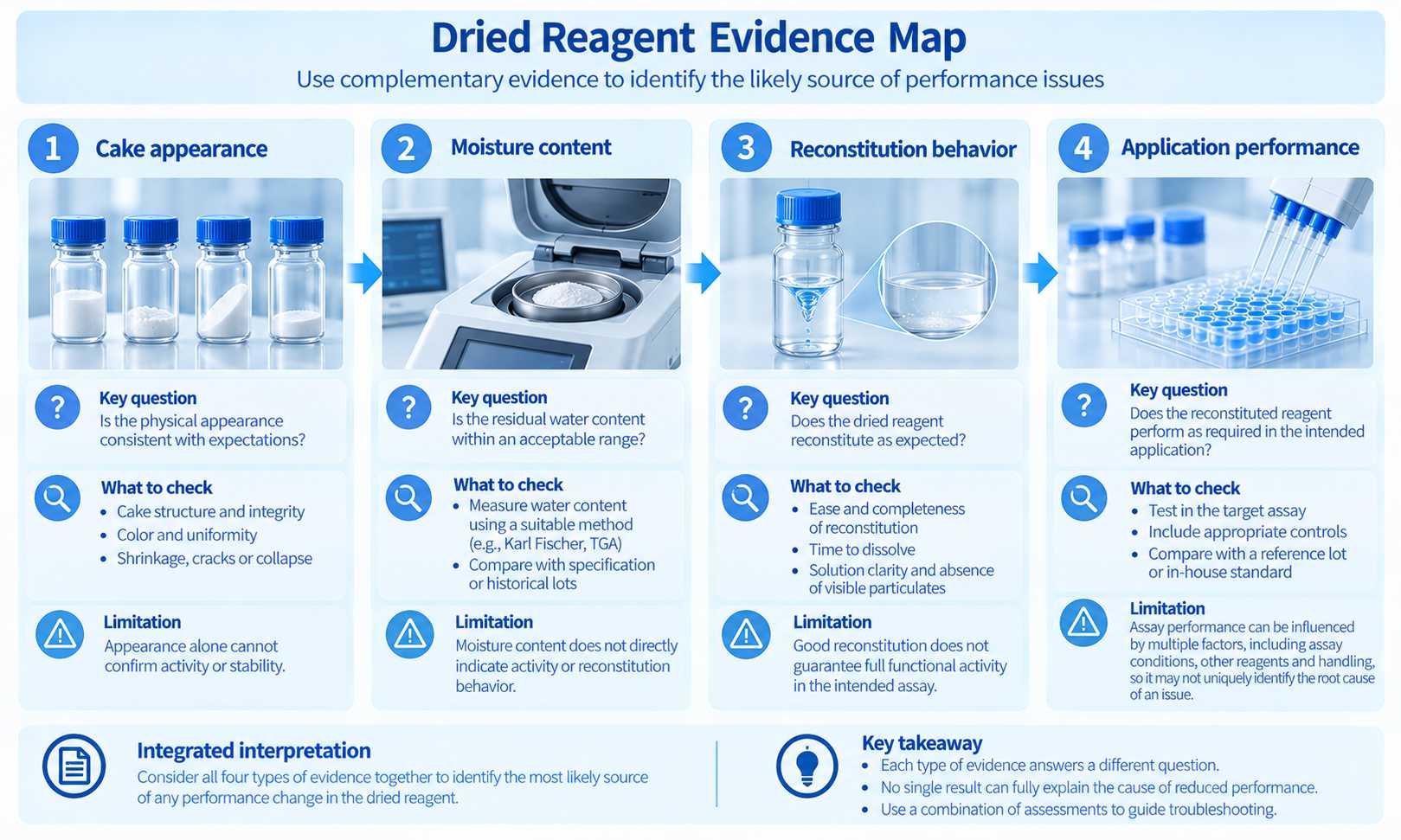
Select characterization to answer the reproduced question. Moisture measurement can test a drying-related hypothesis; thermal or solid-state analysis can investigate formulation behavior; protein or activity measurements can assess a suspected functional loss. A broad set of measurements is less useful if no result would change the next decision.
Appearance is supporting evidence. A visibly altered cake deserves investigation, but an intact cake can still contain a reagent with poor functional recovery. Correlate physical observations with the intended assay before setting or changing a visual acceptance rule.
Separate immediate recovery from packaged storage stability
Use freshly dried, properly reconstituted material as the post-process baseline when investigating subsequent storage loss. Comparing an aged dried reagent only with fresh liquid combines initial process recovery and storage effects. Keep both comparisons when needed, but label the questions separately.
Review the container closure, package barrier, sealing process and exposure during handling. Test material in the package and use configuration relevant to the proposed claim. A dry reagent exposed repeatedly during sampling may experience a different environment from an individually sealed unit.
Measure residual water with a suitable method when moisture is part of the hypothesis. Interpret it together with formulation, exposure and functional results. The enzyme and dried-PCR studies cited here show that water-related behavior depends on the system; they do not establish one universal moisture value or that progressively lower water is always preferable.
CLSI EP25 addresses planned establishment and confirmation of reagent stability claims. For troubleshooting, define the endpoint, package, storage condition and comparison time before interpreting a trend. An accelerated challenge can help rank candidates or expose failure modes, but its results do not automatically establish real-time shelf life.
Distinguish sealed storage stability from open-container and post-reconstitution stability. A formulation may perform acceptably in one state and fail in another. Record the state in which the change occurs so that the corrective action addresses the actual exposure.
Verify the correction in the complete intended workflow
Compare the proposed correction with the reference condition using independently prepared or processed material appropriate to the failure. Include controls that confirm the measurement itself and materials near the application boundary, such as low-target samples or low-activity conditions. A strong positive alone may conceal a partial loss.
Assess the relevant tradeoffs. A formulation change may improve immediate recovery while impairing storage behavior, or improve storage while slowing reconstitution. A cycle change may work for one fill or load arrangement but require further evaluation after scale or container changes.
Document which part of the loss was corrected and which mechanism remains hypothetical. Adding fresh enzyme or another component can be a useful diagnostic experiment, but a rescued response does not uniquely prove that component was the only damaged material. Confirm the final formulation as a complete system.
Close the investigation when the agreed functional criteria and necessary physical controls are met under the intended conditions. If the available stage controls cannot distinguish drying damage from recovery or storage effects, state the uncertainty and collect the missing comparison before claiming a root cause or extending a stability claim.
For broader formulation planning, see Lyophilized qPCR and RT-qPCR Master Mix Guide. For longer-term development, see Ambient-Stable Molecular Diagnostic Reagent Development Guide. The Diagnostic Enzyme Troubleshooting Center provides related failure investigations.
Sources and further reading
- Pikal-Cleland KA and Carpenter JF. Lyophilization-induced protein denaturation in phosphate buffer systems: monomeric and tetrameric beta-galactosidase. Journal of Pharmaceutical Sciences. 2001;90:1255-1268..
- Pisano R and colleagues. Freeze-drying of enzymes in case of water-binding and non-water-binding substrates. European Journal of Pharmaceutics and Biopharmaceutics. 2013;85:974-983..
- Xu J and colleagues. Transferable, easy-to-use and room-temperature-storable PCR mixes for microfluidic molecular diagnostics. Talanta. 2021;235:122797..
- Hammerling MJ, Warfel KF and Jewett MC. Lyophilization of premixed COVID-19 diagnostic RT-qPCR reactions enables stable long-term storage at elevated temperature. Biotechnology Journal. 2021;16:e2000572..
- Clinical and Laboratory Standards Institute. Evaluation of Stability of In Vitro Medical Laboratory Test Reagents. CLSI EP25. Second edition. 2023..