

Poor enzyme-antibody conjugation efficiency can mean too little conjugate formed, too little was recovered, or the recovered material no longer performs well. These are different failures. Define the measurement and its denominator before increasing the enzyme-to-antibody ratio or extending the reaction.
A useful conjugate must retain target recognition and catalytic reporting while giving acceptable background. Strong enzyme activity in an unpurified mixture does not establish successful conjugation, and a large conjugate peak does not establish useful assay performance.
Specify which efficiency is low
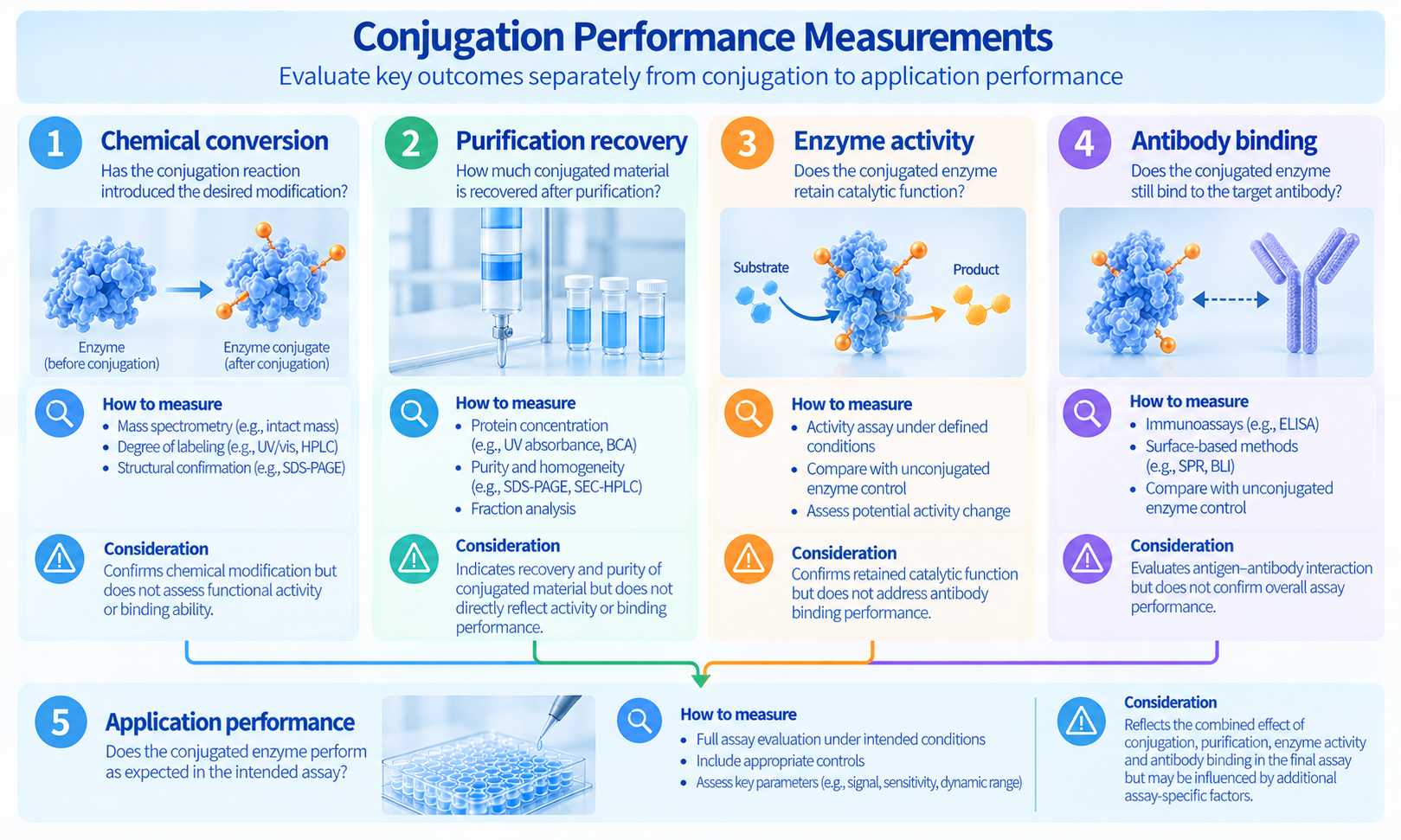
| Measurement | Question it answers | Main interpretation limit |
|---|---|---|
| Chemical conversion | What fraction of a defined input became part of the intended conjugate population? | Requires a method that distinguishes conjugated and unconjugated species. |
| Purified recovery | How much defined material remains after cleanup relative to the stated input? | High conversion can coexist with poor recovery. |
| Retained catalytic activity | Can the recovered enzyme component still generate the expected reaction signal? | Free enzyme can contribute unless the preparation is appropriately characterized. |
| Retained antibody binding | Does the processed antibody still recognize the relevant target? | Binding alone does not establish active enzyme labeling. |
| Complete-assay performance | Does the conjugate provide useful target-dependent response with acceptable background? | The result also depends on the rest of the assay system. |
Report the basis of every comparison. An enzyme-to-antibody input ratio is not the measured ratio in the final product. An average labeling value can also hide a mixture of unlabeled antibody, differently labeled species and aggregates. Avoid describing such a preparation with one apparently precise efficiency number unless the underlying method supports it.
Choose a reference conjugate or prior successful preparation with suitable handling history. Compare equivalent inputs using a defined basis, such as antibody amount for a binding comparison or enzyme activity for a reporting comparison. Different normalizations answer different questions and should remain identifiable in the record.
Establish input quality before investigating the reaction
Confirm the identity, concentration and formulation of both proteins. Review whether the antibody preparation includes carrier protein or other components that could participate in the chosen chemistry. Check whether the enzyme stock is suitable for that coupling route rather than assuming that an active stock is automatically conjugation-ready.
Measure relevant input function with methods that can be compared after processing. Retain a sample of the original enzyme and antibody where feasible. An enzyme-only process control and an antibody-only process control can help reveal damage caused by activation, buffer exchange or handling independently of the final coupling step.
The Assay Guidance Manual distinguishes protein identity and mass purity from enzymatic purity and activity. Apply that distinction to the inputs. A protein concentration measurement does not show that all of the measured protein is the intended enzyme or antibody, and a clean electrophoretic profile does not prove preserved function.
Reconcile dilution and transfer calculations. Record actual protein amounts, preparation times and any concentration or buffer-exchange losses. If a working stock was prepared incorrectly, changing the chemistry may obscure a preparation error rather than improve the process.
Preserve a matched handling control where the investigation requires it. Comparing freshly opened input with a conjugate that has undergone several holds and transfers combines chemical modification with exposure history. The control should experience the stages relevant to the question, without pretending to reproduce a reaction it did not undergo.
Investigate the selected coupling route
Start with the documented chemistry and identify the groups intended to react. Periodate-mediated horseradish peroxidase (HRP) conjugation uses chemistry associated with the enzyme's carbohydrate groups. Amine-reactive and thiol-directed linkers impose different requirements. A remedy for one route should not be applied to another solely because both produce an antibody-enzyme conjugate.
Tijssen and Kurstak's work on active peroxidase conjugates illustrates the importance of preparation and controlled processing in a periodate-mediated system. In troubleshooting, compare the relevant activation and coupling stages with the successful reference. Do not infer that a stronger activation treatment must produce more usable conjugate.
For an amine-reactive route, review competing reactive components and the compatibility of the buffer. For a thiol-directed route, review the intended availability of thiols and whether processing or residual reagents could affect the reaction. Use a suitable analytical check where possible rather than inferring reactive-group availability from the amount of reagent added.
Inspect linker or activation-reagent identity, preparation and handling alongside protein concentration and reaction timing. Hydrolysis, competing reactions or unwanted protein modification are hypotheses whose relevance depends on the actual chemistry. Select a comparison capable of distinguishing the suspected explanation.
Jeanson and colleagues compared procedures for HRP and alkaline phosphatase conjugates using several monoclonal antibodies. Their functional comparisons support evaluating the antibody-enzyme pair as a system. A procedure that gives a strong signal for one pair does not establish a universal optimum for another.
Use a small, interpretable comparison around the known procedure before launching a broad screen. Include both product-distribution and functional measurements. Increasing input ratio or reaction exposure can alter the product population as well as the amount recovered, so a yield improvement requires a separate check of usefulness.
Determine whether the apparent loss occurs during purification
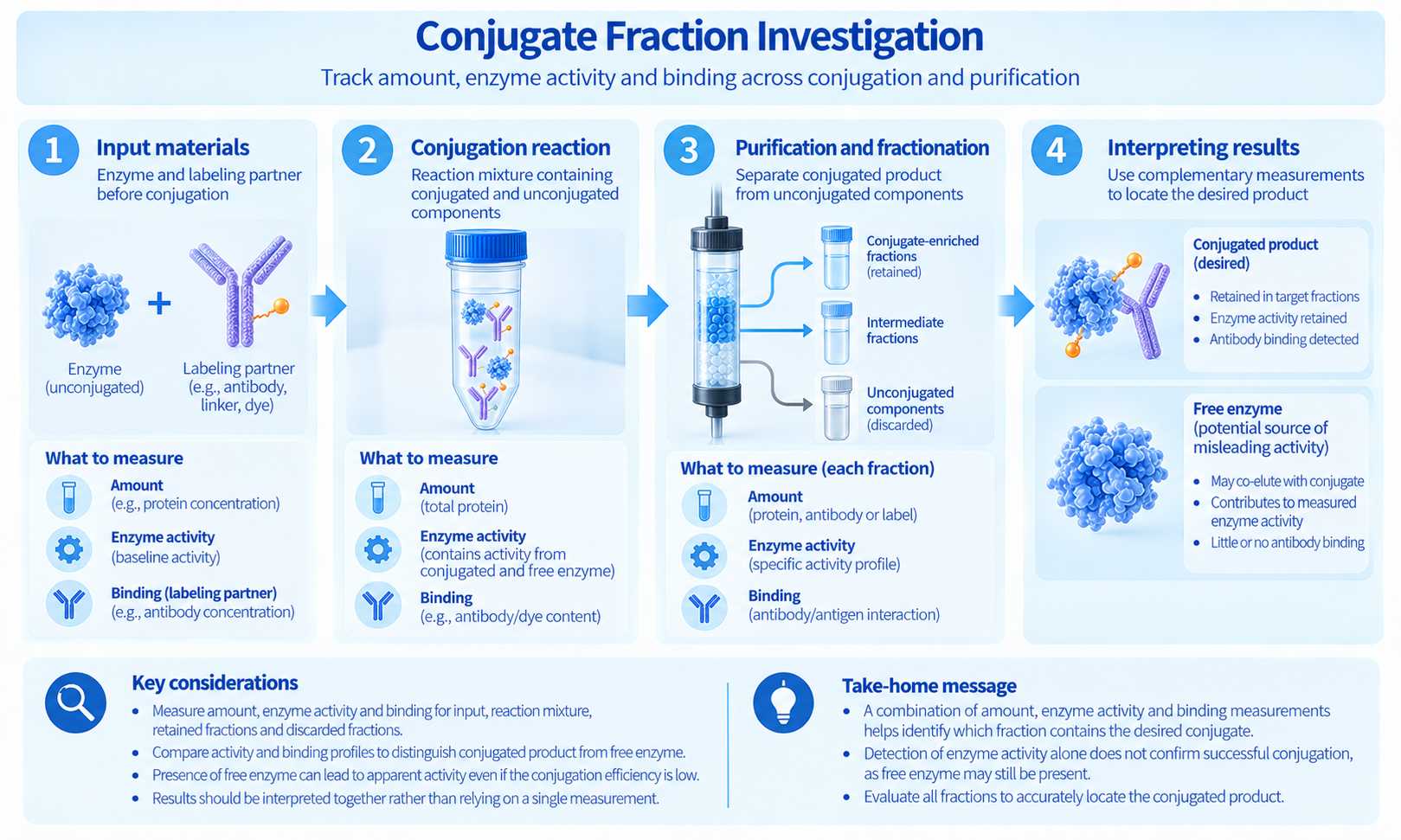
Compare the reaction mixture with the recovered preparation and relevant purification fractions. Track volumes as well as concentrations so that dilution is not mistaken for loss. Where the method permits, account for the enzyme and antibody separately rather than treating total protein as a direct measure of conjugate.
Check whether the selected separation resolves the species of interest. Size-based separation may help distinguish free components and larger products, but overlapping populations can limit the interpretation. A shifted peak, band or retention profile is supporting evidence and may require an additional measurement to establish composition.
Strong enzyme activity before purification can come from excess free enzyme. Its removal may reduce total activity while improving the quality of the conjugate preparation. Conversely, loss of target-binding material into discarded fractions can indicate that the pooling or separation strategy is excluding useful product.
Assess whether the cleanup conditions themselves affect recovery or function. Adsorption, concentration steps and hold time are possible contributors that should be tested against suitable controls. If the largest decrease occurs after the coupling reaction, changing the activation ratio is unlikely to be the most informative first action.
Record the measurement limitations in any material balance. Different assays may respond differently to free proteins and conjugates, and excipients may affect concentration measurements. A balance that does not close is a reason to investigate the method or missing fractions, not to assign the discrepancy automatically to aggregation.
Test catalysis and binding before interpreting the final assay
Measure catalytic activity under defined, comparable conditions. STRENDA guidance emphasizes the conditions needed to interpret enzyme results, including the reaction environment and measurement method. Normalize the comparison appropriately and verify that the substrate system itself is performing as expected.
Evaluate binding independently where practical, using a suitable target and reference antibody or conjugate. If catalytic activity remains acceptable but target-dependent response falls, investigate recognition, accessibility or retention in the assay. If binding is retained but reporting is weak, examine the enzyme component and the reporting conditions.
Then assess the complete assay with negative and low-positive materials. The immunoassay guidance in the Assay Guidance Manual makes clear that reagent interactions and format affect the observed response. A conjugate that functions in solution may still give poor discrimination after capture, incubation and washing.
Use an unpurified or free-enzyme-containing preparation cautiously in this comparison. Unbound enzyme can generate substrate signal without target recognition, while unconjugated antibody may alter competition for available binding sites. Interpret those possibilities through appropriate separation and controls rather than relying only on a high endpoint reading.
Examine background and variability alongside the positive signal. A preparation with more enzyme label may give a stronger response yet require an unfavorable working dilution or produce more unwanted signal. The relevant endpoint is useful performance at a defined input, not the brightest well or the largest apparent conjugate population.
Choose a correction that addresses the demonstrated failure
Match the corrective action to the localized problem. Preparation errors call for corrected inputs. A reproducible activation or coupling effect calls for a controlled chemistry comparison. Purification losses call for recovery and fraction-selection work. Preserved conversion with impaired function calls for a less damaging process or a different compatible route.
Repeat the selected condition with independent preparation where feasible. Confirm conversion or product distribution, recovered amount and functional performance using the same defined comparisons. Include the intended holding or storage interval if the original problem appeared after preparation rather than immediately.
Document which outcome improved and which mechanism remains uncertain. A rescued assay signal after adding more conjugate does not prove improved coupling efficiency. A reproducible correction should retain useful binding and reporting while meeting the assay's background and variability requirements.
If the available evidence cannot distinguish free-enzyme signal from active conjugate, resolve that measurement gap before declaring the process optimized. The final record should make clear how much usable material was obtained and under which assay conditions it was demonstrated to work.
For chemistry selection, see Enzyme-Antibody Conjugation Guide for Diagnostic Assays. For downstream weak response, see Loss of Signal in ELISA and CLIA Assays. Return to the Diagnostic Enzyme Troubleshooting Center for other symptoms.
Sources and further reading
- Jeanson A, Cloes JM, Bouchet M and Rentier B. Comparison of conjugation procedures for the preparation of monoclonal antibody-enzyme conjugates. Journal of Immunological Methods. 1988;111:261-270..
- Tijssen P and Kurstak E. Highly efficient and simple methods for the preparation of peroxidase and active peroxidase-antibody conjugates for enzyme immunoassays. Analytical Biochemistry. 1984;136:451-457..
- Assay Guidance Manual. Validating Identity, Mass Purity and Enzymatic Purity of Enzyme Preparations. NCBI Bookshelf..
- STRENDA Commission. STRENDA Guidelines. Beilstein-Institut. Accessed October 9, 2026..
- Assay Guidance Manual. Immunoassay Methods. NCBI Bookshelf..