

AI protein engineering can help prioritize variants and organize experimental search. For diagnostic enzymes, its value is established when selected variants improve a relevant measured property without compromising the finished assay. A high prediction score or a successful benchmark is an earlier level of evidence.
This selective literature review considers research available through October 20, 2026, with emphasis on experimentally connected work published in 2024–2025. It is not a systematic review or an exhaustive model ranking. Much of the evidence comes from other enzyme applications and requires explicit testing before transfer to diagnostics.
Ask what the model actually helped the experiment decide
Protein engineering papers can report different achievements under the same AI label. Some predict the effects of existing mutations. Others propose new sequences or choose which variants to test next. Still others accelerate the experimental platform. These contributions should not be treated as interchangeable evidence of improved enzyme function.
Start by identifying the experimental decision. Did the model reduce an expensive candidate list, find a useful combination of mutations, or discover activity outside the starting library? Then ask what comparison supports that interpretation. A retrospective correlation does not establish that the model would have selected useful new variants prospectively.
For a diagnostic programme, define the target property before choosing a model. Faster extension, inhibitor tolerance, retained activity after storage and lower unwanted substrate turnover are different objectives. The best training label depends on which property constrains the intended reagent system.
The selected papers support several ways to make the search more informative. They do not establish that one model class is best for polymerases, reverse transcriptases, signal enzymes and metabolic enzymes alike. Differences in datasets and assays prevent a simple cross-paper ranking.
Representations influence what a model can learn
Protein language models convert biological sequence information into representations that can be used for prediction. Their utility depends on whether the learned information relates to the property being optimized. Similarity to natural sequences is not the same measurement as performance in a diagnostic reagent.
The 2024 codon-language study explored information in coding sequences rather than relying only on amino-acid representations. It illustrates that the choice of representation can change predictive information. Its relevance is methodological: a richer input may help a particular task, but it does not remove the need for suitable experimental labels.
The 2025 biophysics-based language-model study examined a route that incorporates biophysical modeling into learned representations. This offers another response to limited labeled data. The publication's results should be interpreted within its tested datasets and generalization settings, rather than as evidence that low-data prediction is universally solved.
In a practical comparison, keep the endpoint and data split fixed while changing the representation. Otherwise, apparent gains may reflect a different test set or preprocessing choice. Include a simple baseline so that model complexity is justified by an observable benefit.
For diagnostic work, record buffer, temperature, substrate, incubation and normalization alongside sequence. A model trained on measurements from incompatible conditions may learn experimental context indirectly. More sequence data cannot automatically repair an unclear or inconsistent phenotype.
Connect model updates to useful functional measurements
The 2025 cell-free expression study connected machine learning with DNA assembly, expression and functional assays. Its contribution is the connection between sequence exploration and experimentally measured enzyme behavior. Results across the reported reaction settings support that platform concept, not a claim that cell-free output predicts finished diagnostic performance.
The active learning-assisted directed evolution study addressed an enzyme landscape involving interacting residues. Active learning uses accumulated results to choose subsequent experiments. This differs from selecting a large batch once and judging the entire method only after the batch has been tested.
The practical benefit depends on the cost and reliability of the measurement. If an assay is noisy, biased by expression or insensitive to the property of interest, the model can repeatedly optimize an artifact. Build repeat measurements and relevant controls into the experimental process before attributing improvement to the algorithm.
A prospective evaluation should preserve the history of candidate selection. Record which measurements were available when each batch was proposed. Information acquired later must not leak into an apparently earlier prediction. This matters when the same dataset is reused for model development and performance reporting.
Also distinguish total activity in an expression mixture from activity of a normalized enzyme preparation. Both can be legitimate engineering endpoints. They answer different questions, and a diagnostic raw-material programme may need to separate expression yield, purity and catalytic function before deciding which variant to advance.
Diversity can be useful even when it lowers the predicted average
A model that always selects nearly identical high-scoring variants can miss alternative regions of sequence space. The 2024 library-design study explicitly considered predicted fitness and diversity together. It supports treating the composition of a candidate set as an engineering decision rather than simply taking the highest-ranked sequences.
This is particularly relevant when several mutations interact. The effect of a combination need not equal the sum of its individual effects. A library based only on individually favorable substitutions may therefore fail to explore combinations that work through a different mechanism.
For a diagnostic enzyme, diversity should still be constrained by the project. A broadly varied library may be unhelpful if most variants cannot be produced or formulated in the required process. Define which properties are essential and which can be traded against one another.
An informative selection report should explain the balance between exploiting promising candidates and testing uncertain alternatives. That explanation makes later failures useful. If a diverse candidate fails, the result may still narrow the search; if every candidate is nearly identical, the batch may add little new information.
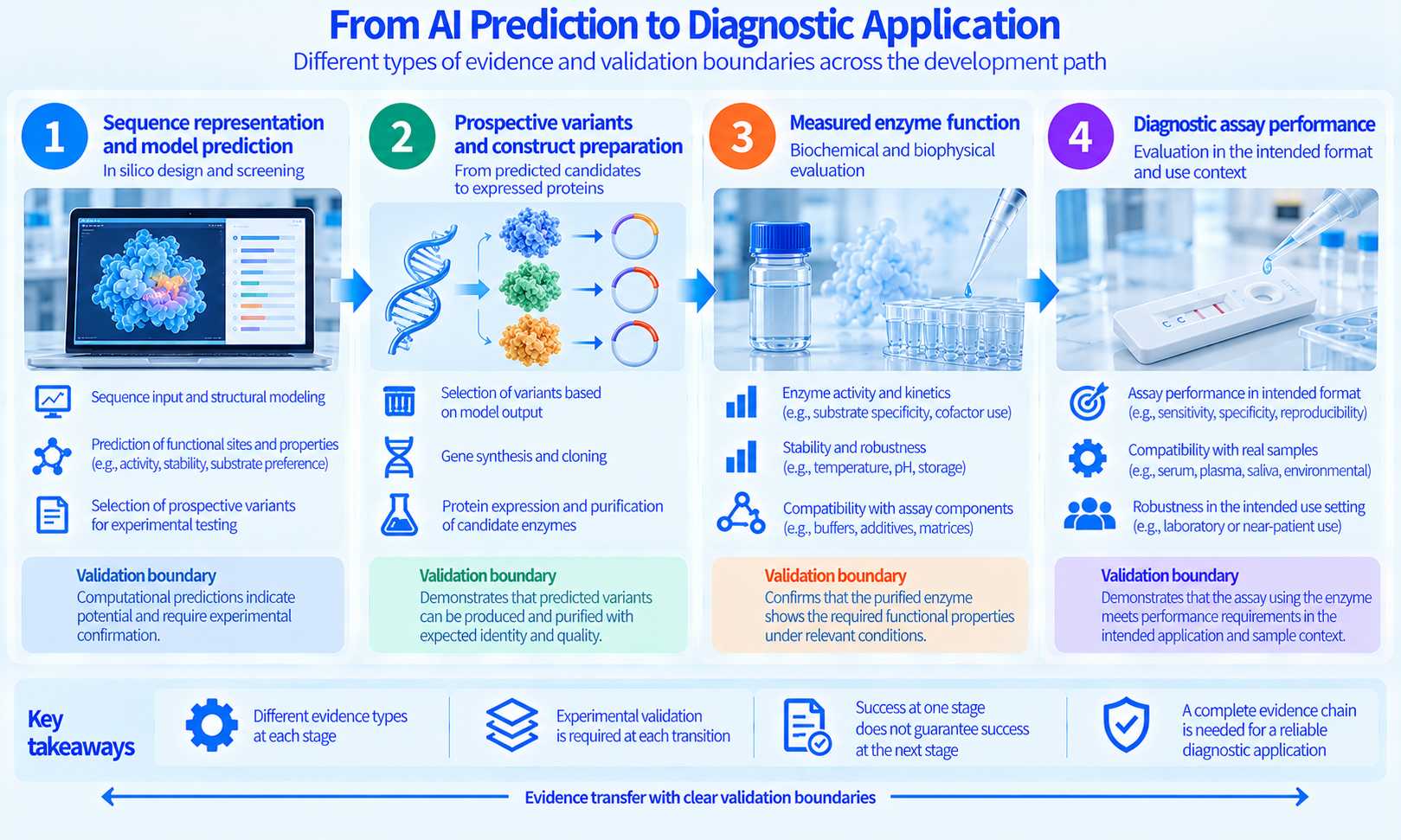
Diagnostic performance requires a separate evidence layer
| Evidence level | Supported conclusion | Remaining diagnostic question |
|---|---|---|
| Retrospective prediction | The model relates to a defined dataset. | Will it select useful unmeasured variants? |
| Prospective functional testing | Selected variants affect the measured property. | Does the effect persist with normalized preparations? |
| Purified enzyme comparison | A biochemical difference is reproducible. | Does it improve the intended reagent formulation? |
| Complete assay assessment | The variant works under tested assay conditions. | Are production variability, stability and intended specimens covered? |
Consider a polymerase variant that improves amplification in a screening buffer. That result may justify further study, but it does not establish performance in a multiplex master mix or in specimens containing inhibitors. The next comparison should preserve the intended assay context and include properties that could have worsened.
For an enzyme label, stronger turnover of a convenient substrate may not improve signal-to-background after conjugation. For a metabolic enzyme, activity at one analyte concentration may miss unwanted reactions with related compounds. These examples illustrate why diagnostic transfer is a distinct experimental question.
Manufacturing and formulation add further boundaries. A useful variant must be obtainable in a suitable preparation and remain compatible with the planned presentation. The engineering objective should make those constraints visible rather than postponing them until a single winner has been selected.
For detailed implementation, the Design-Build-Test-Learn Workflow for Enzyme Evolution guide covers the iterative process. This review's emphasis is whether the published evidence justifies using a method in that process.
Read for reproducibility and relevance rather than a headline score
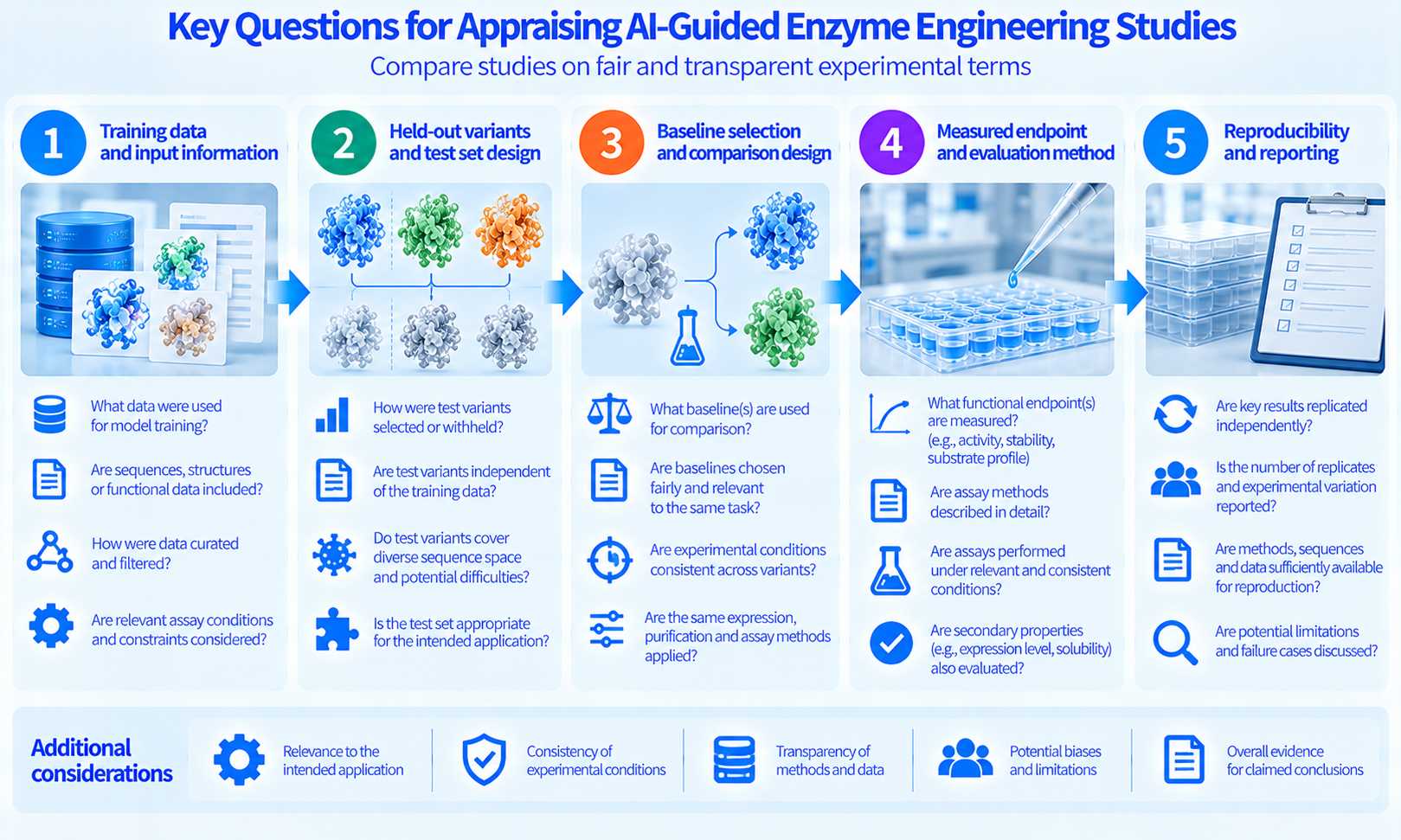
An effective literature assessment extracts the starting enzyme, sequence space, measurement conditions, selection budget and comparison method. It records both improvements and failures. The ability to reconstruct those details is more useful than a single headline fold change whose denominator is unclear.
Ask whether held-out variants are genuinely informative about the proposed use. Randomly dividing closely related variants can test a different generalization problem from predicting distant combinations or transferring between enzyme families. A good score under one split should not be silently generalized to the other.
Check whether gains survive independent preparation and repeat measurement. Compare against a defensible starting enzyme and an appropriate non-model selection strategy where available. These are recommended appraisal questions, not claims that every selected paper performed every comparison.
The literature supports an increasingly experimental role for AI: representations organize information, active learning selects informative work, and library methods balance promise with diversity. For diagnostic enzymes, the unresolved step is often the connection between those gains and the full assay. Make that connection the next evidence objective rather than assuming it.
Related discussions are collected in Technical Articles, Literature Reviews and Industry Insights. A project-specific assessment should state which findings are directly applicable, which are analogies and which remain untested.
Sources and further reading
- Peer-reviewed research. Accelerated enzyme engineering by machine-learning guided cell-free expression. Published 2025..
- Peer-reviewed research. Active learning-assisted directed evolution. Published 2025..
- Peer-reviewed research. Machine learning-guided co-optimization of fitness and diversity facilitates combinatorial library design in enzyme engineering. Published 2024..
- Peer-reviewed research. Biophysics-based protein language models for protein engineering. Published 2025..
- Peer-reviewed research. Codon language embeddings provide strong signals for use in protein engineering. Published 2024..