

A design-build-test-learn workflow improves enzyme evolution when each round produces evidence that changes the next experimental decision. Design defines candidates, build establishes the tested material, test measures the response, and learn updates both the model and the engineering hypothesis.
The cycle needs traceable inputs, reliable controls and a separate route for confirming a selected variant. This guide focuses on those connections, including how to interpret failed builds, uncertain results and apparently promising candidates.
Set up the cycle around a decision
Write the objective, reference and acceptance logic before the first design round. Identify the property to improve, the conditions in which it will be measured and the properties that must remain acceptable. Decide which result would justify another round, independent confirmation or a change in strategy.
Assess the measurement before increasing the candidate count. If the reference varies substantially across runs, a small apparent difference between variants may be difficult to interpret. Repeating a known material can reveal more about readiness than measuring many new sequences once. Reserve capacity for controls, repeats and confirmation when calculating the experiment budget.
Machine learning can guide this cycle, but DBTL does not require that every decision be automated. Wu and colleagues demonstrated model-assisted selection from combinatorial variant information. Yang and colleagues used active learning to connect successive measurements with new candidate choices. These studies support feedback-driven selection in tested systems, without prescribing a universal number of rounds or a guaranteed improvement.
Define responsibilities at the handoffs. The design record should reach the team building the material without sequence ambiguity. The assay team should know the preparation identity and control requirements. The modeling team should receive measurement context and failure reasons, not only a spreadsheet column of ranked responses.
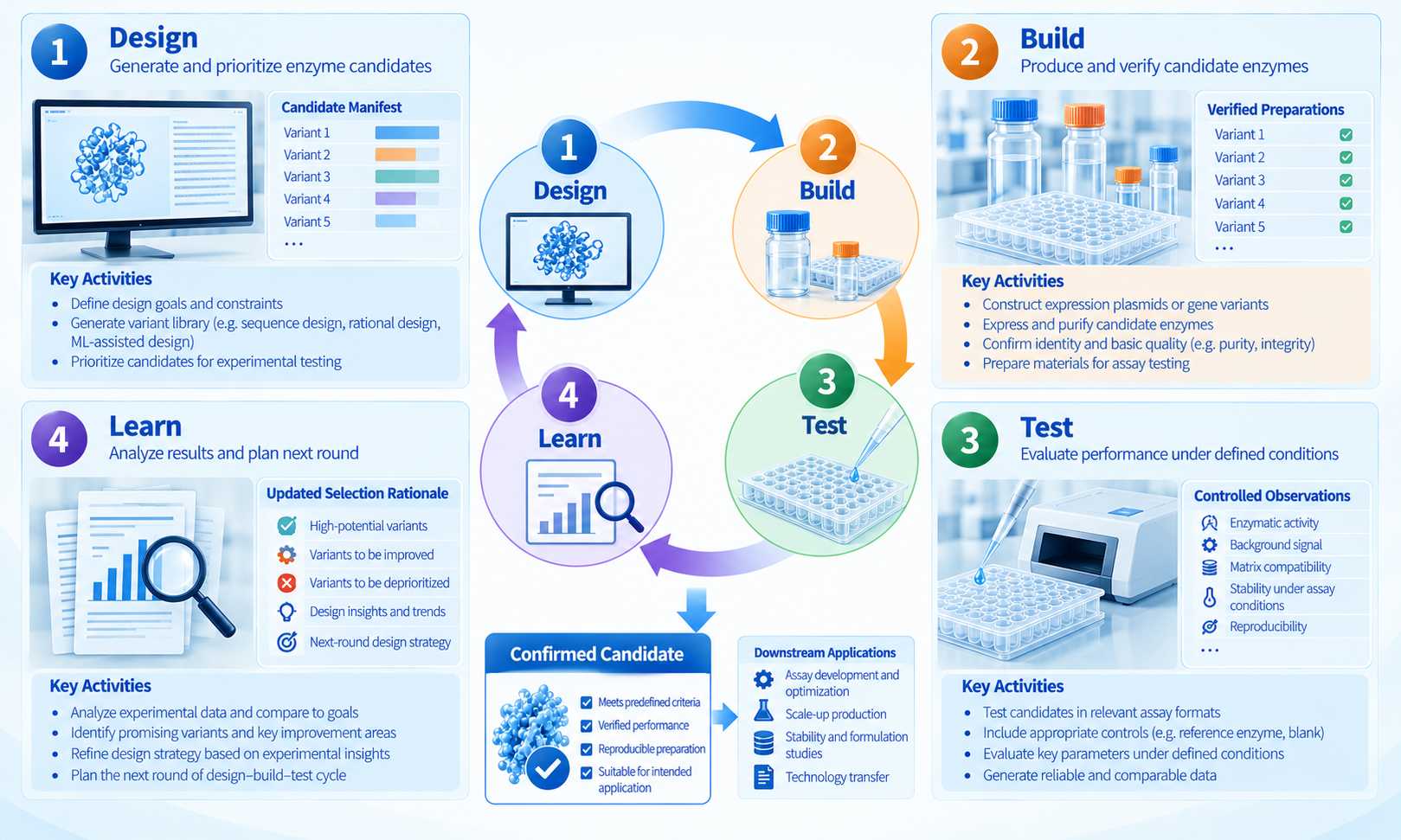
Design a batch that can answer the next question
The candidate list should reflect both the current engineering hypothesis and what remains uncertain. Some candidates may test predicted gains; others may distinguish competing explanations or extend the sampled sequence region. Document why each group is included. A list selected solely because it is easy to generate may be poorly matched to the available assay capacity.
Ding and colleagues explicitly considered predicted fitness and sequence diversity in combinatorial library design. The broader planning lesson is to avoid spending the entire batch on nearly redundant candidates when the model is uncertain. The appropriate diversity depends on the scaffold, constraints and cost of a failed experiment. It is not a fixed percentage that transfers between projects.
Record substitutions relative to a single, versioned reference and retain the full intended sequence. Mutation labels alone can become ambiguous when parents change between rounds. Distinguish a new combination from a previously measured sequence, and document any constraints on the regions being changed.
Freeze the batch manifest and selection method before the corresponding measurements are available. This makes it possible to evaluate whether the selection policy helped. Changes made for build feasibility should remain visible in the record, including planned candidates that were not made. Otherwise, the final dataset may suggest a cleaner and more successful selection process than actually occurred.
| Output | Purpose |
|---|---|
| Candidate manifest | Full sequence, reference version, candidate identity and rationale. |
| Comparison plan | Reference materials, baseline selection and the planned comparison basis. |
| Constraints | Required retained properties and reasons for excluding particular designs. |
| Decision rules | Conditions for repeat testing, advancement and changing the next batch. |
Build traceable material and record unsuccessful outcomes
Link the requested sequence, verified construct and tested preparation with stable identifiers. Keep preparation batches separate even when they share the same sequence. A repeated preparation can help determine whether a response follows the sequence or a production event.
Capture relevant expression, purification and handling information at a level that supports interpretation. The amount of material, concentration method and storage history can matter when comparing responses. If the test uses crude material, state that explicitly and consider how variation in the surrounding material could affect the readout.
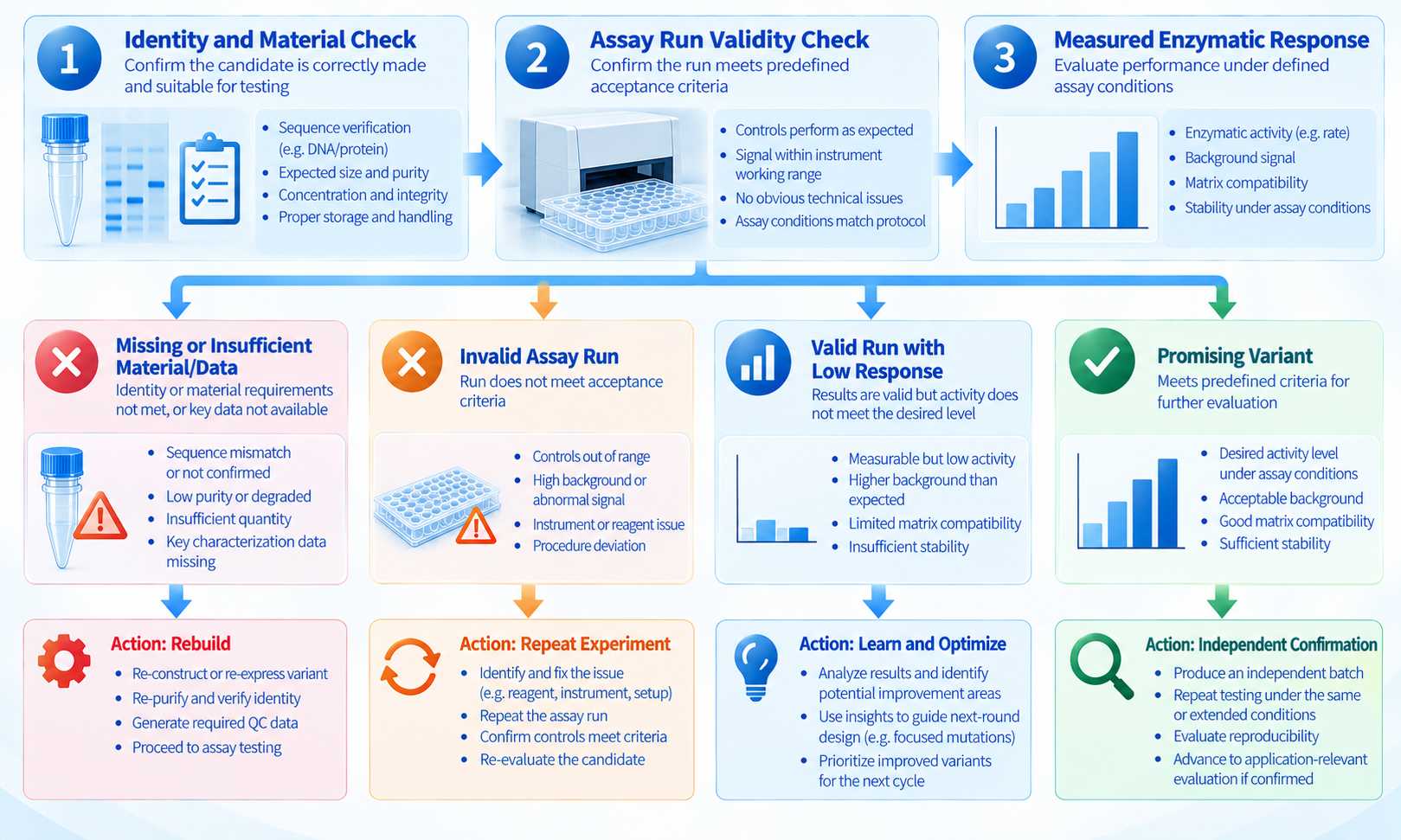
A failed build, insufficient soluble material and a valid measurement of low activity are different outcomes. Do not encode all three as zero activity. Missing or uninterpretable measurements need a reason code, while a measured value below a method's quantification range needs its limit and treatment recorded. The next analysis can then use the information appropriately instead of learning a false sequence-function relationship.
Keep the workflow reproducible when automation is used. Singh and colleagues demonstrated integrated modeling and laboratory automation in two enzyme-engineering examples. For a diagnostic-development team, that work supports the possibility of connecting stages more tightly. It does not remove the need to define assay meaning, review exceptions or establish suitability for the intended diagnostic system.
Test for an interpretable difference
Place suitable reference and blank controls within each run. Where the assay supports it, include a control that distinguishes low from high response. Distribute candidates and controls so that a plate position or processing order does not coincide with one design group. If practical constraints prevent full randomization, document the arrangement and examine the associated effect.
Zhang and colleagues introduced a screening-quality statistic based on signal separation and variability. That principle is useful when assessing whether a screen can distinguish responses. A favorable control statistic alone does not prove that small differences among variants are reproducible, or that the screen predicts performance in the final assay.
Choose replication to address the uncertainty that matters. Repeated readings of one well primarily address reading variation. Replicate reaction setups address another source of variation, and independent preparations address still another. Report which level was repeated instead of using an unqualified replicate count.
Keep the analysis method stable while evaluating a round. Define blank treatment, normalization, exclusion rules and how values outside the usable range will be handled. Inspect raw observations alongside the summary response. A saturated endpoint can hide differences, while a change in background can create a misleading normalized gain.
Use a reference measured in the same run to monitor drift, but retain both raw and normalized values. If a run fails its predefined quality checks, investigate or repeat it before turning its values into training labels. Do not normalize away a failure merely to make the round look comparable with earlier data.
| Observation | Interpretation to preserve | Next action |
|---|---|---|
| Required material is unavailable | No valid activity conclusion. | Resolve the build or mark the candidate untested. |
| Reference or blank behavior is unacceptable | Run validity is uncertain. | Investigate the method and repeat as appropriate. |
| Low response in a valid run | Potentially useful negative evidence. | Retain the result with its measurement limits. |
| Promising response in the primary screen | Candidate for further evaluation. | Repeat with appropriate independence and confirm retained properties. |
Learn from the round before proposing more sequences
Begin with data reconciliation. Check that each observation maps to the intended preparation and sequence, that units and conditions are consistent, and that excluded data retain an explanation. Review missingness by design group. A model trained only on the easiest variants to produce may reflect that selection history.
Compare predictions with the new measurements using the method that was defined before testing. Examine the selected batch as well as the overall fit. If the top predictions fail, ask whether the cause was poor labels, extrapolation, a preparation issue or an unsuitable objective. A more complex model is only one possible response and may not address the actual problem.
Update the dataset without erasing its chronology. Earlier rounds can be informative, but a changed assay or preparation method may require a bridge comparison before pooling. Include the reference under both conditions and document what can be compared. When conditions cannot be reconciled, keep separate tasks rather than pretending the labels are interchangeable.
Active learning uses the updated evidence to choose later experiments. The selection policy may balance expected improvement with information about uncertain regions. Yang and colleagues examined these choices in an enzyme-evolution setting. For local use, compare the policy with a reasonable baseline and preserve the distinction between improving predictions and improving the best confirmed candidate.
At the end of the review, write a short decision: which hypothesis gained support, which assumption failed and what the next batch will resolve. The next round should differ for an explicit reason. Repeating candidate generation without this review can produce more data without improving understanding.
Confirm the candidate and know when to stop
Keep final confirmation separate from the experiments used repeatedly to steer the search. Rebuild or prepare selected candidates independently where appropriate, include the original reference and use the application-relevant evaluation planned at the outset. Confirm both the desired property and the constraints that governed selection.
The strongest screen result deserves particular care because selection favors unusually high observations as well as genuinely improved variants. Repeat evidence helps distinguish these possibilities. If the apparent gain disappears, retain that result and revise the interpretation rather than silently replacing it with the favorable screen value.
Stop or redirect when the program has answered its decision question, when repeated rounds fail to produce useful confirmed gains, or when the measurement cannot resolve the proposed improvement. A plateau may call for a different scaffold, a better assay or a formulation change. It does not automatically justify broader mutation or more candidates.
For a diagnostic enzyme, confirmation in an isolated reaction is still distinct from evaluation in the final reagent system. Carry the selected sequence, preparation details, methods, raw evidence and remaining limits into the next development stage. The workflow should make that handoff easier to review, not imply that the complete assay has already been validated.
Use AI-Ready Experimental Dataset Design for Enzyme Optimization for the data structure behind the cycle and AI Models for Diagnostic Enzyme Variant Design for model evaluation choices. The AI-Driven Enzyme Engineering Resource Center provides the surrounding application and project-planning guides.
Sources and further reading
- Wu Z and colleagues. Machine learning-assisted directed protein evolution with combinatorial libraries. PNAS. 2019;116:8852-8858. DOI: 10.1073/pnas.1901979116.
- Yang J and colleagues. Active learning-assisted directed evolution. Nature Communications. 2025;16:714. DOI: 10.1038/s41467-025-55987-8.
- Ding K and colleagues. Machine learning-guided co-optimization of fitness and diversity facilitates combinatorial library design in enzyme engineering. Nature Communications. 2024;15:6392. DOI: 10.1038/s41467-024-50698-y.
- Singh N and colleagues. A generalized platform for artificial intelligence-powered autonomous enzyme engineering. Nature Communications. 2025;16:5648. DOI: 10.1038/s41467-025-61209-y.
- Zhang JH, Chung TDY, Oldenburg KR. A Simple Statistical Parameter for Use in Evaluation and Validation of High Throughput Screening Assays. Journal of Biomolecular Screening. 1999;4:67-73. DOI: 10.1177/108705719900400206.