

Recent CRISPR diagnostic research is improving how target recognition, amplification and signal generation work together. The most useful advances remove a defined workflow constraint. A lower detection limit in a prepared reaction is valuable, but does not by itself establish a practical diagnostic test.
This focused review covers selected primary studies and scholarly analysis available through October 20, 2026. It compares technical approaches rather than ranking products. The practical assessment distinguishes reaction performance, specimen performance and evidence from intended use.
Start with the reaction that produces the measured signal
A CRISPR assay uses a guide-directed recognition event to connect a target sequence with a measurable output. In many diagnostic designs, target recognition activates collateral cleavage of reporter molecules. This signal-generating reaction must be distinguished from target amplification, which increases the amount of material available for recognition.
That distinction changes how a paper should be read. A strong signal can reflect more target, faster reporter turnover, lower background or a more sensitive detector. These improvements solve different problems. Compare assays only after identifying the sample volume, preparation, amplification stages, detection time and decision rule.
The review by van Dongen and Segerink emphasizes the relationship between low target abundance and enzyme kinetics. Its translational lesson is that biochemical specificity is only one requirement. A test must obtain enough useful information from the available specimen within the intended time.
For development teams, the first question is therefore operational: which step currently prevents the assay from meeting its intended use? If extraction loses most of the target, changing reporter chemistry may not address the dominant limitation. If handling creates contamination, improving analytical sensitivity can make the consequences more apparent.
One-pot systems must manage reactions that can interfere
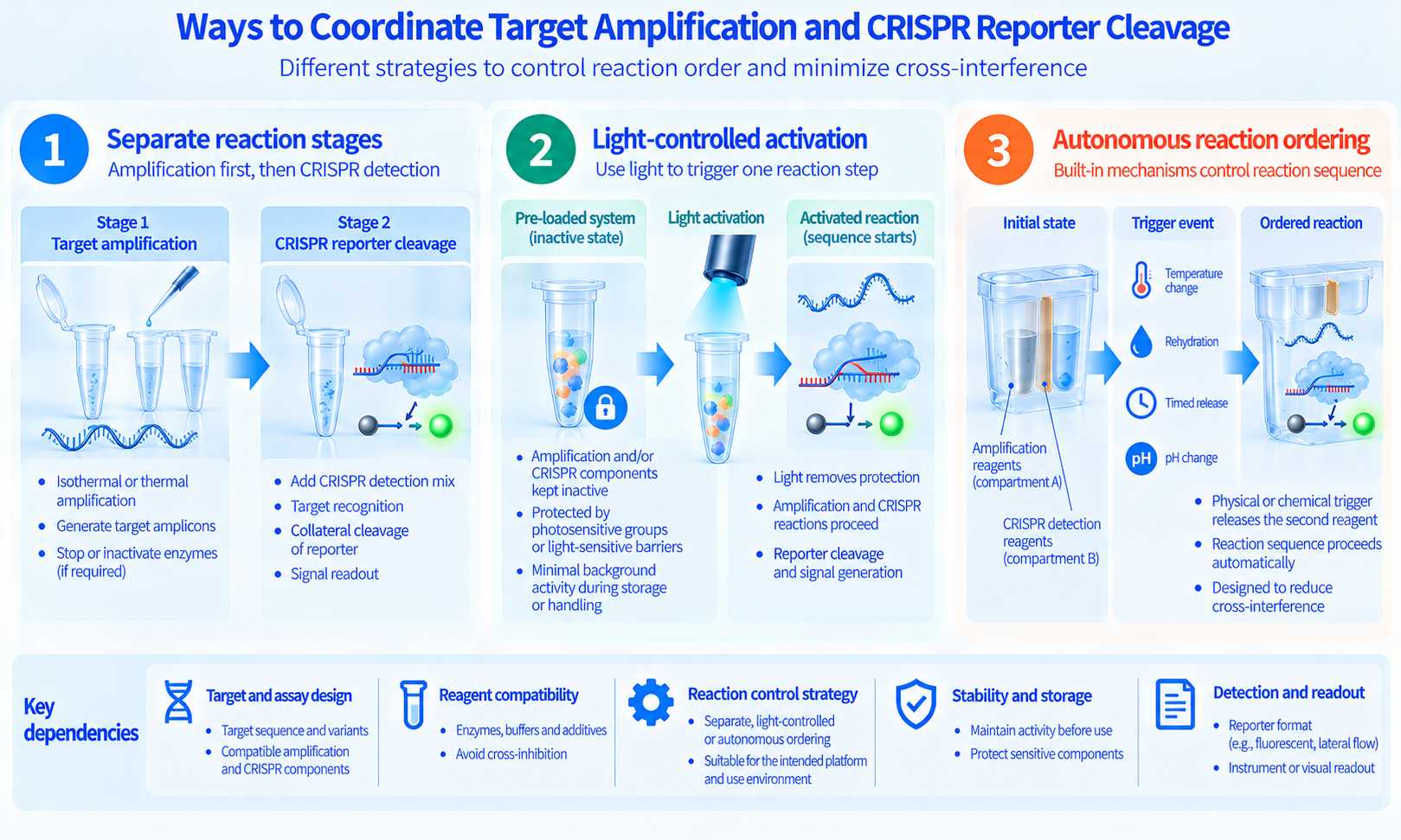
Combining amplification and CRISPR detection reduces transfers, but the component reactions do not automatically cooperate. They can compete for substrates or require different conditions. Cleavage can also affect material needed for amplification. A single tube is a packaging description; compatibility is a biochemical result.
A 2025 study of photo-controlled Cas12a guide activity used light-dependent activation to separate processes in time. This illustrates a controlled-start approach: preserve amplification before enabling the detection reaction. The extra requirement is an activation step whose timing and illumination must be reproducible.
The 2026 thermodynamically programmed platform used reaction design to organize amplification and signal transduction within one environment. Its demonstrations included several target contexts and integration into a microfluidic format. The relevant advance is coordinated reaction behavior, not proof that the same design can be transferred unchanged to every target.
These approaches should be compared through their complete operating requirements. External activation can provide direct control but adds hardware or an operator action. Autonomous ordering can simplify handling but makes performance dependent on the reaction network. Neither approach removes the need to evaluate target concentration, sequence variation and reagent variability.
A useful confirmation experiment should challenge the proposed benefit itself. For a closed-tube design, evaluate whether the final workflow really avoids opening amplified material. For an activation design, examine the permitted operating window. Do not infer workflow robustness from a successful reaction at one carefully chosen condition.
Amplification-free does not mean amplification of no kind
Target-amplification-free assays avoid making additional copies of the target nucleic acid. They may still amplify the signal through catalytic turnover, cascades, concentration steps or sensitive measurement. This terminology matters because two nominally amplification-free methods may have very different complexity and background behavior.
The 2025 CRISPR-CasPhi study investigated enhanced collateral cleavage for pathogen detection without target amplification. It demonstrates a route to stronger output from a defined recognition system. It should not be interpreted as evidence that all low-abundance specimens can bypass enrichment or preparation.
Another 2025 study examined multiple guides in Cas12a detection. Improved reaction behavior was context-dependent, and the magnitude of kinetic benefit differed from earlier expectations. This is a useful reminder that adding guides is a design variable, not a guaranteed multiplication of sensitivity.
Read detection-limit claims with their denominator intact. Concentration in the final reaction, concentration in the original specimen and the total number of molecules processed are different quantities. A large processed volume or a concentration step may explain part of an apparent improvement.
For an intended application, decide whether avoiding amplification actually improves the service. It may reduce carryover risk or simplify timing, while imposing stronger demands on sample recovery and detection hardware. The comparison should include failed runs and invalid results rather than only the best positive traces.
The specimen and the device remain part of the assay
| System boundary | Question to resolve | Evidence to seek |
|---|---|---|
| Specimen preparation | Does the target reach the reaction in a usable form? | Recovery and inhibition assessment in relevant specimens. |
| Integrated reaction | Do components cooperate across the intended range? | Low-target performance, negative specimens and component variability. |
| Readout | Can the signal be interpreted consistently? | Locked thresholds, instrument or reader variation and ambiguous outcomes. |
| Operation | Can intended users perform the complete test? | Handling, invalid-rate and environmental evaluations. |
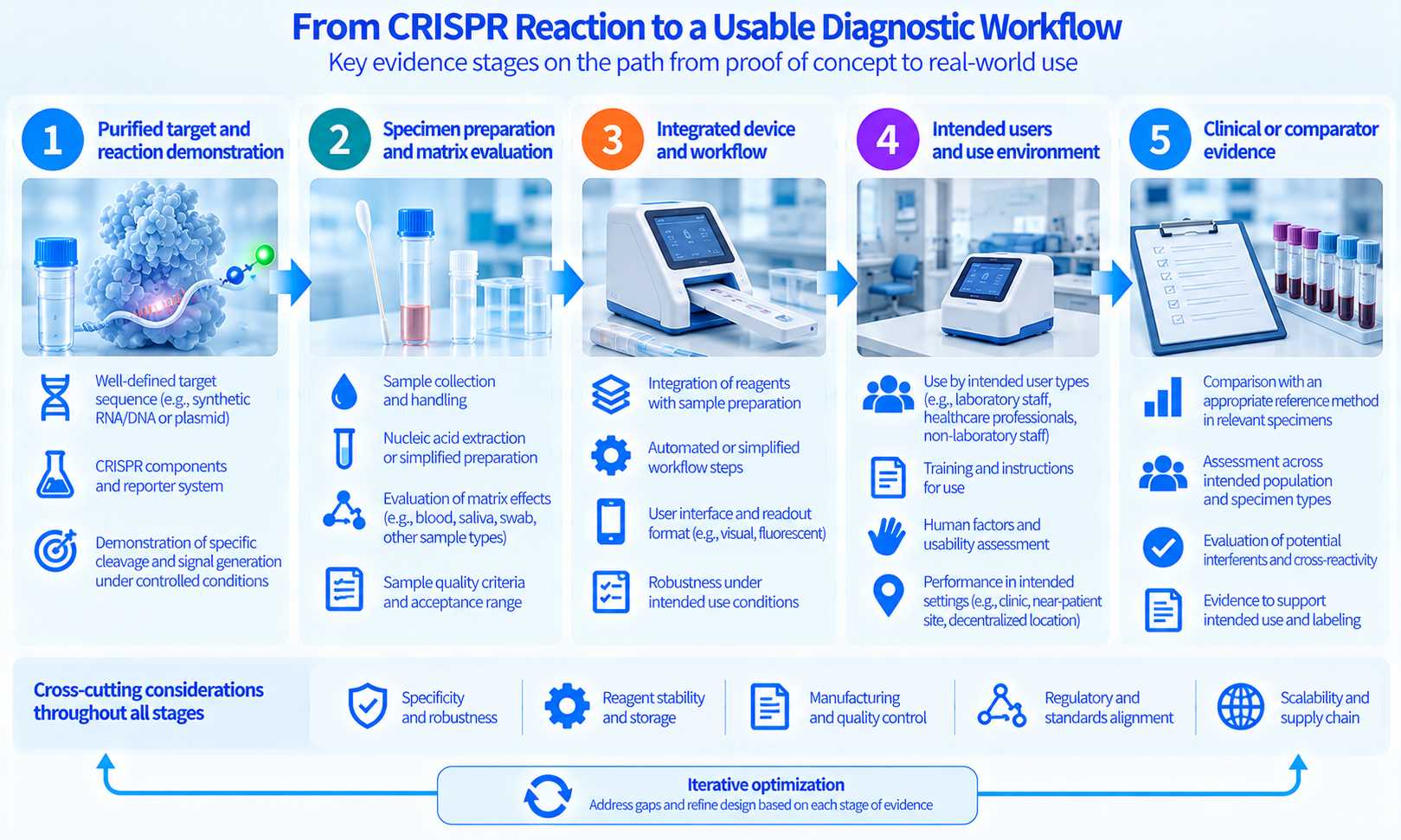
An extracted clinical specimen provides stronger matrix relevance than a purified synthetic target, but it does not necessarily demonstrate sample-to-answer operation. Keep extraction equipment, heat treatment, pipetting and preparation time visible in the workflow description.
Readout also affects the claim. A fluorescence instrument, a lateral-flow strip and a camera-based system can present different sources of variation. A simple-looking result is not automatically an objective result; the decision rule and treatment of borderline signals still need to be specified.
Packaging and storage can change the reaction balance that made integration possible. If several enzymes and guide reagents are combined, their retained functions must be assessed together. Stability of an isolated component does not establish stability of the finished detection system.
Clinical evidence needs a defined comparison and denominator
Clinical specimens are important, but the phrase clinical validation can conceal very different study designs. Ask whether specimens were selected retrospectively, whether readers knew comparator results, and whether the intended population and concentration range were represented. A feasibility panel cannot answer every question about routine performance.
Distinguish analytical sensitivity from clinical sensitivity. The former concerns detection under specified measurement conditions; the latter depends on the disease definition, population, specimen collection and reference method. An assay can perform well analytically and still miss cases because the sampled material does not contain sufficient target.
Report invalid and indeterminate outcomes separately from valid negatives. Excluding difficult specimens without explanation can make a promising chemistry appear more reliable than its operational workflow. Discordant results need a predefined investigation strategy rather than selective retesting until agreement improves.
For variant discrimination or genotyping, challenge relevant neighboring sequences and mixtures. Recognition of the intended sequence is only half of the question; unintended activation can matter just as much. The required discrimination depends on the clinical decision and cannot be inferred from one mismatch demonstration.
Choose the next study by the claim it would support
A development decision should name the specific improvement sought: fewer handling steps, a shorter usable turnaround time, improved discrimination or better recovery at low target abundance. Then select a study that can distinguish the proposed improvement from an alternative explanation.
Keep the comparator realistic. Compare complete workflows under matched specimen and interpretation conditions where possible. A purified-target experiment remains useful for mechanism work, provided it is not presented as equivalent to a clinical workflow comparison.
The strongest direction in the selected literature is better coordination across components. Whether achieved through guide control, reaction ordering or enhanced signal generation, the value must survive specimen preparation, packaging and use. These are proposed evaluation priorities derived from the evidence, not a validated universal development sequence.
For the wider deployment context, see Molecular Point-of-Care Diagnostics Trends. The parent Technical Articles, Literature Reviews and Industry Insights connects this review with related technology and implementation analyses.
Record remaining uncertainties before selecting the next experiment.
Sources and further reading
- Original research. Thermodynamically programmed one-pot CRISPR platform for point-of-care SNP genotyping. Nature Communications. 2026..
- Original research. Identification of a key nucleotide influencing Cas12a crRNA activity for universal photo-controlled CRISPR diagnostics. Nature Communications. 2025..
- Original research. Ultrasensitive detection of clinical pathogens through a target-amplification-free collateral-cleavage-enhancing CRISPR-CasPhi tool. Nature Communications. 2025..
- Original research. Sensitive pathogen DNA detection by a multi-guide RNA Cas12a assay favoring trans- versus cis-cleavage. Nature Communications. 2025..
- van Dongen and Segerink. Building the Future of Clinical Diagnostics: An Analysis of Potential Benefits and Current Barriers in CRISPR/Cas Diagnostics. 2025..