

Molecular point-of-care development is increasingly a question of workflow integration: how to obtain a suitable specimen, process it reliably, run the reaction and deliver a result while it can still inform care. A short amplification time matters, but it is only one part of that sequence.
This narrative review examines developments and implementation questions using evidence available through October 9, 2026. It covers professional near-patient testing and relevant home-use distinctions, with WHO policy and US guidance as examples rather than universal rules for every market.
Define where the test will run and what must happen next
A primary-care clinic, an emergency department, a peripheral laboratory and a home are different operating environments. They differ in staffing, specimen collection, available equipment and the route for follow-up. A platform that fits one setting may be unsuitable for another despite using the same molecular chemistry.
Distinguish reaction time, sample-to-result time and time to clinical action. The first begins after a prepared sample enters the analytical process. The second includes preparation and processing. The third also depends on ordering, queues, communication and whether a responsible person can act on the result.
This distinction changes development priorities. Saving a few minutes in amplification may offer little benefit if collection or reporting dominates the delay. In another workflow, a result delivered before the patient leaves may avoid a separate visit. The appropriate endpoint depends on the use case rather than the instrument label.
Define the fallback route at the same time as the desired workflow. Invalid results, unavailable consumables and results requiring confirmation still occur. A near-patient service needs a practical path for those cases instead of assuming that every specimen produces a final answer on the first attempt.
A 2026 example links test location with specimen access
In March 2026, WHO announced recommendations for a new near-point-of-care nucleic acid amplification test class for initial TB detection at peripheral levels of the health system. The stated class concerns TB detection without rifampicin-resistance detection. That boundary matters when interpreting what a simpler test can replace and what additional testing may still be needed.
The announcement also addresses tongue-swab specimens for defined uses in adults and adolescents unable to produce sputum, as well as a separate sputum-pooling strategy. These are distinct recommendations. They should not be collapsed into a claim that any swab can be used with any molecular TB test.
For developers, the broader lesson is that access can improve through the specimen pathway as well as the instrument. Easier collection may change the target concentration, matrix and preparation requirements entering the reaction. Those consequences must be evaluated in the actual assay.
WHO's recommendation is a policy development, not proof of universal implementation or a commercial forecast. Local programmes still need to evaluate readiness, training and the testing algorithm. The technical opportunity is to fit an identified service need, while retaining the intended-use and evidence boundaries of the recommended approach.
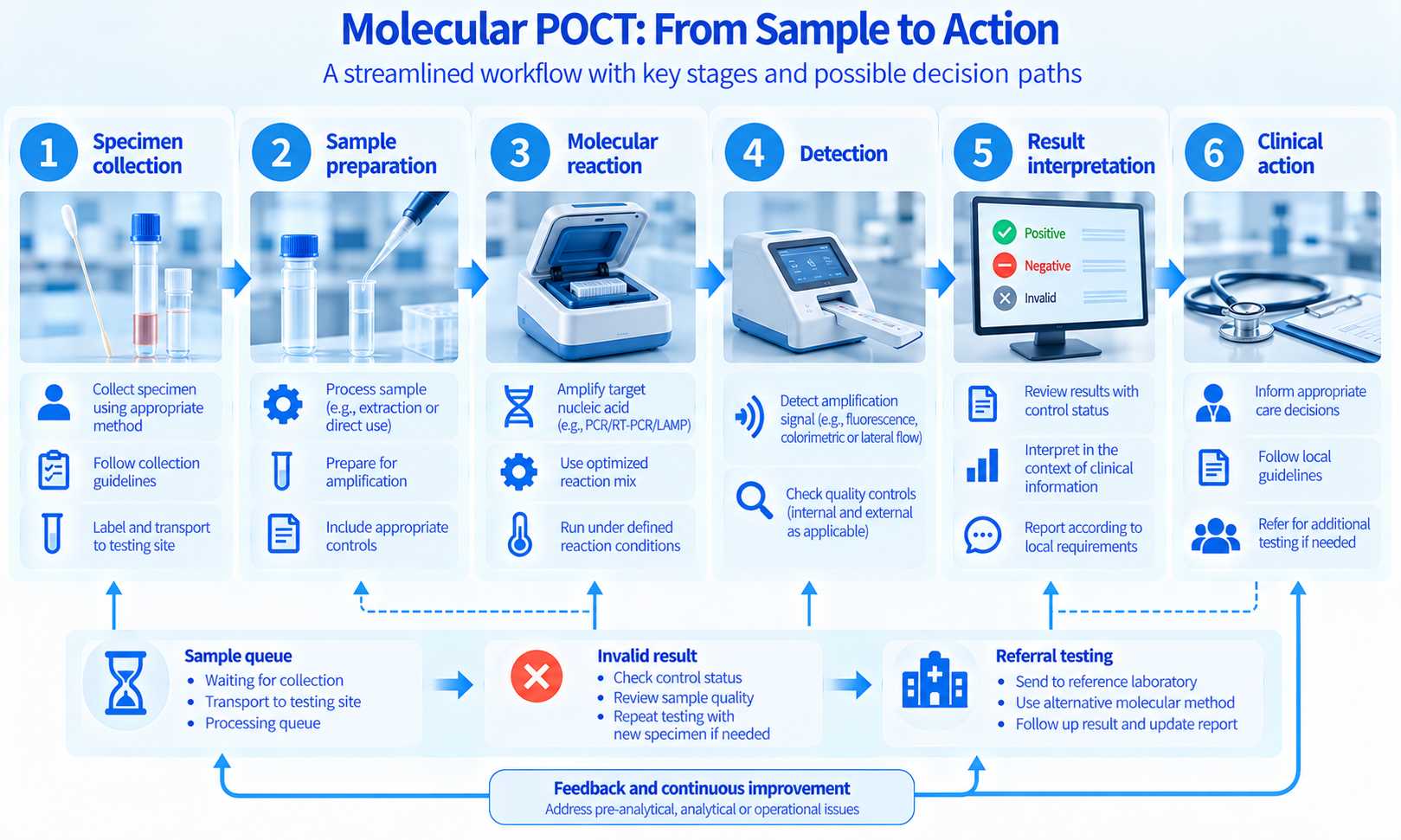
Integration moves complexity from the operator into the system
| Workflow step | Development direction | Question for the reagent system |
|---|---|---|
| Specimen preparation | Fewer manual transfers or preparation within a closed device. | Does the reaction tolerate the actual processed matrix and residual preparation chemistry? |
| Reaction initiation | Predispensed components and controlled activation. | Do mixing, reconstitution and start timing preserve the intended response? |
| Amplification | Compact thermal cycling or an isothermal architecture. | Does the enzyme system work under the device temperature and timing profile? |
| Detection and interpretation | Integrated optical or other automated readout. | Can weak targets, background and invalid runs be distinguished reliably? |
A closed workflow can reduce operator handling, but the cartridge or instrument must perform the operations that were removed. Reagent delivery, fluid movement and timing become part of assay performance. Testing a liquid mix outside the device is therefore only one stage of development.
PCR and isothermal amplification offer different engineering options. Notomi and colleagues' original LAMP work established a strand-displacing amplification architecture. It supports the underlying mechanism, not the conclusion that all isothermal devices are simpler, more sensitive or less expensive than thermal-cycling devices.
Enzyme selection should follow the complete architecture. A simplified preparation can increase exposure to inhibitors. A dried presentation introduces manufacturing and reconstitution questions. A short reaction may be especially sensitive to mixing and temperature equilibration. These trade-offs should be evaluated together rather than optimized in isolation.
The Direct PCR and Sample-Tolerant Enzyme Guide addresses reduced-preparation workflows. Storage and distribution are treated separately in Decentralized Diagnostics and Ambient-Stable Reagents, because a test that is easy to operate can still be difficult to supply reliably.
More targets are useful only when the additional results matter
Multiplexing can make better use of a limited specimen and distinguish conditions with similar presentations. It also adds development work: target interactions, analytical specificity, uneven abundance and interpretation of multiple positive results need evaluation in the final panel.
Choose the panel around a defined decision. A focused set of actionable targets may fit a particular consultation better than a broad panel whose additional findings do not change management. A broad panel can be useful in another setting. Target count alone is not a measure of diagnostic value.
Assess throughput as well as the time required for one test. A fast single-position device can become a bottleneck during a surge. Parallel capacity, operator time, invalid repeats and consumable availability affect the number of usable results delivered during a shift.
For enzyme developers, the relevant challenge is preserving the vulnerable target in the complete mixture. Strong single-target performance does not establish performance when another target is abundant. The Multiplex Assay Cross-Talk and Competition Troubleshooting guide provides a mechanism-based investigation when interactions emerge.
Usability and quality control must travel with the assay
Evaluate the actions the intended operator actually performs: specimen collection, transfer, loading, timing, reading and disposal. A step that looks trivial to a development scientist can be a consequential source of error in another setting. Instructions and device design should be evaluated together.
FDA's CLIA-waiver guidance considers the performance of tests intended to be simple and to present an insignificant risk of erroneous results, including evaluation with intended users. This US framework is distinct from authorization for over-the-counter home use. Neither follows automatically from a compact instrument or a low number of manual steps.
Controls should support a defined interpretation. A reaction control can indicate whether a particular process worked, but it may not establish correct collection or sufficient target recovery. Specify what an invalid result means and how the operator should proceed within the validated workflow.
Land and colleagues' REASSURED perspective highlights the wider diagnostic system, including connectivity. Electronic reporting can support result delivery and quality oversight, but it requires workable identification, data handling and support. Connectivity should improve the service without making routine testing depend on a fragile connection where offline operation is needed.
Plan training and quality oversight for the actual turnover of staff and distribution of sites. Simplicity at the point of use does not remove responsibility for reagent storage, maintenance, records or external support. These are implementation requirements that a reaction-speed comparison cannot capture.
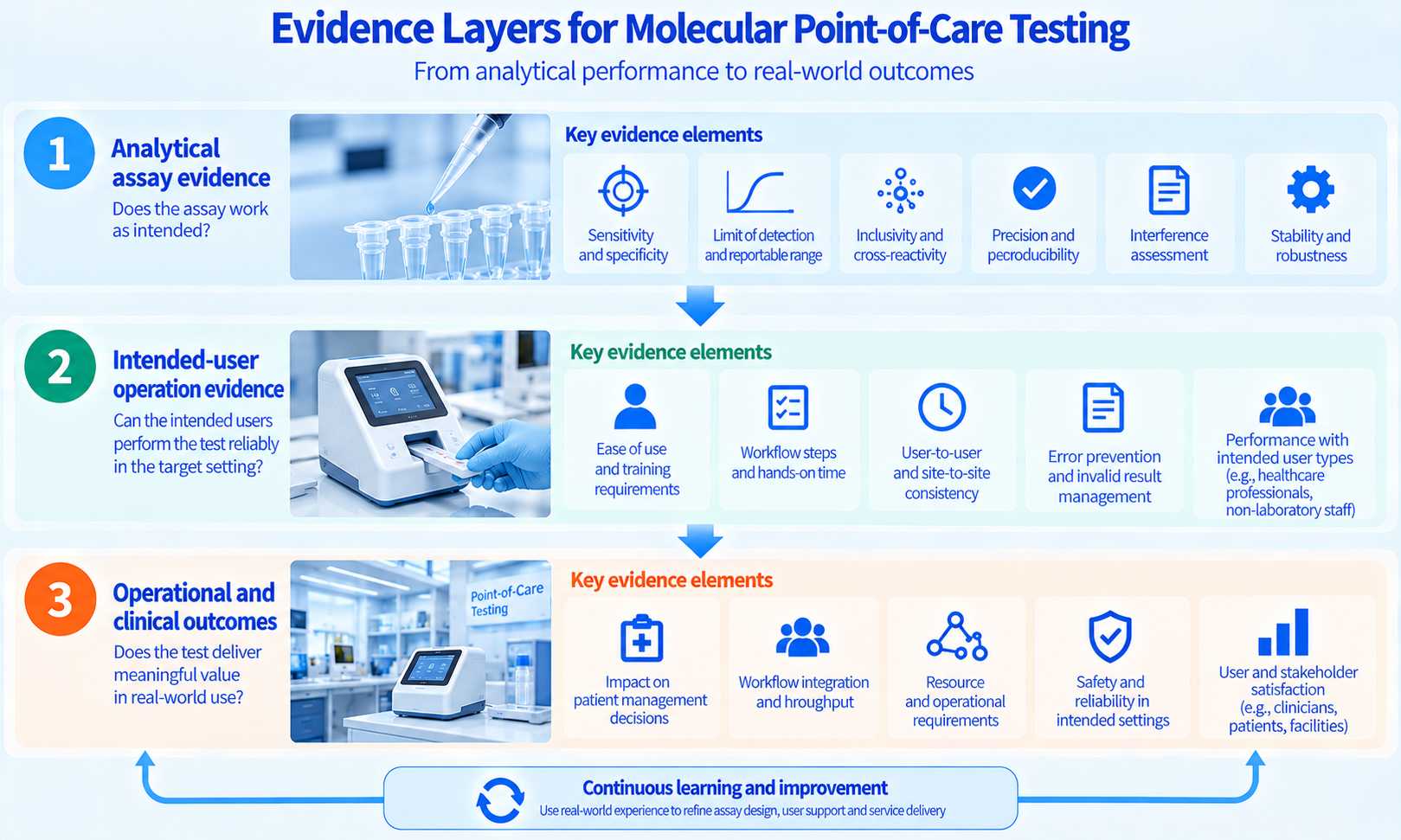
Measure benefit beyond analytical speed
The ResPOC randomized trial offers a useful caution. In adults presenting to a hospital with acute respiratory illness, molecular point-of-care testing delivered faster results, but it did not reduce the proportion receiving antibiotics or overall antibiotic duration. The study did identify other changes, including more brief antibiotic courses. Its findings are specific to that population and workflow.
The implication is not that rapid testing lacks value. It is that analytical information must arrive at the right point in a decision process, and its effect needs measurement. A diagnostic accuracy study and a study of treatment decisions answer different questions.
For a proposed service, define outcomes such as usable results during the visit, time to an appropriate decision, invalid-result frequency, referral completion and total operating burden. Select those that match the intended purpose. Avoid claiming patient benefit solely from a lower analytical detection limit.
The strongest development direction combines an appropriate molecular method with a workable specimen route, intended-user evidence and a service able to act on results. The Technical Articles, Literature Reviews and Industry Insights centre connects these questions to the wider diagnostic-enzyme literature without treating a technology demonstration as proof of routine effectiveness.
Sources and further reading
- World Health Organization. WHO recommends near point-of-care tests, tongue swabs, and sputum pooling for TB diagnosis. March 9, 2026..
- US Food and Drug Administration. Recommendations for Clinical Laboratory Improvement Amendments of 1988 (CLIA) Waiver Applications for Manufacturers of In Vitro Diagnostic Devices. February 2020..
- Brendish NJ and colleagues. Routine molecular point-of-care testing for respiratory viruses in adults presenting to hospital with acute respiratory illness (ResPOC): a pragmatic, open-label, randomised controlled trial. Lancet Respiratory Medicine. 2017;5:401-411..
- Land KJ and colleagues. REASSURED diagnostics to inform disease control strategies, strengthen health systems and improve patient outcomes. Nature Microbiology. 2019;4:46-54..
- Notomi T and colleagues. Loop-mediated isothermal amplification of DNA. Nucleic Acids Research. 2000;28:e63. DOI: 10.1093/nar/28.12.e63.