

Enzyme-based biosensors connect selective biochemical reactions with compact electrical or optical readouts. Recent work is expanding where measurements can be made, particularly in wearable and oral formats. The critical question is whether the measured signal supports a useful result in the intended specimen and setting.
This application-focused review considers literature and official material available through October 20, 2026. It separates established point-of-care testing principles from emerging monitoring concepts. Continuous sensing, portable instrumentation and clinical diagnostic utility are treated as distinct achievements.
An enzyme provides selectivity within a larger measurement system
An enzyme-based biosensor uses catalytic activity as part of recognizing or measuring an analyte. In an electrochemical design, the reaction is coupled to a measurable electrical response. The signal may depend on a reaction product, a mediator or another electron-transfer route; the exact architecture determines its limitations.
Glucose oxidase and lactate oxidase illustrate this principle, but the enzyme name alone does not describe the device. The electrode, membrane, immobilization method, readout and calibration all contribute. Two sensors containing the same enzyme can therefore respond differently to the same specimen.
Distinguish enzymes used to measure their substrates from enzyme labels used to amplify an affinity-binding event. Both are enzyme-based sensing, but their selectivity arises through different mechanisms. A material that mimics enzyme catalysis is also not automatically equivalent to a protein enzyme.
For a development comparison, describe the chain from sample contact to reported result. Identify which element is being improved and which must remain fixed to interpret the experiment. An increase in current can reflect greater catalytic conversion, altered transport or an electrode effect, rather than better analyte specificity.
Recent applications span different levels of maturity
| Application | Useful measurement goal | Important boundary |
|---|---|---|
| Discrete glucose POCT | A result from a defined blood specimen and intended operator workflow. | Prescription use and lay-user home use are not interchangeable evaluation settings. |
| Wearable sweat sensing | Tracking selected metabolites and local conditions over time. | Sweat concentration does not automatically represent a blood concentration. |
| Oral-fluid devices | Accessible sampling and local or systemic biomarker research. | Oral conditions and the proposed clinical relationship need separate evidence. |
| On-chip metabolic sensing | Monitoring a controlled biological research system. | A research platform is not a patient-facing POCT validation. |
The 2024 review by Khumngern and Jeerapan describes enzyme-material integration and energy-harvesting approaches for on-body devices. Its value is to connect materials, catalysis and usable sensor formats. The studies it discusses differ in specimen handling and maturity, so the review should not be read as a list of clinically interchangeable products.
Gao and colleagues' earlier integrated perspiration array remains a useful foundational example. It combined metabolite, electrolyte and temperature measurements in a wearable platform. That achievement demonstrates integration; it does not establish that each sweat measurement can replace a corresponding blood test.
A 2026 review of oral and craniofacial applications extends the application discussion to accessible oral environments. Enzyme-based glucose concepts sit alongside other recognition mechanisms. The relevant opportunity is easier access to a sample, while the relevant uncertainty is what that sample means for the intended decision.
The 2026 organ-on-chip review provides a useful contrast. Continuous metabolic measurements can be valuable in controlled research systems even when they are not clinical diagnostics. Keeping this category separate prevents laboratory monitoring successes from being misrepresented as POCT adoption.
The enzyme-electrode interface is often the decisive engineering layer
Immobilization must retain useful catalytic function while positioning the reaction where the transducer can detect it. More enzyme loading is not always better. A dense layer may alter substrate access or create a response that is less useful over the required concentration range.
Materials choices can change conductivity, surface accessibility and mechanical behavior. Those changes can help a wearable format, but they can also introduce variation in coating, adhesion or transport. A fair comparison should separate material-only responses from enzyme-dependent responses.
For oxidase systems that use oxygen in their catalytic pathway, oxygen availability can become part of the measurement context. The importance depends on the sensor architecture and operating conditions. Evaluate the actual design rather than assigning a single oxygen-sensitivity statement to every enzyme-based sensor.
Interfering electroactive substances can also contribute to the measured response. Selectivity must therefore be assessed at the device level, not inferred solely from enzyme substrate preference. Membranes, potentials and mediators may alter which interferents matter.
As a practical recommendation, compare the sensor before and after the relevant manufacturing and storage processes. A coating that performs well immediately after preparation may behave differently after drying, packaging or mechanical use. The finished interface is the unit that needs evidence.
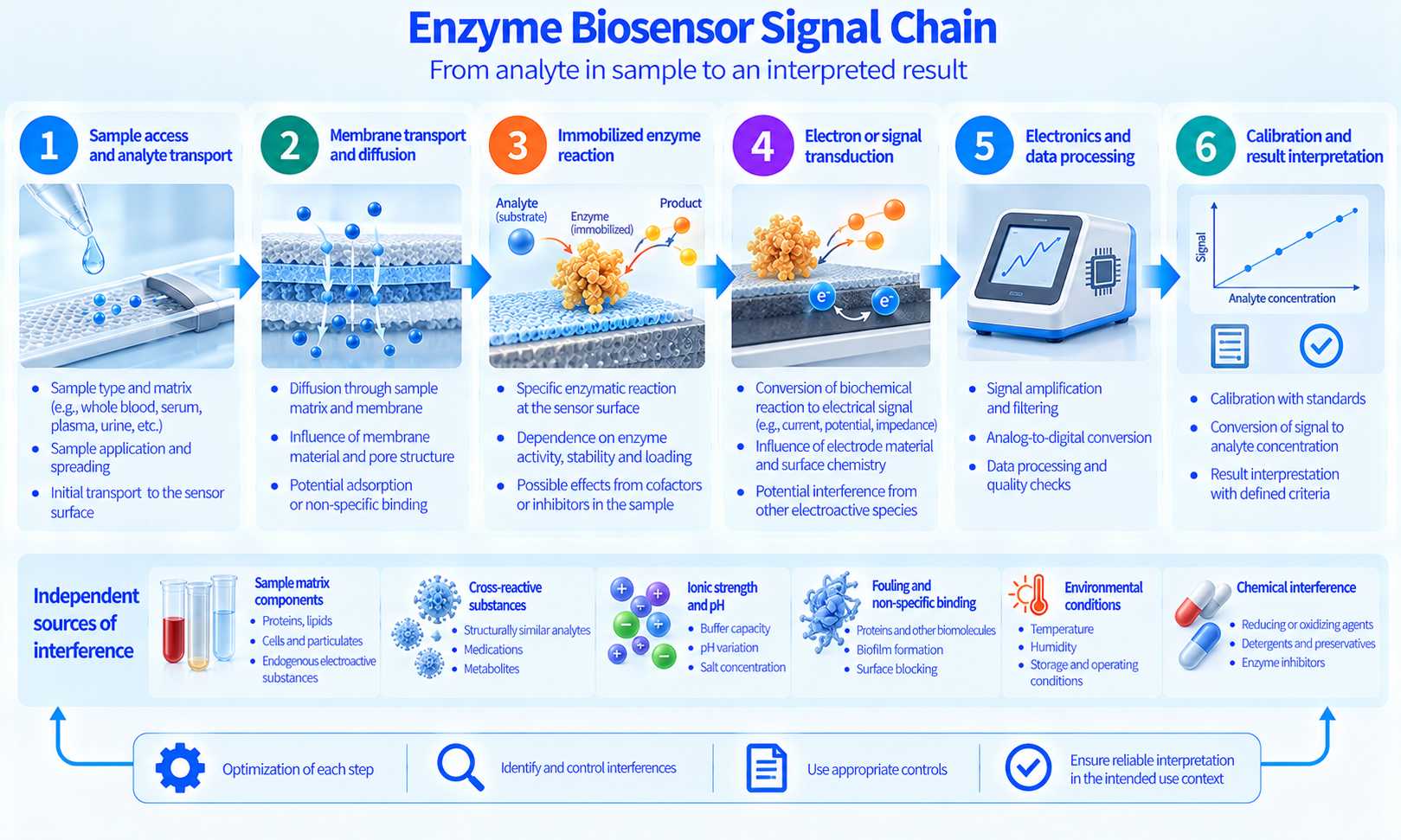
A convenient specimen is not automatically a clinically equivalent specimen
Sweat, saliva, interstitial fluid and blood have different biological and sampling contexts. A sensor may accurately measure an analyte in one fluid without establishing a reliable estimate of its concentration in another. That relationship requires its own study and cannot be supplied by a calibration curve in buffer.
For sweat measurements, collection conditions and local physiology can influence the sample reaching the sensor. Time-dependent signals should therefore be interpreted with the sampling process visible. A change during exercise may reflect several linked processes rather than a single systemic concentration.
Oral sensing brings a different set of conditions, including intermittent sample contact and changes in the local environment. The intended use should distinguish a local oral measurement from an inference about systemic disease or metabolism.
When reviewing a clinical correlation, examine paired sampling, timing and the population studied. Agreement in a narrow experimental setting may not persist across the wider intended range. Correlation alone also does not establish acceptable error for a clinical decision.
These distinctions do not diminish the value of exploratory sensors. They identify the appropriate next question. A device can be useful for investigating biomarker behavior before there is evidence for a clinical threshold or a replacement for an established test.
Portable sensing still requires calibration, quality control and usable handling
The FDA's prescription point-of-care glucose guidance provides a concrete example of an intended-use-specific evaluation framework. It is separate from guidance for over-the-counter self-monitoring systems. That distinction is important when a paper uses point of care as a broad description of compact instrumentation.
For other sensor types, define the user, specimen and result before selecting an evaluation plan. A trained operator performing a single test and a person wearing a continuous device create different handling and interpretation requirements.
Calibration drift should be distinguished from a genuine biological change. Consider the reference signal, sensor-to-sensor variation and the period over which calibration remains applicable. A visually smooth trace is not evidence that drift has been controlled.
Self-powered sensing is an interesting development direction, but an energy-generating component does not establish that the complete device operates reliably. Sampling, sensing, communication and interpretation have their own demands. Assess the integrated system under the intended conditions.
Similarly, a reusable reader with a disposable sensing element requires evidence for both components. Cleaning, replacement, storage and lot differences can influence use. These operational questions belong in the development brief even when the central innovation is biochemical.
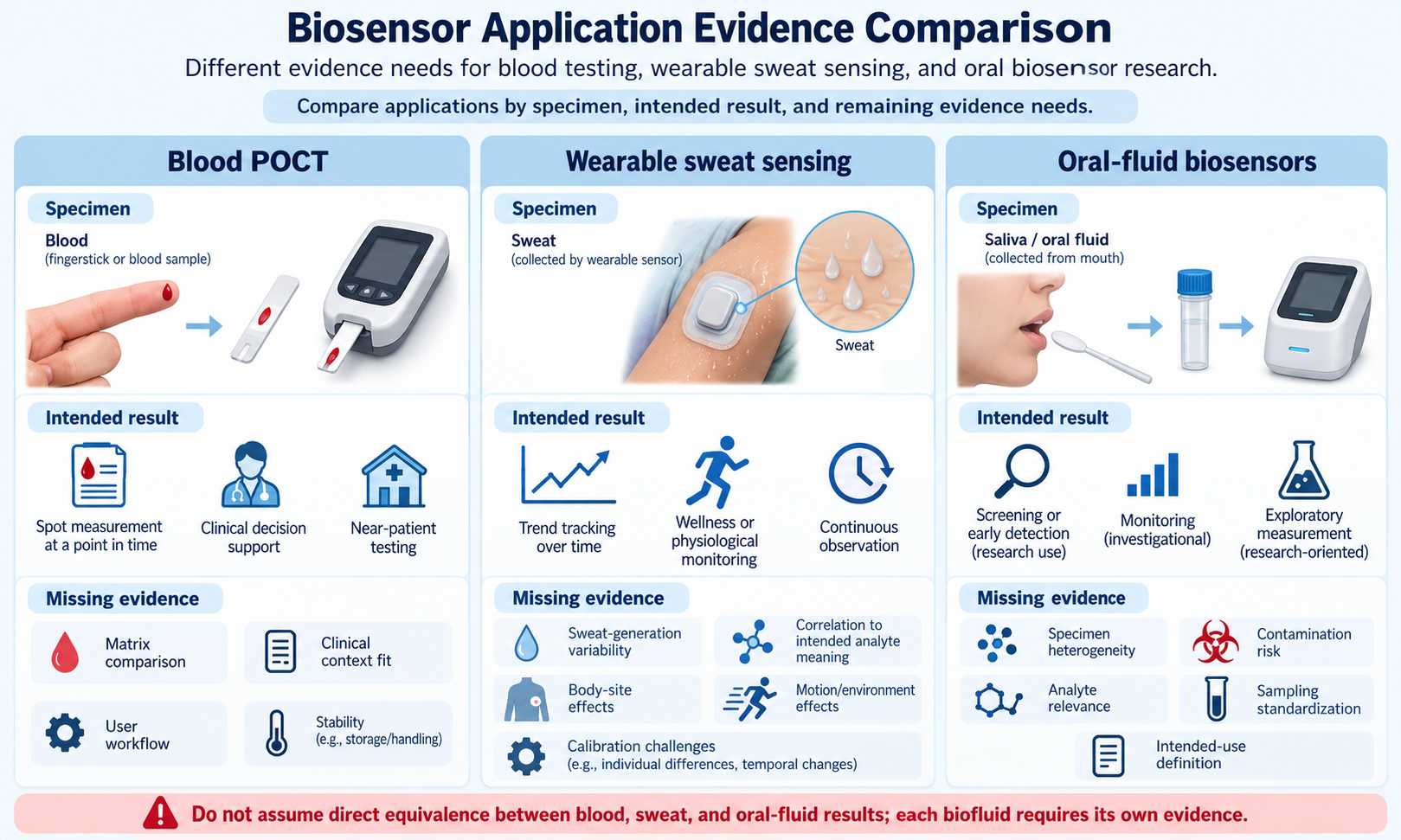
Select the next experiment from the intended result
For a screening concept, begin with a clear analyte response and appropriate negative or interference controls. For a proposed quantitative test, examine measurement error across the intended range and matrix. For a continuous monitor, add time-dependent behavior and the interpretation of changes.
Do not compare detection limits without checking specimen volume, concentration units, calibration conditions and measurement duration. A low limit in buffer can coexist with inadequate discrimination around the range that matters in practice.
The most informative application report connects the enzyme mechanism with an explicit result and a defensible use boundary. It states what was tested, what was inferred and what remains unknown. This makes it possible to identify which advances are ready for assay development and which remain primarily materials or physiology research.
For related deployment considerations, see Decentralized Diagnostics and Ambient-Stable Reagents. Further technology reviews are available through Technical Articles, Literature Reviews and Industry Insights. The development objective is a reliable measurement that answers the intended question, with evidence appropriate to that question.
Sources and further reading
- Khumngern S and Jeerapan I. Synergistic convergence of materials and enzymes for biosensing and self-sustaining energy devices towards on-body health monitoring. Communications Materials. 2024..
- Gao W and colleagues. Fully integrated wearable sensor arrays for multiplexed in situ perspiration analysis. Nature. 2016..
- US Food and Drug Administration. Blood Glucose Monitoring Test Systems for Prescription Point-of-Care Use. Final guidance. September 2020..
- Peer-reviewed review. Biosensors in dental, oral and craniofacial applications. npj Biosensing. 2026..
- Peer-reviewed review. Toward continuous monitoring systems: emerging trends of on-chip sensors in organ-on-a-chip. Microsystems & Nanoengineering. 2026..