

Ambient-stable reagents can make distributed testing easier to supply, but the claim must describe a temperature range, a duration and a product state. A stable enzyme, a stable dried mix and a stable diagnostic kit are different achievements. The weakest required component can still limit the complete workflow.
This deployment-focused review considers published reagent studies and official stability and procurement guidance available through October 9, 2026. It explains how to connect formulation evidence with the route from manufacture to the testing site, without assigning a universal shelf-life or assuming that drying eliminates cold-chain needs.
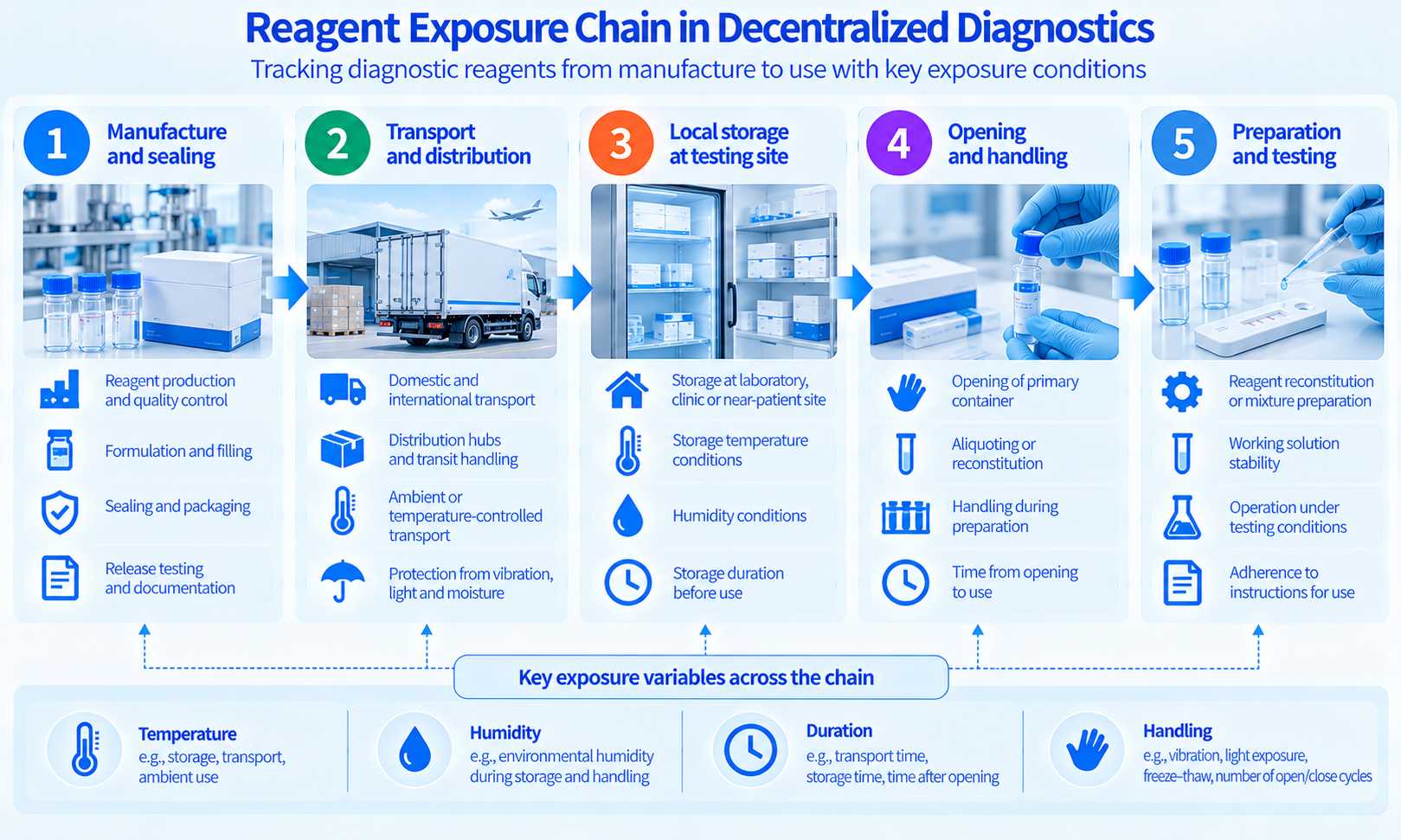
Define ambient conditions along the intended route
Ambient is not a single temperature. A controlled storeroom, an unconditioned clinic and a package in transit can expose the same product to different temperatures and humidity. Start with the intended route and the conditions that need to be supported, rather than choosing a convenient laboratory storage condition and calling it ambient.
Describe the product state at each stage. A sealed dried reagent, an opened pouch and a reconstituted reaction mix no longer have the same protection or expected use period. Record the time between those stages, including delays after receipt and before testing.
Distinguish routine storage from a short excursion. Evidence that a package survives a temporary event does not establish that it can be stored continuously at that condition. Conversely, a routine shelf-life study may not represent the mechanical and thermal sequence of distribution.
WHO's procurement guidance identifies product stability and allowable shelf-life as practical procurement concerns. The development implication is to align the supported storage claim with the service that will receive the product. A technically valid claim can still be unsuitable if too little usable life remains when the shipment reaches a peripheral site.
Evaluate the complete kit, not only the catalytic component
| Object evaluated | Useful conclusion | What remains to be checked |
|---|---|---|
| Purified enzyme | Retained catalytic function under the measured conditions. | Compatibility with the complete formulation and intended assay. |
| Formulated or dried reaction mix | Performance of the specified mixture and preparation. | Final packaging, manufacturing variability and other required kit components. |
| Packaged test components | Performance after the specified storage and distribution exposure. | Opening, preparation and operation by the intended user. |
| Complete deployed test | Usable performance under the defined service conditions. | Other settings or exposures outside the evaluated scope. |
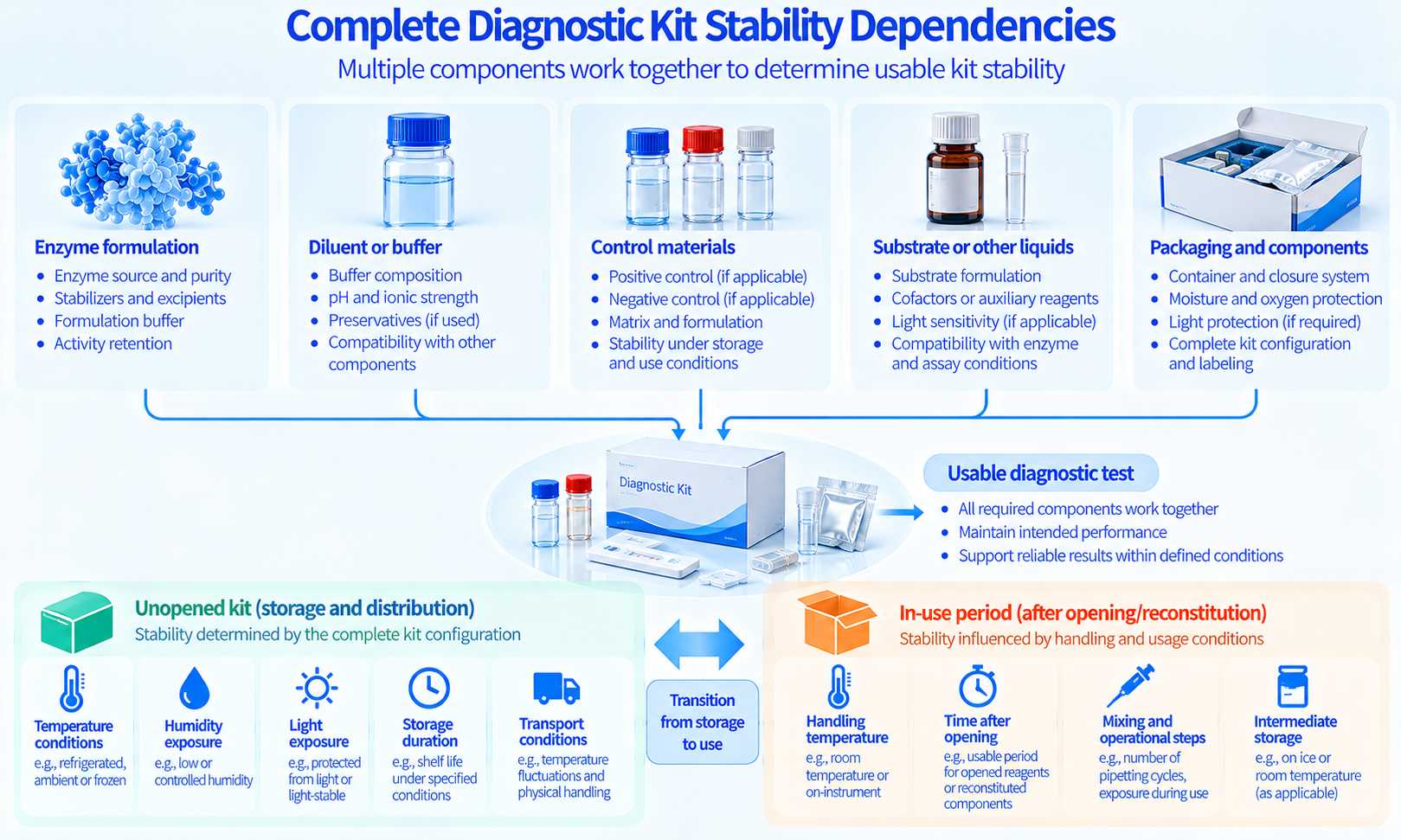
A dried amplification mix may be stable while a required liquid, control material or detection component has a shorter supported life. The kit-level storage instructions must account for everything needed to generate and interpret a result. Separate shipping conditions can also complicate what appears to be a simple ambient product.
Packaging is part of the reagent system. Closure integrity, moisture protection and physical protection can influence what reaches the user. A change in container, fill quantity or pouch configuration should be evaluated for its relevance to the supported claim rather than treated as a purely cosmetic substitution.
The appropriate design need not always be dry. A liquid format may be workable for a particular route if it has adequate evidence and manageable handling requirements. Choose the presentation by the complete use case, including the ability to prepare and dispense it correctly at the site.
Define acceptance through the intended analytical outcome. Residual activity or a satisfactory physical appearance can support an investigation, but neither alone establishes that low-level targets, blanks and relevant controls remain acceptable in the finished assay.
Read dried-reagent studies as bounded demonstrations
Xu and colleagues described freeze-dried PCR mixtures designed for transfer into microfluidic devices. Their study reported room-temperature storage performance for defined preparations and examined accelerated stability testing. It supports the feasibility of integrating dried mixtures into a simplified molecular workflow, not the assignment of the same lifetime to another formulation.
The authors also reported limitations in using a simple temperature-based prediction approach across their tested mixtures. For development planning, the relevant lesson is that accelerated behavior depends on the system. A single assumed acceleration factor should not replace evidence that the model is appropriate for the product and endpoint.
More recently, Qin and colleagues investigated humidity and exposure time during handling and sealing of dried isothermal reagents, alongside enzyme engineering. Published online in 2025 and in a 2026 journal issue, the work illustrates that post-drying processing and enzyme properties can both affect performance. Its specific conditions should not be adopted as a universal manufacturing recipe.
Together, these studies point to an important development direction: formulation, enzyme properties and manufacturing exposure need to be considered together. Improving one element can leave another as the limiting step. This is a synthesis of the studies, not a claim that a particular combination has been validated for every diagnostic format.
When comparing publications, extract the formulation identity, package, tested storage range, measurement endpoint and duration actually observed. Check whether the study used purified target, contrived samples or intended specimens. A report of retained amplification does not necessarily cover every clinical or operational claim attached to a future product.
Build evidence around storage, distribution and use
WHO TGS 2 addresses shelf-life, transport and in-use stability within its IVD prequalification framework. These are related but separate questions. A development plan should identify which evidence supports each proposed statement rather than treating one storage experiment as a substitute for all three.
Use the final product presentation when confirming the intended claim. Earlier screening in laboratory containers can compare formulations, but it may not represent the package or process used for supply. Include relevant production variability and performance endpoints in the confirmation strategy.
Consider the order of exposures. A transport challenge followed by a storage period can answer a different question from storage alone or a challenge applied only at the end. Select combinations that represent the anticipated route and document the rationale. Avoid inventing an extreme scenario that has no connection to the intended use, or ignoring a plausible one because it is inconvenient to test.
CLSI EP25's public scope distinguishes shelf-life from in-use claims. Apply that distinction to opening and preparation: the product may have one period in sealed storage and another after a pouch is opened or liquid is added. Those periods should be supported and communicated separately.
The Accelerated and Real-Time Stability Testing for Diagnostic Reagents guide explains study design in greater depth. For this deployment question, the priority is whether the evidence matches the stated route, state and period, including any remaining uncertainty that affects supply decisions.
Match pack size and preparation to site demand
Small sites may use reagents intermittently. A large pack can reduce unit purchase cost but increase the amount discarded after opening. A single-use format can reduce repeated exposure while increasing packaging and distribution volume. Compare the actual usage pattern rather than assuming that one pack size is always more economical.
Plan the remaining shelf-life at receipt, expected stock turnover and replenishment time. A long laboratory shelf-life can still translate into a short practical use window after manufacturing release, transport and central storage. Inventory visibility and appropriate stock rotation are part of making the stability benefit usable.
If reconstitution is required, evaluate the diluent, volume delivery, mixing and time before use. Determine whether those steps are performed reliably by the intended operator with available supplies. A stable dried bead is of limited value if the field workflow cannot prepare it consistently.
Make the storage instructions actionable. Staff need to know where the product can be kept, how opening affects the use period and what to do when an exposure falls outside the supported conditions. An ambient claim does not remove the need to monitor and respond to conditions relevant to that claim.
Separate reagent robustness from the rest of the service. Instruments may still need reliable power or maintenance; specimen handling may still require equipment. The Molecular Point-of-Care Diagnostics Trends article addresses those wider workflow requirements without assuming that an ambient reagent makes the entire test infrastructure-free.
Assess the value as reliable usable testing capacity
Evaluate the benefit in terms of tests that can be supplied and used correctly. Reduced dependence on refrigeration may be valuable, but it should be weighed with packaging, expiry losses, preparation burden and the consequences of invalid results. A storage improvement is meaningful when it reduces a real constraint in the intended service.
Use a deployment brief that states the testing volume, replenishment route, expected environmental profile, operator tasks and required remaining life at receipt. These inputs allow formulation and packaging teams to work toward a defined requirement rather than an ambiguous request for room-temperature stability.
Confirm the claimed benefit with the final kit and relevant operating conditions. If performance deteriorates unexpectedly, the Shelf-Life Failure Analysis for Diagnostic Reagents guide provides an investigation path. If the system is still being developed, the Ambient-Stable Molecular Diagnostic Reagent Development Guide addresses the formulation programme.
Ambient-stable reagents are therefore an enabling component of decentralized diagnostics. Their value depends on a supported environmental claim, a usable presentation and a supply system that preserves both. The objective is dependable testing at the intended site, not simply removing a refrigerator from a product description.
Sources and further reading
- World Health Organization. Guidance for procurement of in vitro diagnostics and related laboratory items and equipment. May 29, 2017..
- World Health Organization. TGS 2: Establishing stability of in vitro diagnostic medical devices. 2018. WHO/BS/2017.2304 Rev. 1..
- Xu J and colleagues. Transferable, easy-to-use and room-temperature-storable PCR mixes for microfluidic molecular diagnostics. Talanta. 2021;235:122797..
- Qin H and colleagues. Exposure humidity and time control of lyophilization and enzyme engineering for stable isothermal nucleic acid detection reagents. Preparative Biochemistry & Biotechnology. 2026;56:1099-1108. Online November 25, 2025..
- Clinical and Laboratory Standards Institute. EP25: Evaluation of Stability of In Vitro Medical Laboratory Test Reagents. Published April 26, 2023..