

An essential diagnostic is useful only when people can obtain a reliable result and the health service can act on it. In low-resource settings, test selection therefore needs to consider specimen access, staffing, quality control, supply and referral alongside analytical performance.
This guide reviews WHO material available through October 20, 2026. It uses the current electronic Essential Diagnostics List as a planning reference, then asks what is needed to deliver testing locally. Low-resource describes specific constraints, not a uniform country category or a reason to accept unreliable results.
Begin with the decision the test must support
Describe the health problem, intended population and decision that a result will inform. A screening service, a confirmatory test and treatment monitoring may require different turnaround times and referral arrangements even when they measure a related analyte.
The electronic WHO database currently identifies itself as the fifth Model List of Essential In Vitro Diagnostics. It provides filters for laboratory and non-laboratory settings, specimen types and levels of testing service. These are useful planning dimensions; the list is not a purchasing catalogue for named products.
National and local priorities still need to reflect disease burden and the existing health system. WHO's diagnostics-capacity work explicitly connects selection with national needs, quality and implementation. Listing a test category does not demonstrate that a particular clinic can operate it successfully.
Keep three questions separate: is the test needed, is a suitable product available, and can the service deliver it? A strong answer to the first question does not resolve the other two. This separation helps avoid buying equipment before the specimen, staffing and treatment pathways are ready.
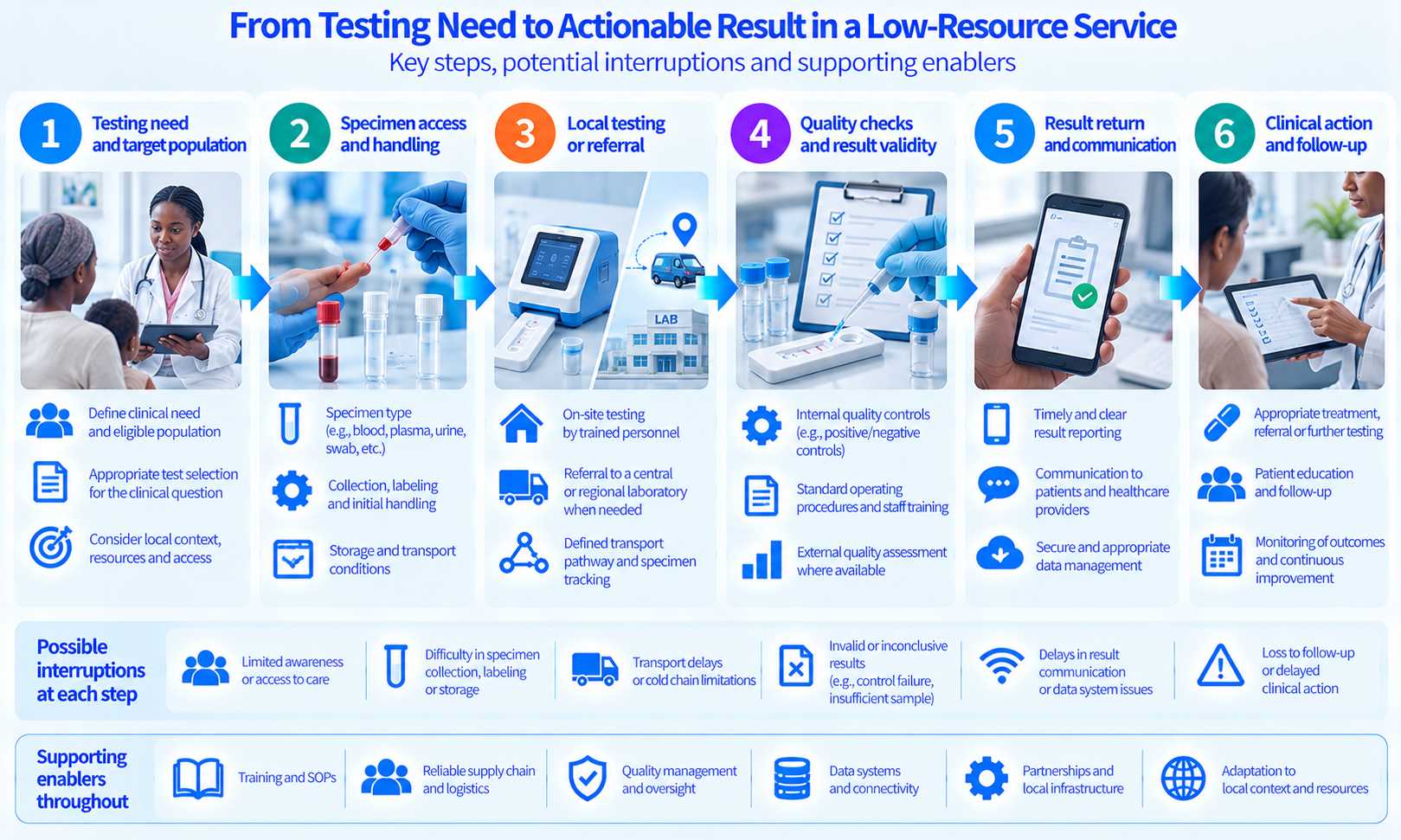
Choose local testing and referral as parts of one network
Not every essential test belongs at every site. A local test may shorten time to action, while a referral laboratory may provide capabilities that cannot be sustained at low throughput. The appropriate design depends on urgency, access and the reliability of the complete route.
Map the journey of the specimen and the result. A technically good referral test can have limited value if specimens are delayed or results do not return. Conversely, a local instrument can be underused if collection is difficult or the clinical team cannot act on its result.
WHO's March 2026 TB announcement illustrates how test access and specimen options can evolve together. Its near-point-of-care and sampling recommendations have defined scopes. They should prompt a programme-specific review, not an assumption that every new molecular technology is suitable for peripheral deployment.
For a proposed local service, compare the achievable turnaround time with the actual decision window. Include preparation, queues, repeats and result communication. Instrument run time alone is an incomplete measure of whether the test changes access.
Also define what happens when local testing fails or produces an unresolved result. A referral route remains useful even when testing is decentralized. The service should have a clear way to recover from an invalid run rather than leaving the patient to navigate the failure.
Describe the site through observable operating conditions
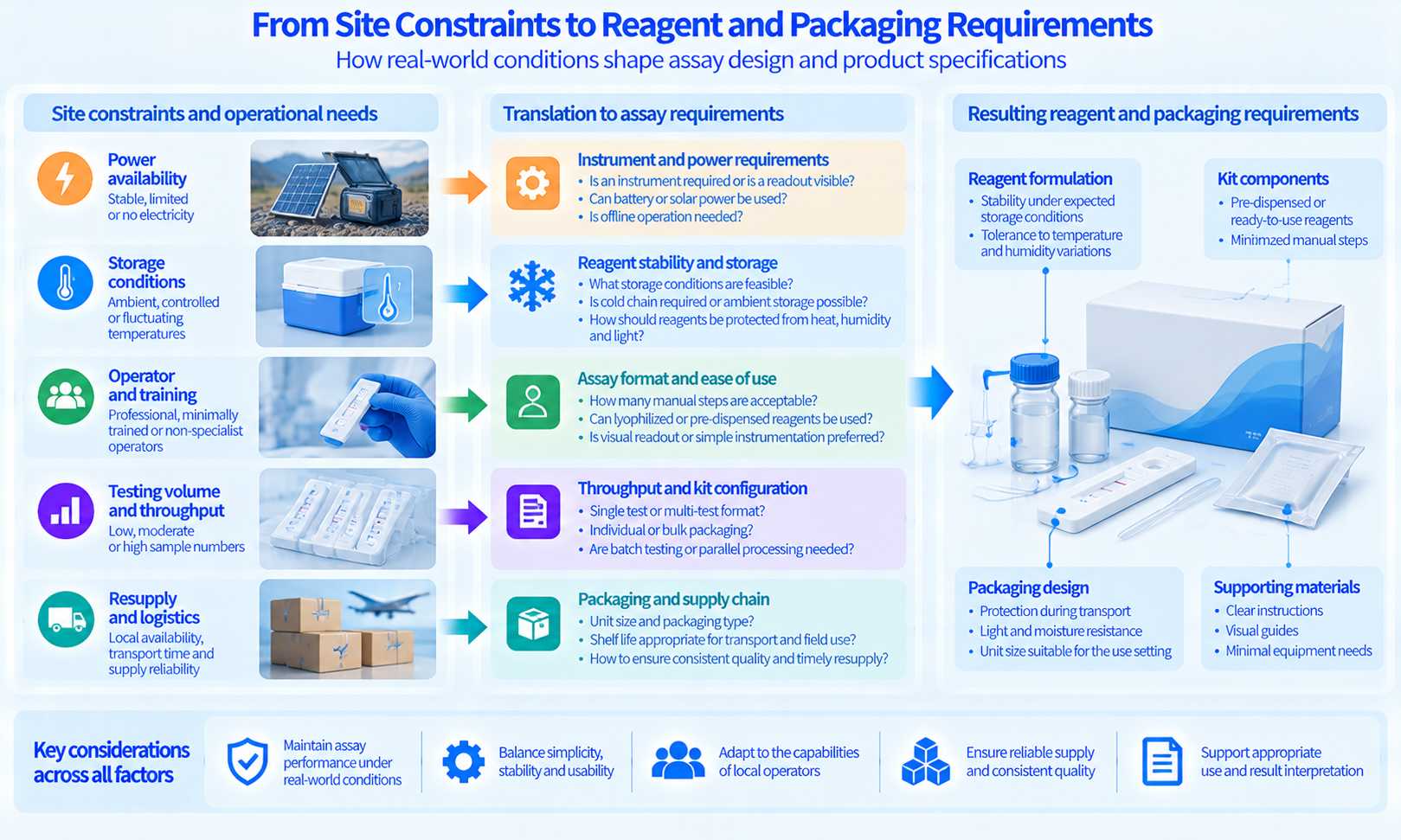
| Constraint | Question to document | Possible design implication |
|---|---|---|
| Power and equipment | What interruptions and maintenance support are realistic? | Select an operating format and recovery process suited to the site. |
| Storage and transport | What temperatures, durations and exposures occur? | Define supported storage, packaging and excursion requirements. |
| Operator workload | Which steps can be performed consistently? | Reduce sensitive handling steps and verify instructions. |
| Testing volume | How often is testing needed and in what batch sizes? | Align pack size, open-pack life and stock rotation. |
| Specimen access | What can be collected and prepared reliably? | Match the validated specimen pathway rather than substituting informally. |
Avoid replacing a site assessment with an assumed room-temperature requirement. The route may include central storage, transport and intermittent use under different conditions. The intended product state also matters: sealed, opened and prepared reagents can have different limits.
Operator requirements should be described as tasks, not vague training labels. Identify volume transfers, timing decisions, result interpretation and waste handling. A short procedure can still contain a difficult step that determines performance.
The same applies to connectivity. If reporting depends on a network connection, define the offline behavior and the way results are reconciled later. Reliable data return is part of the service even when it is outside the enzyme formulation team's work.
Compare the cost of a usable result
WHO's procurement guidance emphasizes products appropriate to their intended setting. For a practical comparison, consider the resources consumed to obtain and report usable results, not only the purchase price of a kit or instrument.
Relevant costs can include controls, consumables, maintenance, staff time, transport, expiry losses and repeats. These are proposed planning categories rather than a universal costing formula. Their importance depends on the test and site.
Low-volume sites may face a different trade-off from high-volume laboratories. A large pack can have a favorable unit price while producing more waste after opening. A small pack can reduce waste but increase packaging or distribution costs.
Product quality assessment is another separate question. WHO prequalification evaluates eligible products within its programme; EDL inclusion concerns test categories. Neither should be confused with automatic approval of an enzyme raw material or a guarantee that every product in the category meets a site's needs.
Before procurement, identify who will support installation, training, troubleshooting and replacement. A contract that supplies reagents but leaves essential service gaps unresolved can create an interruption even when deliveries arrive on time.
Translate service requirements into enzyme-system requirements
For an enzyme-based assay, begin with the complete reaction and the intended specimen. The relevant requirement may be retained performance after storage, tolerance of a preparation method, consistent signal or fewer handling steps. Higher isolated-enzyme activity is not necessarily the limiting improvement.
Write measurable development inputs without inventing acceptance values. Specify the environmental conditions to investigate, the intended operating interval and the specimens that represent use. The assay developer must establish suitable performance criteria for the final test.
Stability should cover the required components and final package. A stable catalytic enzyme does not compensate for an unstable substrate, control or diluent. Likewise, a dried mix that requires difficult reconstitution may shift the burden from storage to operation.
The Decentralized Diagnostics and Ambient-Stable Reagents article examines these storage and packaging relationships in more detail. Here, the priority is selecting the requirement from a real service constraint rather than developing an attractive property without a use case.
Confirm that the proposed service works under intended conditions
A staged implementation should examine analytical performance, handling and service continuity together. Record invalid runs, stock interruptions and result-return problems as well as successful tests. These observations distinguish reagent limitations from failures elsewhere in the pathway.
Quality control and external quality assessment, where applicable, need an operating plan and resources. Simplified testing does not remove the need to detect problems. Responsibilities should remain clear when testing moves away from a central laboratory.
Use early experience to revise the service design. Repeated expiry losses may indicate unsuitable pack size or forecasting. Delayed action may indicate a reporting or referral problem. These issues call for different responses and should not all be attributed to test chemistry.
The most useful development brief connects the essential need, intended site, complete workflow and evidence still required. It enables reagent scientists and programme planners to work toward the same outcome: reliable testing that reaches the intended population.
For adjacent technology analyses, see Technical Articles, Literature Reviews and Industry Insights. Essential diagnostics planning is ultimately a service-design task supported by appropriate products, rather than a list of technologies to purchase.
Sources and further reading
- World Health Organization. Fifth WHO Model List of Essential In Vitro Diagnostics: electronic database. Accessed October 20, 2026..
- World Health Organization. Strengthening diagnostics capacity. Accessed October 20, 2026..
- World Health Organization. Guidance for procurement of in vitro diagnostics and related laboratory items and equipment. Accessed October 20, 2026..
- World Health Organization. Prequalification of In Vitro Diagnostics. Accessed October 20, 2026..
- World Health Organization. WHO recommends near-point-of-care tests, tongue swabs and sputum pooling for TB diagnosis. Accessed October 20, 2026..