

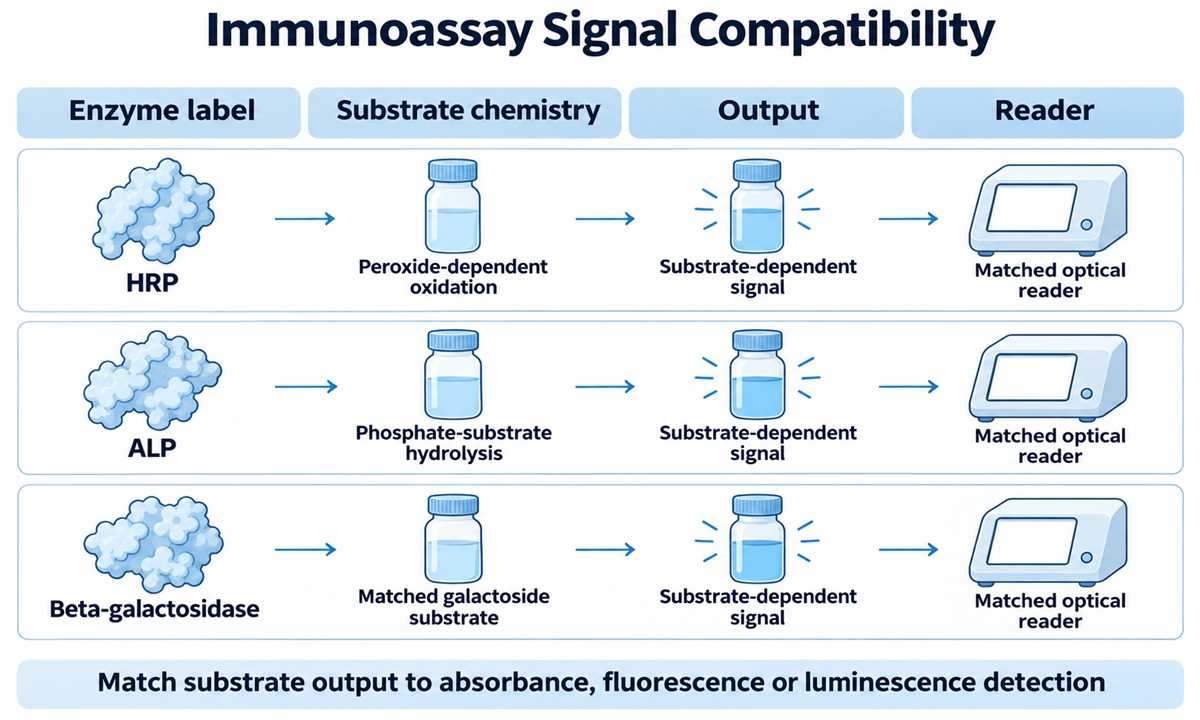
Horseradish peroxidase (HRP) and alkaline phosphatase (ALP, also called AP) are signal-generating labels. Their usefulness depends on the substrate, conjugate, assay format and reader. Selecting the enzyme name alone does not define the sensitivity or reliability of an immunoassay.
These answers focus on enzyme-linked immunosorbent assays (ELISA), chemiluminescent immunoassays and related formats. They help distinguish a signal-chemistry problem from an antibody-binding or specimen problem, so that the next comparison tests a clear hypothesis.
Choose a label in its assay context
What does HRP do in an immunoassay?
HRP catalyses oxidation of a suitable substrate using hydrogen peroxide. The IUBMB entry includes tetramethylbenzidine, commonly abbreviated TMB, among substrates used by peroxidases. In an immunoassay, the amount of retained label contributes to the measured response. The relationship between that response and analyte concentration still depends on the binding format and calibration.
How is ALP signal chemistry different from HRP chemistry?
ALP hydrolyses phosphate monoesters, whereas HRP uses peroxide-dependent oxidation. The substrate must be appropriate for the chosen catalyst. A substrate reagent intended for one label cannot be assumed to work with the other. Changing the label therefore requires reconsidering the reaction conditions and measurement system, rather than simply exchanging the enzyme stock.
Are AP and ALP different immunoassay labels?
Both abbreviations commonly refer to alkaline phosphatase in this context. However, a shared name does not establish that two preparations have the same source, formulation or application behavior. Confirm the material identity and specifications when comparing records. Use consistent terminology within an assay-development document so that an abbreviation change is not mistaken for a material change.
Is HRP always more sensitive than ALP?
No universal ranking is justified. Analytical detection depends on the complete label-substrate system, binding reagents, background and measurement procedure. Compare candidate systems under conditions relevant to the intended assay. A higher signal at one analyte concentration does not establish a lower detection limit, a wider measuring interval or better performance in specimens.
Where does beta-galactosidase fit?
It is another enzyme-label option when paired with suitable substrates. Bronstein and colleagues demonstrated distinct dioxetane substrates activated by ALP and beta-galactosidase. This illustrates why the substrate structure matters, even when both systems ultimately emit light. Compare the entire system, including coupling and readout, before treating a different enzyme as a direct substitute.
Can activity units from different labels be compared directly?
Not as a general sensitivity ranking. An activity value belongs to a stated measurement method, including its substrate and conditions. Request those definitions when comparing enzyme inputs. For the development decision, measure the response of the resulting conjugates in the intended assay. Equal numerical units do not establish equivalent labeling behavior or analytical performance.
Match substrate chemistry to measurement
Does chemiluminescent describe the enzyme itself?
It describes light generated by a chemical reaction. The enzyme and substrate system together determine how that reaction is initiated and measured. ALP-triggered dioxetane chemistry is one documented example. Specify the substrate formulation and measurement conditions along with the enzyme, instead of treating chemiluminescence as an intrinsic property of every preparation of that label.
Can TMB be used as an ALP substrate?
TMB is associated with peroxidase oxidation chemistry; it is not a replacement for a phosphate-bearing ALP substrate. Check the substrate identity rather than relying on a generic label such as enzyme substrate. If changing detection systems, review all linked components, including the reaction buffer, stopping procedure where used, and the reader configuration.
Will a stronger substrate signal always improve the assay?
Only if the useful response improves relative to background and variability over the relevant range. Evaluate blanks, low-level samples and higher concentrations under the same measurement conditions. A bright response that saturates the reader or increases background can be unhelpful. Define the intended analytical improvement before selecting a formulation on signal magnitude alone.
Why does the interval between substrate addition and reading matter?
The measured output can change as the reaction proceeds. Control the addition sequence, incubation and read window when comparing wells or formulations. For an endpoint method, follow its defined stopping and reading procedure. For a continuing light reaction, assess timing explicitly. A difference in elapsed time should not be mistaken for a change in enzyme quality.
Can the reader settings remain unchanged after switching substrates?
They should be reviewed. Confirm that the instrument can measure the output and that its settings suit the method. Integration time, detector range and optical configuration may affect the comparison. Retain raw readings and the settings used. An apparent chemistry improvement is difficult to interpret if the measurement conditions changed at the same time.
Why should sodium azide be checked in an HRP workflow?
Azide can inactivate HRP under catalytic conditions, as shown by Ortiz de Montellano and colleagues. Review preservatives introduced by antibody stocks, diluents and other reagents when investigating reduced signal. The relevant exposure depends on concentration and workflow. Do not infer a universal safe residual level from a mechanistic study, or replace preservatives without checking the formulation.
Evaluate the conjugate as a functional reagent
Does successful coupling prove that the conjugate works?
No. Structural evidence of coupling and functional performance answer different questions. Assess both antibody recognition and enzyme activity after the coupling and purification steps. The multi-detection chromatography study by Stimac and colleagues illustrates the value of examining conjugate composition alongside functional measurements. A single absorbance reading cannot establish all of those properties.
Is a higher enzyme-to-antibody ratio always preferable?
No. Treat the ratio as a development variable rather than a universal target. Compare relevant binding, signal, background and physical-quality endpoints across candidate preparations. The best choice depends on the intended assay. Reporting only an average ratio can also conceal a heterogeneous preparation, so interpret that value alongside suitable characterization and performance evidence.
Why do free enzyme and aggregates matter?
They can make a preparation different from the intended conjugate population. Their effect on the assay depends on how material is retained, removed and detected. Characterize the preparation and compare appropriate fractions or controls where feasible. Do not assume that every increase in total enzyme activity represents more useful antibody-linked signal.
Does activity of the unconjugated enzyme predict conjugate shelf life?
It does not establish it. Coupling, purification and formulation produce a different material, and antibody recognition must also remain suitable. Plan stability assessment around the stored conjugate and its intended use. Separate a failure of the enzyme-substrate reaction from loss of assay binding, and avoid transferring an expiry from the starting enzyme stock.
Can an ELISA conjugate be moved directly to a lateral-flow format?
It needs evaluation in the new format. Release, movement through the strip, retention and substrate delivery create additional requirements. A conjugate that performs well in a washed plate assay may behave differently on a membrane. Compare the complete strip workflow and intended reading time before claiming that the change preserves analytical performance.
Interpret signal problems with discriminating controls
How can I distinguish binding failure from signal-generation failure?
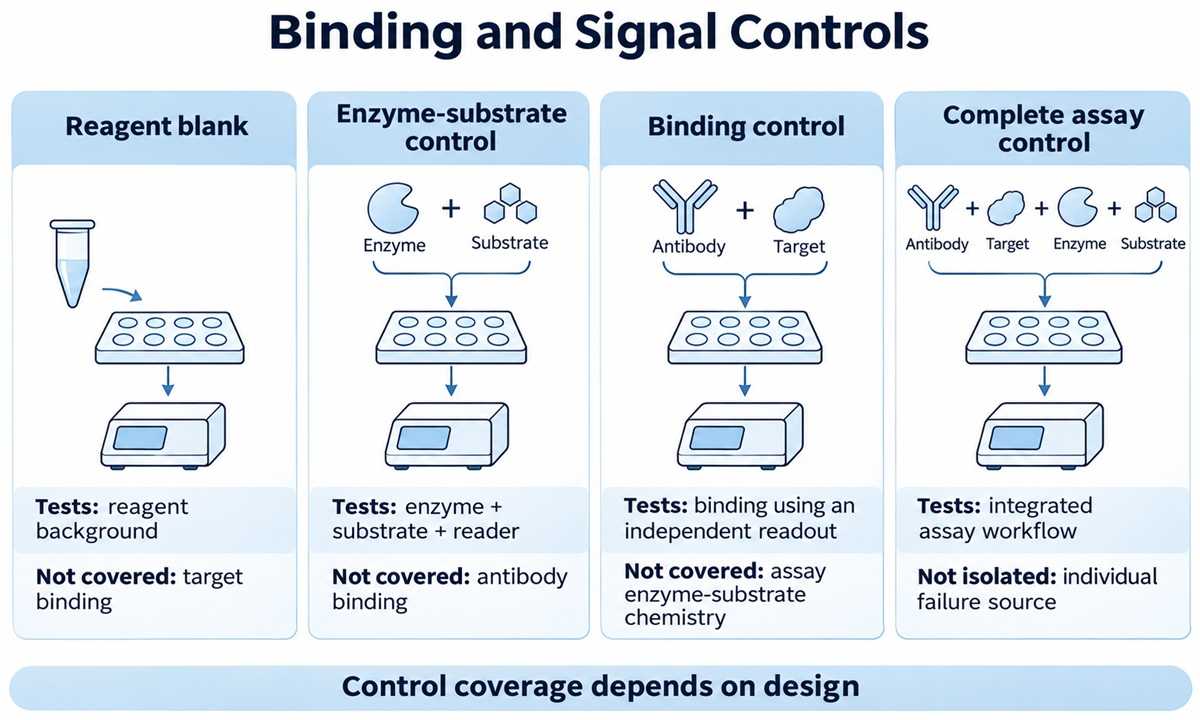
Use controls that exercise different parts of the system. An enzyme-substrate control can test signal generation without the full binding sequence. A suitable binding or complete-assay control covers other stages. Record what each control actually contains. Passing one control narrows the investigation, but does not automatically identify the failed component.
Does high background always mean too much enzyme?
No. Excess retained label is one hypothesis, but nonspecific binding, incomplete separation, substrate background or specimen effects may also contribute. Begin by locating which blank or negative control is elevated. Change one justified variable at a time. Reducing conjugate concentration without understanding the background can also reduce the useful low-level response.
Can blocking eliminate every form of interference?
No. Interference can arise through mechanisms that are not corrected by one blocking reagent. Ghazal and colleagues describe cross-reaction, heterophile antibodies and other causes of positive or negative bias. Evaluate blocking within the intended method and specimen population. A reduction in background does not prove that every relevant interference has been removed.
Will changing HRP to ALP solve heterophilic antibody interference?
Not necessarily. If the interference affects antibody interactions, changing the signal enzyme may leave that mechanism intact. Use an investigation designed to distinguish binding-related interference from signal chemistry. An alternative method can provide useful evidence, but differences between methods require interpretation. Do not treat a label substitution as a general cure for discordant results.
What should be retained when a new conjugate lot changes results?
Keep the old and new lot identifiers, dilution records, substrate lots, timing, reader settings and raw control results. Compare lots using the same relevant samples and conditions where possible. Review both signal and background, rather than only the final calculated concentration. A documented comparison helps distinguish a conjugate difference from a simultaneous change elsewhere in the assay.
Select a focused follow-up
| Question | Evidence to compare |
|---|---|
| Label or substrate change | Matched blanks and samples across the relevant response range. |
| Conjugation change | Physical characterization plus retained binding and enzyme functions. |
| Unexpected specimen result | Appropriate interference investigation, not label intensity alone. |
For a structured comparison, see HRP vs ALP vs Beta-Galactosidase for Immunoassays. For coupling decisions, use Enzyme-Antibody Conjugation Guide for Diagnostic Assays. Return to FAQ for other topic collections.
Sources and further reading
- IUBMB Enzyme Nomenclature. EC 1.11.1.7: Peroxidase. Accessed October 20, 2026..
- IUBMB Enzyme Nomenclature. EC 3.1.3.1: Alkaline phosphatase. Accessed October 20, 2026..
- Bronstein I, Edwards B, Voyta JC. 1,2-Dioxetanes: novel chemiluminescent enzyme substrates. Applications to immunoassays. Journal of Bioluminescence and Chemiluminescence. 1989;4:99–111. DOI: 10.1002/bio.1170040116.
- Ortiz de Montellano PR and colleagues. Mechanism-based inactivation of horseradish peroxidase by sodium azide. Formation of meso-azidoprotoporphyrin IX. Biochemistry. 1988;27:5470–5476. DOI: 10.1021/bi00415a013.
- Stimac A, Kurtovic T, Halassy B. Multi-Detection Size Exclusion Chromatography as an Advanced Tool for Monitoring Enzyme–Antibody Conjugation Reaction and Quality Control of a Final Product. Molecules. 2023;28:4567. DOI: 10.3390/molecules28114567.
- Ghazal K and colleagues. Hormone Immunoassay Interference: A 2021 Update. Annals of Laboratory Medicine. 2022;42:3–23. DOI: 10.3343/alm.2022.42.1.3.