

Find practical answers to common questions about diagnostic enzymes and the assays that use them. Start with the topic closest to your decision, then use the linked guides when you need a fuller explanation or an investigation framework.
These resources are written for assay developers, technical sourcing teams and laboratory professionals. They explain principles and evidence requirements; product-specific values must come from the relevant material documentation and testing.
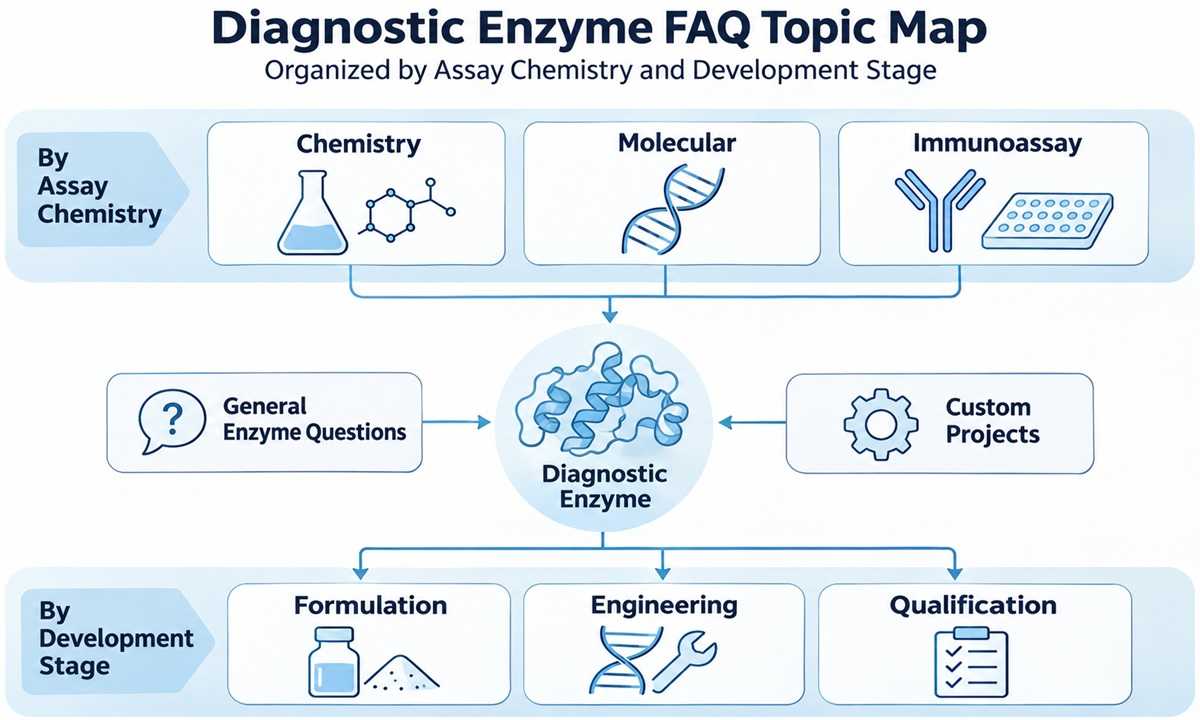
Browse questions by topic
Diagnostic Enzymes FAQ
Start here for activity units, specific activity, purity, recombinant production, documentation and the difference between a reagent component and a diagnostic test. This is the general foundation when the question is not tied to one assay chemistry.
Clinical Chemistry Enzymes FAQ
Use this topic for coupled reactions, endpoint and kinetic measurements, cofactors, substrates, reagent blanks, interference and linearity. It distinguishes enzymes added as reagents from enzymes measured as biomarkers in a specimen.
Molecular Diagnostic Enzymes FAQ
Find explanations of polymerases, reverse transcriptases, hot-start systems, inhibition, carryover control, multiplexing and amplification controls. The focus is on choosing and interpreting complete reaction systems rather than reading a single enzyme specification.
Lyophilized and Glycerol-Free Enzymes FAQ
Explore the relationship between formulation, drying, reconstitution and storage. Questions about a proposed shelf-life need evidence for the final presentation; a formulation description alone cannot establish a storage claim.
HRP, ALP and Immunoassay Enzymes FAQ
Follow this route for enzyme labels, compatible substrates, conjugation, signal development and background. It helps separate binding problems from signal-generation problems before a reagent is replaced.
AI Enzyme Engineering FAQ
Use this topic for model predictions, experimental datasets and the evidence needed to confirm engineered variants. Prediction confidence, measured enzyme function and improved diagnostic performance are distinct questions.
IVD Raw Material Qualification FAQ
Read about specifications, lot records, supplier documentation, application testing and changes. A qualification decision needs a defined intended use and suitable evidence, rather than a grade label alone.
Custom and OEM Diagnostic Enzyme Projects FAQ
Find guidance on describing a development objective, required inputs, deliverables and technical boundaries. Project-specific capability, timing and commercial commitments require an agreed scope and verified information.
Clarify which level of the system your question concerns
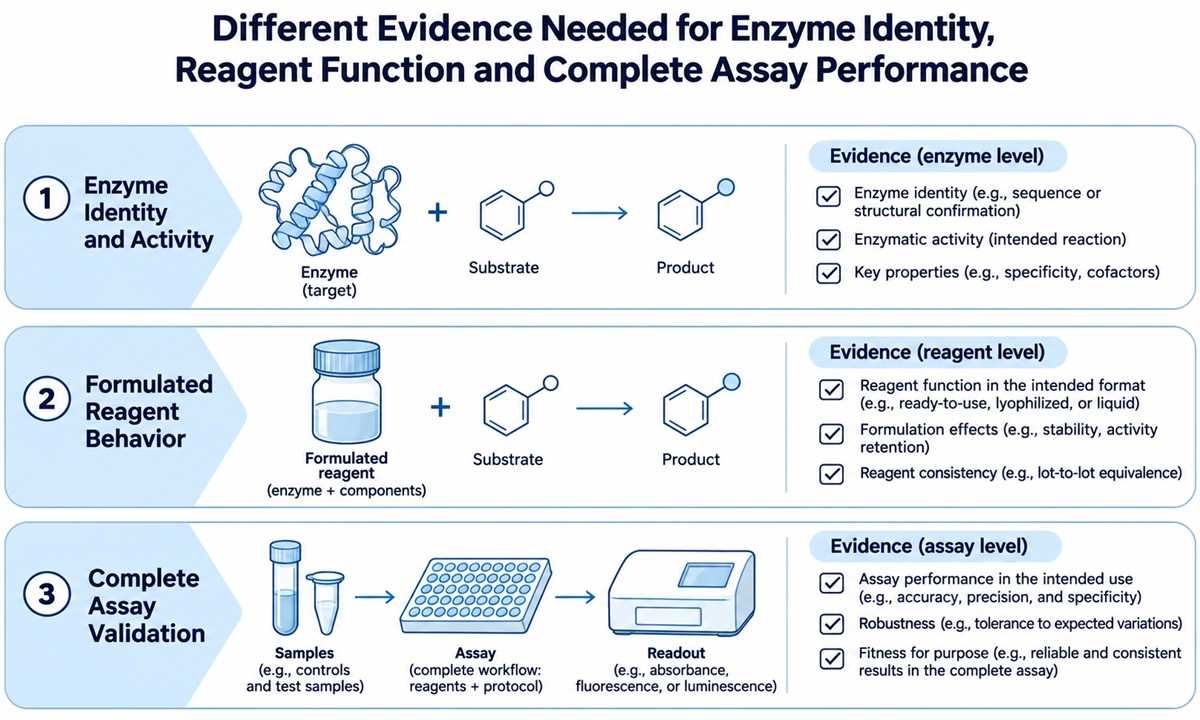
| Question concerns | Typical evidence | What it does not establish |
|---|---|---|
| Enzyme identity and activity | Identity, preparation and a defined activity method. | Performance in every diagnostic formulation. |
| Reagent behavior | Compatibility, signal and stability in a specified mixture. | Clinical suitability for an intended population. |
| Complete assay | Analytical and intended-use evaluation of the whole method. | Suitability for untested specimens or applications. |
IUBMB terminology helps distinguish catalytic activity from the amount of protein present. When comparing numerical activity claims, keep the method and conditions attached to the value. A number without that context may not answer the comparison you want to make.
Quality documents answer other questions. A lot certificate describes results against specifications, while a quality-system record describes an organizational scope. Neither automatically proves that a material works in a new assay. The ISO 13485 framework is relevant to quality management, but application evidence remains separate.
For unexpected results, describe the observation before naming the cause. Low signal might reflect the enzyme, substrate, specimen, instrument or handling. Starting with a presumed enzyme failure can lead to changing the wrong component.
Prepare the information that makes an answer useful
For a material question, record the enzyme identity, lot, concentration or activity units, formulation and storage history. Include the activity method when a comparison depends on units. Avoid treating an abbreviation as a complete specification.
For an assay question, describe the specimen, intended readout, relevant conditions and controls. State whether the issue occurs with all samples, one matrix, one lot or one instrument. A clear pattern often narrows the investigation more effectively than a long list of possible causes.
For interference, include both the measurement affected and the suspected interfering condition. CLSI EP07 addresses interference in defined measurement procedures; the effect cannot be assumed to be the same across all assays using the same enzyme.
For storage questions, distinguish unopened storage, transport exposure and use after preparation. CLSI EP25's scope separates shelf-life and in-use evaluation. Describe the actual product state and the result you need to preserve.
These details do not replace a controlled evaluation. They help identify which evidence is missing and which deeper guide is most relevant.
Use concise answers as a starting point for a defined decision
FAQ answers summarize principles and common distinctions. They are not universal operating procedures, product specifications or acceptance criteria. Where an answer depends on the formulation or intended use, that qualification is part of the answer.
Research-use labeling should also be read in context. FDA guidance distinguishes products intended for research from clinical diagnostic use. A useful research reagent is not automatically a clinically authorized test, and a technical FAQ cannot change that status.
If a result may affect a released product, follow the applicable investigation and change-control process. Keep the original observation and supporting records so that a later explanation can be checked against evidence.
Choose a focused FAQ for a short answer and a related Resource guide for the full reasoning. When no general answer resolves the issue, the next step is to define the missing product-specific or assay-specific evidence rather than infer a guarantee from general guidance.
Sources and further reading
- IUBMB. Current IUBMB recommendations on enzyme nomenclature and kinetics. Perspectives in Science. 2014..
- US Food and Drug Administration. Distribution of In Vitro Diagnostic Products Labeled for Research Use Only or Investigational Use Only. Accessed October 20, 2026..
- International Organization for Standardization. ISO 13485:2016 — Medical devices: Quality management systems. Accessed October 20, 2026..
- Clinical and Laboratory Standards Institute. Interference Testing in Clinical Chemistry. Accessed October 20, 2026..
- Clinical and Laboratory Standards Institute. EP25: Evaluation of Stability of In Vitro Medical Laboratory Test Reagents. Published April 26, 2023..