

Low measured enzyme activity does not, by itself, demonstrate that the enzyme has degraded. The apparent loss may come from an incorrect comparison, a restricted reaction, a weak reporting system or less active material reaching the assay.
Start with a reference preparation and a defined measurement method. Then isolate the measurement, reaction conditions and material history in turn. A correction is useful only when it restores the intended activity and survives a matched confirmation experiment.
Make sure the two activity values are comparable
Identify what the reported value represents. Total activity in a vial, activity per unit volume and specific activity per mass of protein are different quantities. A lower concentration after dilution can reduce the first two without showing that the enzyme molecules have become less functional.
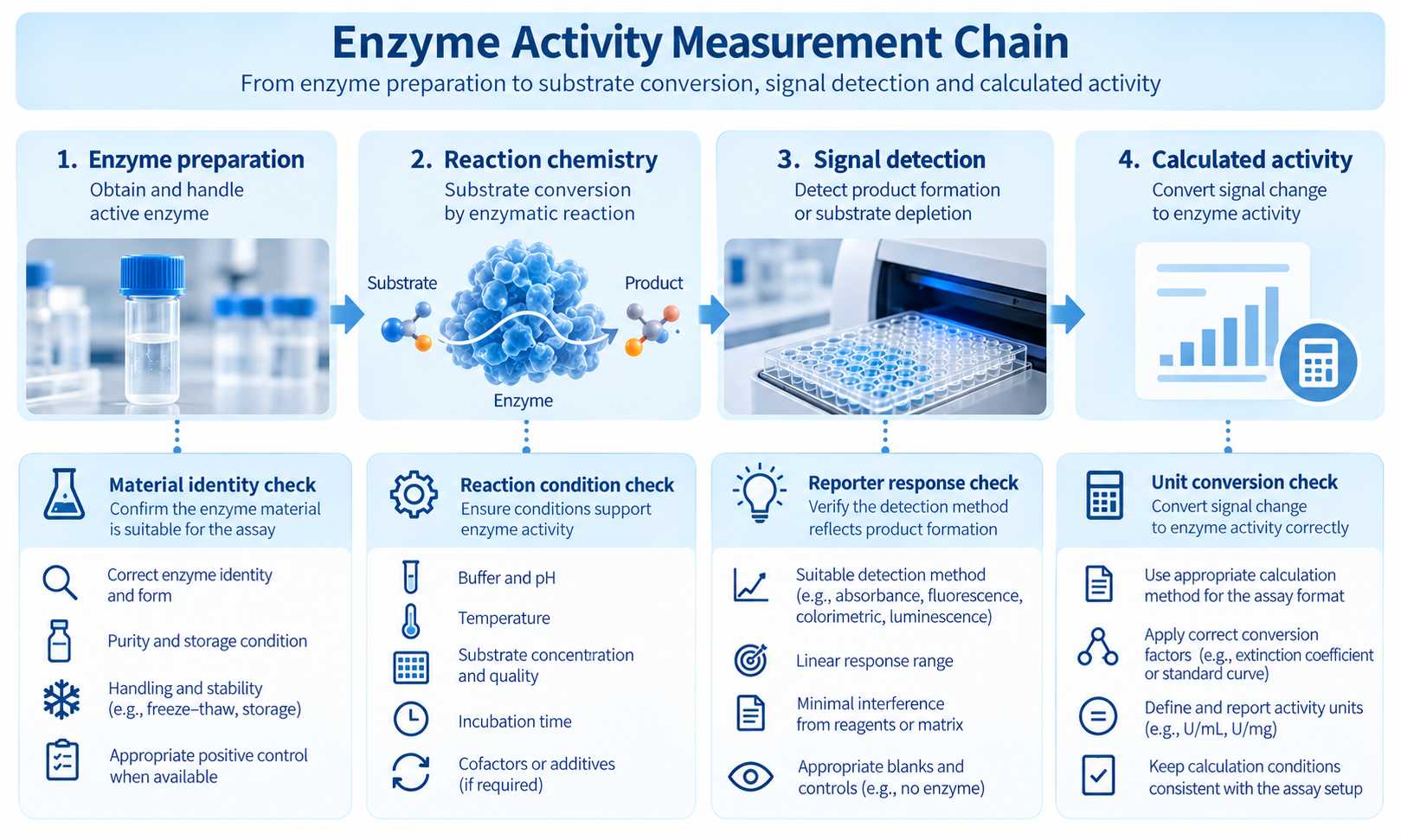
Check the assay definition behind the reference value. Substrate, pH, temperature, cofactors and measurement interval affect the comparison. STRENDA's reporting guidance makes these conditions part of an interpretable enzyme result. A value obtained using another method should not automatically be treated as the expected value in the local assay.
Audit the calculation from the original signal to the final unit. Confirm dilution factors, reaction volume, time units and any calibration or optical conversion used. If specific activity is reported, inspect the protein-concentration method and its compatibility with the preparation. A changed denominator can create an apparent change in specific activity.
Define the reference material and the acceptance basis. An established method-specific specification is different from an approximate literature value or a single earlier run. If the reference itself has changed during storage or preparation, first resolve whether it still provides a valid comparison.
Record whether the suspected loss appears immediately, after dilution, during incubation or after a handling step. That timing will guide later comparisons. It is more informative than describing the sample only as inactive.
Check the measurement before changing the enzyme
Inspect raw reaction progress and blank behavior. A flat or curved trace can have several explanations, including timing, detector range or reaction limitations. Brooks and colleagues' enzymatic-assay guidance describes the importance of the measurement window and initial-rate behavior. Do not fit a convenient interval without checking that it represents the intended measurement.
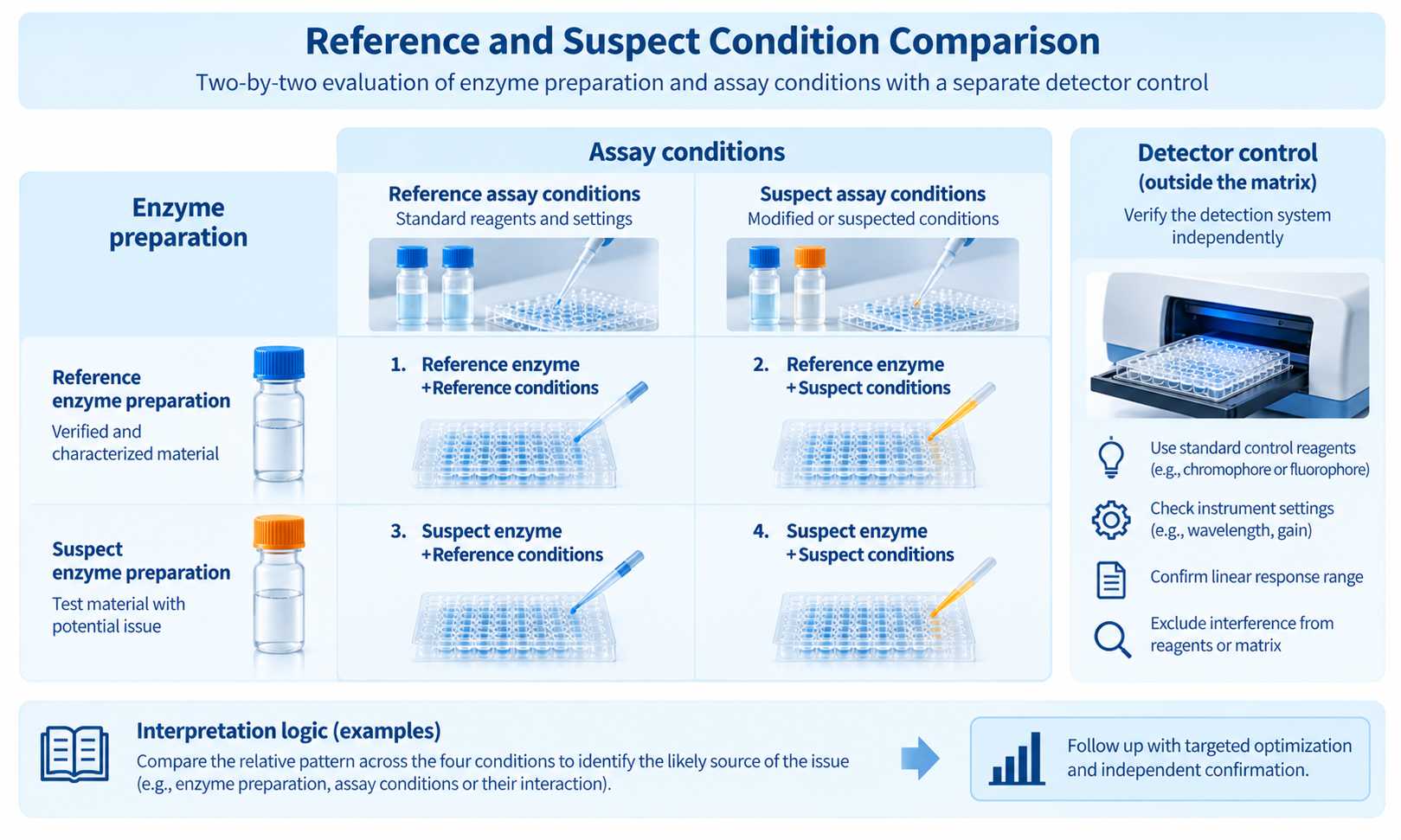
Use an appropriate signal or product control where the assay permits one. It asks whether the downstream detection system can respond under the conditions being tested. A failed detector-side control makes enzyme replacement a poor first response because the measured signal is already unreliable downstream of catalysis.
For a coupled assay, consider the reporting reaction separately from the enzyme of interest. A limiting coupling component can make added target enzyme appear ineffective. Compare the downstream system with a suitable intermediate or reference reaction when chemically appropriate, while recognizing that this does not establish the upstream enzyme's performance.
Check instrument mode, wavelength or channel, acquisition timing, plate suitability and calibration status as relevant to the method. Compare the actual run settings with the approved method rather than relying on the displayed method name. A saved template can retain an unintended setting.
Preserve uncorrected and blank-corrected results. Excessive subtraction can create a low or negative calculated rate even when raw responses differ for a reason that needs investigation. Resolve an abnormal blank instead of allowing arithmetic alone to hide it.
Ask whether the reaction environment suppresses function
Compare reference and suspect preparations in the same reaction mixture. If both perform poorly in the suspect environment but recover in the reference environment, the conditions deserve attention. If the suspect material remains lower in both environments, a preparation-related explanation becomes more plausible. Neither pattern excludes an interaction between material and conditions.
Confirm that required substrates and cofactors are present in the intended forms and amounts. Review preparation records, stock identity and expiry or handling information. An omission, calculation error or incompatible mixture should be corrected from the method, not by indiscriminately increasing every component.
Consider substances introduced with the sample or enzyme stock. Preservatives, salts, chelators, solvents and other additives may alter the reaction or its detection, depending on the enzyme and method. CLSI's interference guidance distinguishes these mechanisms. The relevant test is a controlled comparison that isolates the proposed contribution.
Dilution can be informative but is not a unique diagnostic test. It changes enzyme concentration and potentially inhibitory components together. Where feasible, maintain the intended enzyme amount while changing the suspected carryover, or compare with a matched additive control. Interpret recovery as evidence to investigate, not proof of one inhibition mechanism.
Avoid assuming that a general enzyme-family preference defines the optimum for this preparation and assay. A useful corrective condition must preserve the target reaction, reporter compatibility and the intended application. An isolated activity increase in a new buffer may not solve the original reagent-system problem.
Choose a comparison that distinguishes the leading explanations
| Pattern | Comparison to make | Action if supported |
|---|---|---|
| Reference and suspect both read low | Check reporter response and compare shared reaction reagents with a verified reference set. | Correct the demonstrated measurement or reagent fault before evaluating the enzyme lot. |
| Only the suspect preparation reads low | Compare matched amounts under common conditions and verify concentration and identity. | Investigate preparation, handling or active fraction rather than changing the entire assay. |
| Loss follows dilution or waiting | Compare freshly prepared and held dilutions with matched timing and compatible containers. | Revise the supported handling factor and confirm that detection remains unaffected. |
| Response depends on matrix addition | Compare matrix and control mixtures with equivalent enzyme and assay conditions. | Investigate inhibition or detection interference with a suitable orthogonal check. |
| Added enzyme gives little extra response | Examine reaction progress, substrate availability, coupling capacity and detector range. | Restore an interpretable measurement range before assigning specific activity. |
| Activity differs despite similar protein content | Check identity and functional measurements rather than relying on total protein alone. | Evaluate active material and relevant impurities using methods suited to the preparation. |
These patterns select experiments; they are not diagnoses. For each comparison, state in advance which result would support or weaken the hypothesis. Keep a contemporaneous reference and avoid changing storage, buffer and measurement settings together unless the experiment explicitly evaluates those factors.
A repeat that reproduces the low value establishes repeatability of the observation. It does not identify the cause. Choose the next test for its ability to separate explanations rather than simply accumulating more measurements of the same failure.
Investigate how much active material reaches the assay
Review shipment, storage, freeze-thaw, mixing, dilution and hold history. Compare the affected material with an appropriately retained or newly prepared reference where available. A handling event that precedes the loss is a candidate cause; matched functional evidence is needed to connect it to the outcome.
Consider loss to surfaces or changes associated with aggregation when behavior follows dilution, containers or holding time. The Assay Guidance Manual discusses adsorption-related losses and the need to verify additive compatibility. A surfactant or carrier may affect other parts of the assay, so improved signal after adding one does not alone identify the mechanism or establish a suitable formulation.
Separate protein identity, mass purity and enzymatic purity. The manual's chapter on enzyme preparations explains why these measurements answer different questions. A clean electrophoretic band does not establish the active fraction, and a high total-protein result does not demonstrate that the desired reaction is intact.
Use additional characterization only when it addresses the leading hypothesis. An identity question, a suspected fragment and a possible loss of soluble material require different evidence. Broad characterization without a decision question can generate data without explaining the activity change.
If changing the preparation method appears to restore activity, retest under the original application conditions. The correction may have removed an inhibitory carryover, improved material recovery or altered the assay environment. Describe the supported explanation and leave unresolved alternatives visible.
Confirm the correction and define the material disposition
Confirm the revised condition with the reference and suspect material, using the same activity definition and appropriate controls. Check that the apparent recovery is not a consequence of increased enzyme loading, altered normalization or a stronger reporter response unrelated to the target reaction.
For a consequential disposition, include independent preparation or a later confirmation run as appropriate. Record the evidence, the corrected factor, the acceptance basis and the conditions where the conclusion applies. A material that works in a diagnostic activity assay may still need evaluation in the complete reagent system.
When a reference fails, the measurement remains uninterpretable or the cause cannot be isolated, pause the material conclusion and obtain the missing method or characterization evidence. Repeated addition of enzyme may mask the fault without explaining it.
If catalytic activity is acceptable but the complete immunoassay signal remains weak, continue with Loss of Signal in ELISA and CLIA Assays. For a lot-specific pattern, use Diagnostic Enzyme Lot Variation Troubleshooting. Return to the Diagnostic Enzyme Troubleshooting Center when the dominant symptom points to another part of the system.
Sources and further reading
- STRENDA Commission. STRENDA Guidelines. Beilstein-Institut. Accessed October 9, 2026..
- Brooks HB and colleagues. Basics of Enzymatic Assays for HTS. Assay Guidance Manual. NCBI Bookshelf..
- Clinical and Laboratory Standards Institute. Clinical Laboratory Testing Interference. June 3, 2019..
- Assay Guidance Manual. Validating Identity, Mass Purity and Enzymatic Purity of Enzyme Preparations. NCBI Bookshelf..
- Assay Guidance Manual. Assay Interference by Aggregation. NCBI Bookshelf..