

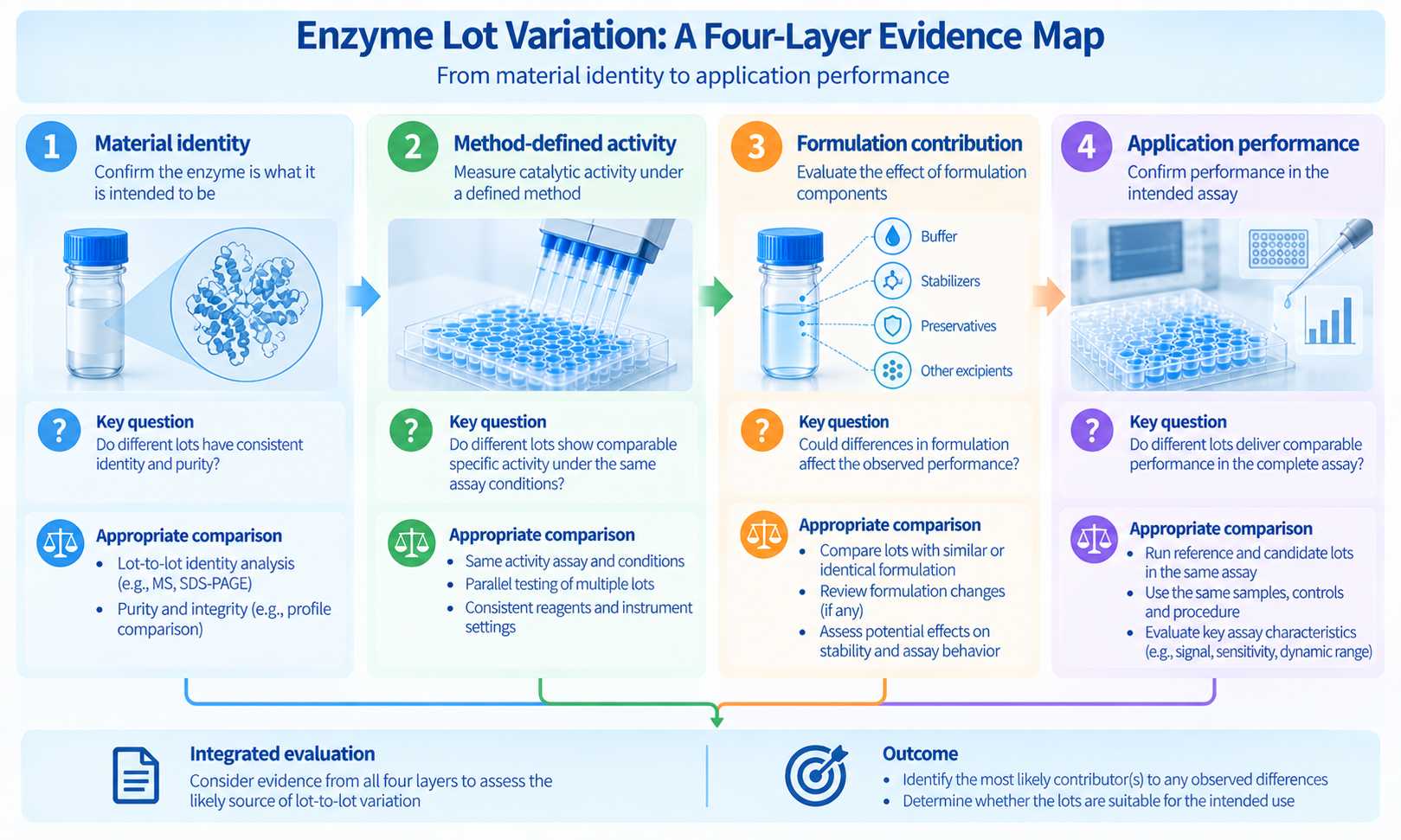
A performance change noticed after opening a new enzyme lot is a reason to investigate, not proof that the lot caused it. Compare the reference and candidate lots under matched conditions, then determine whether the difference follows enzyme amount, formulation, handling or the complete assay interaction.
The essential distinction is between a raw-material measurement and the behavior of the finished reagent system. Two lots can meet the same release specification yet differ in a particular application; an apparent application difference can also originate outside the enzyme.
Record the change before changing the assay
Describe the failure using the relevant raw measurement: reaction rate, blank response, calibration slope, target recovery, amplification behavior or replicate variation. State when it first appeared and which materials were affected. A change in calculated concentration may need a different investigation from a change in the underlying signal.
Retain enough reference and candidate material for a controlled comparison when possible. Record lot identifiers, receipt and opening dates, preparation records, storage exposure and freeze-thaw history. An older reference lot and a newly opened candidate do not automatically have equivalent handling histories.
Review the full change record around the transition. Substrate, buffer, calibrator, conjugation reagent, extraction material, instrument maintenance or analysis settings may have changed at the same time. Identify these potential confounders before attributing the first abnormal result to the newest item on the bench.
Define the practical consequence and the decision that must be made. A small mean shift, poor low-level detection and increased variability are different problems. Preserve the existing acceptance criteria and document the evidence needed for use, restricted use, further investigation or rejection under the applicable quality process.
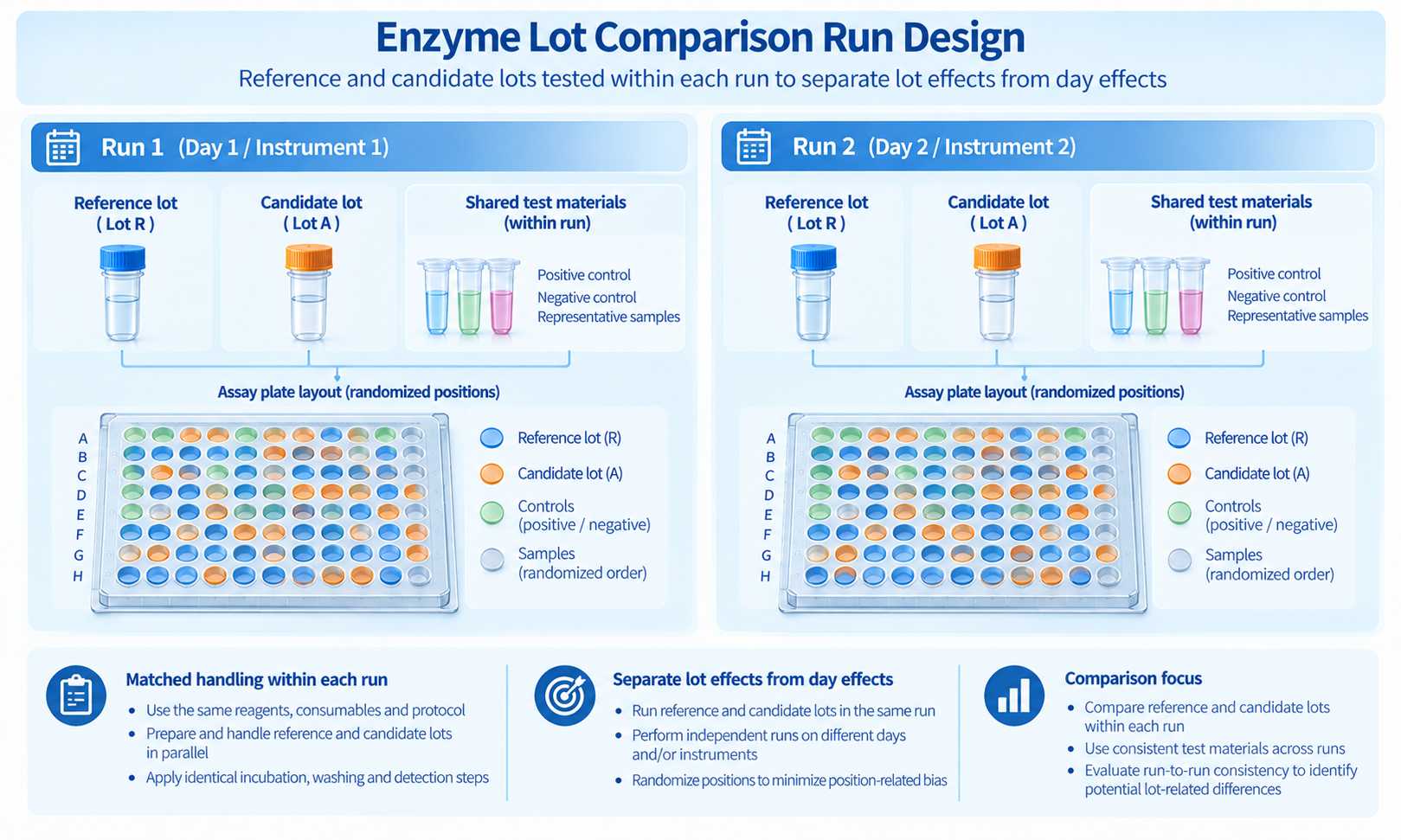
Compare the lots within matched runs
Avoid testing all reference material on one day and all candidate material on another. That arrangement confounds lot with day. Include both lots within the same run or block wherever practical, using common test materials and matched preparation. Repeat across the independent conditions needed to assess the suspected effect.
NIST's guidance on randomized block designs explains how a factor of interest can be separated from nuisance variation. Applied here, a run or preparation block can contain both enzyme lots, while well positions or processing order are randomized where feasible. The analysis should retain that paired structure.
Distinguish repeat readings from independent preparations. Several wells filled from one dilution provide information about technical repeatability, but they do not represent several independently prepared enzyme dilutions. Similarly, multiple aliquots from one lot cannot establish variability across manufacturing lots generally.
Keep relevant handling consistent: dilution vehicle, preparation-to-use time, mixing, incubation and measurement conditions. If historical reference data are used, establish whether the method and material remain comparable. A side-by-side result is usually easier to interpret than a comparison with a distant run made under incompletely documented conditions.
CLSI EP26 addresses user evaluation of reagent-lot changes in clinical laboratories. Its emphasis on a planned comparison is relevant, but a raw diagnostic-enzyme investigation has a different object and may require additional material characterization. Do not label a small developer experiment EP26-compliant merely because it compares two lots.
Reconcile what equal enzyme input means
Review the certificate of analysis (COA) together with the activity method. An enzyme unit depends on the stated reaction and measurement conditions. STRENDA reporting guidance emphasizes enzyme identity, assay conditions and activity information because results cannot be interpreted independently of those details.
Equal stock volume, equal protein mass and equal nominal activity are different comparisons. Equal volume asks whether the supplied preparations are interchangeable at the current dispense. Equal activity asks whether performance matches after normalization to a defined activity assay. Equal mass can help characterize the preparation but does not guarantee equal active enzyme.
Select the normalization that answers the investigation question, and record the others where relevant. If a candidate lot requires more stock volume to supply the same nominal units, it also contributes more of its storage formulation. A subsequent assay difference could involve both enzyme input and carried-in buffer components.
Check calculations, units, dilutions and method versions before commissioning a broad analytical panel. Confirm whether a reported concentration refers to total protein, target enzyme or a different basis. Reconcile any change in stabilizer, salt or preservative contribution with the complete reaction composition.
When practical, compare both the intended production dispense and a justified normalized input. Agreement after normalization can help localize an amount-related effect, but it does not automatically authorize a revised dispense. The modified condition must still meet the complete assay's requirements.
Use targeted comparisons to locate the difference
| Reproduced observation | Discriminating investigation | Possible next action |
|---|---|---|
| Activity differs under a shared reference method | Verify preparation, activity calculation and an appropriate independent reference. | Resolve amount or method differences before changing the finished assay. |
| Reference activity agrees but application response differs | Cross enzyme lots with reference and suspect companion reagents. | Investigate an enzyme-formulation or enzyme-substrate interaction. |
| The difference grows during bench or storage exposure | Compare matched exposure histories and relevant stability time points. | Investigate handling or stability rather than only initial release activity. |
| Blank or unwanted side activity increases | Choose characterization directed at the suspected side reaction or impurity. | Refine relevant purity or contaminating-activity controls if supported. |
| Only one preparation or container behaves differently | Compare independent aliquots and preparations with traceable handling. | Separate a local preparation issue from a lot-wide effect. |
A crossed comparison can use reference and candidate enzyme lots with each of two companion-reagent conditions. If the difference appears only in one combination, that pattern points toward an interaction. It does not justify declaring either component universally defective.
The Assay Guidance Manual distinguishes identity, mass purity and enzymatic purity. A clean protein profile does not exclude a functionally important contaminating activity, and a satisfactory activity value does not establish identity by itself. Select orthogonal measurements that address the reproduced symptom instead of ordering unrelated assays simply because they are available.
Assess the effect across relevant matrices and response levels
Compare results across the range that matters to the assay. An average difference can hide an effect confined to low target levels, high substrate loading or a particular matrix. Inspect individual paired differences and replicate behavior before reducing the comparison to one summary statistic.
For quantitative assays, consider the magnitude and uncertainty of bias as well as precision. For qualitative assays, examine agreement near the intended decision region and include appropriate negatives. Choose the extent of testing according to the smallest consequential difference and the observed variability; no universal sample count can serve every enzyme application.
Miller and colleagues showed that QC materials may behave differently from patient samples across clinical reagent lots. For development work, this is a reason to assess whether the chosen controls represent the intended matrices. Agreement in a convenient control material does not establish agreement in every sample type.
Use representative, appropriately sourced materials and document their preparation and limitations. A contrived sample may answer a focused question well, but its relevance must be established for the decision being made. Avoid treating a single pooled material as evidence of coverage across heterogeneous matrices.
Do not recalibrate or renormalize away the difference before understanding its impact. Such adjustments may be legitimate parts of an assay procedure, but their effect on recovery, range and decision-making needs evaluation. A corrected mean alone can conceal a remaining concentration-dependent or sample-dependent error.
Separate root-cause evidence from the lot-use decision
Summarize what was demonstrated: whether the shift was reproduced, which comparisons isolated it, what remains uncertain, and which criteria were met. A causal explanation and a use decision are related but distinct. A material may be unsuitable for an application even when its precise molecular failure mechanism remains unresolved.
If a correction changes enzyme input, formulation, processing or calibration, control that change and confirm the affected performance. Do not redefine the acceptance interval after inspecting the candidate result simply to make it pass. Record any justified specification revision through the appropriate review process.
Provide a supplier investigation with the relevant lot identifiers, shared method, normalized inputs, raw observations and handling history. Describe the discrepancy without asserting an unsupported manufacturing cause. A concise, reproducible comparison is more informative than a statement that the new batch seems weaker.
Use the findings to improve future incoming checks and retained-sample planning. Track the demonstrated sensitive attributes and application endpoints rather than expanding every release panel indiscriminately. If the evidence remains inconclusive, preserve the limitation and define the next comparison needed for a defensible decision.
For incoming evaluation, see Diagnostic Enzyme QC Checklist. For a new supply source, see Second-Source Qualification Guide for Diagnostic Enzymes. Return to the Diagnostic Enzyme Troubleshooting Center for symptom-specific investigations.
Sources and further reading
- Clinical and Laboratory Standards Institute. User Evaluation of Acceptability of a Reagent Lot Change. CLSI EP26. Second edition..
- STRENDA Commission. STRENDA Guidelines. Beilstein-Institut. Accessed October 9, 2026..
- Assay Guidance Manual. Validating Identity, Mass Purity and Enzymatic Purity of Enzyme Preparations. NCBI Bookshelf..
- National Institute of Standards and Technology. Randomized block designs. Engineering Statistics Handbook, section 5.3.3.2..
- Miller WG and colleagues. Commutability limitations influence quality control results with different reagent lots. Clinical Chemistry. 2011;57:76-83..