

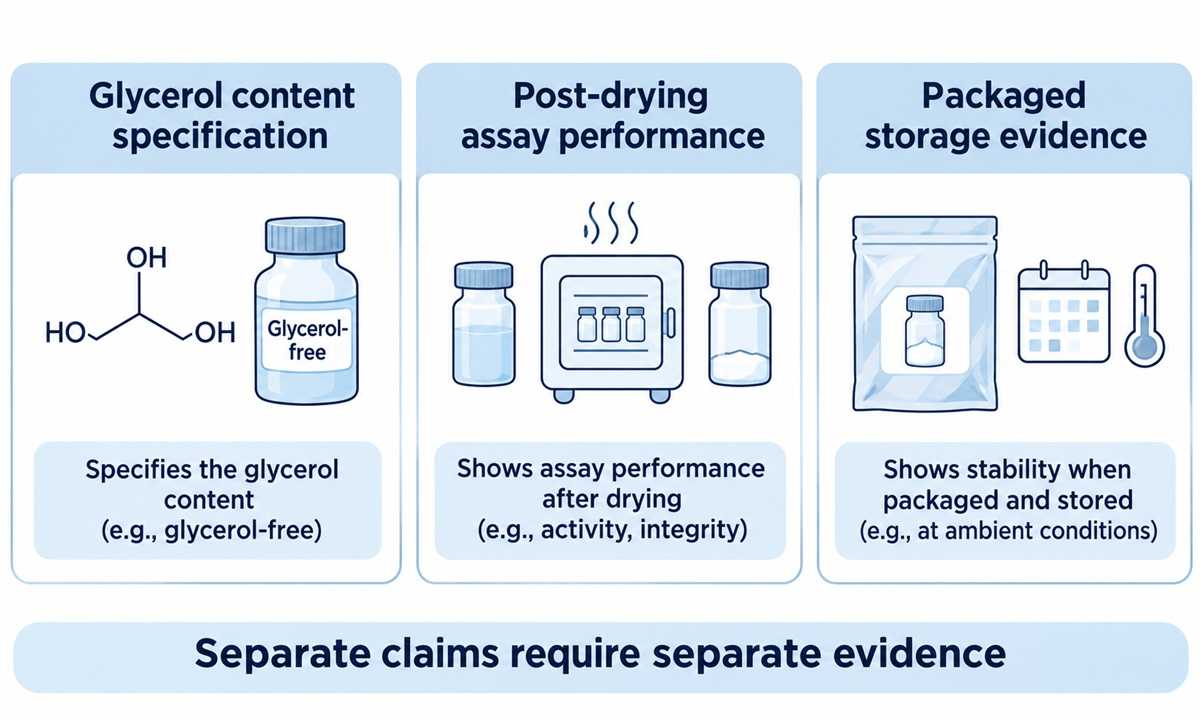
Glycerol-free describes formulation composition. Lyophilized describes a dried presentation. Neither term establishes room-temperature shelf life. For diagnostic reagents, the useful question is whether the complete formulation performs as intended after processing, storage and reconstitution.
These FAQs explain how to interpret those labels and plan meaningful comparisons. They cover isolated enzymes and complete reaction mixtures, while keeping their evidence requirements distinct. A preparation that survives drying still needs assessment in its final assay and package.
Understand the formulation description
Does glycerol-free mean lyophilized?
No. A glycerol-free enzyme can be supplied as a liquid. A lyophilized reagent has undergone freeze-drying and may contain several protective excipients. Ask separately about physical presentation, composition and intended processing. Combining those descriptions into one purchasing requirement can conceal a missing specification, such as the allowable residual glycerol level.
Does glycerol-free mean absolutely no glycerol is present?
The wording alone does not define an analytical limit. Ask whether it means no intentionally added glycerol or a measured concentration below a stated threshold. If residual glycerol matters to your process, agree on the specification, method and reporting basis. Treat an unspecified label as incomplete information, rather than assuming a zero concentration.
Why is glycerol removed for some drying projects?
Glycerol can change the physical behavior of a drying formulation. Its effect depends on the mixture and processing conditions. In a trehalose and lysozyme study, it reduced protection during one drying stage but improved it during another. That finding supports evaluating glycerol in context; it does not support a universal rule that every trace is harmful.
Is a glycerol-free enzyme automatically more stable in liquid storage?
No. Removing a component changes the formulation and can remove a contribution to liquid-state stability. Compare the converted preparation with an appropriate original control under the proposed handling conditions. Request storage instructions specific to the new preparation. A storage claim for the original stock should not be copied to a compositionally different material.
Are glycerol-free and excipient-free equivalent?
No. A glycerol-free preparation can contain sugars, salts, surfactants, proteins or other additives. Those components may affect the downstream assay or drying process. Request a sufficiently detailed composition statement and clarify any undisclosed ingredients that could affect compatibility. Evaluate the final reaction concentration of additives as well as their concentration in the supplied stock.
Can one glycerol-free enzyme establish that a master mix is glycerol-free?
No. Other enzyme stocks or added reagents may introduce glycerol. Review all inputs and calculate their contributions on a consistent concentration basis. Where a quantitative limit is important, the final mixture needs an appropriate verification strategy. An ingredient-level statement does not by itself describe the composition of the assembled reaction.
Assess conversion and drying separately
Can buffer exchange be treated as a neutral handling step?
It should be evaluated as a formulation change. Buffer exchange may alter enzyme recovery, concentration and the surrounding solution, even when the intended change is only glycerol removal. Retain samples before and after conversion. Compare both activity and relevant assay behavior so that a later drying failure is not incorrectly attributed to the drying cycle.
Why might an enzyme lose activity during freeze-drying?
Freezing and dehydration expose proteins to stresses that differ from liquid storage. Carpenter and colleagues describe the need to protect against those stages when developing dried protein formulations. For an investigation, separate damage already present after freezing or formulation conversion from damage associated with drying. A single measurement at the end cannot locate the first failing stage.
Is a thermostable enzyme necessarily tolerant of drying?
No. Heat tolerance in solution does not establish resistance to freezing, dehydration or reconstitution. Hammerling and colleagues found markedly different responses among premixed RT-qPCR systems under their tested drying conditions. Use thermal stability as one property, then test the actual dried formulation. Avoid selecting an enzyme solely from its high-temperature activity description.
Can trehalose or sucrose be added without checking the reaction?
Protective sugars are useful candidates, but their concentration and interactions need evaluation. Compare the proposed formulation as a liquid before testing it after drying. This helps distinguish a reaction effect caused by the additive from a processing effect. A protective ingredient is only useful if the reconstituted reagent still meets the assay requirements.
Can a successful enzyme-only formulation be used for a complete assay mix?
It is a starting point, not proof of compatibility. Nucleotides, primers, probes, cofactors and other components create a different mixture. Test the assembled assay and any interactions that matter to its readout. For RT-qPCR, for example, preserving polymerase activity alone does not demonstrate that reverse transcription and the complete RNA-target workflow remain functional.
Does an attractive cake prove that the formulation is acceptable?
No. Appearance is one observation, while functional recovery answers a different question. Record cake appearance and reconstitution behavior alongside assay results. If the appearance changes, investigate the associated process or formulation differences. A good-looking cake cannot substitute for performance measurements, and an appearance defect should not be diagnosed from a photograph alone.
Control reconstitution and package exposure
Is the lowest possible residual moisture always best?
No universal moisture target applies to every formulation. Xu and colleagues found that the residual-moisture conditions they studied affected PCR-mixture stability, with lower moisture not always giving the best outcome. Set a justified range for the particular product using physical and functional evidence. Do not adopt a published percentage without the accompanying formulation and process context.
Why does the specified reconstitution volume matter?
It determines the concentrations of components in the restored reagent. A volume change can alter enzyme, salt, cofactor and excipient concentrations together. Use the defined diluent and volume when comparing batches or storage conditions. Otherwise, an apparent stability difference may partly reflect how the material was reconstituted rather than what happened during storage.
Can I replace the recommended diluent with water?
Only if the product or developed method supports that substitution. The diluent may supply required buffer components or establish the intended final composition. Compare the complete reconstructed mixture, not just whether the cake dissolves. Record diluent identity and lot during troubleshooting, particularly when a new diluent coincides with a change in assay behavior.
Does slow dissolution mean the enzyme has been destroyed?
Not necessarily. Dissolution behavior and retained function are separate observations. First document the diluent, volume, temperature, mixing method and time used. Then assess the fully reconstituted material with appropriate controls. Avoid compensating by adding an unrecorded extra volume, because that changes the reaction and makes the original problem harder to interpret.
Does a sealed vial remove the need for packaging studies?
No. Assess the product in the intended container and closure, including relevant distribution and handling exposures. A different vial, stopper, pouch or sealing process should be considered in the evaluation. The package is part of the proposed storage system. Results from a laboratory container do not automatically establish performance in the commercial presentation.
Can the dry-storage expiry be used after opening or reconstitution?
No. Opening or adding liquid creates a different exposure condition. Establish the relevant time and temperature limits for that state, and communicate when the clock begins. Where users repeatedly access the material, include that use pattern in the assessment. An unopened storage claim does not describe all subsequent handling conditions.
Interpret stability evidence and failures
What should be compared immediately after drying?
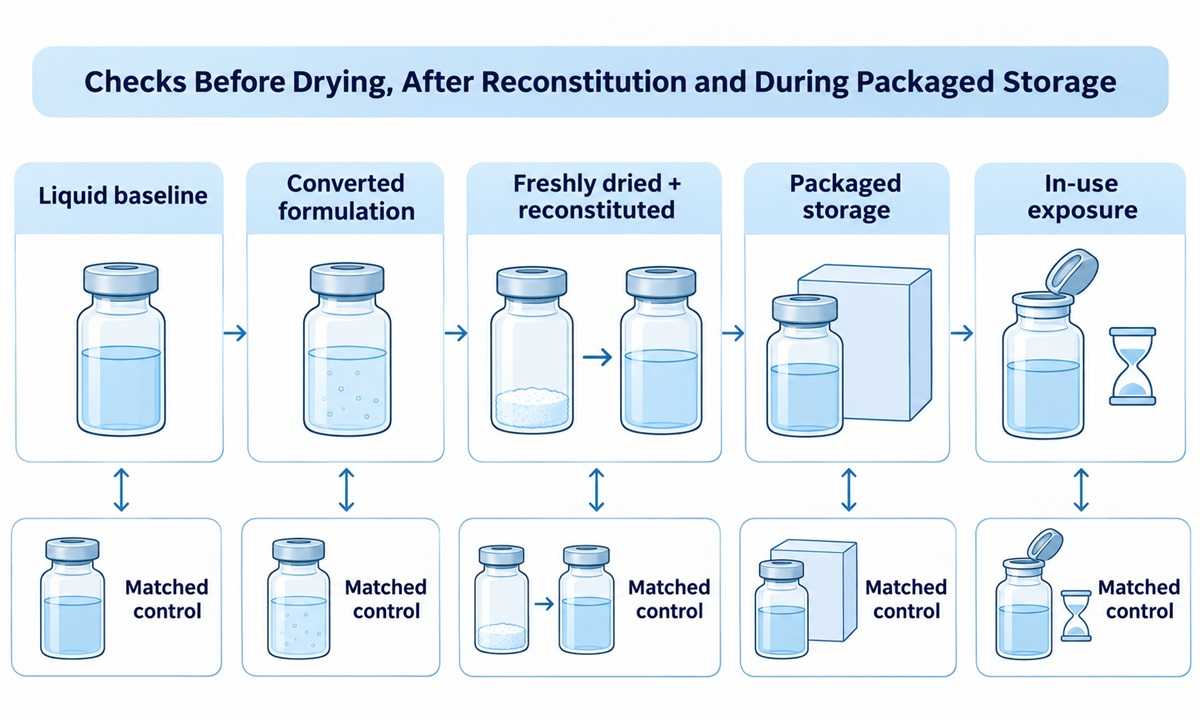
Use matched controls to separate formulation effects from processing effects. A useful comparison includes the original liquid system, the proposed liquid formulation and the freshly dried, reconstituted preparation. Choose endpoints that matter to the assay, including low-level performance where relevant. Record recovery and preparation details before beginning a long storage study.
Can accelerated testing alone establish the shelf life?
Do not treat an accelerated result as an automatic conversion into a storage claim. Any extrapolation needs a justified model and supporting product evidence. CLSI EP25 covers appropriate uses of accelerated testing alongside other stability-study considerations. Assess whether the stressed material fails in a way relevant to the intended storage conditions.
Does a successful high-concentration control prove stability?
It shows performance at that control level, but may miss deterioration elsewhere in the measuring or detection range. Select challenge levels and endpoints based on the claim and assay risks. A positive result alone may hide increased variability, quantitative drift or loss of low-level detection. Preserve the underlying response rather than recording only pass or fail.
Is unchanged enzyme activity enough to support a reagent expiry?
Not for a complete diagnostic reagent. The activity assay measures a defined biochemical response, while the finished system also depends on other components and interactions. Use the activity result to support investigation, then assess the relevant assay endpoints. The claimed product, package and intended use determine which evidence is needed.
How should a temperature excursion be investigated?
Document the temperature history, duration, package condition and product state. Compare the event with the available stability and transport evidence. If that evidence does not cover the exposure, arrange an appropriate assessment rather than assuming that a dried reagent is unaffected. Keep the conclusion specific to the material and event reviewed.
What information is useful when a dried reagent fails?
Retain the formulation version, input lots, processing record, storage history, package details and reconstitution procedure. Identify whether freshly dried material already failed or performance changed only during storage. Include matched controls and raw assay outputs. This allows the investigation to test competing explanations instead of repeatedly changing the drying cycle without a baseline.
Choose the next investigation
| Observation | Useful next comparison |
|---|---|
| Converted liquid already differs | Original and converted liquids under matched assay conditions. |
| Freshly dried material differs | Proposed liquid formulation and reconstituted material. |
| Performance drifts during storage | Retained baseline and stored material in the intended package. |
For formulation development, continue with Lyophilized qPCR and RT-qPCR Master Mix Guide. For the composition question, see Why Glycerol-Free Reagents Matter in Molecular Diagnostics. The FAQ directory connects related topics.
Sources and further reading
- Carpenter JF and colleagues. Rational design of stable lyophilized protein formulations: some practical advice. Pharmaceutical Research. 1997..
- Journal of Pharmaceutical Sciences. Influence of a Small Amount of Glycerol on the Trehalose Bioprotective Action Analyzed In Situ During Freeze-Drying of Lyzozyme Formulations by Micro-Raman Spectroscopy. 2017..
- Xu J and colleagues. Transferable, easy-to-use and room-temperature-storable PCR mixes for microfluidic molecular diagnostics. Talanta. 2021;235:122797. DOI: 10.1016/j.talanta.2021.122797.
- Hammerling MJ, Warfel KF, Jewett MC. Lyophilization of premixed COVID-19 diagnostic RT-qPCR reactions enables stable long-term storage at elevated temperature. Biotechnology Journal. 2021;16:2000572. DOI: 10.1002/biot.202000572.
- Clinical and Laboratory Standards Institute. EP25: Evaluation of Stability of In Vitro Medical Laboratory Test Reagents. Accessed October 20, 2026..