

Molecular diagnostic enzymes must work with the target, primers, probes, specimen preparation and instrument. These answers explain common choices and interpretation problems in PCR, reverse-transcription PCR and isothermal amplification.
The emphasis is on complete reaction systems and appropriate controls. No single enzyme property guarantees a reliable diagnostic assay, and general guidance does not replace validation of the intended method.
Enzyme selection
Can any DNA polymerase be used for diagnostic qPCR?
No. The polymerase must be compatible with the reaction conditions and detection chemistry as well as the intended target. Evaluate specificity, amplification behavior and relevant specimen effects in the complete assay. A product that amplifies DNA in another application is not automatically suitable for your qPCR method. The formulation and activation requirements matter alongside the enzyme identity.
Is high fidelity the same as high diagnostic sensitivity?
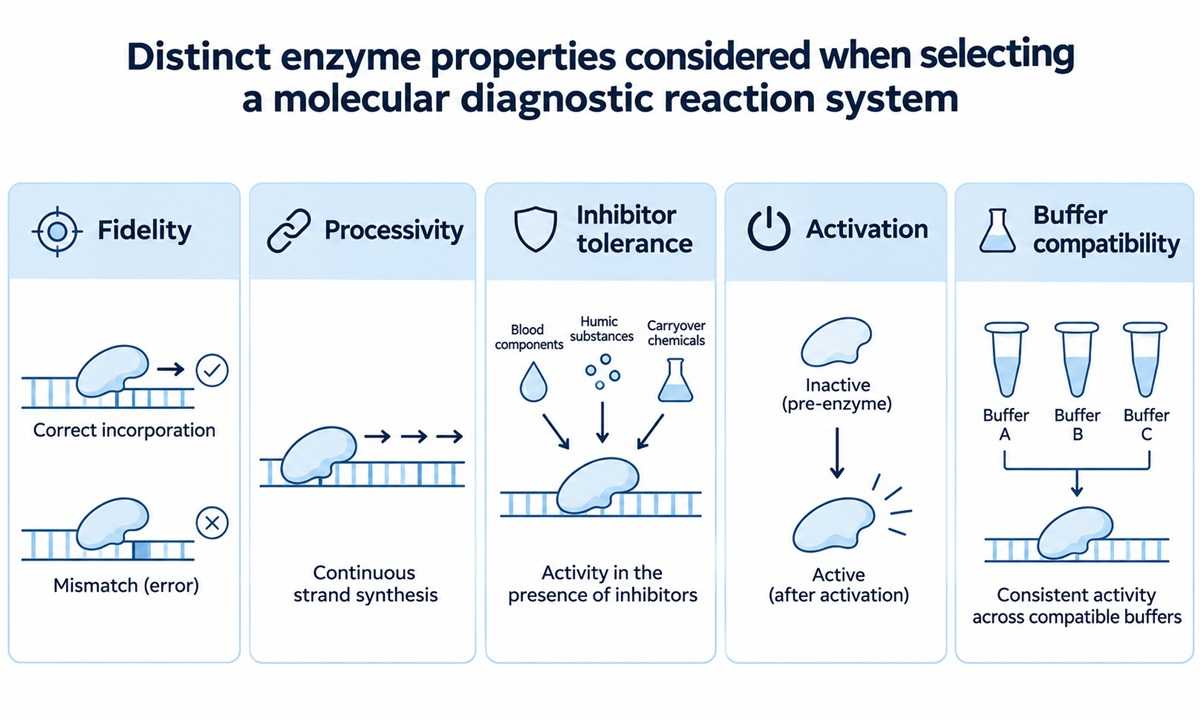
No. Fidelity concerns copying accuracy, while analytical detection capability depends on the whole method, including sample recovery, amplification and interpretation. A high-fidelity enzyme can be useful for some applications without being the best choice for every diagnostic reaction. Select the properties needed for the intended task rather than treating one performance label as a universal ranking.
Is processivity the same as extension speed?
They are related to different aspects of polymerase behavior. Processivity concerns synthesis during an enzyme-binding event, while extension speed concerns the rate of nucleotide addition under defined conditions. Neither alone establishes assay turnaround time. The target, cycling programme and complete reaction also contribute, so compare the actual method rather than isolated descriptive labels.
Why use a hot-start system?
It is intended to limit unwanted polymerase activity before the planned reaction begins. The activation mechanism and conditions vary between systems. Confirm that the activation step is compatible with the assay and other components. Hot start can address one source of unwanted amplification, but it does not repair every primer-design, contamination or specimen problem.
When is reverse transcriptase needed?
RNA-target workflows commonly require conversion of RNA into complementary DNA before DNA amplification. The reverse-transcription stage has its own efficiency and compatibility constraints. A DNA-only positive control does not test that stage. Define the target and workflow first, then choose controls that can reveal problems in both reverse transcription and subsequent amplification.
Reaction compatibility
Is one-step RT-qPCR always better than two-step RT-qPCR?
No. One-step formats can simplify handling, while two-step formats allow the generated cDNA to be used in separate reactions. Each has different flexibility and handling considerations. Compare the intended workflow, sample availability and evidence requirements. A change between formats should be evaluated as a method change rather than assumed to preserve the same quantitative relationship.
Can I combine a polymerase and reverse transcriptase that work well separately?
Separate performance does not prove compatibility in a shared mixture. Buffer, salts, cofactors, temperature sequence and component concentrations can affect the combined system. Evaluate the actual RT-qPCR formulation and controls. If performance changes, identify which stage is affected instead of assuming that one enzyme is intrinsically poor. The interaction between components may be the relevant issue.
Does inhibitor-tolerant mean extraction is unnecessary?
No. Tolerance is specific to the inhibitor, concentration and assay conditions tested. A preparation method may still be needed to release target, manage the specimen or remove incompatible material. Evaluate the complete direct-testing workflow in representative samples. Avoid generalizing a result with one inhibitor to every specimen or collection medium.
Why can diluting a sample improve amplification?
Dilution can reduce inhibitory components, but it also reduces target concentration. An improved response can therefore suggest inhibition without providing a universally acceptable remedy. Check the method’s validated dilution procedure and detection requirements. Near the detection limit, losing target may outweigh the benefit. Interpret the comparison with controls rather than using dilution as an automatic correction.
Can a singleplex master mix be used unchanged for multiplexing?
Not without evaluation. Multiple primer and probe systems share reaction resources and can interact. Performance should be checked for individual targets, combinations and relevant concentration imbalances. A strong high-level target can conceal a problem affecting another target. The complete panel, rather than a successful singleplex reaction, is the unit that needs evidence.
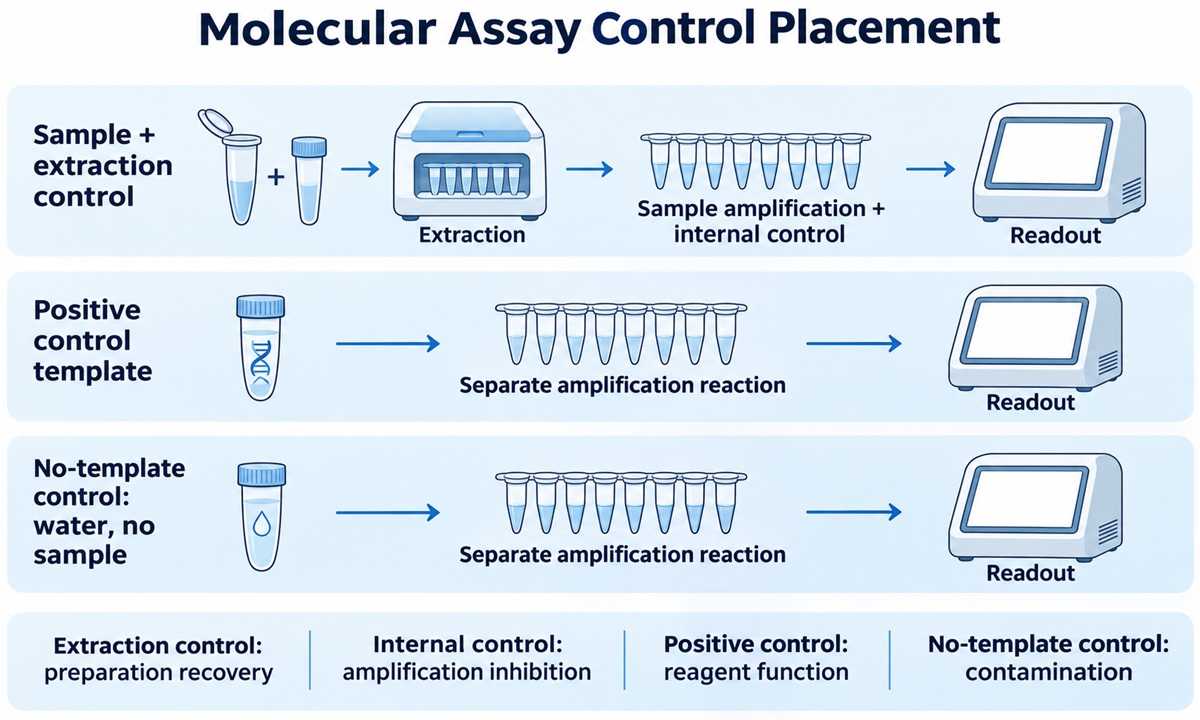
Controls and result interpretation
What does a no-template control detect?
It can reveal contamination or unwanted signal in a reaction without the intended template. It does not necessarily monitor extraction or every specimen-specific problem. Its exact interpretation depends on what was added and where it entered the workflow. A clean no-template control is necessary in many designs, but it does not prove that every sample reaction is valid.
What does an internal amplification control tell me?
It can help identify a problem affecting the reaction in which it is included, subject to its design and acceptance rules. It may not behave exactly like the target. If introduced after extraction, it cannot demonstrate extraction recovery. Interpret the control according to the stages it experiences rather than treating it as a universal indicator of the entire process.
Does a positive control verify RNA extraction?
Only if its material and introduction point make it suitable for that purpose. A purified DNA control verifies neither RNA recovery nor reverse transcription. A control added late in the process monitors fewer stages than one carried through preparation. Specify the intended purpose of each control and avoid claiming more coverage than its design provides.
Does a lower Cq always mean a better enzyme?
No. Quantification cycle can be affected by target input, threshold settings, background and the complete reaction. Compare under controlled conditions and consider specificity, efficiency and variability. A lower value caused by an unwanted product is not an improvement. MIQE 2.0 emphasizes reporting the experimental and analytical context needed to interpret qPCR results.
Can digital PCR eliminate inhibition?
No. Partitioning changes the measurement approach but does not make the chemistry immune to specimen effects. Inhibition can affect positive-partition identification and other aspects of interpretation. Use appropriate controls and validated analysis. The digital MIQE guidance addresses reporting and evaluation of the complete digital experiment; the word digital is not an accuracy guarantee.
Handling, contamination and assay transfer
What does UDG carryover prevention remove?
In a compatible dUTP-based system, uracil-DNA glycosylase targets uracil-containing DNA from prior amplification. The approach described by Longo and colleagues does not eliminate every contamination source. It requires compatible reaction design and pretreatment. DNA without the relevant uracil incorporation, sample contamination and other sources still need appropriate handling controls.
Can UDG be added to any amplification reaction?
No. Compatibility depends on the enzyme system, nucleotide formulation and timing of UDG activity. The treatment must not compromise intended amplification products or other required stages. Evaluate the complete workflow rather than adding the enzyme as an isolated safeguard. A successful carryover-control strategy is a coordinated method, not simply the presence of UDG in the tube.
Is LAMP just PCR run at one temperature?
No. Loop-mediated isothermal amplification uses a distinct primer architecture and strand-displacing synthesis, as described in the original Notomi study. Its design and interpretation requirements differ from PCR. An enzyme suitable for one method is not automatically suitable for the other. Evaluate target specificity, controls and contamination handling within the chosen amplification format.
Can a liquid master mix be dried without further development?
Drying changes the product presentation and can alter component performance, reconstitution and stability. A liquid formulation that works well is a starting point, not evidence for a dried product. Evaluate the final mix, package and preparation procedure. Confirm the complete assay response rather than relying only on appearance or activity of one isolated enzyme.
What should be checked when changing enzyme or master mix?
Assess the complete method under relevant conditions, including target range, specimens, controls and detection chemistry. Retain the original comparison material where appropriate and document lot and formulation differences. The extent of evaluation depends on the potential impact. Matching a single Cq value does not establish unchanged specificity, low-target performance, multiplex behavior or stability.
Match the question to the next check
| Problem | Useful distinction |
|---|---|
| Poor amplification | Target recovery versus inhibition or reaction failure. |
| Unexpected positive signal | Contamination versus unwanted amplification or interpretation. |
| Changed quantitative result | Input and analysis differences versus altered reaction behavior. |
Preserve amplification traces, control results and the preparation history before changing the reaction. PCR and qPCR Enzyme Selection Guide provides a broader selection framework; FAQ links the other question collections.
Sources and further reading
- Bustin SA and colleagues. MIQE 2.0: Revision of the Minimum Information for Publication of Quantitative Real-Time PCR Experiments Guidelines. Clinical Chemistry. 2025;71:634–651. DOI: 10.1093/clinchem/hvaf043.
- Longo MC, Berninger MS, Hartley JL. Use of uracil DNA glycosylase to control carry-over contamination in polymerase chain reactions. Gene. 1990;93:125–128. DOI: 10.1016/0378-1119(90)90145-H.
- Notomi T and colleagues. Loop-mediated isothermal amplification of DNA. Nucleic Acids Research. 2000;28:e63. DOI: 10.1093/nar/28.12.e63.
- Schrader C and colleagues. PCR inhibitors: occurrence, properties and removal. Journal of Applied Microbiology. 2012..
- dMIQE Group; Huggett JF. The Digital MIQE Guidelines Update: Minimum Information for Publication of Quantitative Digital PCR Experiments for 2020. Clinical Chemistry. 2020;66:1012–1029. DOI: 10.1093/clinchem/hvaa125.