

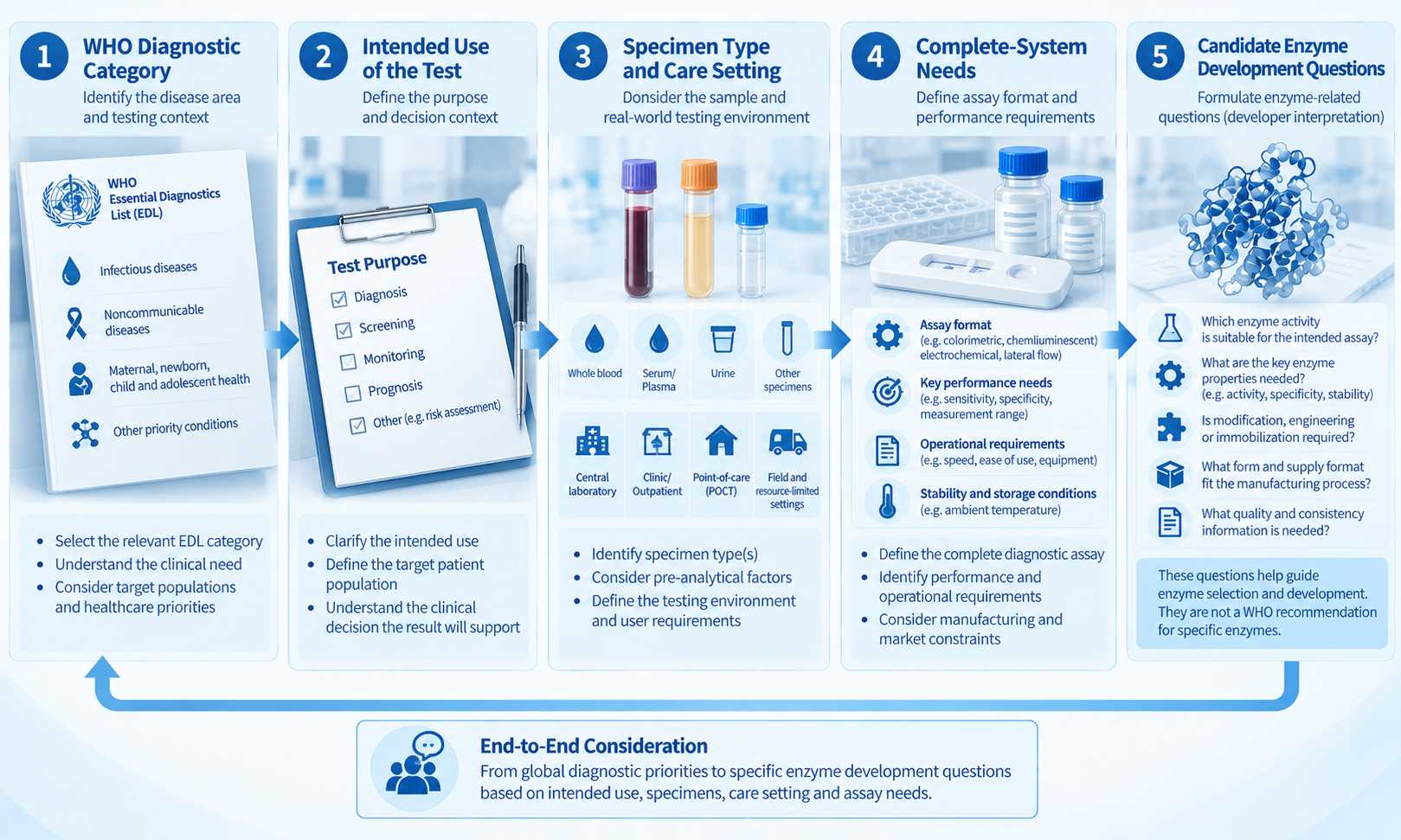
The WHO Essential Diagnostics List helps identify diagnostic testing needs that health systems should consider. For enzyme developers, its value is the connection between a test purpose, a specimen and a service setting. It does not identify a preferred raw-material supplier or guarantee demand for a particular enzyme.
A useful opportunity analysis starts with a complete diagnostic category, then asks whether an enzyme-based implementation could meet the required performance and operational needs. The examples below use selected records in the official electronic list, checked on September 24, 2026.
Use the EDL as a guide to diagnostic priorities
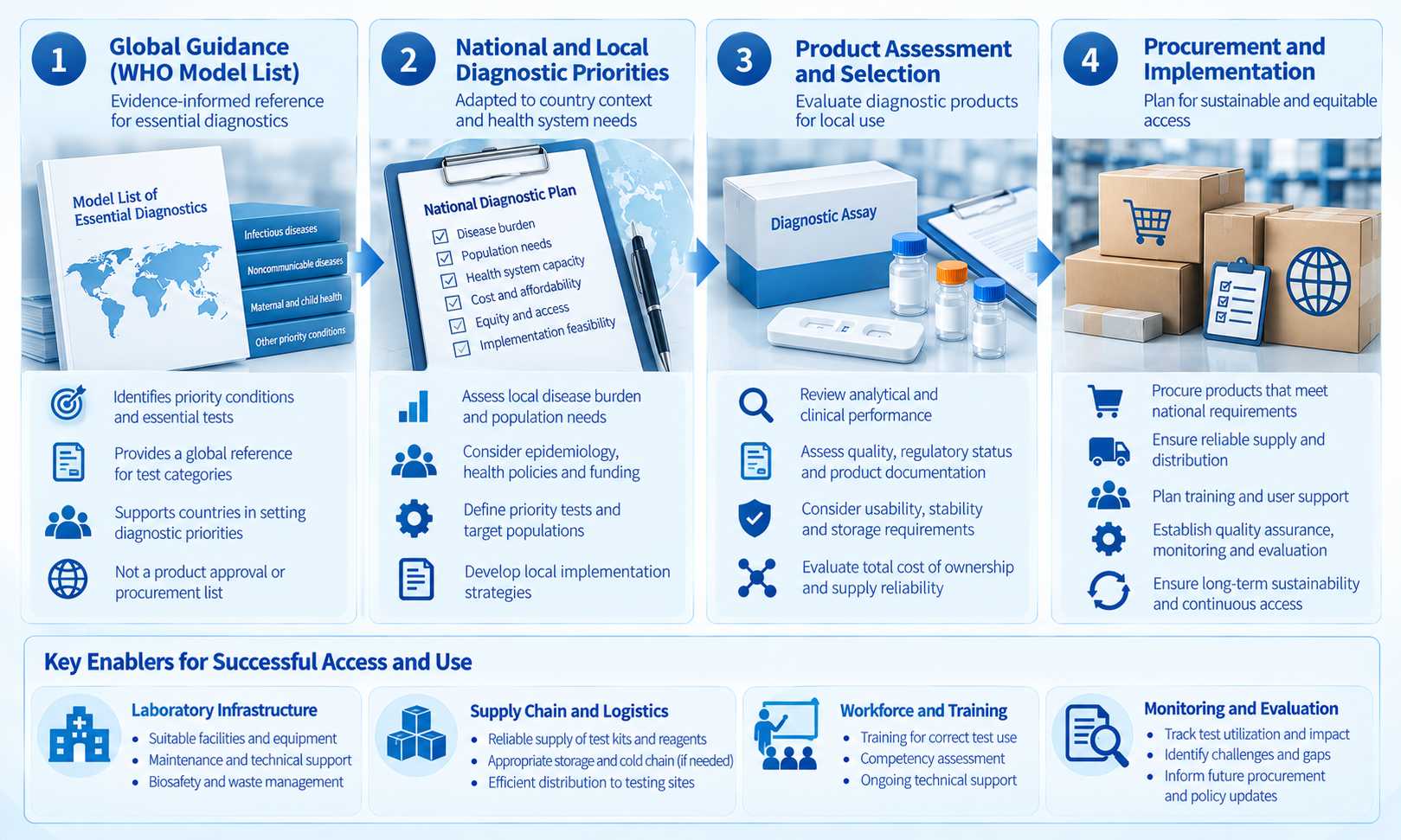
The WHO Model List of Essential In Vitro Diagnostics, commonly called the EDL, supports the development and updating of national essential diagnostics lists. It organizes categories of tests rather than serving as a catalog of enzyme products.
The official electronic database reviewed for this guide displays the Fifth WHO Model List. Its records contain fields for test purpose, assay format, specimen, setting and supporting information. Record the access date and individual entry used when preparing a project brief, because an electronic record can change after a report is downloaded.
Avoid mixing information from different editions without identifying it. An older technical report can explain how a recommendation developed, while a current electronic entry may include later changes. A publication list or an old presentation is not enough to establish the current status of every category.
WHO's country-level guidance explains that national lists should reflect local needs, health plans and service arrangements. A globally listed category may therefore lead to different implementation priorities in different countries. The list is a starting point for asking where a test fits, not a substitute for understanding the intended health system.
Read the purpose, format, specimen and setting together
Searching by analyte is useful for finding a record, but the analyte name alone is an incomplete development brief. The same analyte can appear in different formats or settings, with different purposes. Screening, diagnosis and monitoring should not be treated as interchangeable claims.
Read the specimen field before inferring a sample-preparation or enzyme requirement. Whole blood, serum, plasma and respiratory material present different development questions. The entry identifies the listed specimen context; it does not establish that a new formulation will perform with it.
Review the setting and tiered service information where provided. A test intended for self-use, a district laboratory and a reference laboratory may have very different operator, equipment and workflow assumptions. These differences can matter as much as the biochemical reaction when evaluating feasibility.
Open supporting guidance and read qualifications attached to the entry. Conditional recommendations, population restrictions and algorithm context can materially narrow the apparent opportunity. Preserve those qualifications in working notes instead of reducing a detailed record to a favorable category name.
Separate the list's fields from your interpretation. A statement about the listed specimen or format is a source-based fact. A proposal to investigate an enzyme, stabilizer or manufacturing route is a development hypothesis. Labeling that distinction keeps the research brief accurate when it is passed to another team.
| Field | Why it matters to development |
|---|---|
| Test purpose and population | Defines the question the finished test is intended to answer. |
| Assay format | Constrains the workflow and possible signal or amplification approach. |
| Specimen type | Frames sample handling, matrix and compatibility questions. |
| Setting and service tier | Frames operator, instrument and infrastructure assumptions. |
| Qualifications and supporting guidance | Prevents an opportunity statement from exceeding the recommendation. |
Compare three entries without turning them into enzyme endorsements
The reviewed glucose self-testing record specifies home monitoring of type 1 and type 2 diabetes using capillary whole blood. It does not provide a specification for a glucose-sensing enzyme. For a team considering an enzyme-based implementation, the development question is whether the complete sensing system can support that intended use and user environment.
The anti-hepatitis D virus antibody record describes a laboratory immunoassay using serum or plasma in the stated population of people who are also hepatitis B surface antigen positive. It illustrates why population and workflow context must remain attached to a serology opportunity. The record does not select a universal signal-enzyme preparation or substrate system.
The combined tuberculosis and rifampicin-resistance entry identifies a low-complexity automated nucleic acid amplification test, or NAAT. Its supporting information links to WHO tuberculosis guidance. For a molecular-reagent team, this can frame questions about compatibility with the defined sample and automated workflow, but it does not rank polymerases or establish performance for a proposed new test.
These examples point to different technical roles and product environments. They should not be converted into a claim that one enzyme platform can serve all essential diagnostics. Nor does an immunoassay or rapid-test label alone establish that every implementation uses an enzyme reporter.
| Verified entry context | Candidate question for an enzyme-based implementation | Evidence still needed |
|---|---|---|
| Glucose self-testing; capillary whole blood; home monitoring | Can the chosen sensing chemistry remain suitable in the complete strip or device? | System performance, user handling, interference and stored-device evidence. |
| Anti-HDV immunoassay; serum or plasma; laboratory setting | If an enzyme reporter is selected, how does the conjugate-substrate system perform in the complete assay? | Specificity, background, sample behavior and relevant assay validation. |
| Combined TB and rifampicin-resistance NAAT; automated format | Can the reagent system fit the intended processing and amplification workflow? | Target and specimen coverage, contamination controls and complete-test performance. |
The questions in this table are editorial development prompts. They are not WHO raw-material recommendations, procurement specifications or evidence that a particular component is acceptable.
Translate the service setting into a testable requirement
Begin with the complete use scenario. Describe where the specimen is collected, who performs the test, what equipment is available and how the result reaches the next clinical step. An enzyme optimization that does not improve a meaningful part of this pathway may have little practical value.
Then identify the component constraint that could be addressed. Possible questions include compatibility with a sample-preparation step, retention of performance after formulation, suitability for a defined readout or consistency across production lots. State the hypothesis narrowly enough that a study can confirm or reject it.
For storage and distribution, define the actual exposure states before proposing a stability target. Consider transport, unopened storage, opening and use, and any reconstitution or on-board period. A development aspiration such as ambient use needs a supported temperature and time envelope in the finished configuration.
Consider workflow burden alongside reaction performance. Additional wash steps, separate reagent additions or demanding timing can change what is practical in the target setting. Assess those effects in the complete system rather than assuming that a stronger signal always produces a more usable test.
WHO's procurement guidance emphasizes appropriate products for the intended setting and the importance of stability and available shelf life. As a practical extension, evaluate the cost of obtaining a usable result, including controls, consumables, waste, repeat testing and support. A lower enzyme price alone does not establish a lower-cost diagnostic service.
Keep a comparison baseline. If the proposed improvement is reduced handling burden or better stored performance, define the existing workflow and the measurement that would demonstrate the difference. Avoid adding numerical benefit claims until there is traceable evidence.
Separate essentiality, prequalification and purchase decisions
An EDL entry addresses a diagnostic category. A national list adapts priorities to a particular health system. Product assessment addresses a specific finished product, while procurement also considers availability, logistics and purchasing requirements. These decisions are related, but none automatically completes the next.
WHO states that its prequalified IVD products have been assessed and found acceptable in principle for procurement by UN agencies. The program's explanation also distinguishes that status from national regulatory approval and from a guarantee of procurement. Do not transfer a finished product's status to every enzyme used in its manufacture.
For a specific development program, check whether a relevant prequalification route exists and what product-specific evidence it requires. Do not infer eligibility merely because a broadly similar diagnostic category appears in the EDL. Similarly, absence from a product list is not a reliable measure of whether the category is scientifically useful.
Investigate local adoption separately. Relevant information may include the national diagnostic list, clinical algorithms, service capacity and purchasing plans. If these sources have not been reviewed, state that the commercial or implementation opportunity remains unconfirmed.
Avoid using WHO names, lists or visual identity to imply endorsement of a supplier or development project. A neutral statement that a test category appears in the reviewed list is different from claiming that a company's reagent is recommended by WHO.
Build an opportunity brief that another team can evaluate
A concise brief should name the exact entry and version context, the intended setting, and the relevant purpose and specimen. It should explain the proposed enzyme role and the operational constraint that motivates the work. Keep source facts and developer assumptions in separate fields.
List the evidence needed to advance the concept. That may include biochemical feasibility, formulation work, complete-assay performance, storage studies and user-workflow evaluation. Assign each study to a specific uncertainty rather than compiling a generic test list.
Record reasons to stop or narrow the project. The target setting may lack necessary infrastructure, an alternative format may fit better, or the proposed enzyme change may not address the main barrier to access. An opportunity assessment is more useful when it can reject a weak fit.
Treat any demand estimate as a separate research task. Category inclusion does not supply test volumes, adoption rates, purchasing budgets or market share. Without country and program evidence, describe the result as a technical development direction rather than a quantified market opportunity.
For the relevant technology foundations, see Immunoassay Signal Enzyme and Substrate Guides and Molecular Diagnostic Enzyme and Master Mix Guides. Quality and evidence topics are collected in Diagnostic Enzyme QC, Validation and Regulatory Resources.
Electronic list and selected records checked September 24, 2026. Review the entry again before using it in a project decision and review this guide within six months. No complete catalog reproduction, market forecast or WHO endorsement is intended.
Sources and further reading
- World Health Organization. Electronic WHO Model List of Essential In Vitro Diagnostics. Database displays Fifth WHO Model List; accessed September 24, 2026.
- World Health Organization. Selection of essential in vitro diagnostics at country level. 2021; ISBN 9789240030923.
- World Health Organization, eEDL. Glucose: Self-testing. Live record; accessed September 24, 2026.
- World Health Organization, eEDL. Antibodies to hepatitis D virus: Immunoassay. Live record; accessed September 24, 2026.
- World Health Organization, eEDL. Combined Mycobacterium tuberculosis nucleic acid amplification test and rifampicin resistance detection. Live record; accessed September 24, 2026.
- World Health Organization. Prequalified In Vitro Diagnostics. Current official page; accessed September 24, 2026.
- World Health Organization. Guidance for procurement of in vitro diagnostics and related laboratory items and equipment. 2017; ISBN 9789241512558.