

Diagnostic enzyme quality is established through several kinds of evidence. Identity and impurity testing describe the material. Activity methods describe catalytic performance under stated conditions. Application studies determine whether that material supports the intended diagnostic reaction. Documentation connects the findings to a traceable product and its permitted use.
Use this resource center to choose the next question to investigate. The guides separate routine quality control, method validation and regulatory context so that a strong result in one area is not mistaken for complete evidence in another.
Identify the decision before collecting more test results
A certificate reporting high activity may be enough to confirm one incoming specification, yet leave an important application question unanswered. An enzyme can meet a supplier's activity test and still behave differently in a concentrated master mix, a conjugate or a specimen-containing reaction. Start by deciding which of these situations the evidence needs to address.
The same distinction applies to purity. A dominant band on an electrophoretic gel gives information about the proteins detected under that method. It does not automatically rule out a trace nuclease, residual host DNA or a substance that changes the final assay signal. The relevant impurity questions depend on what the enzyme will do in the product.
STRENDA reporting guidance emphasizes the enzyme preparation and experimental conditions needed to interpret catalytic data. Those details help make results comparable, but a well-described experiment is not automatically a validated release method. Validation asks whether the measurement is sufficiently reliable for its intended decision.
| Decision | Evidence to seek | Boundary |
|---|---|---|
| Can this enzyme lot be accepted? | Identity, activity, relevant impurities and documented specifications. | Acceptance is tied to the agreed material specification. |
| Can this measurement be trusted? | Method performance, controls and a defined usable range. | Reliability applies to the evaluated method and conditions. |
| Does the diagnostic system perform as intended? | Complete-assay studies with relevant specimens and use conditions. | Material QC alone does not establish clinical performance. |
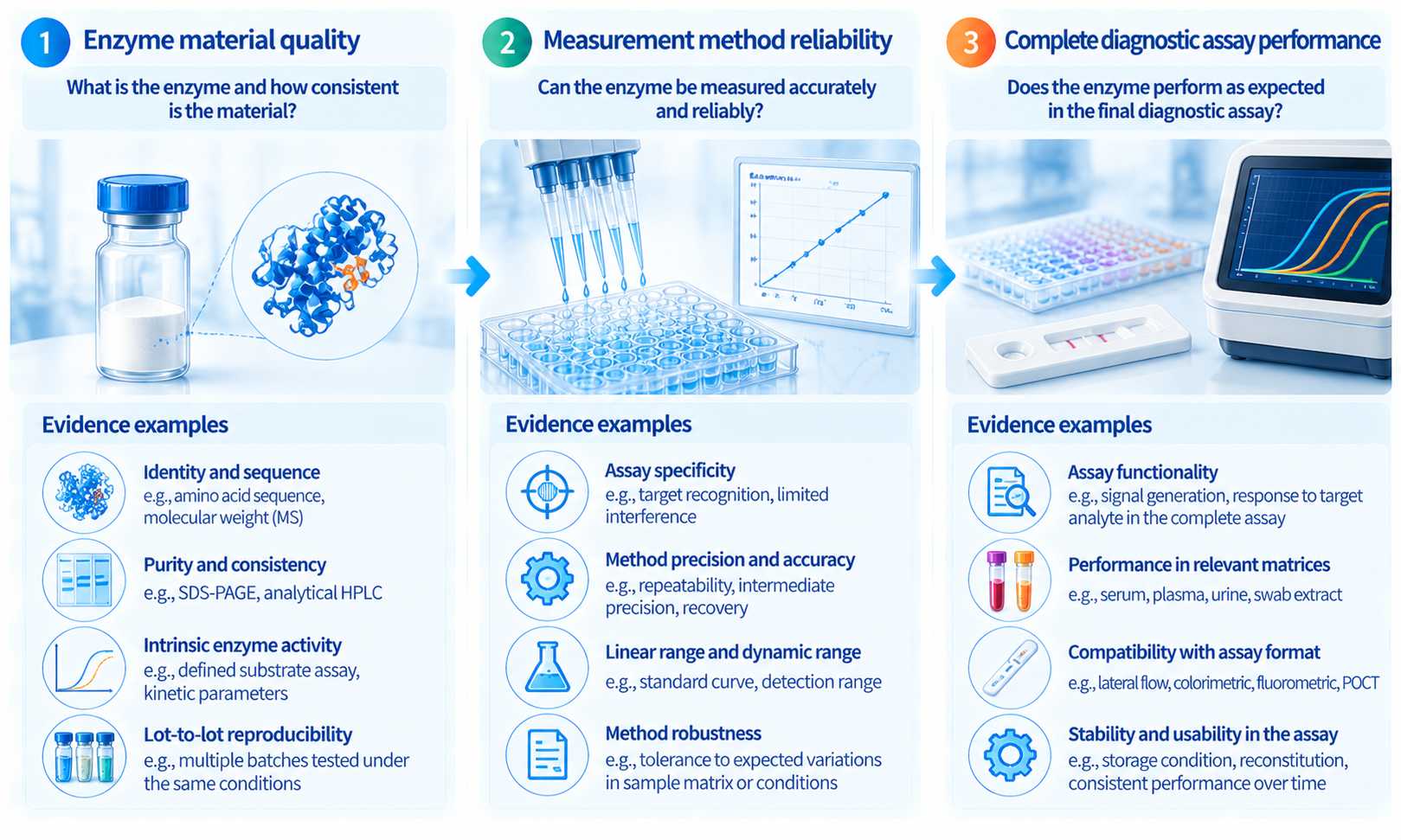
Start with material quality when qualifying an enzyme
For an incoming lot, begin with a defined specification and the identity of the material received. Review the lot number, formulation, concentration basis, activity definition and storage history alongside the analytical results. A missing method condition can make two apparently similar certificate values incomparable.
For a new preparation, broader characterization may be needed before a lean routine panel can be justified. Characterization explores what is present and what could affect use; routine QC monitors selected attributes once their importance is understood. The two activities should inform one another without requiring every exploratory method on every lot.
- Diagnostic Enzyme QC Checklist — Build a practical review of identity, activity, relevant impurities, handling and disposition.
- Purity Characterization Methods for Diagnostic Enzymes — Select complementary methods and understand what each purity result can and cannot reveal.
Use the checklist to organize the acceptance decision and the characterization guide to resolve uncertainty about the material itself. Neither supplies a universal purity percentage or contaminant limit. Those limits require a rationale connected to the intended reagent system.
Separate enzyme activity measurement from assay-performance evaluation
An activity assay measures a rate under specified conditions. A complete diagnostic assay measures or detects its target through a larger system that includes sample handling, reaction chemistry and signal interpretation. Improving the precision of the first measurement does not automatically improve the performance of the second.
Eurachem's method-validation guidance provides a general framework for fitness for purpose. CLSI EP06 addresses a more specific question: whether deviations from linearity are acceptable across a quantitative measurement interval. Use the appropriate framework for the actual claim rather than applying the same study to every endpoint.
- Activity Assay Method Validation for Diagnostic Enzymes — Define activity, establish a usable rate measurement and evaluate method performance.
- Precision, Linearity, LoD, LoQ and Interference in Diagnostic Assays — Distinguish the analytical characteristics and select studies that answer each question.
- CLSI EP Method Comparison Guide for Assay Developers — Choose relevant evaluation documents without confusing method comparison with the rest of validation.
Plan acceptance criteria before interpreting the study. A high correlation, low variation or strong signal can each be encouraging while still failing to answer the intended question. Report the tested range, material and conditions with the conclusion.
Read quality documents in the context of intended use
A certificate of analysis reports selected lot-specific findings; a technical data sheet usually describes the material and its use conditions more generally. Compare their statements with the agreed specification. Ask whether a result is measured for that lot, carried over from qualification, or stated as a general product attribute.
Quality-system status and product authorization answer different questions. As of September 24, 2026, FDA states that QMSR has been effective since February 2, 2026 and incorporates ISO 13485:2016 by reference. This concerns applicable device quality-system requirements; it does not establish that a particular enzyme is an authorized diagnostic product.
FDA's RUO guidance addresses intended use and distribution of IVD products. A label should not be interpreted as a numerical purity grade. Similarly, an informal description such as IVD-grade needs supporting specifications and use boundaries rather than an assumption that the words alone resolve regulatory suitability.
- ISO 13485 and Raw Material Documentation for IVD Enzyme Suppliers — Understand the relationship between supplier records and device-manufacturer needs.
- COA, TDS and Quality Documentation Template for Diagnostic Enzymes — Organize the documents needed for a traceable material review.
- RUO vs IVD-Grade Raw Materials: Practical Differences — Examine intended-use statements, specifications and qualification responsibilities.
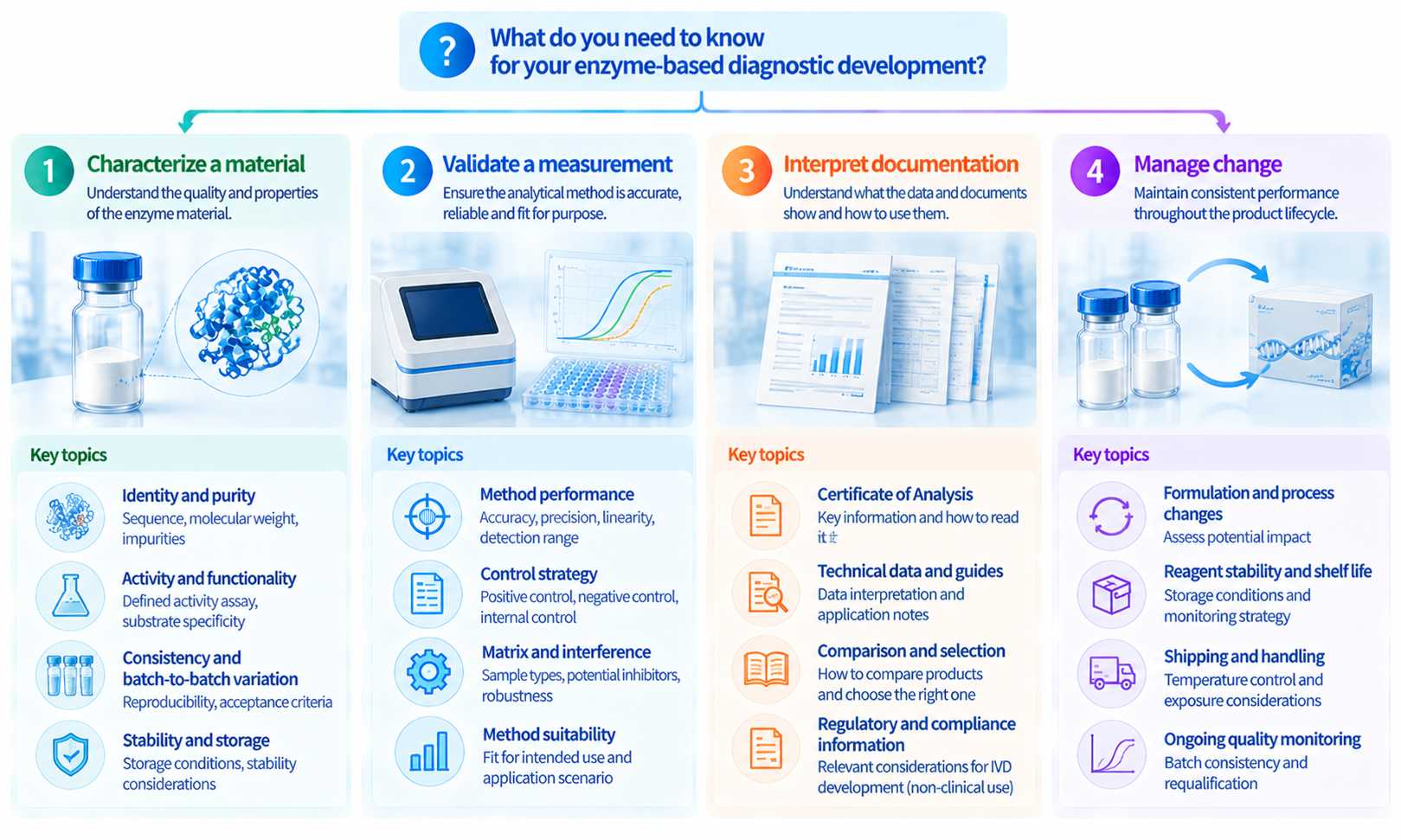
Keep qualification useful when materials or requirements change
Qualification is a starting point for continued control. A new source, expression system, formulation or analytical method can change the relationship between an existing specification and actual assay performance. The next study should address what changed and what the original evidence no longer covers.
Separate material-change work from monitoring changes in the regulatory landscape. The first concerns comparability of the reagent and its application. The second concerns current requirements, intended use and jurisdiction. Both need traceable records, but they should not be collapsed into one generic compliance checklist.
- Second-Source Qualification Guide for Diagnostic Enzymes — Build a comparison that tests the relevant material and application risks.
- Change Control for IVD Raw Materials and Diagnostic Enzymes — Connect a proposed change to the evidence needed before implementation.
- Laboratory Developed Tests Regulatory Update: What IVD Developers Should Know — Review the current U.S. LDT context using dated official sources.
- WHO Essential Diagnostics List and Opportunities for Enzyme-Based Tests — Understand the role and scope of the WHO list.
- How to Use the FDA Companion Diagnostic Device List — Interpret device-list entries and their stated context.
Regulatory information in this center is jurisdiction-specific and date-sensitive. The legal manufacturer or sponsor must determine the applicable requirements for the complete product. This hub was researched on September 24, 2026; recheck official sources when making a regulatory decision and review this section within six months.
Sources and further reading
- STRENDA Commission, Beilstein-Institut. STRENDA Guidelines: Enzyme Kinetics and Assay Conditions. Current public guidelines; accessed September 24, 2026.
- Eurachem. The Fitness for Purpose of Analytical Methods: A Laboratory Guide to Method Validation and Related Topics. Third edition, 2025.
- Clinical and Laboratory Standards Institute. EP06: Evaluation of Linearity of Quantitative Measurement Procedures. Second edition, 2020.
- U.S. Food and Drug Administration. Quality Management System Regulation (QMSR). Current official page; accessed September 24, 2026.
- U.S. Food and Drug Administration. Distribution of In Vitro Diagnostic Products Labeled for Research Use Only or Investigational Use Only. Guidance for Industry and FDA Staff, November 2013.