

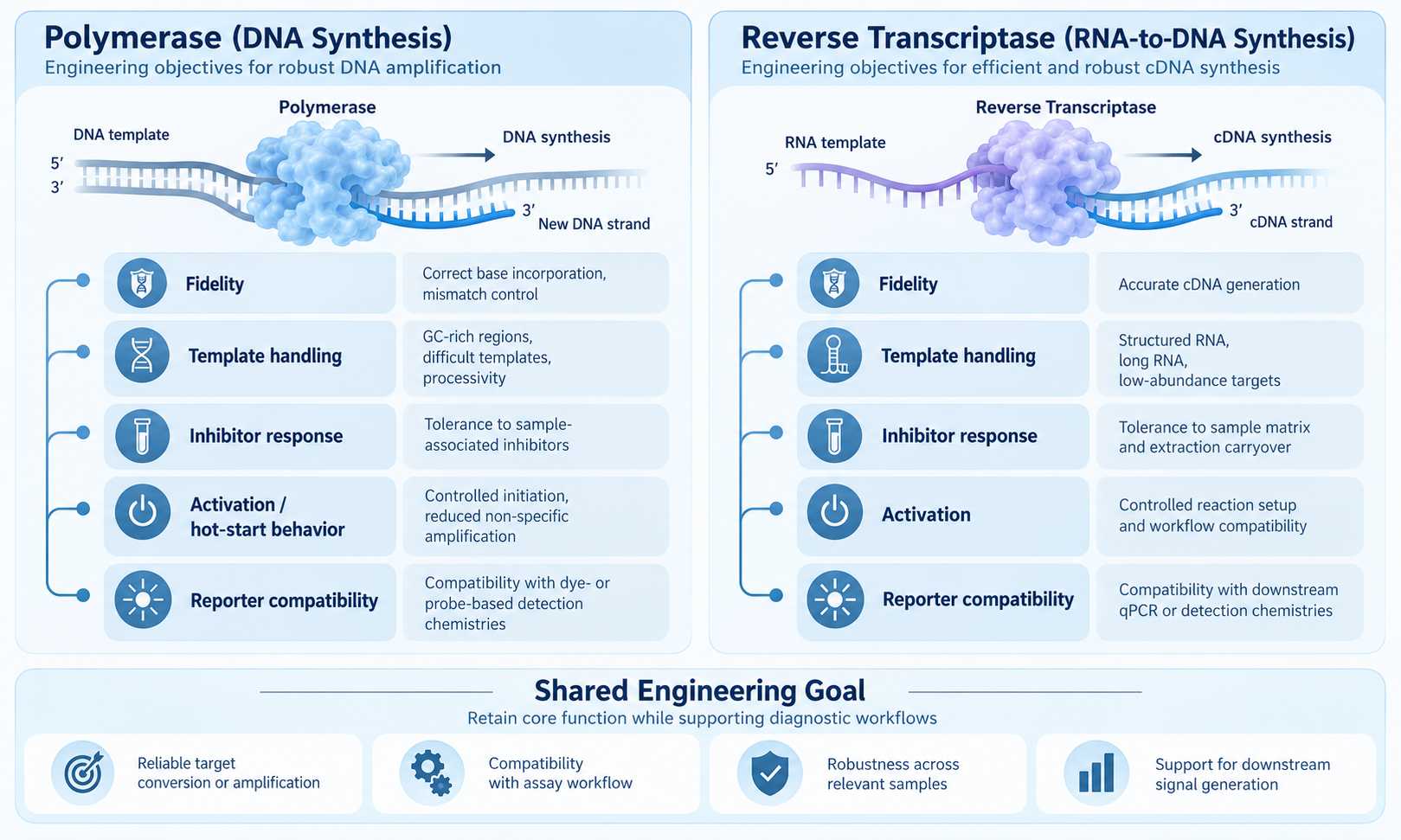
AI-guided polymerase and reverse transcriptase engineering should optimize a defined combination of properties. Faster synthesis, stronger template binding or greater thermal tolerance is useful only when the enzyme also supports the specificity, chemistry and operating conditions required by the assay.
The central challenge is choosing what to measure and attributing an observed improvement to the correct part of the enzyme system. This guide focuses on engineering decisions for DNA synthesis, RNA-to-DNA synthesis and their integration in molecular diagnostic reagents.
Define the enzyme system before redesigning it
A project may modify a DNA polymerase, a reverse transcriptase or an enzyme intended to perform both functions. In a two-enzyme reverse-transcription quantitative PCR system, the enzymes also share a chemical environment and a sequence of operating steps. Decide which architecture is being developed before setting the optimization target.
Name the failure that sequence changes are expected to address. It might be inadequate synthesis during a shortened reaction, poor behavior with a defined template class or loss of function in a particular matrix. First establish that the limitation follows the enzyme under controlled comparisons. Primer design, sample preparation and reaction chemistry remain alternative intervention points.
Keep the reference scaffold and preparation explicit. A fusion, truncation or change of enzyme family can affect production and application behavior as well as the property that motivated the change. Mohr and colleagues' work on group II intron RT fusion proteins illustrates the importance of scaffold and expression strategy. It does not establish that one RT family is universally preferable or that the results were obtained through AI.
For a program based on an established reagent, identify which aspects of the workflow must remain compatible. Retaining the thermal program, reporter mechanism or contamination-control chemistry may impose tighter constraints than a new assay designed around the candidate. These constraints should be visible to both the computational and experimental teams.
Define the properties as separate experimental questions
| Target | Question for the experiment | Property that should also be checked |
|---|---|---|
| Faster useful synthesis | Does the required product form during the intended reaction interval? | Product identity, low-input behavior and unwanted amplification. |
| Processivity or template handling | Does the enzyme remain productively engaged under the defined substrate conditions? | Template-dependent bias and performance across relevant target lengths. |
| Inhibitor tolerance | Does function persist in the specified inhibitor or matrix challenge? | Unchallenged performance and changes in optical response. |
| Reverse-transcription capability | Is useful cDNA produced from the selected RNA templates? | DNA-dependent synthesis, fidelity and compatibility with downstream detection. |
| Altered nucleotide acceptance | Does the required nucleotide chemistry support the intended reaction? | Error behavior, discrimination and any associated workflow constraints. |
| Compatibility with activation or detection | Does the modified enzyme function with the intended control and reporter mechanism? | Suppression before activation, recovery afterward and negative reactions. |
Processivity, extension rate and final amplification output are related but distinct. A faster endpoint does not identify which mechanism changed. Use the measurement that supports the intended claim, and treat a whole-assay readout as a system result until the contribution of the enzyme has been separated.
Fidelity is also method-dependent. Record the substrate, assay and analysis used to estimate errors rather than treating all reported values as directly comparable. A design that broadens substrate acceptance should be evaluated for the consequences relevant to its intended task. Greater acceptance is beneficial in some workflows and undesirable in others.
For inhibitor tolerance, define the actual challenge and how it enters the reaction. An individual inhibitor and a complex specimen preparation can produce different behavior. Keep the reference conditions matched and distinguish inhibition of synthesis from a change in the fluorescent measurement.
Use direct AI evidence without losing its boundaries
Tomilova and colleagues combined protein language-model representations with regression models and repeated experimental characterization to engineer Taq variants with enhanced reverse-transcription activity. Their selection considered multiple properties rather than one response. Some variants were evaluated in single-enzyme real-time reverse-transcription PCR.
The reported improvements also involved interdependent changes, including altered binding and reduced fidelity in the studied variants. This makes the paper useful evidence for multiproperty design, rather than a demonstration that improving one function preserves every other function automatically. Its findings remain tied to the tested variants and methods.
Conventional evolution provides a relevant comparator. Arezi and colleagues selected Taq variants under fast-cycling conditions and investigated altered binding and blood resistance. The study shows how the selection environment shapes useful enzyme properties. It does not establish that an AI method is necessary to obtain those properties, or that a model-guided program will outperform the same experimental baseline.
Tao and colleagues' AI-guided RT redesign study examined prime editors. It supplies evidence that constrained redesign can improve properties of evolved RT domains in that application. Prime editing differs from diagnostic cDNA synthesis, so those results should not be described as improved RT-qPCR sensitivity.
Together, these examples support a practical evaluation rule: identify the measured endpoint, the reference and the experimental context before transferring a published engineering claim. When assessing a local AI method, ask whether its selected candidates provide a useful advantage under a comparable test budget and the actual project constraints.
Separate component effects from the combined assay result
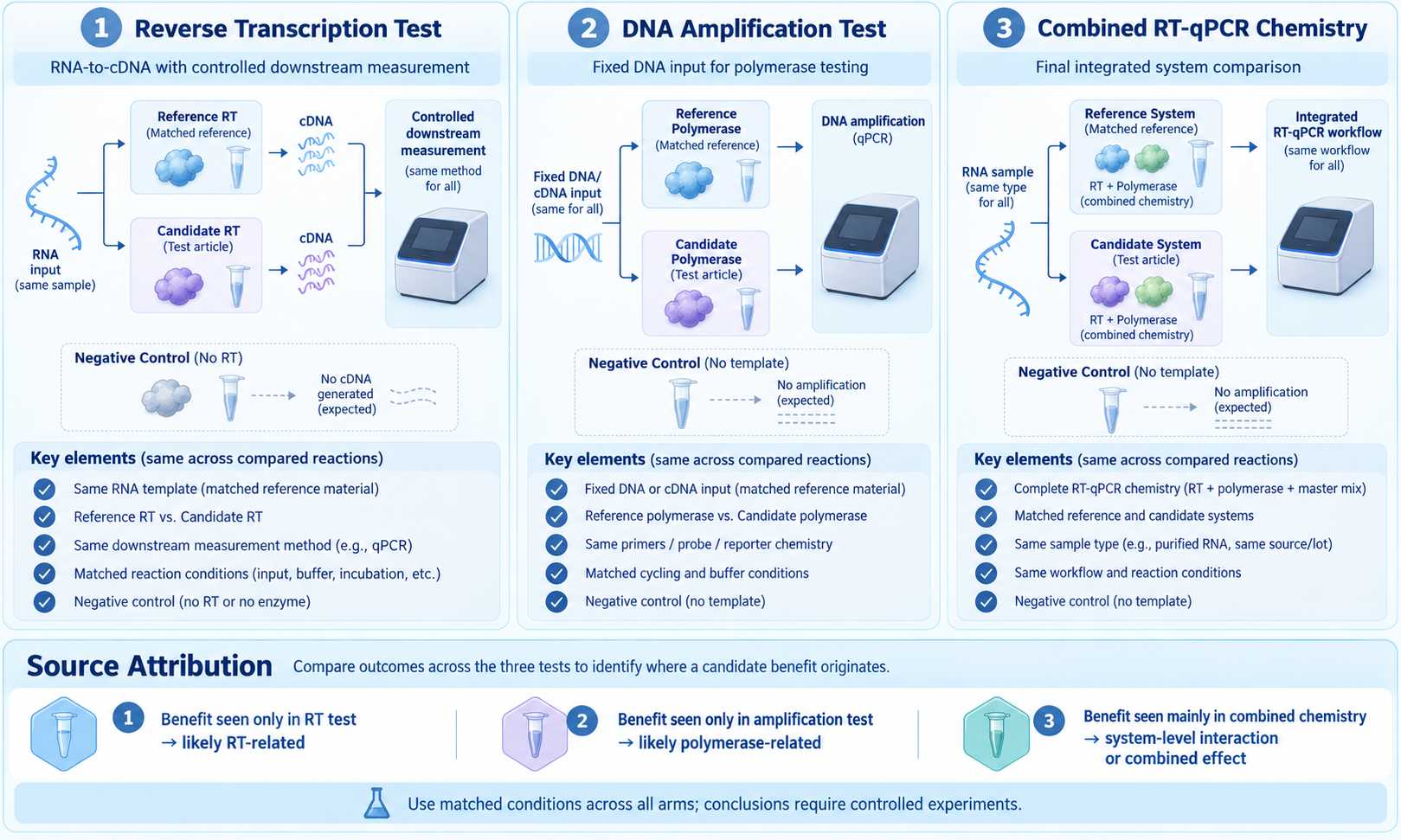
For a DNA-polymerase program, compare candidates with a fixed DNA input under a controlled reaction and detection method. This avoids introducing reverse-transcription variation into the first assessment. If a faster or stronger signal is observed, confirm that the intended product explains it and investigate the accompanying negative reactions.
For an RT program, hold downstream DNA amplification as constant as practical while comparing RNA-to-cDNA conversion. Include appropriate controls for DNA background and reaction contamination. A changed RT preparation can carry a different chemical environment into the downstream measurement, so consider whether that carryover could explain the signal difference.
Next evaluate the complete system. An RT and polymerase that each perform well separately may require different conditions for optimal function. A combined assay must satisfy both stages and the reporter chemistry. Test the actual operating sequence, including activation and transitions, instead of assuming that isolated-enzyme results will simply add together.
For an enzyme intended to perform both DNA- and RNA-dependent synthesis, preserve separate tests for each capability. A strong DNA amplification result cannot establish reverse-transcription performance. Conversely, a gain in RNA-derived signal does not confirm that DNA synthesis, error behavior or reporter compatibility remained acceptable.
MIQE 2.0 emphasizes transparent reporting of the factors that affect qPCR interpretation. Apply that principle to variant comparison: retain sample information, reaction conditions, controls and analysis choices. An earlier quantification cycle can be useful evidence, but by itself does not establish a lower limit of detection or a clinical performance benefit.
Challenge the conditions that could change the ranking
Use a template panel that represents the intended assay requirements. The goal is not to claim coverage of every possible sequence, but to learn whether the candidate's benefit depends on a narrow set of substrates. Document the features used to select the panel and retain target-level results instead of reporting only an average.
Include relevant low-input conditions when the application depends on them. A gain at abundant template may not persist near the assay's practical decision range. Distinguish a missing signal caused by sampling from a failure of the reaction, using a study design appropriate to the question. Avoid calling a small screening comparison a validated sensitivity study.
Review interactions with hot-start control, nucleotide composition and probe chemistry where these are part of the workflow. Sequence changes can alter compatibility even when the primary synthesis measurement improves. The required functions should be tested in the intended combination rather than inferred from the reference enzyme.
Keep formulation changes identifiable. Comparing a variant in a newly optimized mixture with the reference in an older mixture measures a combined development outcome. It can be commercially useful, but it does not isolate the effect of the sequence. A matched comparison or an appropriate sequence-by-formulation design helps make the attribution clearer.
For multiplex assays, retain per-target observations and assess the conditions relevant to competition among targets. A single combined signal or mean response can conceal a loss for one target. The candidate must meet the application's full acceptance logic, including negative reactions and the conditions where the reference already performs adequately.
Select a candidate with a clear development case
Advance a variant when the benefit is reproducible, the required companion properties remain acceptable and the remaining development work is understood. A candidate with a modest but consistent advantage may be more useful than one with a large improvement on a narrow surrogate test.
Record the exact sequence, preparation history, comparison basis and the conditions in which the ranking changes. Keep the model version and selection rationale as design provenance. The performance conclusion should point to the experimental comparison, while the computational record explains why the candidate was investigated.
When a program stalls, revisit the mechanism and objective before expanding the search. The bottleneck may lie in formulation or assay design, or the measurement may not distinguish the intended gain. The next experiment should resolve that uncertainty rather than produce another unexplained ranking.
Use DNA Polymerase Fidelity, Processivity and Inhibitor Tolerance for the underlying property distinctions and Reverse Transcriptase Selection for Molecular Diagnostics for broader selection considerations. For candidate iteration, see Design-Build-Test-Learn Workflow for Enzyme Evolution. The AI-Driven Enzyme Engineering Resource Center connects these guides to the wider engineering program.
Sources and further reading
- Tomilova YE and colleagues. Enhancing the reverse transcriptase function in Taq polymerase via AI-driven multiparametric rational design. Frontiers in Bioengineering and Biotechnology. 2024;12:1495267. DOI: 10.3389/fbioe.2024.1495267.
- Mohr S and colleagues. Thermostable group II intron reverse transcriptase fusion proteins and their use in cDNA synthesis and next-generation RNA sequencing. RNA. 2013;19:958-970. DOI: 10.1261/rna.039743.113.
- Arezi B and colleagues. Compartmentalized self-replication under fast PCR cycling conditions yields Taq DNA polymerase mutants with increased DNA-binding affinity and blood resistance. Frontiers in Microbiology. 2014;5:408. DOI: 10.3389/fmicb.2014.00408.
- Tao YA and colleagues. AI-guided redesign of laboratory-evolved reverse transcriptases enhances prime editing. Nature Biotechnology. 2026. DOI: 10.1038/s41587-026-03149-6.
- Bustin SA and colleagues. MIQE 2.0: Revision of the Minimum Information for Publication of Quantitative Real-Time PCR Experiments Guidelines. Clinical Chemistry. 2025;71:634–651. DOI: 10.1093/clinchem/hvaf043.