

AI-driven enzyme engineering uses computational models to help decide which protein variants to make and test. Its value for a diagnostic project depends on whether those experiments measure the property that limits the intended assay.
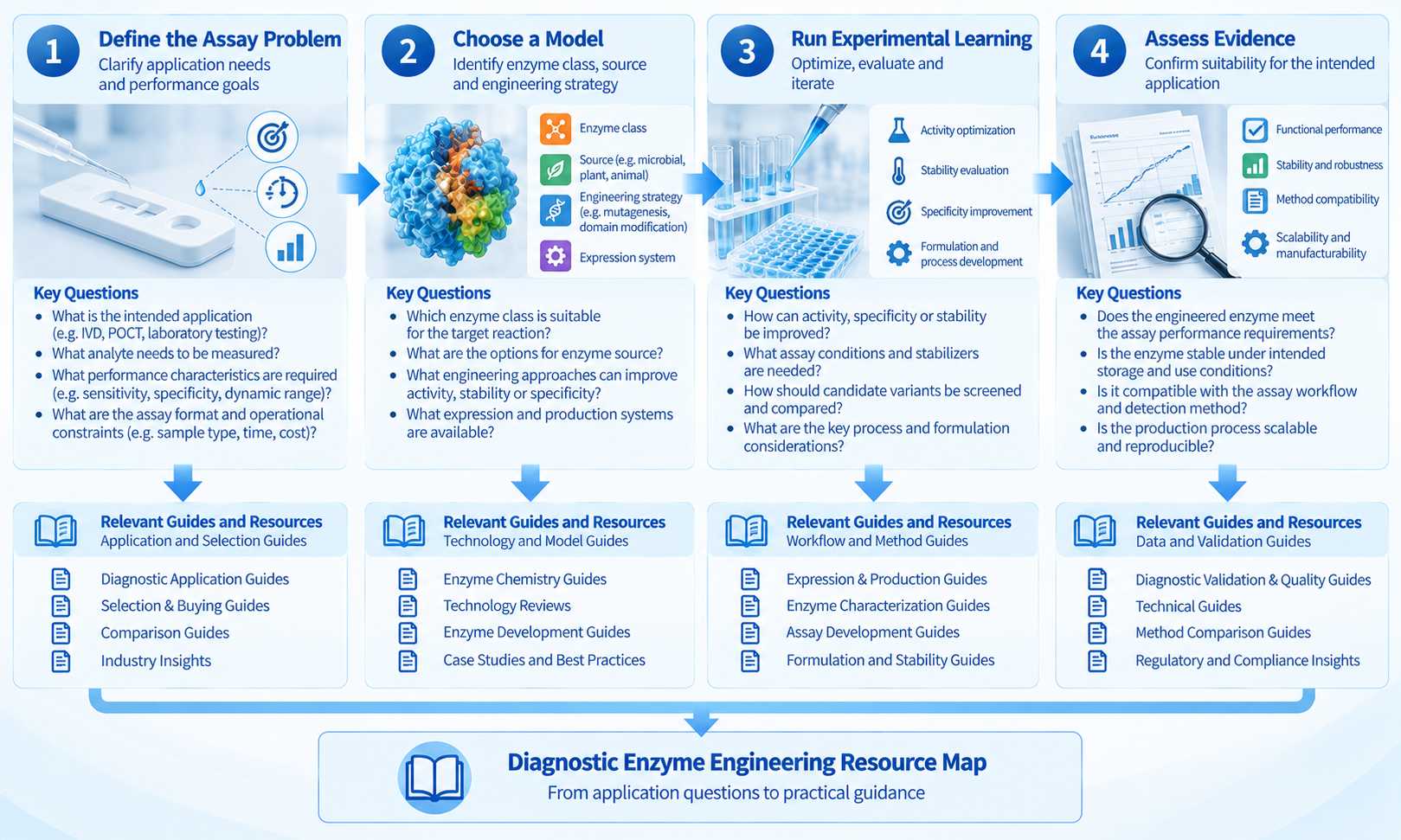
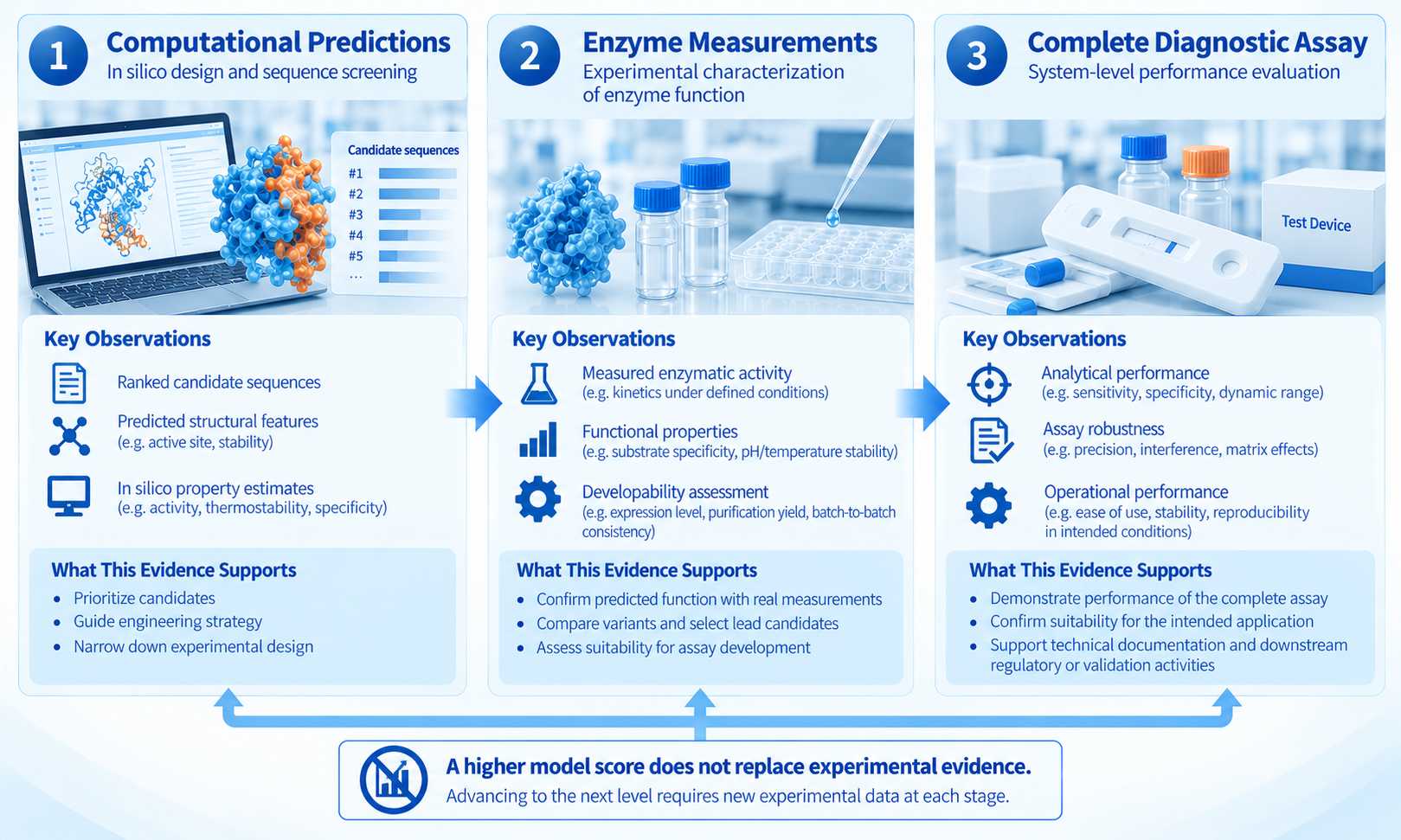
Use this resource center to move from a defined assay problem to a suitable modeling approach and an interpretable experimental program. The guides separate predicted sequence properties, measured enzyme behavior and performance in a complete diagnostic system.
Choose a starting point
Start with the decision that is currently blocking progress. A team with inconsistent assay results needs a different entry point from a team with a reproducible screen and a library of measured variants. Models can help prioritize candidates, but choosing a model before defining the experimental question often leaves its output difficult to interpret.
The following three guides provide the core reading path. Read them in sequence when planning a new program, or go directly to the question that matches your current work.
| Your question | Guide | What it helps you decide |
|---|---|---|
| Is enzyme engineering the right intervention? | AI-Driven Enzyme Engineering for Diagnostic Applications | Translate assay limitations into measurable enzyme objectives and identify alternative causes. |
| Which model fits the available evidence? | AI Models for Diagnostic Enzyme Variant Design | Compare sequence, structure and assay-trained approaches without treating their scores as equivalent. |
| How should experiments inform the next round? | Design-Build-Test-Learn Workflow for Enzyme Evolution | Organize candidate selection, measurement, feedback and confirmation around clear decisions. |
Define what the enzyme must do in the assay
An engineering objective should name both the desired change and the conditions in which that change matters. More signal, higher stability and greater tolerance are incomplete specifications on their own. Identify the substrate, matrix, reaction format, exposure history and comparison material before using those terms as optimization targets.
For example, improved activity after a brief heat exposure answers a different question from activity retained during storage. Similarly, a reverse transcriptase that performs well in one molecular context still needs testing in the intended amplification chemistry. These distinctions help keep a program focused on the final use rather than an attractive surrogate measurement.
| Topic | Resource | Decision focus |
|---|---|---|
| Temperature and retained function | AI-Assisted Thermostability Engineering of Diagnostic Enzymes | Separate thermal unfolding, activity after stress and formulation stability. |
| Nucleic acid synthesis | AI-Guided Polymerase and Reverse Transcriptase Engineering | Define the reaction requirements and compatibility constraints for the enzyme system. |
| Reaction selectivity | AI-Guided Substrate Specificity and Cross-Reactivity Reduction | Evaluate desired turnover alongside unwanted reactions and assay background. |
Connect the model to reliable data
A useful model-development record explains where sequences came from, how their labels were measured and what kind of new candidate the model is expected to encounter. Predictions for nearby variants within one scaffold and predictions for distant protein families are different tasks. Choose an evaluation that resembles the intended task before interpreting an accuracy statistic.
Hsu and colleagues demonstrated that combining evolutionary information with measured labels can be useful, with simple methods providing important baselines. Biswas and colleagues showed data-efficient engineering in specific experimental systems. Neither result establishes a universal training-set size or guarantees that a transferred representation captures the property of interest in a diagnostic reagent.
| Resource | Use it when |
|---|---|
| AI-Ready Experimental Dataset Design for Enzyme Optimization | You need consistent sequence identifiers, assay metadata and records of unsuccessful experiments. |
| AlphaFold, RFdiffusion and ProteinMPNN for Enzyme Design: Practical Limits | You need to distinguish structure prediction, backbone generation and sequence design. |
| Responsible AI and Sequence Screening in Protein Engineering | You are defining provenance, appropriate review and responsibilities for generated sequences. |
These topics connect but should not be collapsed into a single model score. Structural plausibility, assay-label prediction and sequence provenance each address a separate question. Record the evidence for each one so that a later reviewer can understand why a candidate was selected.
Read engineering claims at the correct evidence level
Published engineering studies establish what happened in their tested systems. Wu and colleagues used measured combinatorial libraries to guide protein evolution. Yang and colleagues explored iterative active learning. These studies support experimental prioritization as a practical role for machine learning; they do not establish that every diagnostic enzyme will benefit from the same selection strategy.
Recent work also illustrates the importance of application boundaries. Tao and colleagues used AI-guided redesign of reverse transcriptase domains in prime editors. That is relevant evidence for the engineering approach, but improved genome editing cannot be reported as improved RT-qPCR sensitivity. A diagnostic claim requires evidence generated in the diagnostic setting.
| Evidence available | Reasonable interpretation | What is still needed |
|---|---|---|
| Computational score or predicted structure | A candidate is worth investigating under the stated model assumptions. | Identity, expression and functional measurements. |
| Measured purified-enzyme property | The tested preparation behaves differently under the recorded conditions. | Confirmation of the mechanism and transfer to the complete reagent system. |
| Performance in an assay prototype | The variant affects the tested assay and sample conditions. | Broader analytical assessment and evidence appropriate to the intended use. |
| Repeatable results across relevant preparations and conditions | The effect survives the tested sources of variation. | Defined specifications, transfer controls and continued monitoring. |
Prepare the inputs for a useful engineering discussion
Bring an exact reference sequence, a description of the current preparation and an assay problem that can be reproduced. Include the measurement method, raw observations, controls and the conditions under which the reference fails. State which properties must remain acceptable while the target property improves.
Also identify practical constraints: how many candidates can be built, which measurements consume most time, whether purified material is available and when independent confirmation can be performed. A program with limited high-quality testing may benefit from a different selection strategy than one with a large but indirect screen. The experiment budget should include confirmation rather than being spent entirely on new designs.
Use How to Prepare a Project Brief for AI Enzyme Optimization to assemble those inputs. Return to the application guide when the limiting mechanism is uncertain, to the model guide when candidate scores are hard to interpret, and to the workflow guide when experimental feedback is not changing the next selection. A useful program produces both a better-supported candidate and a clearer account of what the remaining evidence can establish.
Sources and further reading
- Wu Z and colleagues. Machine learning-assisted directed protein evolution with combinatorial libraries. PNAS. 2019;116:8852-8858. DOI: 10.1073/pnas.1901979116.
- Biswas S and colleagues. Low-N protein engineering with data-efficient deep learning. Nature Methods. 2021;18:389-396. DOI: 10.1038/s41592-021-01100-y.
- Hsu C and colleagues. Learning protein fitness models from evolutionary and assay-labeled data. Nature Biotechnology. 2022;40:1114-1122. DOI: 10.1038/s41587-021-01146-5.
- Yang J and colleagues. Active learning-assisted directed evolution. Nature Communications. 2025;16:714. DOI: 10.1038/s41467-025-55987-8.
- Tao YA and colleagues. AI-guided redesign of laboratory-evolved reverse transcriptases enhances prime editing. Nature Biotechnology. 2026. DOI: 10.1038/s41587-026-03149-6.