

AI-guided specificity engineering can help prioritize enzyme variants that retain a desired reaction while reducing conversion of unwanted substrates. The useful endpoint is a better-defined reaction profile under the assay conditions, not simply a lower background signal.
Cross-reactivity can also originate in target recognition or signal detection. This guide separates those mechanisms, explains what substrate-pair predictions can support, and sets out a practical way to test selectivity without confusing it with general enzyme inactivation.
Locate the unwanted reaction before redesigning the enzyme
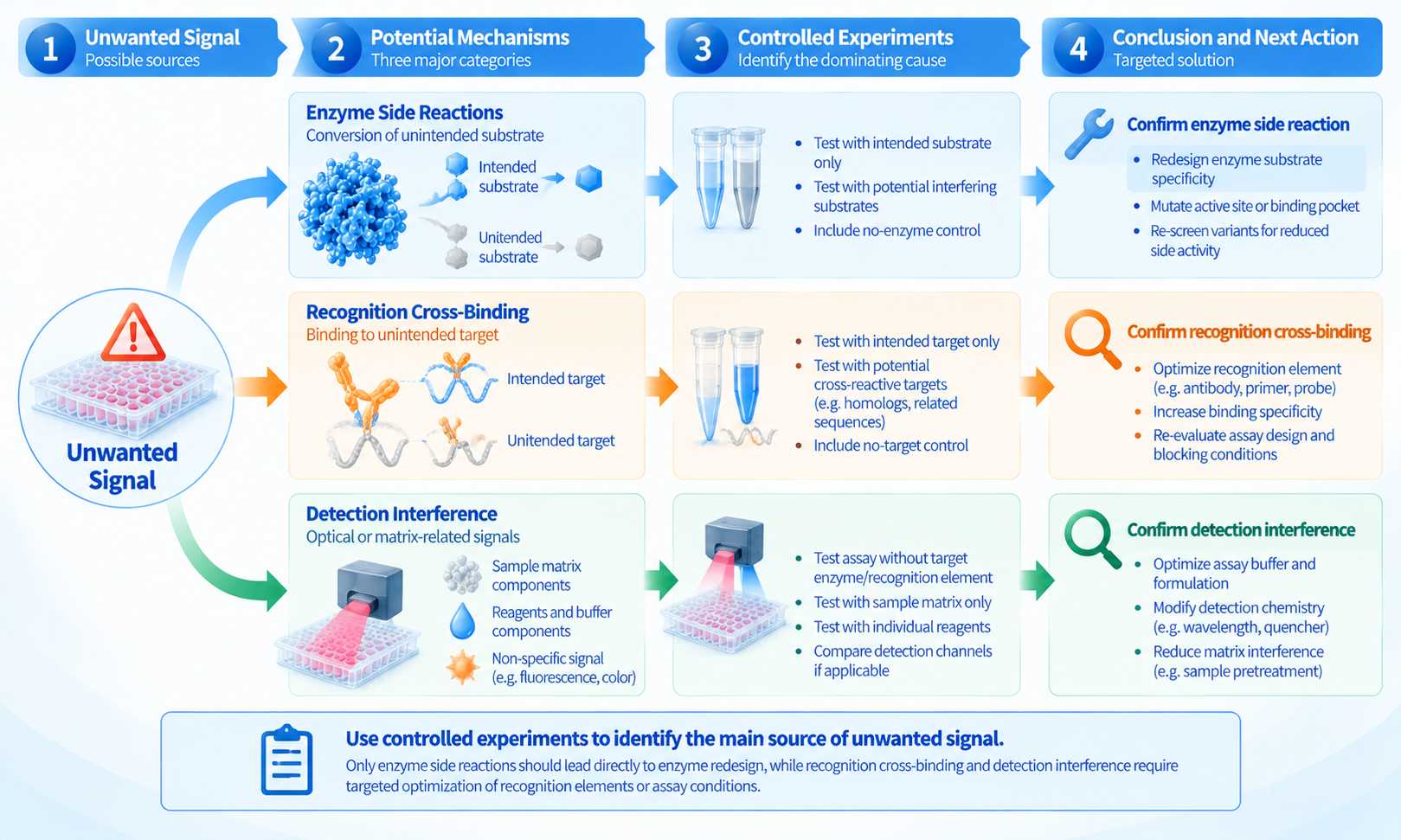
Begin with a mechanism question: does the enzyme convert an unintended chemical substrate, or does another component create the observed signal? In a coupled assay, a side reaction upstream may feed the intended reporter reaction. In an immunoassay, unintended binding can bring a correctly functioning enzyme label into the detection zone. These failures need different experiments and may need different remedies.
Compare the complete assay with controls that omit or replace selected components while preserving the relevant chemistry. An enzyme-free control can reveal nonenzymatic signal, but it cannot by itself distinguish every source of background. Removing a component may alter the reaction environment, so interpret the control against an appropriate matched reference.
Use sequence engineering when there is evidence that the enzyme's reaction profile contributes materially to the problem. If unwanted binding determines how much label is retained, changing the label's substrate pocket may leave the underlying binding problem intact. The dedicated interference resources address that separate mechanism.
| Observed mechanism | Question to resolve | Relevant development direction |
|---|---|---|
| Alternative substrate conversion | Does the enzyme form product from the challenged compound? | Engineer and measure the reaction profile. |
| Unintended recognition or binding | Does the recognition reagent recruit signal in the wrong context? | Investigate recognition chemistry, blocking and assay architecture. |
| Matrix or optical contribution | Does the sample alter the measured output without the proposed reaction? | Separate signal generation from detection and assess the matrix. |
| Coupled-reaction background | Which reaction supplies the unwanted intermediate? | Test the implicated step and then reconnect the full system. |
Choose a challenge panel that represents the intended use
Define the desired substrate, expected product and operating concentration range first. Then identify alternatives that could be present in the sample or reagent system and have a plausible route to unwanted conversion. Chemical similarity is a useful starting point, but actual exposure and reaction mechanism should determine which compounds matter most.
Include close structural analogues where relevant, along with compounds identified through observed interference or known sample composition. Record why each is present in the panel. A convenient laboratory substrate is not automatically an adequate surrogate for the substance encountered in the final assay, and an absent challenge compound cannot support a claim about its behavior.
Distinguish a measured negative from an untested pair. A pair that produced no quantifiable product under a specified method has a qualified experimental result. A molecule drawn from a database and assumed not to be a substrate is a different kind of label. Keep that distinction visible when assembling training examples and when interpreting a model's apparent discrimination.
Challenge alternative substrates individually before combining them. Individual tests help identify the source of a response; mixtures then ask whether competition, inhibition or coupled chemistry changes the result. Select concentrations based on the assay's intended context and justified challenge conditions. There is no universal concentration panel that establishes specificity for every enzyme or specimen type.
Plan target-plus-challenge experiments as well as challenge-only reactions. A compound may produce little signal on its own yet alter the intended reaction. That effect belongs in assay development even when the compound is not demonstrably an alternative substrate.
Match the prediction to the question it can answer
Kroll and colleagues' ESP study represents both enzymes and small molecules to predict substrate pairs. Its training strategy also addresses the shortage of negative examples through sampled non-substrates. Such predictions can help prioritize a panel or identify hypotheses, but a classification score does not establish the rate of an unwanted reaction at the concentration used in a diagnostic assay.
Li and colleagues' DLKcat work instead predicts turnover from enzyme sequences and substrate representations. This is a different output from a substrate compatibility classification. Neither output, by itself, supplies a validated target-to-off-target response ratio for a newly designed variant in a particular formulation.
Structural models can suggest pocket contacts, access routes or candidate substitutions. A plausible pose is evidence for a testable interaction hypothesis, not confirmation of catalytic conversion. Catalysis also depends on productive geometry, chemical steps and the surrounding reaction environment. Keep structural confidence separate from confidence in an activity prediction.
Yeh and colleagues demonstrated deep-learning-assisted design of luciferases with specificity for synthetic luciferin substrates. The study provides a concrete example of designed substrate preference. Its research results do not establish the analytical specificity of an immunoassay or show that all enzyme families can be redesigned in the same way.
For a local engineering program, compare predictions with measurements from the actual scaffold and challenge panel before relying on fine differences between candidates. Broad performance across enzyme families may not translate into accurate ranking of closely related substitutions. Use uncertain predictions to choose informative experiments rather than presenting uncertainty as a measured benefit.
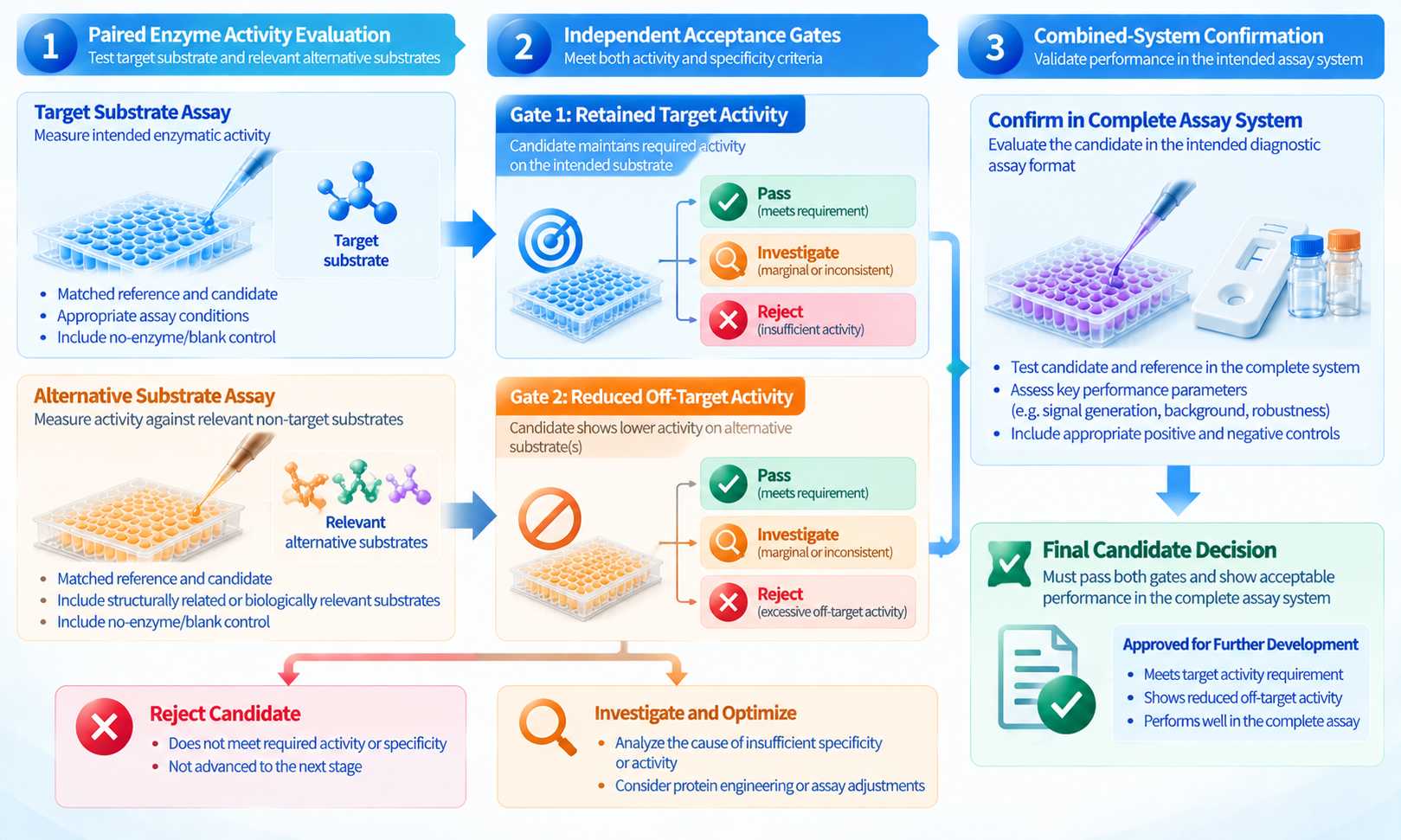
Require both retained function and reduced side activity
Evaluate the absolute target response and each unwanted response before calculating a selectivity ratio. A ratio may improve while the target reaction becomes too weak for the intended workflow. Conversely, greater target activity can improve the ratio while leaving an unacceptable unwanted reaction unchanged. Neither result alone answers the development question.
Set separate criteria for the minimum useful target function and the maximum acceptable response to each relevant challenge. These criteria should reflect the assay's needs, measurement capability and intended reaction interval. Apply them to matched reference and candidate preparations, with the same basis for enzyme amount or activity and a clear explanation of that basis.
Where the kinetic model is appropriate and supported by the data, parameters such as catalytic efficiency can help describe substrate discrimination. They should not replace evaluation at the operating concentrations. Saturation, competing substrates and a limited detection interval can make the practical assay response differ from a simple comparison of fitted parameters.
Aharoni and colleagues showed that laboratory evolution can alter promiscuous functions much more strongly than native function. That finding supports measuring the functions separately. It is conventional evolution evidence, not a guarantee that an AI-proposed mutation will selectively suppress an unwanted reaction.
If off-target activity falls below the method's quantification capability, report the qualification and its bound. Do not turn that result into zero activity or an infinite specificity ratio. Replicate measurements should establish whether the apparent difference exceeds experimental variation before the candidate advances.
Confirm chemistry before interpreting the complete assay
Use an orthogonal measurement of substrate conversion or product identity when the primary signal can be affected by the challenge compound. For example, a lower reporter output could reflect inhibition or quenching rather than reduced formation of the unwanted product. The confirmatory method should address the specific ambiguity; repeating the same optical readout under a new name does not resolve it.
Record enzyme identity, preparation, reaction conditions and the method used to derive rates. STRENDA provides a framework for reporting this experimental context. Complete reporting makes a comparison interpretable, but it does not make an unsuitable assay valid or demonstrate that two preparations have equivalent active enzyme content.
Recheck the selected candidate in the full reagent system. Include the intended substrate, relevant alternatives, cofactors, coupling enzymes and representative matrix conditions. An improvement in an isolated step can disappear when another reaction limits output or when formulation changes the candidate's behavior.
Compare independent preparations where feasible, and retain a contemporaneous reference. This helps distinguish sequence-associated behavior from preparation-specific contamination, concentration error or loss of activity. A reduced background caused by a generally weaker preparation should not be promoted as engineered discrimination.
The most useful confirmation result links a chemical change to the application outcome: the candidate reduces the identified unwanted conversion, retains useful target function, and improves the relevant assay response under the tested conditions. If one link is missing, state what remains unresolved instead of collapsing the evidence into a single specificity label.
Describe the specificity that was actually tested
A defensible handoff names the reference and candidate, challenged substrates and concentrations, measurement methods, retained target performance, and the conditions under which the unwanted response changed. Preserve unsuccessful and ambiguous results so that later teams can see the boundary of the conclusion.
Use a bounded statement such as reduced response to a named alternative substrate under the tested assay conditions. Avoid claiming that the enzyme has no cross-reactivity or that the complete diagnostic test is clinically specific. Untested compounds, different matrices and changes in assay architecture remain outside the demonstrated scope.
If the evidence points to antibody-mediated interference, continue with Heterophilic Antibody and Rheumatoid Factor Interference Guide. For organizing the paired activity records that support model training, see AI-Ready Experimental Dataset Design for Enzyme Optimization. The AI-Driven Enzyme Engineering Resource Center connects these topics with the wider engineering workflow.
Sources and further reading
- Kroll A and colleagues. A general model to predict small molecule substrates of enzymes based on machine and deep learning. Nature Communications. 2023;14:2787. DOI: 10.1038/s41467-023-38347-2.
- Li F and colleagues. Deep learning-based kcat prediction enables improved enzyme-constrained model reconstruction. Nature Catalysis. 2022;5:662-672. DOI: 10.1038/s41929-022-00798-z.
- Yeh AH and colleagues. De novo design of luciferases using deep learning. Nature. 2023;614:774-780. DOI: 10.1038/s41586-023-05696-3.
- Aharoni A and colleagues. The evolvability of promiscuous protein functions. Nature Genetics. 2005;37:73-76. DOI: 10.1038/ng1482.
- STRENDA Commission. STRENDA Guidelines. Beilstein-Institut. Accessed October 9, 2026..