

An AI-ready enzyme dataset connects each result to the exact material, experimental conditions and analysis that produced it. A sequence column beside an activity column is rarely sufficient: the same variant can produce different measurements because of preparation, substrate, formulation or readout differences.
The design goal is to preserve those distinctions while making records consistent enough to compare and model. This guide explains how to structure observations, retain qualified results and evaluate predictions without allowing related experiments to leak across the test boundary.
Define what one prediction is supposed to mean
Start with the decision the model will support. Predicting purified-enzyme activity under one fixed condition is different from predicting performance across formulations or ranking variants in a complete diagnostic reagent. Each task needs a different set of inputs and a different interpretation of the output.
Write the target as a measurement with an explicit method and context. Terms such as stability, activity and fitness are too broad on their own. A thermal-transition result, activity remaining after a defined exposure, and retained assay performance after storage should occupy distinct fields or clearly distinguished tasks rather than being merged into one stability score.
Choose the unit of observation before collecting data. It may be an individual reaction, a fitted result from a concentration series, or an aggregate across independent preparations. Preserve the underlying observations whichever unit is used for training. Otherwise, a later analyst cannot determine whether a precise-looking label represents one measurement or substantial replication.
Specify which information will be available when the prediction is made. A purification yield measured after producing the candidate may be a legitimate input for a downstream decision, but it cannot be used without qualification in a model intended to rank unbuilt sequences. This distinction prevents an apparently useful predictor from depending on information the real workflow does not yet have.
Link sequence identity to the experimental material
Use stable identifiers for the sequence, construct, preparation, assay condition and measurement. A mutation label such as a residue substitution is incomplete without the reference sequence and numbering convention. Record the full tested sequence, including relevant tags, truncations or fusion regions, and preserve a mapping to the reference used to describe changes.
Keep sequence identity separate from preparation identity. Two independently expressed and purified batches of the same sequence are related records, not duplicates. Conversely, repeated measurements from the same preparation should not appear to be independent production experiments. Linking these levels makes it possible to estimate variability and choose sensible evaluation groups.
Store assay conditions as structured fields or as a versioned condition record. A free-text note can retain unusual details, but it should supplement fields that need consistent querying. For example, substrate identity and concentration should not be hidden in a filename that an analyst must interpret manually.
ProtaBank illustrates the value of organizing protein-engineering results around sequences and assay information. MaveDB provides a complementary example for multiplexed variant-effect data. These resources motivate traceable records; they do not imply that all deposited measurements share a common biological meaning or can be pooled without examining their methods.
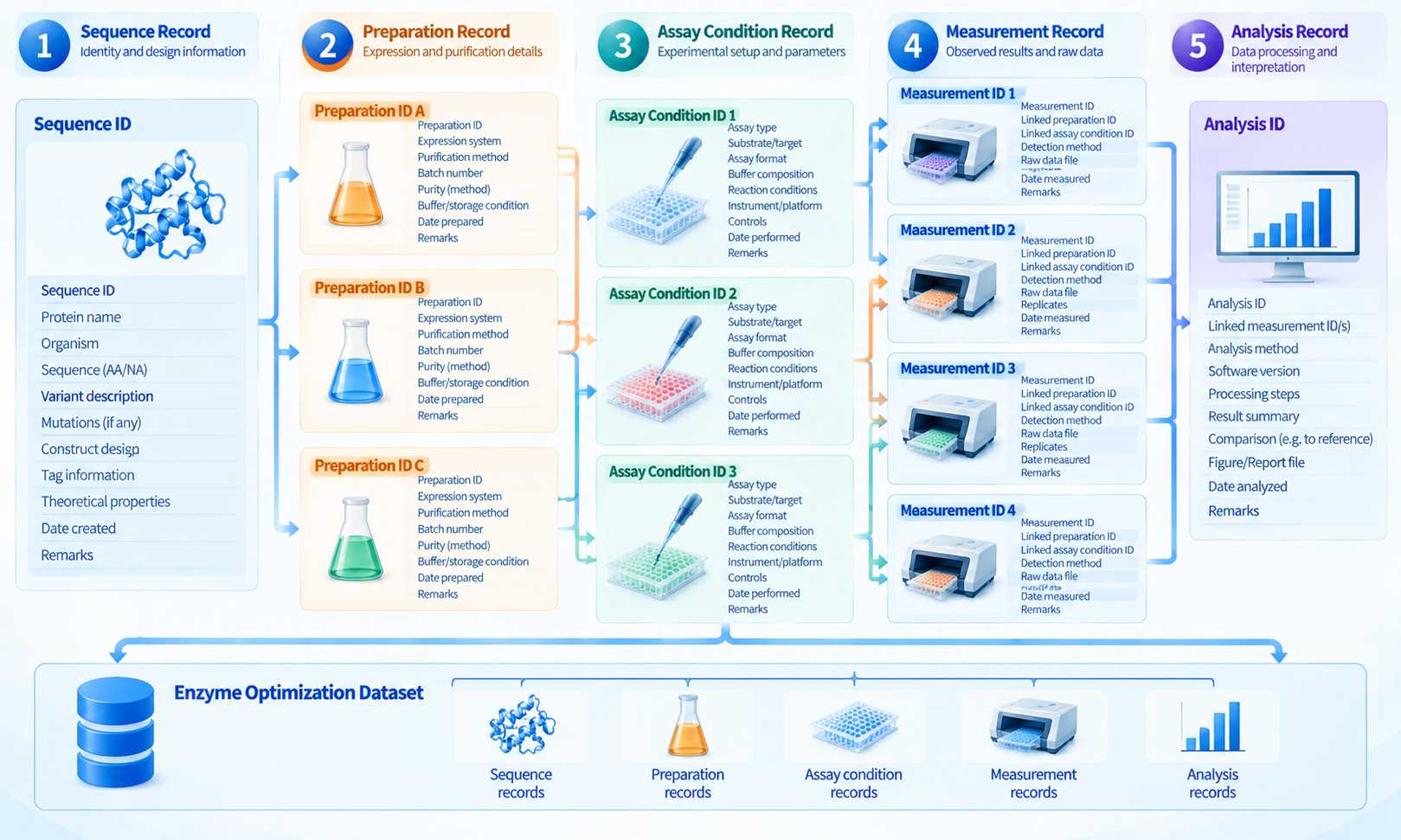
Build a data dictionary around interpretation
| Record group | Information to retain | Why it matters |
|---|---|---|
| Sequence and construct | Stable identifier, exact sequence, reference, substitutions and construct features. | Resolves what was tested and prevents ambiguous variant mapping. |
| Material preparation | Preparation identifier, expression and purification context, concentration basis and storage history. | Separates sequence effects from material-specific differences. |
| Reaction conditions | Substrate and cofactor identities, concentrations, buffer, pH, temperature and timing. | Defines the chemical setting in which the label is meaningful. |
| Measurement | Raw-file reference, instrument or method version, result, unit and qualification. | Preserves the path from signal to reported property. |
| Controls and replication | Reference and blank identifiers, run, plate, position and replicate relationships. | Supports comparison, variability assessment and investigation of run effects. |
| Analysis and provenance | Processing version, fitting method, exclusions, uncertainty and source record. | Allows results to be reproduced and revised transparently. |
Define allowed units, field types and missing-value codes before combining sources. Keep the original value and unit when converting to a canonical representation. Enzyme activity units require their measurement definition; a shared unit label does not guarantee comparable assay chemistry or conditions.
STRENDA emphasizes the context needed to report enzymology measurements. Use that guidance to identify missing scientific information, then add the identifiers and provenance needed by the local data pipeline. The table above is a proposed working structure, not a claim that STRENDA prescribes this particular database design.
Preserve raw data separately from derived labels, with an explicit link between them. Record the analysis method and its version, including background handling, normalization, curve fitting and exclusion rules. If a reanalysis changes a result, create a traceable revision rather than silently replacing the value that an earlier model used.
Distinguish measured, literature-extracted, model-predicted and manually inferred values. They can all be useful, but they should not appear as equivalent experimental observations. A predicted label used for a specific training strategy must remain identifiable so that it is not later mistaken for independent validation evidence.
Retain uncertainty, failures and measurement limits
Keep individual replicates and their grouping even if the modeling table uses an average. Technical repeats mainly describe variability in repeated measurement of the same material. Independent preparations address another source of variation. Record the replicate type and sample count rather than reducing both to an unexplained error bar.
Use explicit result states for not tested, failed quality control, below detection, below quantification and above range. These are not interchangeable with zero, and a failed reaction is not automatically evidence that the sequence is inactive. Where a measurement is censored by a limit, preserve the limit and direction alongside the available result.
Document exclusions and their reasons. An instrument fault, incorrect construct and confirmed low-activity candidate represent different situations. Removing all poor performers produces a biased view of the explored sequence space, while treating every failed experiment as a valid low-activity label introduces a different error. The dataset should allow the analyst to distinguish them.
Normalization needs its own provenance. Retain the raw response, reference response, normalization rule and run identity. A reference that drifts between days can change normalized values even when a candidate has not changed. Repeated controls and deliberate overlap across runs help reveal this problem before the data are pooled.
Balance experimental placement where practical. If every new variant is measured in a later run and every reference variant in an earlier run, sequence and run effects can become difficult to separate. Metadata can expose the confounding, but recording it does not necessarily provide enough information to correct it afterward.
Make the evaluation resemble the intended future use
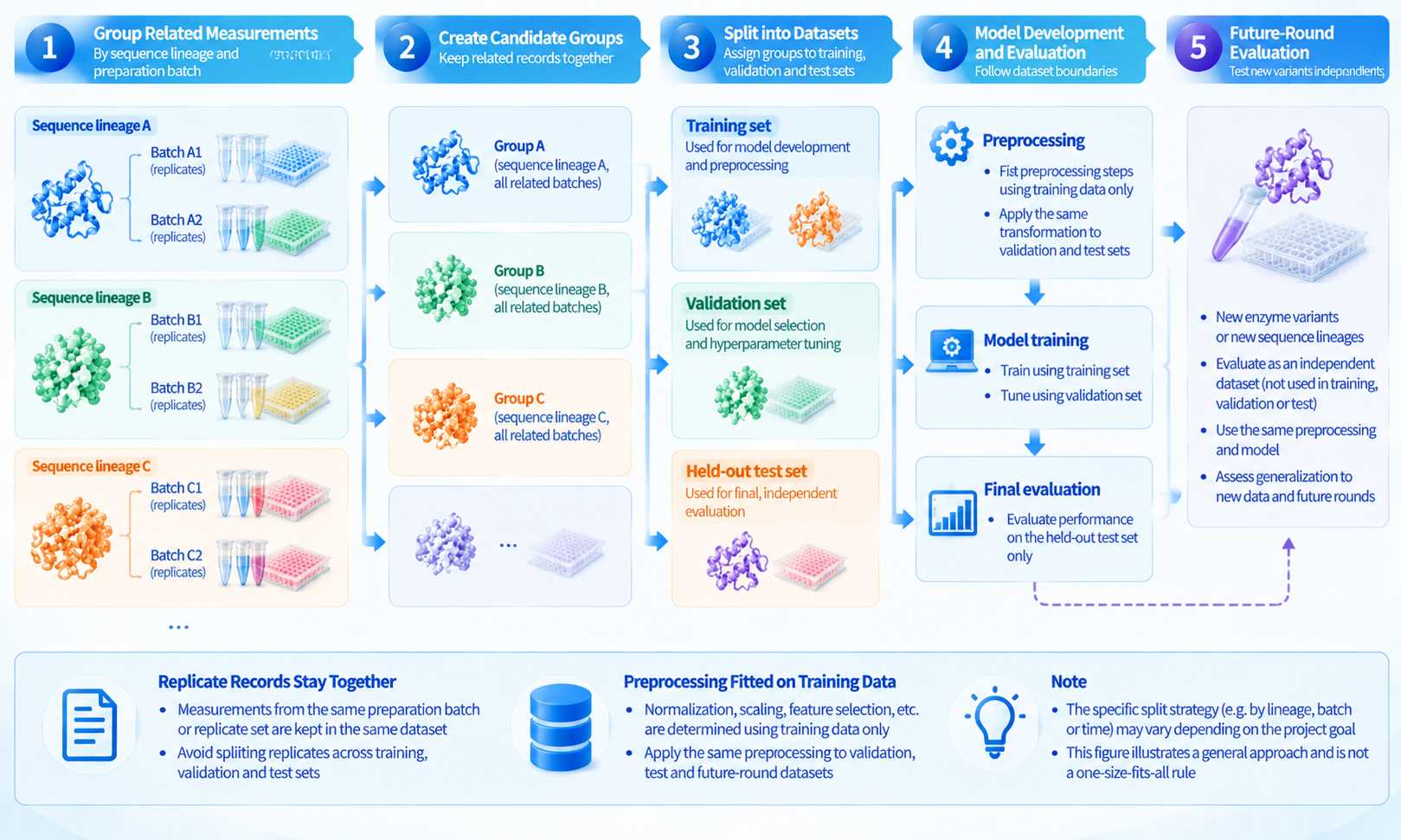
Choose the evaluation question before splitting rows. Predicting another measurement of a known variant is easier and different from predicting a new sequence family, a later experimental round or an unfamiliar substrate. Report which task the held-out data represent, because a strong result on one does not establish performance on the others.
Keep related records together when their separation would make the test artificially easy. Replicates, repeated preparations and closely related variants may require grouping, depending on the question. For models of enzyme-substrate pairs, inspect relationships on both sides: an unfamiliar enzyme paired with a familiar substrate is a different challenge from an unfamiliar enzyme and unfamiliar substrate together.
Joeres and colleagues' DataSAIL work addresses similarity-aware splitting to reduce information leakage. It supports deliberate partition design rather than assuming that a random row split measures generalization. The choice of similarity measure and grouping rule still needs to reflect the local scientific task.
Fit learned preprocessing on training data, then apply the fitted transformation to validation and test data. The same principle applies to data-driven feature selection and imputation. Experimentally predefined processing may be applied consistently, but its specification should remain independent of held-out outcomes.
Use validation data for model and parameter choices, and preserve an untouched test set for the stated final comparison. Repeatedly selecting the best model based on test performance turns the test into another development dataset. For iterative engineering, a prospectively defined future round can provide additional evidence, provided the selection process and any overlap with training are recorded.
Release a reproducible dataset, not just a cleaned table
Before handoff, check that identifiers resolve, sequences match their mutation descriptions, units are consistent and every included label has a defined meaning. Inspect duplicate records, missing conditions and unexplained changes in distributions across runs. These checks establish usability; they do not substitute for scientific review of the assay or the model's intended use.
Package the dataset with a dictionary, source manifest, processing code or executable analysis description, exclusion log and split assignments. Give the release a version and state which experiments it contains. Keep a record of the model training snapshot so that subsequent additions do not alter the evidence behind an earlier result.
The FAIR principles provide a useful framework for making data findable, accessible, interoperable and reusable. Access arrangements should reflect ownership and permissions. Reusability depends on understandable provenance and terms as well as file availability; a dataset can be carefully documented while access remains controlled.
Define readiness through the intended prediction task rather than a universal row count. A large table of incomparable measurements may be less informative than a smaller, well-controlled dataset. Remaining gaps should be visible in the handoff: unrepresented sequence families, narrow condition coverage, weak negative examples or uncertainty in a particular measurement class.
For selecting experiments after the dataset is established, continue with Design-Build-Test-Learn Workflow for Enzyme Evolution. For the experimental interpretation of paired target and off-target labels, see AI-Guided Substrate Specificity and Cross-Reactivity Reduction. The AI-Driven Enzyme Engineering Resource Center provides the surrounding model and application guides.
Sources and further reading
- STRENDA Commission. STRENDA Guidelines. Beilstein-Institut. Accessed October 9, 2026..
- Wilkinson MD and colleagues. The FAIR Guiding Principles for scientific data management and stewardship. Scientific Data. 2016;3:160018. DOI: 10.1038/sdata.2016.18.
- Wang CY and colleagues. ProtaBank: A repository for protein design and engineering data. Protein Science. 2018;27:1113-1124. DOI: 10.1002/pro.3406.
- Esposito D and colleagues. MaveDB: an open-source platform to distribute and interpret data from multiplexed assays of variant effect. Genome Biology. 2019;20:223. DOI: 10.1186/s13059-019-1845-6.
- Joeres R and colleagues. Data splitting to avoid information leakage with DataSAIL. Nature Communications. 2025;16:3337. DOI: 10.1038/s41467-025-58606-8.