

Clinical chemistry assays rely on the entire reaction and measurement system. These answers explain common questions about enzyme roles, coupled reactions, readout timing, specimen effects and reagent evaluation.
The page is intended for assay development and technical investigation. It does not interpret an individual patient result or provide a universal formulation. General questions about enzyme specifications are covered in the Diagnostic Enzymes FAQ.
Reaction roles
Is the enzyme being measured or used as a reagent?
Both arrangements occur. An assay may measure a specimen enzyme through its catalytic activity, or add enzymes to determine another analyte. The distinction determines the calibration and control strategy. State the measurand first, then identify the function of each added reagent. A useful enzyme component is not necessarily the substance reported in the final result.
What is a coupled enzyme assay?
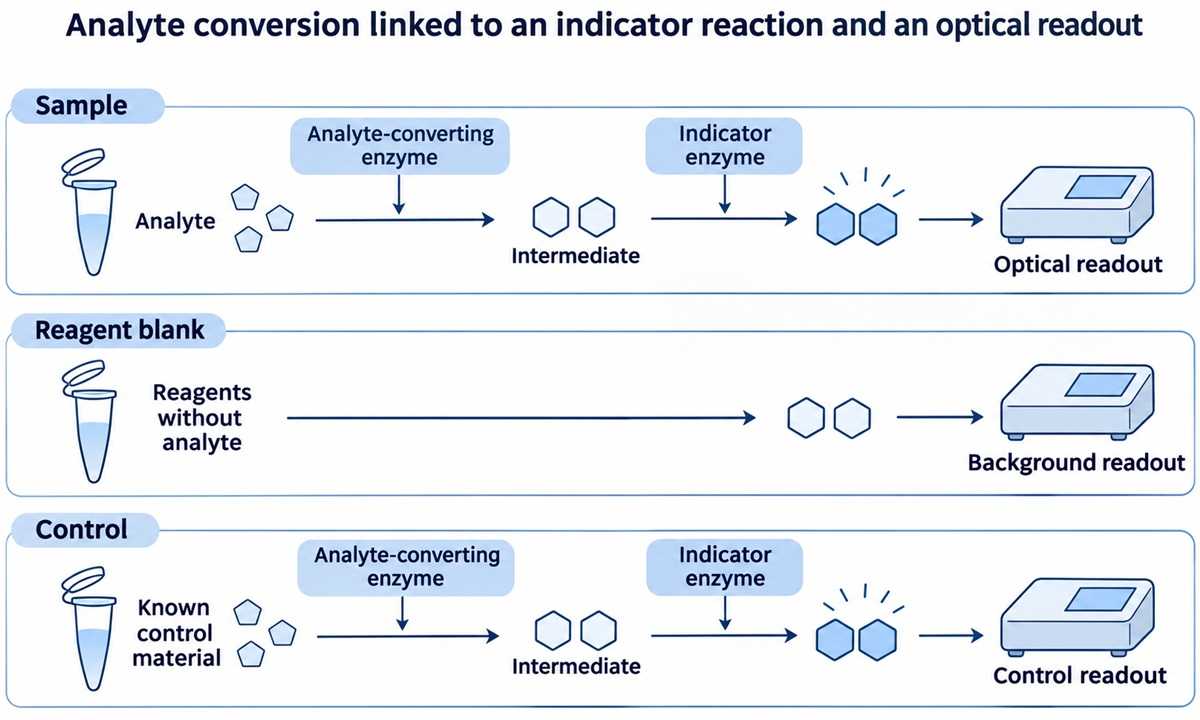
It links the reaction of interest to another reaction that produces a convenient measurable change. The indicator stage must operate appropriately over the intended range so that it does not distort the relationship to the original analyte. Evaluate the complete chain, including timing and background. Good isolated activity of the first enzyme does not prove that the coupled assay is performing correctly.
Why does adding more indicator enzyme sometimes help?
It may reduce a limitation in the indicator stage, but that explanation must be tested. More enzyme can also change background or formulation behavior. Compare the response and controls over relevant analyte levels rather than relying on one sample. The aim is a stable relationship between the target reaction and readout, not the highest possible enzyme dose.
Are oxidase and dehydrogenase systems interchangeable?
No. Their reaction partners and readout arrangements can differ, including oxygen, cofactors or electron-transfer components. Compare the actual enzyme and detection chemistry. A change can affect specificity, matrix behavior and operating conditions, so it should be evaluated as a system change. A shared analyte does not make two measurement principles equivalent.
Why can oxygen matter in a glucose oxidase assay?
The IUBMB reaction for glucose oxidase includes oxygen as a reactant and hydrogen peroxide as a product. Whether oxygen availability limits a particular measurement depends on its design and conditions. Check the complete reaction and specimen context. Do not assume that every glucose assay uses this chemistry or that all glucose oxidase formats have identical limitations.
Measurement design
What is the difference between endpoint and kinetic measurement?
An endpoint method uses a defined final or fixed-time response, while a kinetic method uses change over a specified interval. The read window and calculation are part of the method. Neither approach is universally superior. Select the approach that supports the intended measurand and verify that the reaction behaves appropriately during the interval being interpreted.
Can I move the read time to obtain a stronger signal?
Only through an appropriate method evaluation. A later reading may increase desired signal but also background, substrate depletion or other effects. Examine the relationship between concentration and response across the intended interval. Changing the time can change what the result means, even when the instrument settings and reagent identities remain otherwise unchanged.
What does a reagent blank tell me?
It helps characterize signal arising from the reagent system without the intended analyte contribution under the defined blank conditions. It does not necessarily capture specimen-specific color or matrix effects. Choose controls that address the suspected source of signal. A low reagent blank does not prove that every specimen will produce an interference-free result.
Why are cofactors and metal ions important?
Some enzymes require particular cofactors or ions for useful activity, and the complete reaction can depend on their availability. Other ingredients may alter that availability. Identify the requirements of the actual enzyme system and evaluate the formulation rather than adding components empirically. A concentration suitable for one reaction can be unsuitable for another stage of a coupled assay.
Can activity results measured at different temperatures be compared directly?
Not without a justified relationship between the methods. Catalytic activity is condition-dependent, so temperature belongs with the reported value. A general correction factor may not represent the actual enzyme and assay. Compare under a common defined method where appropriate, and preserve the original conditions when interpreting published or supplier results.
Specimen effects
Does every abnormal color indicate enzyme inhibition?
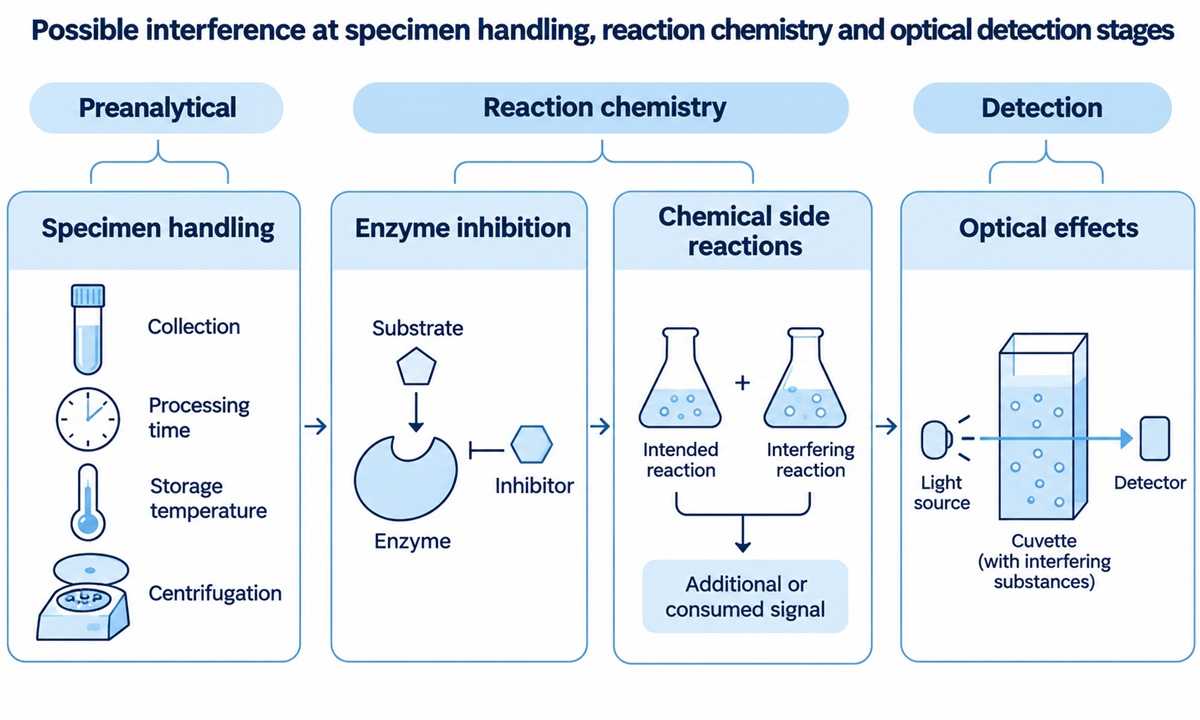
No. A colored or turbid specimen can affect the optical measurement, while other components can alter reaction chemistry or enzyme activity. These mechanisms may coexist. Use suitable comparisons to distinguish the readout contribution from the biochemical contribution. Changing enzyme concentration alone is unlikely to resolve every optical or specimen-related problem.
Are hemolysis, lipemia and icterus effects the same for all methods?
No. The effect depends on the measurement procedure, analyte level and specimen conditions. A limit supported for one assay should not be transferred to another merely because both use enzymes. Evaluate the relevant method and document the conditions. Use validated handling and interpretation rules rather than a universal assumption about specimen appearance.
Can anticoagulants affect an enzyme-based assay?
They can, depending on the chemistry and the validated specimen type. Possible effects include altered ion availability or other matrix changes. Use the specimen types supported for the method. An acceptable result in serum does not automatically establish performance in every plasma collection condition, and an unplanned substitution needs an appropriate assessment.
Is poor recovery always caused by the reagent enzyme?
No. Recovery can be influenced by sample preparation, matrix, calibration, the added material and the measurement procedure. First check whether the comparison represents the intended analyte and specimen. A poor result is an observation to investigate, not proof of a specific mechanism. Preserve the controls and preparation details needed to distinguish the alternatives.
How is a preanalytical change different from analytical interference?
A preanalytical change can alter the amount or state of the measurand before measurement. Analytical interference affects the measurement itself. CLSI distinguishes these concepts because they require different investigations. For example, a specimen that changes during handling may not be corrected by modifying the reagent. Establish when the relevant change occurred before selecting an intervention.
Reagent performance
Does a straight calibration line prove the assay is linear?
It is not sufficient by itself. Linearity concerns the relationship between measured results and concentration across a defined interval, with suitable study design and assessment. CLSI EP06 addresses this evaluation. Do not infer an unlimited measuring range from a few calibration points or assume that acceptable linearity also establishes precision and low-end performance.
Can dilution solve an out-of-range or matrix problem?
It can be useful only when the dilution procedure is supported for the method. Dilution changes both analyte concentration and matrix conditions, so the result may not follow a simple proportional relationship. Use an appropriate diluent and validated calculation. An apparently improved result after dilution can inform an investigation but does not automatically validate the procedure.
Does good precision prove that results are correct?
No. Repeated measurements can agree closely while sharing a systematic error or an interference effect. Precision, bias, linearity and interference address different properties. Evaluate the characteristics relevant to the intended use instead of treating one successful metric as complete validation. A consistent reaction signal is useful, but its relationship to the measurand still needs evidence.
What should be checked after changing an enzyme lot?
Assess the change against the material controls and the potential effect on the finished method. Relevant checks may include response, blank, difficult concentrations and applicable matrix conditions. The exact plan depends on the assay and risk. Maintain lot traceability and avoid using a single midrange control as universal evidence that all performance characteristics are unchanged.
How should reagent stability be judged?
Use endpoints that represent the intended assay, including relevant response and background behavior in the final presentation. Distinguish storage, transport and in-use conditions. A retained activity result for an isolated component is not enough if another part of the reagent system becomes limiting. Support the claimed period with appropriate evidence rather than extrapolating from appearance or one favorable time point.
Choose the next investigation
| Observation | First distinction |
|---|---|
| Weak response | Reaction limitation versus readout or specimen effect. |
| High blank | Reagent background versus specimen-specific signal. |
| Changing results | Material, calibration, handling or stability change. |
Record the method, specimen type, reagent lots, read conditions and controls before drawing a conclusion. Diagnostic Enzymes FAQ explains general material specifications; FAQ provides the full topic index.
Sources and further reading
- IUBMB. Current IUBMB recommendations on enzyme nomenclature and kinetics. Perspectives in Science. 2014..
- IUBMB. EC 1.1.3.4: Glucose oxidase. Accessed October 20, 2026..
- Clinical and Laboratory Standards Institute. Clinical Laboratory Testing Interference. Accessed October 20, 2026..
- Clinical and Laboratory Standards Institute. Evaluation of Linearity of Quantitative Measurement Procedures. Accessed October 20, 2026..
- Clinical and Laboratory Standards Institute. EP25: Evaluation of Stability of In Vitro Medical Laboratory Test Reagents. Published April 26, 2023..