

Diagnostic enzyme selection depends on more than an enzyme name or an activity value. These answers explain how to interpret specifications, handle materials and identify the evidence needed for a particular assay.
The focus is on general reagent questions. Clinical chemistry and molecular reaction details are covered in their own FAQs. Product-specific storage conditions, specifications and suitability must be confirmed for the actual preparation.
Identity and role
What is a diagnostic enzyme?
It is an enzyme used in a diagnostic measurement system, for example to convert an analyte, amplify nucleic acid or generate a signal. The phrase describes a role, not a single regulated grade. An enzyme may be a component of an assay without being a complete diagnostic product. Its suitability depends on the preparation and intended application.
Is a reagent enzyme the same as an enzyme biomarker?
No. A reagent enzyme is added to help perform the measurement. An enzyme biomarker is part of the specimen and is itself being measured, often through catalytic activity. Confusing these roles can lead to incorrect calibration or troubleshooting assumptions. State whether the enzyme is the measurement tool or the measurand before choosing controls.
Does an EC number identify an interchangeable product?
An EC number classifies an enzyme-catalyzed reaction. It does not specify every property of a commercial preparation, such as sequence, source, formulation or impurity profile. IUBMB nomenclature is useful for identifying the reaction, but two preparations with the same classification may behave differently in a diagnostic system. Evaluate the actual materials rather than the label alone.
Are recombinant enzymes always better than native enzymes?
Neither production route guarantees better application performance. Recombinant production may support defined sequence control or engineering, while a native preparation may have properties useful for a particular method. Compare relevant identity, activity, contaminants, consistency and formulation. The decision should follow evidence for the assay, not a general preference for one source description.
Does IVD-grade mean the enzyme is approved for clinical testing?
Do not infer authorization from that phrase alone. Ask what specifications, quality controls and intended-use documentation the supplier associates with it. The finished diagnostic product has its own evidence and applicable regulatory requirements. A raw-material description, quality-system certificate or technical statement does not automatically establish approval of a complete assay.
Activity and purity
What does one enzyme unit mean?
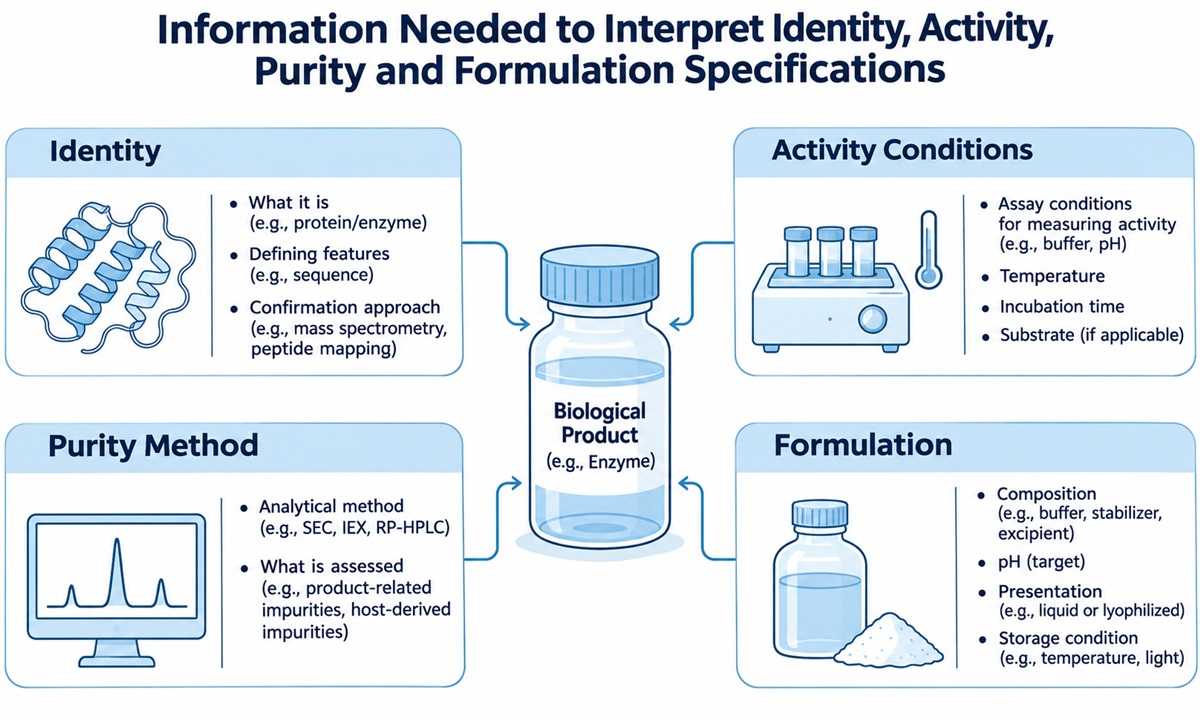
The conventional enzyme unit describes conversion of one micromole of substrate per minute under specified assay conditions. The substrate, temperature, pH and method are therefore part of the meaning. Read the supplier’s exact definition before comparing values. Some products use application-specific units, which should not be assumed equivalent to the conventional definition.
Can I compare U/mL values from different suppliers directly?
Only after confirming that the activity methods and unit definitions are comparable. Different substrates, reaction conditions or calculations can produce different numbers for the same preparation. If the methods differ, use a justified bridging comparison or evaluate both materials in the intended assay. Matching the printed value alone is not evidence of equal performance.
What is the difference between activity and specific activity?
Activity describes a measured catalytic rate, while specific activity relates that rate to an amount of protein, commonly expressed per milligram. Both require defined measurement methods. Specific activity can help characterize a preparation, but it is not a complete purity measurement and does not reveal every contaminant relevant to a diagnostic application.
Does higher purity always produce a better assay?
Higher purity can be useful, particularly when interfering activities or contaminants matter, but a purity percentage is method-dependent. It may not reveal low-level nucleases, proteases or other functionally important components. Assess the impurities relevant to the assay and the complete reagent behavior. Do not substitute a general purity number for application testing.
Should I choose the preparation with the highest activity?
Not automatically. The relevant objective is acceptable assay performance at a suitable dose and formulation. Additional enzyme can alter background, reaction balance or stability without improving the desired result. Compare the preparation over the intended conditions and consider the complete system. A high isolated activity value is a starting characterization, not a universal selection rule.
Handling and stability
Can all diagnostic enzymes be stored at the same temperature?
No. Storage requirements depend on the enzyme preparation, concentration, formulation and container. Follow the conditions supported for the specific product. A temperature used for another enzyme or an earlier formulation cannot be transferred without evidence. Also distinguish unopened storage from use after dilution or preparation, because the relevant stability can change.
Does freezing always preserve enzyme activity?
No universal rule applies. Freezing can be appropriate for some preparations and unsuitable for others, depending on formulation and handling. Use the documented conditions and avoid assuming that colder is always safer. If an unexpected freezing event occurs, record the exposure and assess it through the relevant material procedure rather than assuming either damage or acceptability.
How many freeze-thaw cycles are acceptable?
Use a supported limit for the specific preparation, if available. There is no universal cycle count for diagnostic enzymes. Aliquoting can reduce repeated handling, but container choice and aliquot stability also need consideration. Record actual exposure when investigating a problem, and do not claim retained performance simply because a sample looks unchanged.
Can I dilute an enzyme in water?
Only if that dilution condition is appropriate and supported. Dilution changes the concentrations of stabilizers, salts and other formulation components as well as the enzyme. Adsorption or loss of activity may become more important at low concentration. Evaluate the intended dilution medium, container and use interval rather than assuming the stock preparation’s stability carries over.
Does retained activity prove the reagent shelf-life?
It supports one part of the assessment, but a complete reagent may fail through another component or through a change in background or response. CLSI EP25 distinguishes shelf-life and in-use evaluation. Define the performance endpoint for the finished presentation and the conditions being claimed. A single residual-activity result does not establish a universal expiry period.
Documentation and changes
What should I request with an enzyme sample?
Request enough information to identify and evaluate the preparation: material identity, lot, activity definition, formulation, supported storage and relevant specifications. A certificate of analysis and technical data can help, but the required package depends on the application. State the intended assay and known constraints so that missing information can be identified before testing.
What is the difference between a COA and a TDS?
A certificate of analysis normally reports lot-specific results against defined specifications. A technical data sheet generally describes product characteristics and handling information. Check the actual content because document conventions vary. Neither document by itself proves that the material works in your assay; the evaluation still needs to address the intended use and conditions.
Does ISO 13485 certification prove product performance?
No. ISO 13485 concerns a quality-management system within a defined scope. Verify the relevant organization, site, activities and current certificate rather than treating the logo as a product result. Assay performance and material suitability require their own evidence. The quality system and the technical evaluation complement each other but answer different questions.
Can I replace an enzyme with another preparation at the same stated units?
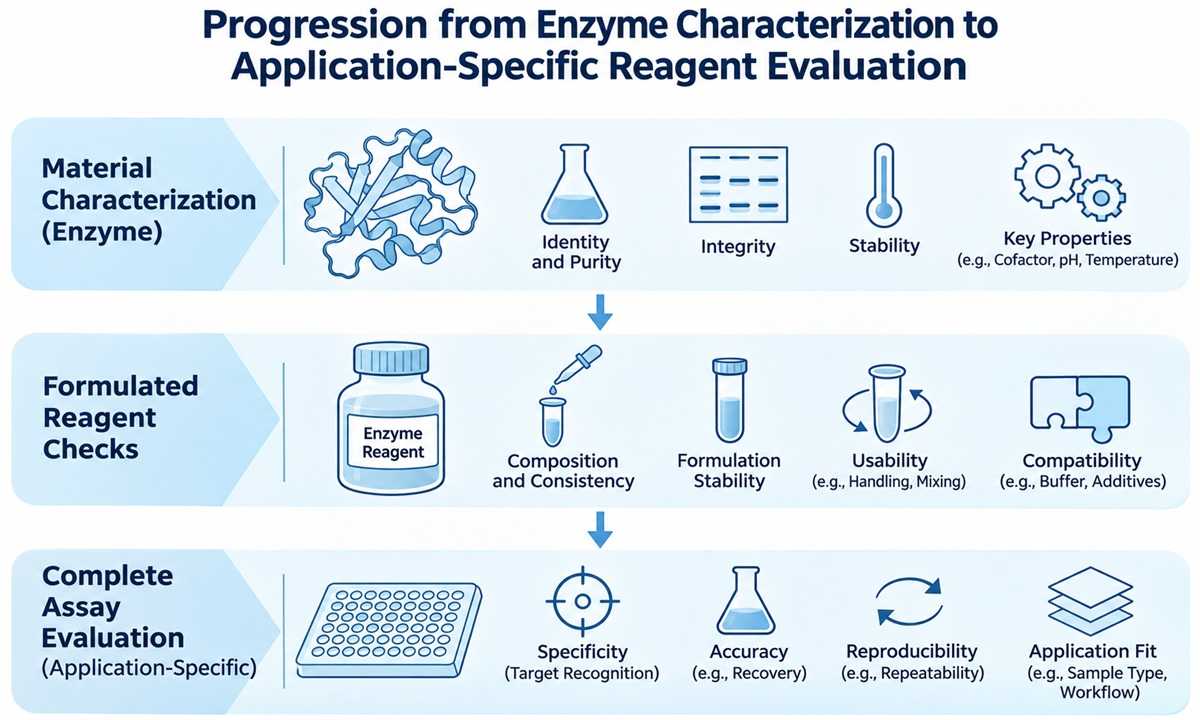
Treat the replacement as a material change requiring an appropriate assessment. Activity definitions, formulation and impurity profiles may differ even when units appear to match. Compare the complete assay under relevant conditions and retain lot traceability. The extent of evaluation should reflect the potential impact, rather than assuming either automatic equivalence or universal incompatibility.
What information helps investigate unexpected performance?
Record the observation, affected samples, lot, preparation steps, storage exposure and controls. Identify what changed and whether the issue occurs across all conditions or only a subset. Preserve the original records before repeating the test. A structured comparison helps distinguish enzyme behavior from substrate, matrix, instrument or handling effects without prematurely assigning a root cause.
Where to go next
| Question | Resource |
|---|---|
| Reaction chemistry | Clinical Chemistry Enzymes FAQ |
| Amplification systems | Molecular Diagnostic Enzymes FAQ |
| All FAQ topics | FAQ |
Use these answers to define the next evidence question. They do not replace product documentation, assay validation or the applicable change-control process. FDA research-use guidance also makes intended use important: a research reagent should not be treated as a clinically authorized test merely because it produces a useful experimental result.
Sources and further reading
- IUBMB. Current IUBMB recommendations on enzyme nomenclature and kinetics. Perspectives in Science. 2014..
- US Food and Drug Administration. Distribution of In Vitro Diagnostic Products Labeled for Research Use Only or Investigational Use Only. Accessed October 20, 2026..
- International Organization for Standardization. ISO 13485:2016 — Medical devices: Quality management systems. Accessed October 20, 2026..
- Clinical and Laboratory Standards Institute. EP25: Evaluation of Stability of In Vitro Medical Laboratory Test Reagents. Published April 26, 2023..
- Clinical and Laboratory Standards Institute. Interference Testing in Clinical Chemistry. Accessed October 20, 2026..