

Companion diagnostic development remains tied to a specific therapeutic decision and a defined test claim. Current opportunities include broader scientifically supported labeling and diverse testing formats, but authorization records do not measure market size or establish that assays are interchangeable.
This update reviews public US and EU official material through October 20, 2026. It separates current regulatory information from qualitative commercial interpretation. It does not provide a country-specific submission strategy, revenue forecast or determination of legal requirements for an individual project.
The therapeutic context defines the companion diagnostic claim
A companion diagnostic supplies information essential to the safe and effective use of a corresponding therapy. A biomarker measurement used in research, prognosis or general profiling is not automatically a companion diagnostic. The intended purpose and the relationship to the therapeutic decision matter.
The FDA list links device indications with specimen types, biomarkers and therapeutic products. Some entries have group-labeling indications. These distinctions make the list useful for mapping the authorized landscape, but individual labels remain necessary for understanding a particular use.
Do not reduce a claim to a gene name. A relevant alteration, tumor context, specimen and treatment relationship may all be part of the scope. Two tests that mention the same biomarker can still have different supported uses.
The same caution applies when describing enzyme opportunities. An enzyme may support sample preparation, amplification, library construction or signal generation within a test. Its technical role does not make the raw material an authorized companion diagnostic or establish the clinical suitability of a finished assay.
US developments should be read as changes in specific regulatory instruments
The 2014 FDA companion diagnostic guidance remains a foundational reference for planning the connection between diagnostic and therapeutic development. For a current programme, begin with the intended claim and applicable official materials rather than treating the age of one guidance as evidence that it has been replaced.
FDA's final 2020 group-labeling guidance provides a route to broader oncology therapeutic labeling where scientifically appropriate. It does not mean that any test detecting the same biomarker can be used across every therapy in a class. The supporting evidence and authorized wording still control the claim.
The voluntary oncology diagnostics pilot announced in 2023 addresses transparency about performance characteristics for certain tests associated with certain oncology therapies. FDA states that the pilot does not change drug-approval or companion diagnostic marketing-authorization standards. Participation or publication of performance information should not be described as an alternative authorization.
A separate 2026 development is the effective date of the Quality Management System Regulation: February 2, 2026. This affects the quality-system context for applicable device manufacturers. It is distinct from evidence supporting a particular CDx indication and should not be used as shorthand for product approval.
For a project review, keep these instruments in separate fields: intended diagnostic claim, applicable guidance, authorization status and quality-system responsibilities. Combining them into a single regulatory-ready label conceals the work that remains.
EU assessment includes a distinct medicines-authority consultation
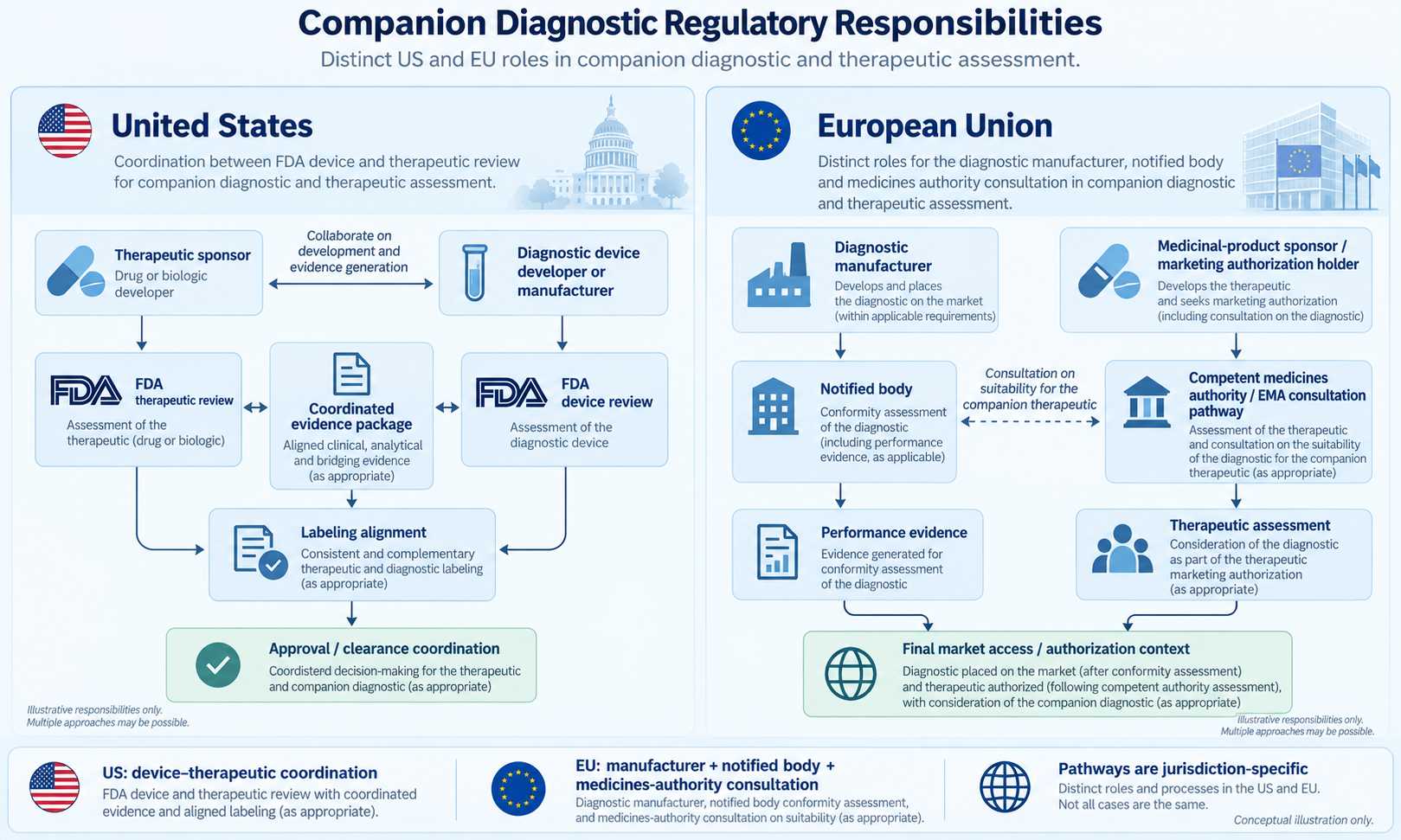
EMA describes companion diagnostics within the In Vitro Diagnostic Medical Devices Regulation framework. The device undergoes conformity assessment through a notified body, with consultation involving the relevant medicines authority on suitability in relation to the corresponding medicinal product.
The medicines-authority role should not be confused with complete device certification. The manufacturer, notified body and medicines authority have different responsibilities. A favorable scientific opinion in the consultation is not a replacement for the complete conformity-assessment process.
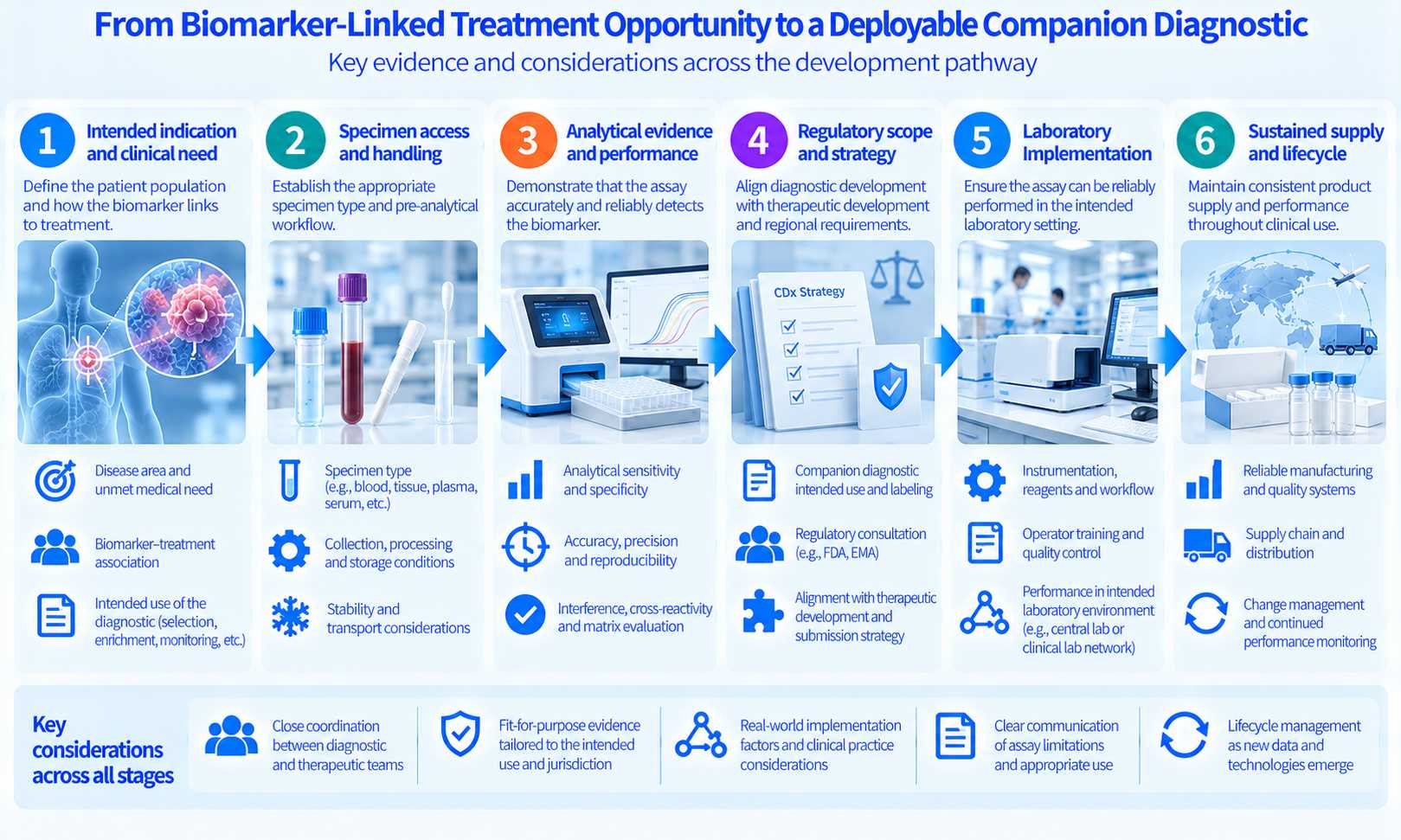
The practical implication is coordination. Diagnostic and therapeutic teams need consistent information about the intended population, biomarker and test use. A late change in the therapeutic context can affect the information needed for the diagnostic assessment.
US authorization and EU conformity assessment are separate pathways. Evidence may be relevant to both, but a development team should not assume that acceptance in one jurisdiction automatically resolves the other's requirements. Maintain a jurisdiction-specific record of the claim and outstanding questions.
This review deliberately does not generalize transition provisions to a particular product. Eligibility and deadlines can depend on device circumstances and evolving official provisions. Resolve those questions against the current applicable documents when planning an actual submission or supply decision.
Official records support a landscape view, not a revenue forecast
| Observation | Reasonable interpretation | Unsupported extrapolation |
|---|---|---|
| Multiple specimen and testing contexts | Development opportunities differ by clinical and laboratory workflow. | Every format has equal adoption or commercial value. |
| Group-labeling provisions | Some broader claims may be supported by suitable evidence. | All tests for the biomarker are interchangeable. |
| New or expanded authorized indications | The set of supported diagnostic uses can evolve. | A proportional increase in revenue or enzyme demand. |
| Distinct regional pathways | Global programmes need coordinated evidence planning. | One authorization guarantees access everywhere. |
The current FDA list shows a landscape organized around biomarker-linked therapeutic use, including different sample types and group-labeling contexts. The commercial inference is that opportunity should be assessed at the level of a specific testing pathway, not merely by counting biomarkers.
Testing volume depends on more than regulatory availability. Eligible populations, specimen access, laboratory capacity, treatment pathways and payment arrangements can influence use. This article does not quantify those factors, and therefore does not assign a market size, growth rate or supplier ranking.
Broader profiling and focused testing can serve different workflow needs. A panel may support several questions, while a focused assay may fit a narrower decision. The better commercial fit depends on the setting and claim; the authorization list alone cannot establish a universally preferred platform.
Similarly, tissue and liquid specimens can address different access constraints. A specimen label is part of the assay claim, not an interchangeable input. Any commercial comparison should preserve the actual workflow and interpretation requirements rather than treating convenience as equivalent clinical evidence.
The defensible market conclusion is qualitative: development value is created when a test reliably connects an available specimen to an actionable, supported therapeutic decision. That creates opportunities for assay chemistry and supply, but also imposes evidence and implementation costs.
Raw-material value depends on consistency within the validated assay
For enzyme suppliers, the relevant question is which reagent property constrains the chosen test. Amplification enzymes, reverse transcriptases, library-preparation enzymes and signal enzymes have different roles. A general association with precision medicine does not identify the required specification.
Once an enzyme becomes part of a defined assay, lot consistency and change communication can be important to maintaining performance. A supplier's activity assay may help characterize the material, but the assay developer must establish how that measurement relates to the finished test.
Changes in enzyme preparation, formulation or source should therefore be assessed through their potential effects on the complete method. This is a practical development recommendation, not a statement that every change follows the same regulatory process.
The commercial implication is that documentation and reliable supply can matter alongside catalytic performance. However, no company-specific certification, capacity or regulatory status is inferred here. Such claims require verified records for the relevant organization and scope.
The Change Control for IVD Raw Materials and Diagnostic Enzymes guide addresses the operational assessment of material changes. The How to Use the FDA Companion Diagnostic Device List guide provides a more detailed reading method for individual authorization records.
Maintain a claim-specific update record
Track the official device and therapeutic labeling relevant to the project, not only general regulatory announcements. Record the document version, jurisdiction, affected indication and the development decision that may change. An update is meaningful when it alters a requirement or opportunity for the intended use.
For US programmes, monitor relevant authorized indications, guidance status and the scope of any pilot being considered. For EU programmes, monitor the applicable conformity-assessment and consultation materials. Distinguish a draft, consultation, final guidance and binding requirement in the record.
Review market assumptions separately from regulatory facts. If a business case assumes testing volume, reimbursement or laboratory adoption, identify a source for each assumption. Do not let an authorization count silently stand in for patient access or commercial uptake.
The next review should be triggered by a relevant label change, official guidance change or material shift in the proposed assay. A scheduled review within six months is also appropriate for this time-sensitive topic. The broader Technical Articles, Literature Reviews and Industry Insights connects regulatory interpretation with technology and deployment analysis.
Sources and further reading
- US Food and Drug Administration. List of FDA-Authorized Companion Diagnostic Devices (In Vitro and Imaging Tools). Official material reviewed October 20, 2026..
- US Food and Drug Administration. In Vitro Companion Diagnostic Devices. Official material reviewed October 20, 2026..
- US Food and Drug Administration. Developing and Labeling In Vitro Companion Diagnostic Devices for a Specific Group of Oncology Therapeutic Products. Official material reviewed October 20, 2026..
- US Food and Drug Administration. Oncology Drug Products Used with Certain In Vitro Diagnostics Pilot Program. Official material reviewed October 20, 2026..
- European Medicines Agency. Companion diagnostics (in vitro diagnostics). Official material reviewed October 20, 2026..
- US Food and Drug Administration. Quality Management System Regulation (QMSR). Official material reviewed October 20, 2026..