

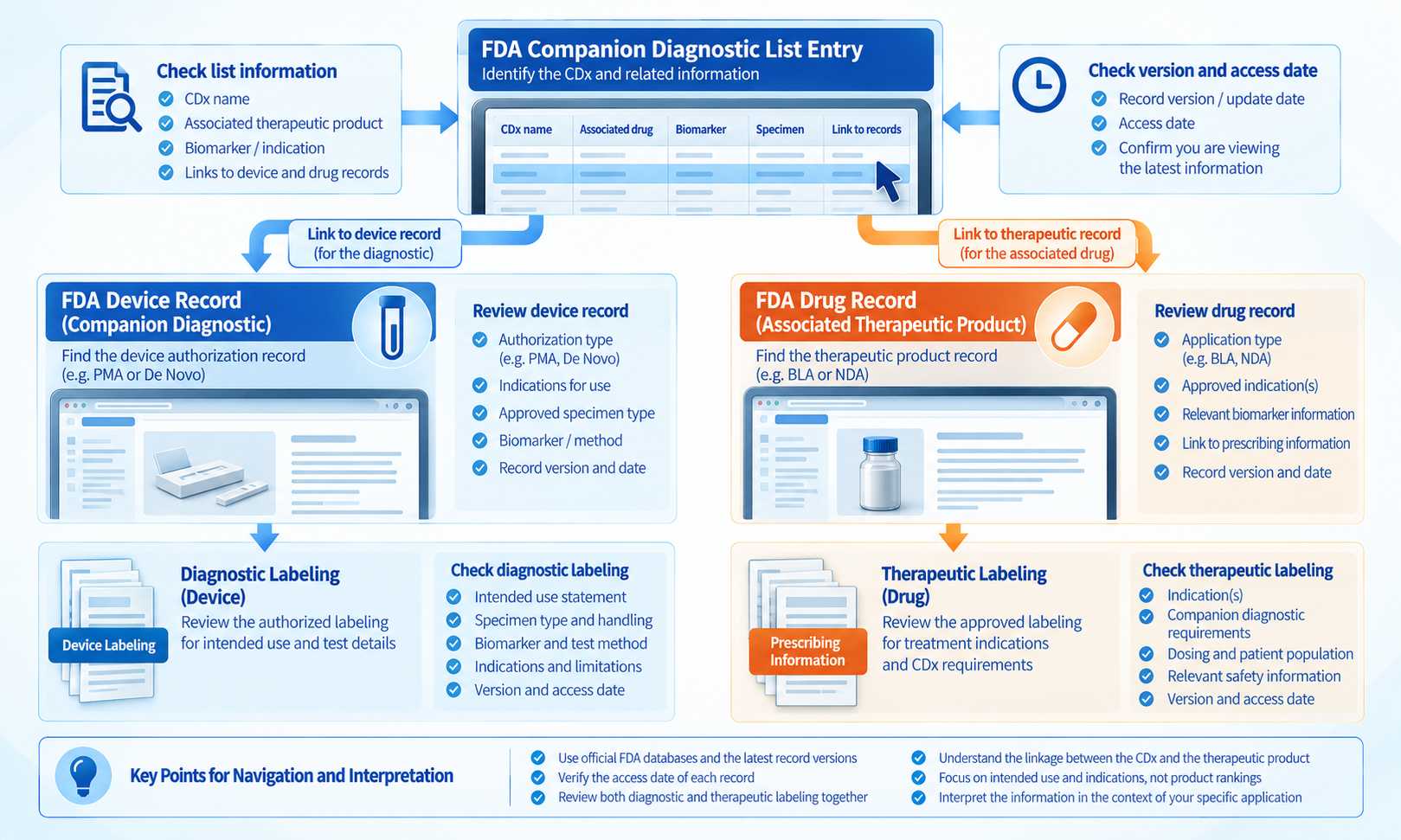
The FDA companion diagnostic list is a starting point for finding an authorized device and its associated therapeutic use. To understand what the entry supports, follow the linked record and check the diagnostic and therapeutic labeling. A shared biomarker name does not establish that two tests have the same indication.
This guide explains a repeatable research workflow for assay developers and technical sourcing teams. It focuses on retrieving and interpreting public evidence, rather than choosing a treatment or recommending a particular diagnostic product.
Start with a specific question about an intended use
FDA describes a companion diagnostic, or CDx, as a device that provides information essential to the safe and effective use of a corresponding drug or biological product. The device may be an in vitro diagnostic or an imaging tool. This is a defined relationship between a diagnostic use and a therapeutic use, not a general label for every biomarker assay.
Write down the question before searching. You may be looking for a diagnostic associated with a therapeutic product, a defined biomarker alteration, a disease setting or a specimen type. These are different entry points into the same evidence chain.
For development work, make the question narrower than whether a gene appears anywhere in the list. Specify the disease context, alteration or expression measure, sample and intended decision where known. Record unknown fields so they remain questions to resolve rather than assumptions added during browsing.
Use the current FDA-hosted list. At the research cutoff, its title is List of FDA-Authorized Companion Diagnostic Devices (In Vitro and Imaging Tools). Older pages may use a cleared-or-approved title. Preserve the current destination and access date in the research file rather than relying on an undated copied table.
Do not use the list to estimate demand, rank analytical quality or identify an enzyme supplier. Those questions require different evidence. The useful first result is a relevant entry whose exact scope can be investigated.
Read the entry as a connected set of fields
The main table links the diagnostic name, indication and sample type, therapeutic product, biomarker details and authorization record. A separate table covers devices with group-labeling indications. Read across the row before extracting a conclusion from any one cell.
For each candidate match, create a short note containing the fields relevant to your question. If several rows appear similar, retain their distinct record identifiers and indications. Combining them too early can erase differences that explain why the entries are separate.
Use biomarker details to refine the search. A gene symbol can refer to a specific substitution, a deletion category, an amplification or a protein-expression result. These are not interchangeable analytical targets. Carry the actual detail into the comparison rather than replacing it with the shortest possible gene name.
Keep the specimen and indication attached to the biomarker. If your project uses a different specimen or population, mark that difference as an evidence gap. A list match establishes a lead for further reading; it does not validate the new combination.
When a table cell is abbreviated or ambiguous, move to the supporting record. Do not fill missing information from a neighboring row or infer a broader claim because another product has one. Preserve uncertainty until a relevant document resolves it.
| Field to retain | Question it helps answer |
|---|---|
| Diagnostic identity and version | Which exact device is being considered? |
| Indication and specimen | Does the entry address the intended setting and material? |
| Biomarker detail | What alteration, expression measure or other feature is relevant? |
| Therapeutic relationship | Which product or defined group is associated with the use? |
| Authorization identifier and date | Which regulatory record should be opened? |
| Document version and access date | Can another reviewer reproduce the lookup? |
Follow the authorization record and preserve its history
Open the authorization identifier linked to the relevant entry. Read the record type before deciding what document to seek. The list can point to different regulatory pathways; do not assume every entry is an original premarket approval, or PMA.
For a PMA record, FDA explains that public materials can include an approval order, a Summary of Safety and Effectiveness Data and product labeling. These documents answer different questions. The order identifies the regulatory decision, the summary describes supporting evidence, and the labeling describes the indicated use and instructions within its version.
Check whether the linked record is a supplement. A supplement may address a particular expansion or change rather than restating the complete original device. Follow the original record and relevant subsequent records as needed to understand the configuration and claim you are reviewing.
Record document dates, not just the database page's update date. A recently refreshed database page can still link a document issued years earlier. Conversely, the original approval date does not describe every later indication added to a device.
Review whether the available labeling is the version relevant to the present question. Do not assume that the first downloadable PDF is the latest complete instruction set. If the public record does not resolve a version question, state the gap and obtain clarification before using the finding in a consequential development decision.
Avoid overreading the public summary. It is not a complete manufacturing dossier, and it may not identify every reagent component or supplier. A missing enzyme detail should remain unknown rather than being reconstructed from a platform name.
Cross-check the diagnostic and therapeutic labeling
FDA's list directs readers to the therapeutic product label for specific information about use with a corresponding diagnostic. Treat this as a two-sided check: confirm the diagnostic's indicated use and the therapeutic's relevant testing language, rather than assuming the table alone contains the complete relationship.
For products within its scope, Drugs@FDA provides approval information and FDA-approved labeling. FDA's resource page explains that the database does not cover every biological product regulated by the agency. Use the appropriate official product resource when a therapeutic falls outside that scope.
Compare the disease setting, biomarker qualification, specimen restrictions and any test-related instructions that are relevant to the question. Preserve the labels' distinctions. If they appear inconsistent, check versions and related records before drawing a conclusion.
Group labeling needs a separate reading. FDA's April 2020 guidance describes evidence considerations for a diagnostic intended for a specific group of oncology therapeutic products. A group can be more narrowly defined than an entire drug class. The presence of group labeling is not permission to extend the claim to any drug that acts through a similar pathway.
Do not treat an expanded therapeutic landscape as automatic expansion of every diagnostic label. Assess the defined group, indication and supporting evidence in the applicable documents. If your proposed use exceeds that scope, record it as a development and regulatory question.
This lookup is also different from selecting a treatment for an individual. The article supports evidence review by developers; it does not interpret a patient's result or resolve patient-specific eligibility.
Use an EGFR search to practice the distinctions
An EGFR search in the reviewed list produces entries that differ in alteration detail, specimen and therapeutic relationship. This makes it a useful navigation exercise: finding the gene name is only the first step.
Begin with a bounded research question, such as identifying records relevant to a stated EGFR alteration in a specified specimen. Retain the exact match criteria in the note. Separate entries that do not meet them instead of treating every search hit as equivalent evidence.
One publicly linked example is PMA supplement P120019/S031, with a decision date of October 27, 2020. Its FDA record describes a labeling expansion for a group claim involving EGFR tyrosine kinase inhibitors and specified mutations. The page explicitly identifies itself as a supplement and directs readers to the original PMA.
The useful lesson is how to follow the record, not which product to choose. The supplement's description points to a defined change. It does not reveal the full current labeling, establish interchangeability with another test or supply a specification for a polymerase.
Complete the exercise by recording what still needs checking: the relevant diagnostic labeling version, the therapeutic label, the precise alteration and specimen, and any indication limitations. If any field remains unresolved, keep it visible in the research summary.
Turn the lookup into an evidence map for development
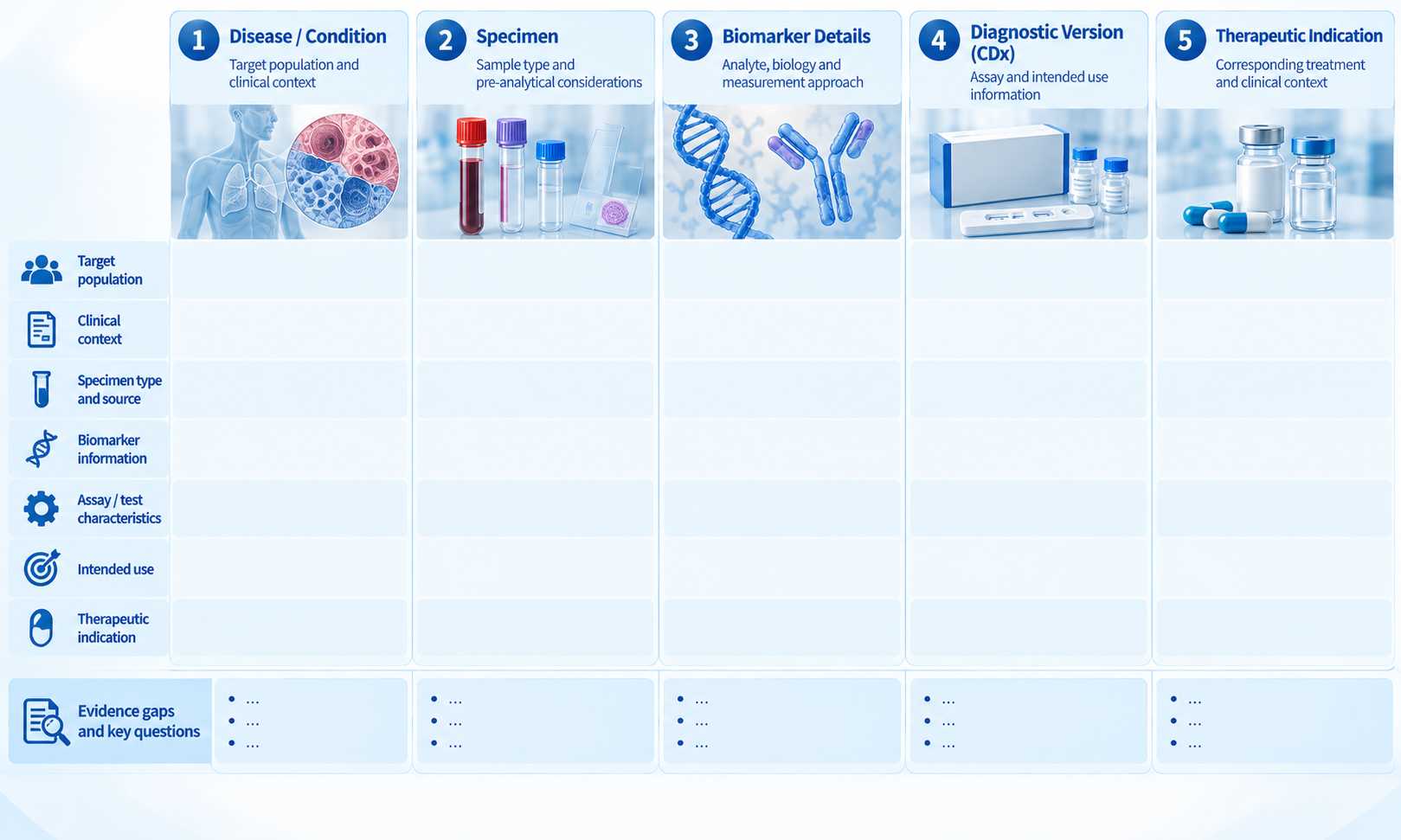
Summarize the findings in two parts. First, record what the official sources establish about the listed device and use. Then list the differences between that configuration and the proposed assay. This prevents a regulatory precedent from being presented as evidence that a new product already meets the same standard.
For enzyme development, use those differences to frame technical questions. A proposed amplification or signal system may need evaluation in the intended specimen and complete workflow. The CDx list cannot choose the enzyme grade, use level, formulation or acceptance limits for that work.
FDA's 2014 CDx guidance emphasizes the relationship between diagnostic development and the corresponding therapeutic use. Use it to place a public-record review within a broader development plan, with appropriate scientific and regulatory input. A literature and database search is preparation for that plan, not a substitute for it.
Avoid counting rows as if each were a unique technology or independent market opportunity. Repeated devices, multiple indications and supplements can produce several entries related to one platform. Any quantitative landscape analysis needs an explicit counting method and a dated dataset.
Keep a short source log with the URL, record identifier, document title, version, access date and the conclusion it supports. Revisit it before an important decision and when the intended use changes. A reliable lookup remains useful because another reviewer can trace the conclusion and see its limits.
For material changes arising during development, see Change Control for IVD Raw Materials and Diagnostic Enzymes. For laboratory-policy context, see Laboratory Developed Tests Regulatory Update: What IVD Developers Should Know. Further evidence resources appear in Diagnostic Enzyme QC, Validation and Regulatory Resources.
List and official resources checked September 24, 2026. Review within six months and recheck the relevant records before relying on a specific indication. No complete list reproduction, product endorsement or authorization of a raw-material enzyme is implied.
Sources and further reading
- U.S. Food and Drug Administration. List of FDA-Authorized Companion Diagnostic Devices (In Vitro and Imaging Tools). Live table; checked September 24, 2026.
- U.S. Food and Drug Administration. Companion Diagnostics. Current overview; accessed September 24, 2026.
- U.S. Food and Drug Administration. In Vitro Companion Diagnostic Devices. Final guidance, August 2014.
- U.S. Food and Drug Administration. Developing and Labeling In Vitro Companion Diagnostic Devices for a Specific Group of Oncology Therapeutic Products. Final guidance, April 2020.
- U.S. Food and Drug Administration. PMA Frequently Asked Questions. Current official page; accessed September 24, 2026.
- U.S. Food and Drug Administration. Resources for Information: Approved Drugs. Current official page; accessed September 24, 2026.
- U.S. Food and Drug Administration. PMA supplement record P120019/S031. Decision October 27, 2020; record checked September 24, 2026.