

Change control connects a change in a diagnostic raw material to the products, claims and operations that may depend on it. A supplier notification begins that assessment. It does not establish that the changed enzyme is interchangeable with the current preparation or ready for unrestricted production use.
A useful record explains what changed, which configurations are affected, what evidence is needed and who can authorize the transition. This guide follows that record through implementation and closure, with practical examples for enzyme raw materials.
Capture a change against a defined baseline
Record the current material and the proposed version before discussing whether the change is minor or major. Include the supplier identifier, specification revision, formulation, manufacturing site where relevant, and the lots that separate old from new supply. A description such as process improvement is too broad to support a technical decision.
Identify the initiator and reason. Changes may originate with the supplier, a subcontractor, internal manufacturing, an analytical laboratory or a corrective action. They may affect the physical material, the way it is measured, or only its documentation. These possibilities require different questions even when the product code stays the same.
Ask for the implementation date, first affected lot, available comparison evidence and any period of overlapping supply. If a change has already occurred, establish which received or consumed lots may be affected. Treat incomplete notice as an information gap requiring disposition, rather than silently assigning it a low-risk category.
Distinguish a planned change from an isolated deviation. A temperature excursion in one shipment may need a deviation investigation; a permanent revision to shipping conditions may also require change control. Link the records when they address the same issue, while preserving the different decisions each record supports.
| Record element | Question to resolve |
|---|---|
| Change description | What differs between the current and proposed configuration? |
| Material boundary | Which item codes, specifications, sites and lots are affected? |
| Timing | When does the change take effect, and what supply remains under the old configuration? |
| Supporting evidence | Which studies and method details are available, and what remains unknown? |
| Responsibility | Who owns the assessment, supplier response and final disposition? |
Trace the change into every affected use
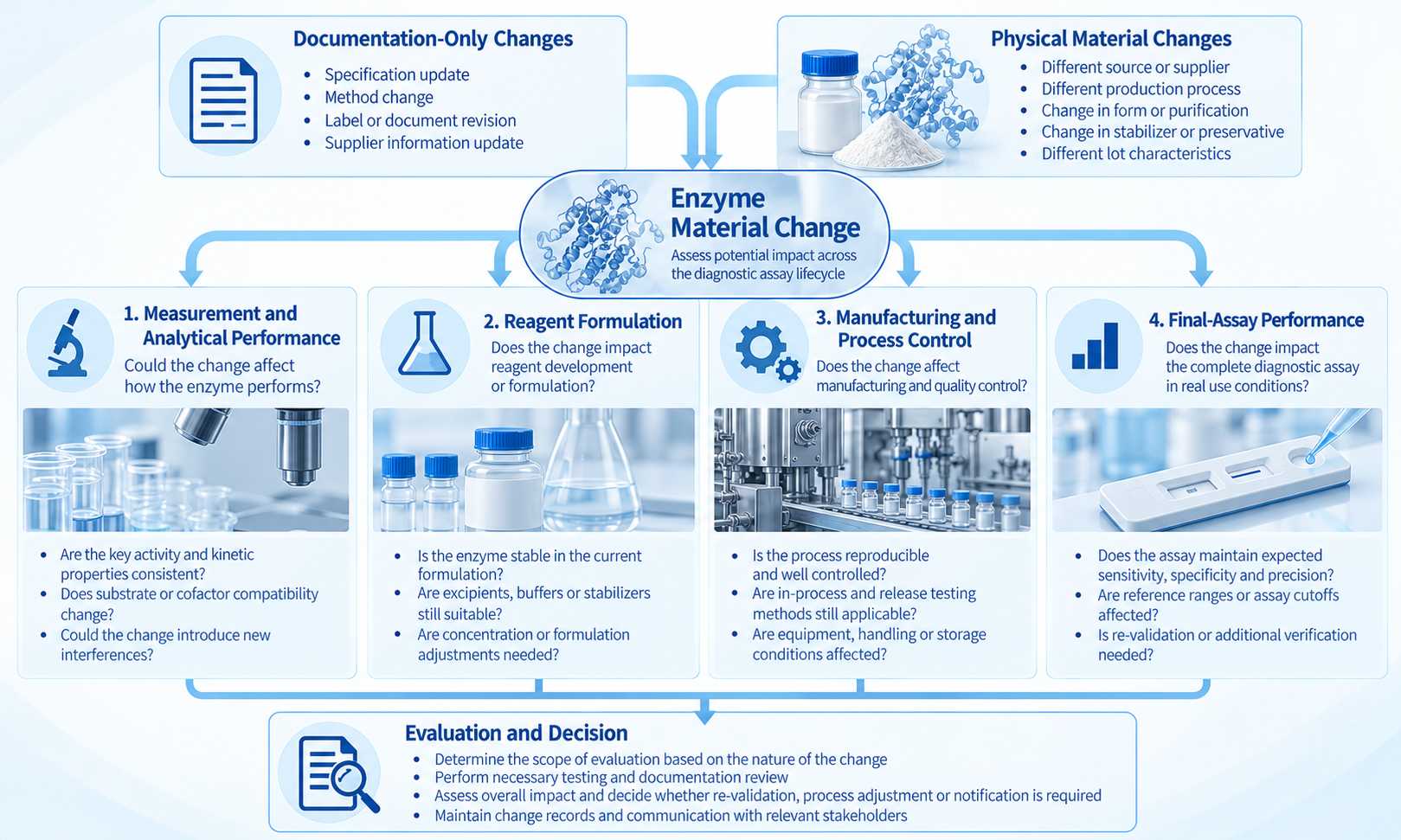
Map the material to the reagent formulas and assays that use it. Include development versions, released products, retained inventory and work in progress when relevant. A change accepted for one formulation is not automatically accepted for every assay using the same enzyme stock.
Consider the mechanism of a possible effect. A stock-concentration change can alter addition volume. An additive change can alter the final mixture. A purification change may affect impurities, while a container change may alter recovery or exposure during handling. These are investigation pathways, not claims that every such change necessarily harms performance.
An analytical-method change deserves separate attention. A new substrate, calculation or reference preparation can shift a reported activity value without the same shift in the material itself. STRENDA highlights the experimental information needed to interpret enzyme activity. Ask whether historical and new release results remain comparable before treating their numerical difference as a manufacturing trend.
Review interactions among changes. A revised enzyme preparation and a revised drying process may each appear acceptable alone but require assessment together. Keep the combined configuration visible in the record so that evidence from separate experiments is not accidentally treated as evidence for an untested combination.
Prioritize consequences using the intended assay, existing controls and uncertainty. A useful assessment names the failure mechanism, the endpoint it could affect and the evidence or control that addresses it. Labels such as low risk are most useful when accompanied by that reasoning.
Match the evidence plan to the unresolved question
Begin with what is already known. Relevant supplier characterization, prior internal data and a justified comparison with the approved baseline may resolve some questions. Record why the evidence applies to this material and use. Avoid carrying forward a study merely because its title sounds similar to the current change.
Identify the additional work needed to address remaining uncertainty. Depending on the change, this may involve method comparability, targeted impurity testing, complete-assay comparison, process evaluation or stability work. Define the acceptance criteria and the supported configuration before generating new results.
For a measurement change, consider whether the old and new procedures can be compared using suitable materials over the intended range. For a formulation change, compare the complete reagent under relevant sample and operating conditions. The study should test the proposed consequence, not simply repeat the easiest incoming quality-control measurement.
Include stored and handled states where the change could affect them. CLSI EP25 addresses stability claims for in vitro laboratory reagents, including shelf life, in-use life and transport considerations. A satisfactory initial result cannot by itself establish the behavior of the changed final reagent throughout its claimed life.
Plan how unexpected findings will be handled. Define the investigation route and the conditions for additional testing, rejection or a narrower implementation decision. Do not move acceptance limits after seeing unfavorable data without a separately justified and approved rationale.
Keep exploratory work distinct from confirmation. Development experiments may identify a useful new formulation or adjustment. If that happens, revise the change scope and evaluate the resulting configuration explicitly. A successful optimization is not evidence that the original unchanged process supported direct substitution.
| Change example | Main uncertainty | Possible evidence route |
|---|---|---|
| Activity method revision | Are old and new results on a comparable basis? | Method comparison with clearly defined conditions and reporting units. |
| Buffer or stabilizer revision | Does the final reaction or handling behavior change? | Formulation-aware assay comparison and relevant exposure studies. |
| Production or purification revision | Do relevant attributes or impurities differ? | Targeted characterization linked to complete-assay risks. |
| Packaging or shipping revision | Is material performance maintained through the new exposure? | Handling and transport evaluation for the supplied configuration. |
Keep technical approval and regulatory assessment connected
Technical review establishes what the evidence supports. It should identify the material version, permitted uses, study conclusions and unresolved limitations. A decision to continue evaluation is different from a decision to release the changed material for production.
Regulatory review asks what the change means for the affected finished device in its markets. In the United States, FDA's guidance on changes to existing devices includes an IVD-specific pathway that considers risk and verification or validation outcomes. Its scope and the device's existing authorization determine how it applies. Neither a supplier's change category nor a passing bench test settles the submission question by itself.
The FDA Quality Management System Regulation, or QMSR, became effective on February 2, 2026 and incorporates ISO 13485:2016 by reference. FDA describes its applicability in terms of finished-device manufacturers. Do not assume that every enzyme raw-material supplier has the same regulatory obligations as the legal manufacturer of the assay.
Separate current requirements from older guidance language. The 2017 change guidance now carries a notice about QMSR. The archived GHTF supplier-control guidance also cites earlier quality-system frameworks. Use those documents within their stated context rather than copying historical clause references into a current procedure.
Bring the conclusions together before implementation. Record whether technical acceptance, required regulatory actions, document updates and production readiness are complete. Assign responsibility for any condition that must be fulfilled before the changed configuration can be used.
Make the old-to-new lot transition unambiguous
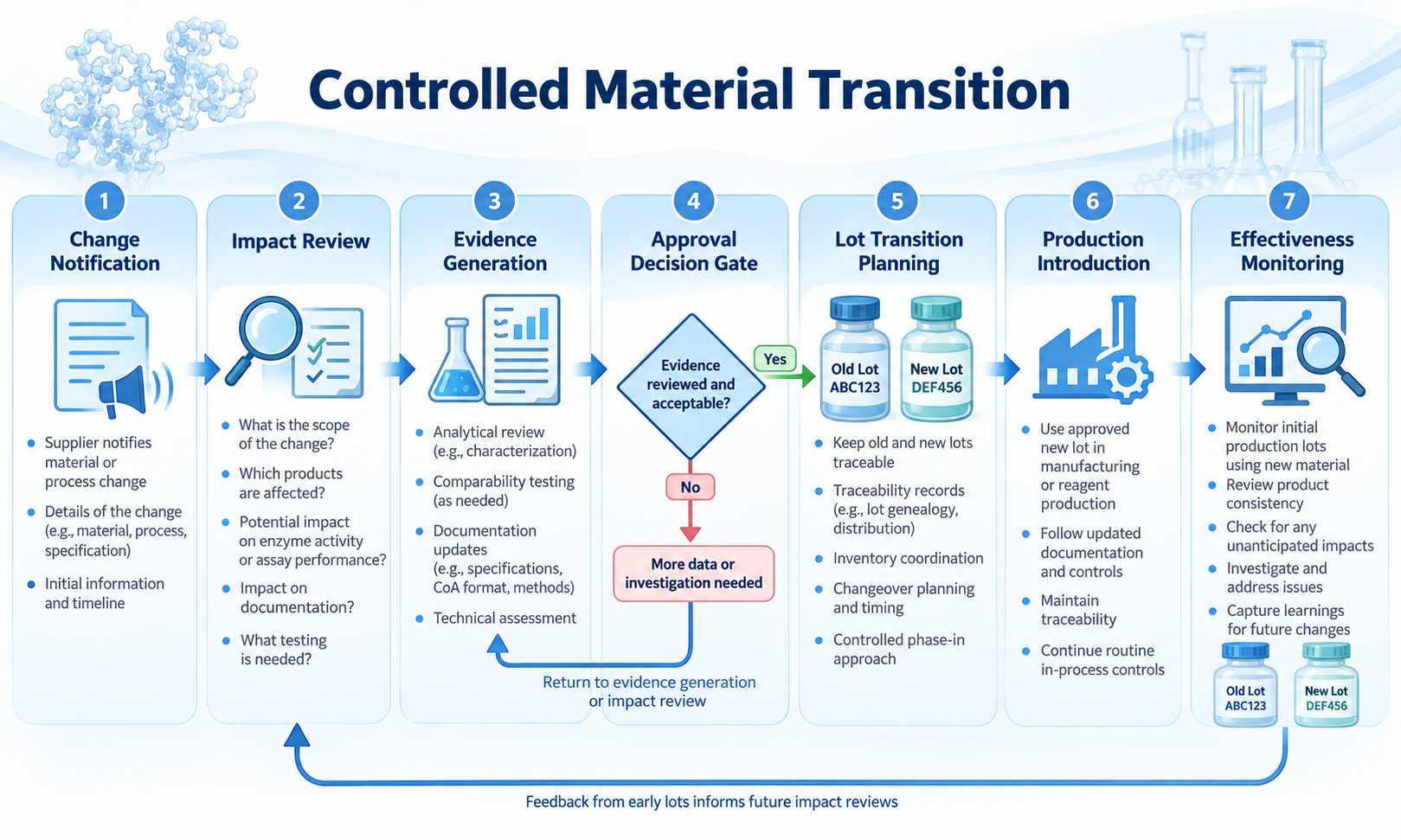
Define the first authorized lot and the products or manufacturing orders for which it may be used. Update purchasing, receiving, formulation and production records as needed. A technically sound assessment can still fail operationally if teams cannot distinguish the approved new configuration from the old one.
Decide how to manage remaining stock, partially processed material and retained samples. Do not assume that mixing old and new material is covered by a comparison of each alone. If a mixed configuration is proposed, assess that use explicitly or prevent it through the transition instructions.
Set the evidence needed at receipt and at initial production use. This may include confirmation of the supplier version, targeted checks or review of early finished-reagent results. The controls should follow the reasons the change was considered important, rather than becoming a permanent list of unrelated extra tests.
Prepare a response if the introduction reveals an unexpected problem. Identify who can pause use, which lots remain traceable and what evidence is needed for a disposition. Returning to an old source may itself require checking stock condition, availability and whether other product changes have occurred in the meantime.
Close the record with evidence that the transition worked
Closure should show that the approved configuration was actually implemented and that required follow-up work was completed. Confirm the linked document revisions, training or communication, lot identification and study reports. An approval signature alone does not demonstrate these operational steps.
Review the monitoring results against the concerns identified at the start. Look for relevant shifts, unexpected deviations or repeated supplier information gaps. If a new issue emerges, connect the investigation to the original change rather than treating every event as unrelated.
Record the basis for returning to routine controls. Some follow-up may remain scheduled, such as ongoing real-time stability observations. Make those obligations visible and assign ownership instead of describing an incomplete program as fully resolved.
Use the record to improve future notifications. If essential information arrived too late, revise the agreed communication route or purchasing arrangement. The purpose is a maintainable chain from a known material version to a supported assay configuration, with decisions that another reviewer can reconstruct.
For the experimental evaluation of an alternative source, see Second-Source Qualification Guide for Diagnostic Enzymes. For the supplier record package, see ISO 13485 and Raw Material Documentation for IVD Enzyme Suppliers. Related topics are collected in Diagnostic Enzyme QC, Validation and Regulatory Resources.
Regulatory context checked September 24, 2026. Review within six months or sooner after a relevant requirement changes. The workflow and examples are practical editorial recommendations, not a universal classification scheme or a product-specific legal determination.
Sources and further reading
- Global Harmonization Task Force, Study Group 3. Guidance on the Control of Products and Services Obtained from Suppliers. GHTF/SG3/N17R9:2008, December 11, 2008.
- U.S. Food and Drug Administration. Quality Management System Regulation (QMSR). Current official page; accessed September 24, 2026.
- U.S. Food and Drug Administration. Deciding When to Submit a 510(k) for a Change to an Existing Device. October 25, 2017; current PDF includes QMSR notice.
- STRENDA Commission, Beilstein-Institut. STRENDA Guidelines: Enzyme Kinetics and Assay Conditions. Current public guidelines; accessed September 24, 2026.
- Clinical and Laboratory Standards Institute. EP25: Evaluation of Stability of In Vitro Medical Laboratory Test Reagents. Second edition, 2023.