

A custom diagnostic enzyme project works best when both parties agree on the problem, the material to be delivered and the evidence that will demonstrate success. The same enzyme name can describe very different assignments: a formulation change, a new variant, a transferred production process or recurring manufacture to an agreed specification.
These FAQs explain how to frame that work and prepare for handoff. They do not describe a fixed supplier package, price, timeline or guaranteed outcome. Quality and regulatory references were checked on October 20, 2026; the applicable responsibilities depend on the product, market and contractual roles.
Define the assignment before requesting a proposal
How do custom development and OEM supply differ?
Custom development changes or creates a material or process to meet defined needs. Original equipment manufacturer (OEM) supply commonly describes production for incorporation into another company’s offering, but commercial usage varies. State the actual work: development, formulation, bulk manufacture, filling, labeling or another agreed activity. The term OEM alone does not define a complete scope.
What belongs in the first project brief?
Describe the assay function, current limitation, target material format and intended operating conditions. Include the existing benchmark, important constraints, requested outputs and anticipated demand. Separate essential requirements from preferences. A useful brief explains what decision the project must enable; it need not reveal every proprietary detail before a suitable confidentiality arrangement is in place.
When is adaptation of an existing preparation a sensible first step?
Consider it when the identified gap could be resolved by concentration, formulation, packaging or handling changes rather than a different enzyme sequence. First establish what causes the limitation and which variables can change. Sequence engineering is a separate scope when needed. Comparing realistic options early helps avoid commissioning a larger development program than the application requires.
Which client inputs can delay a technically ready project?
Assay access, representative materials, reference lots, approved test methods and timely technical decisions can all be dependencies. List who supplies each input, its required condition and when it is needed. If direct sharing is impossible, agree on an alternative test arrangement. A schedule should distinguish supplier work from waiting time for client-provided evidence or approvals.
Can feasibility begin before the final specification is settled?
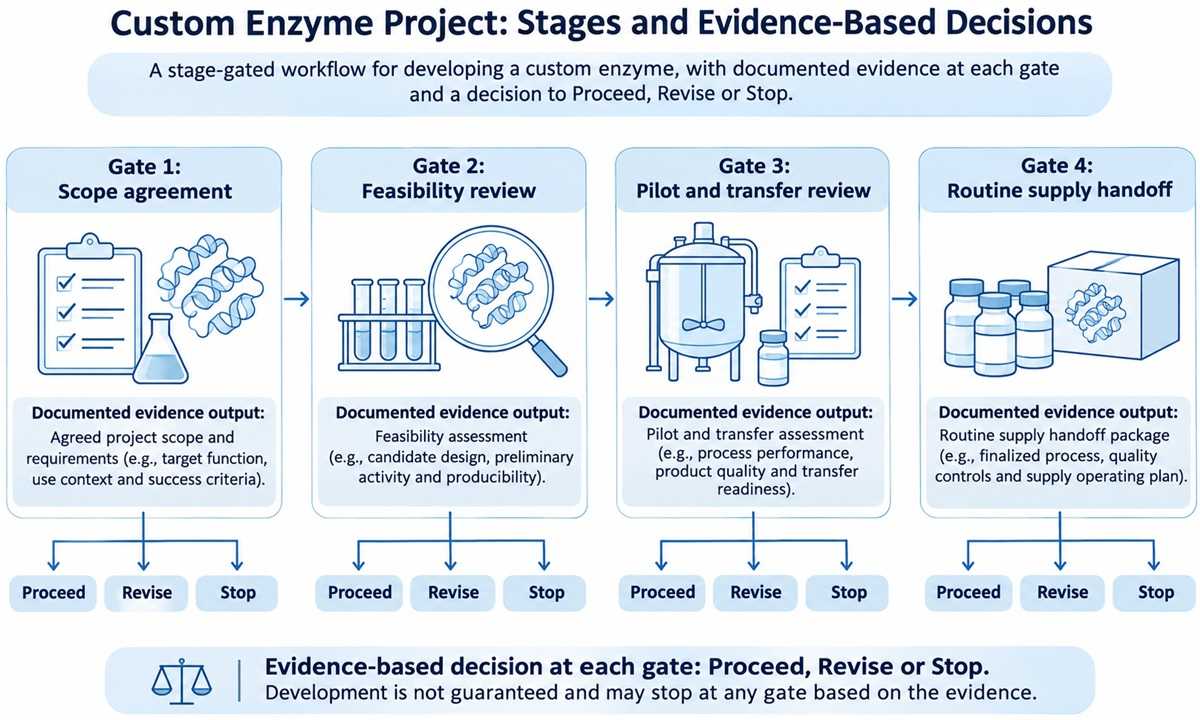
Yes, if the uncertainty itself is part of the agreed study. Define provisional targets, the experiments that will inform them and the decision expected at completion. Do not describe exploratory samples as production-qualified material. Once feasibility clarifies the achievable range, review the specification and later-stage scope before committing to scale-up or routine supply.
Does signing an NDA settle ownership of project results?
Do not assume so. Confidentiality, ownership and permission to use results are different matters. WIPO distinguishes confidentiality agreements from licensing and collaboration arrangements. Address the relevant terms expressly, with appropriate legal review, before relying on access to a sequence, process, dataset or formulation for future manufacture.
Make milestones testable and decisions explicit
What should a feasibility milestone deliver?
Specify the samples, methods, results and interpretation needed to decide whether to proceed. Include unfavorable findings and unresolved limitations, not just the best-performing sample. A milestone might establish that a target is achievable under defined conditions while leaving scale or shelf life unproven. The report should make that boundary visible to the next decision-maker.
How should project acceptance criteria be written?
Tie each required outcome to a defined test, sample state, comparison and decision rule. Identify who performs the test and approves the result. Avoid phrases such as improved performance without a baseline or meaningfully stable without conditions. Criteria can include documentation and deliverables as well as technical results; agree on them before evaluating the milestone.
What if supplier and client assays give different results?
Plan a comparison before using either method as the sole acceptance gate. Check preparation steps, reaction conditions, instruments, controls and calculations. Shared samples or reference materials can help locate the difference. The goal is an interpretable relationship between methods, not forced numerical agreement. Record which method governs each decision and how discrepancies will be resolved.
Why retain a baseline preparation during development?
It provides a comparison across experiments and reduces reliance on memory or historical summaries. Identify its lot, handling history and suitability for the test. If it ages or runs out, document how a replacement is related to it. Without a controlled reference, an apparent improvement may reflect changes in the assay or comparator rather than the candidate.
How should a new requirement affect an active project?
Assess its effect on experiments, dependencies, cost, schedule and acceptance criteria before adding it to the work. Record the agreed revision and the point from which it applies. For example, adding a dried format after a liquid prototype passes may create new formulation and packaging studies. An informal request should not silently redefine an accepted milestone.
What happens when a milestone misses its target?
Use the agreed review process to decide whether to investigate, revise the scope or stop. Preserve the evidence and distinguish an unmet technical target from an incomplete agreed task. Define the treatment of additional work and outstanding deliverables in the project terms. Development uncertainty should be visible from the outset, rather than resolved by promising success.
Prepare the process and evidence for the next scale
Does a successful laboratory batch establish production readiness?
It demonstrates performance for that batch and context. Larger equipment, hold times, mixing, purification or filling can introduce different conditions. Plan the evidence needed to show that the process and output remain suitable at the intended scale. A pilot stage should answer specific transfer questions, rather than serve only as a larger sample order.
What needs to transfer besides a manufacturing recipe?
Transfer the relevant material definitions, process controls, test methods, reference materials, handling instructions and records. Include the knowledge needed to interpret deviations and identify unsuitable output. Decide which activities require demonstration at the receiving site. A written recipe without usable controls or a reproducible acceptance method leaves important parts of the process undefined.
Can a new fill volume or dried format be treated as packaging only?
Assess the effect before making that assumption. Surface contact, dispensing, drying and reconstitution may alter performance or variability. Define the final presentation early where possible, and include relevant studies when it changes. Keep bulk material performance, filled-unit performance and finished-assay performance distinguishable so that a successful result is not extended beyond the tested state.
Who should own stability studies in a joint project?
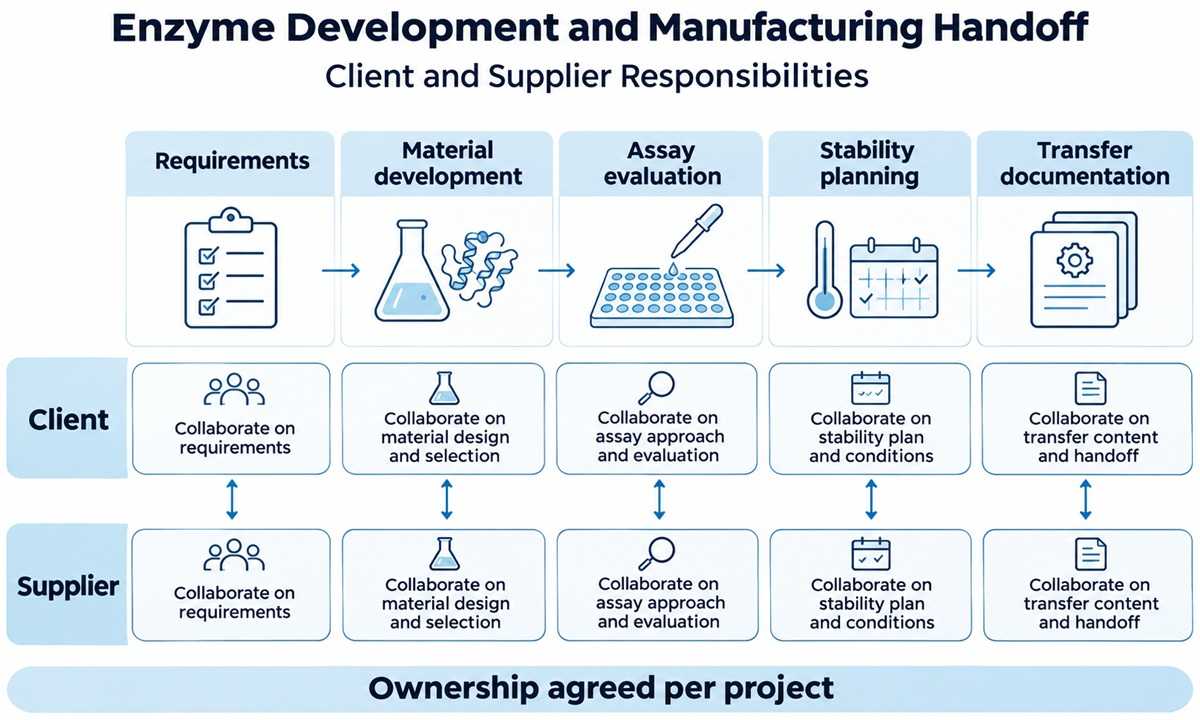
Agree who designs the study, supplies samples, performs measurements, reviews results and maintains the claim. Distinguish bulk storage from filled-product, transport and in-use conditions. CLSI EP25 provides a reagent-stability framework, but it does not assign project responsibilities. The party relying on a particular claim needs access to evidence supporting that claim and its limitations.
How should development and routine production lots be identified?
Use traceable identifiers that connect each delivered sample to its process, formulation and test records. Define what constitutes a lot for the actual production arrangement and identify development-only status where relevant. When the process changes, preserve that distinction. A shared product name should not conceal differences between exploratory material and output made under the agreed routine controls.
Does outsourcing enzyme manufacture transfer finished-IVD obligations?
Do not infer that from the purchase arrangement. Establish the legal manufacturer and each organization’s role under applicable requirements. FDA’s QMSR addresses covered device manufacturers; IMDRF’s principles concern the device’s intended performance. Assign operational tasks and access to evidence explicitly, while confirming the regulatory responsibilities that remain with the responsible organization.
Separate project completion from ongoing supply
What should be included in a technical handoff package?
List the approved material definition, relevant method and process versions, agreed data, deviations, unresolved issues and handling instructions. Include the status of each requirement and the person authorized to accept it. Identify records that remain with the supplier and how they can be accessed. The package should support the receiving team’s next activity without reconstructing development history.
How should existing technology and newly created results be addressed?
Identify pre-existing technology separately from project-generated results, then agree ownership and necessary access rights. Consider sequences, methods, formulations, data and know-how. Payment for work should not be used as a substitute for explicit terms. WIPO’s agreement guidance is a starting point; the actual allocation depends on the negotiated arrangement and applicable law.
What should be clarified about access after a project ends?
Agree what materials and records are delivered, retained or returned, and what use rights continue. Consider whether any future manufacturing or transfer activity depends on technology controlled by the other party. Address these questions before relying on an alternative supply route. The answer should come from the agreement, not an assumption that technical access implies permission.
Are minimum order quantities and lead times standard across projects?
No universal figures can be inferred from the enzyme category. Request a proposal that separates development quantities, pilot demand and routine orders, with the assumptions behind timing and price. Clarify how changes in format, specification or forecast affect the offer. Treat an indicative estimate as such until the scope and commercial terms are agreed.
What should be agreed before recurring orders begin?
Confirm ordering and forecast arrangements, release documentation, shipping conditions, change communication and routes for investigating problems. Identify which technical agreement governs the supplied material. Discuss capacity and continuity assumptions that matter to the application. A completed development project does not automatically establish every condition needed for predictable, recurring supply.
When can the project be considered complete?
Close it against the agreed deliverables and acceptance record, including any documented limitations or outstanding work transferred to a later phase. Separate completion of development from approval for a particular assay or market. Record the handoff to the routine supply or support team. This avoids leaving an accepted prototype with no clear owner for the next decision.
Use a short responsibility record
| Stage | Required agreement |
|---|---|
| Start | Scope, inputs, confidentiality and decision authority. |
| Feasibility review | Evidence, limitations and the next-stage decision. |
| Transfer | Methods, process controls and receiving-team readiness. |
| Routine supply | Release records, change communication and continuing responsibilities. |
For the receiving material’s acceptance framework, see IVD Raw Material Qualification FAQ. For transfer risks, use Assay Transfer from R&D to Manufacturing: Common Pitfalls. The FAQ directory connects related topics.
Sources and further reading
- International Organization for Standardization. ISO 13485:2016 — Medical devices: Quality management systems. Accessed October 20, 2026.
- US Food and Drug Administration. Quality Management System Regulation (QMSR). Accessed October 20, 2026.
- World Intellectual Property Organization. Technology Transfer Agreements. Accessed October 20, 2026.
- International Medical Device Regulators Forum. Essential Principles of Safety and Performance of Medical Devices and IVD Medical Devices, Edition 2. Accessed October 20, 2026.
- Clinical and Laboratory Standards Institute. EP25: Evaluation of Stability of In Vitro Medical Laboratory Test Reagents. Accessed October 20, 2026.