

Raw material qualification asks whether a defined enzyme preparation is suitable for a specified use in an in vitro diagnostic (IVD) system. It brings together supplier information, material specifications, relevant testing and an approved decision about use. A certificate or a passing activity value alone cannot answer the whole question.
These FAQs distinguish supplier approval, material qualification and incoming-lot acceptance. The recommendations are a practical framework to adapt to the product and its risks. Regulatory references were checked on October 20, 2026; applicability depends on the market, product and organization’s role.
Define what is being approved
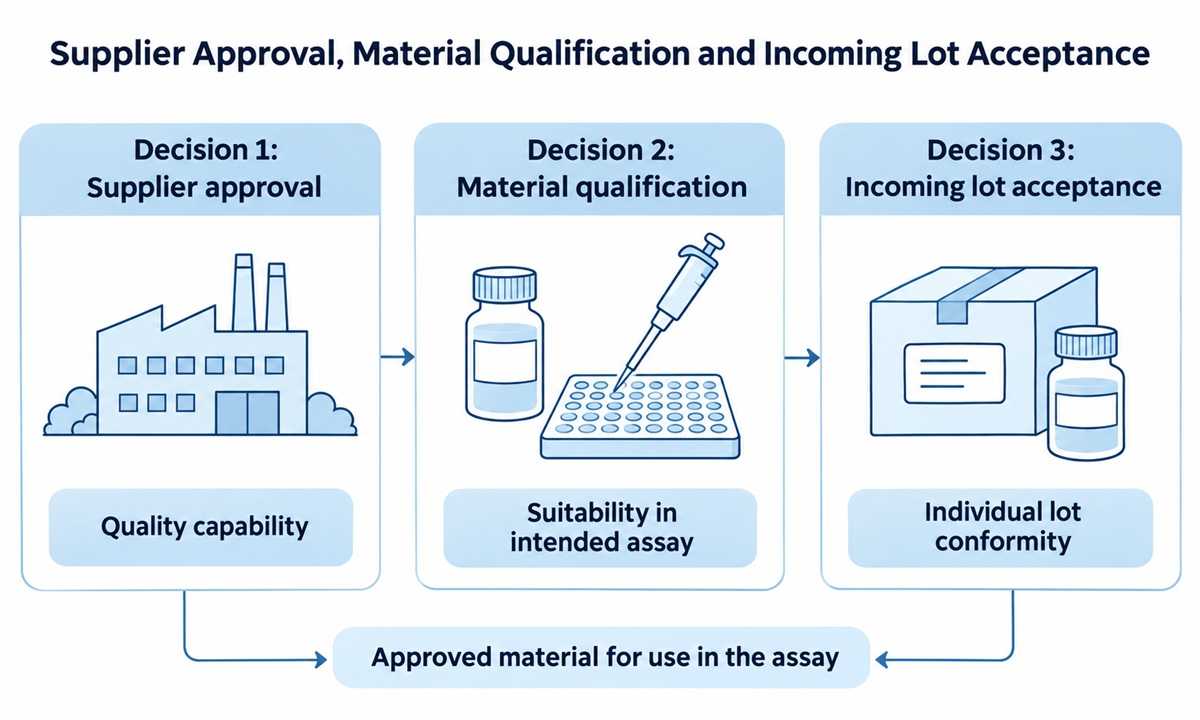
What is the difference between supplier approval and material qualification?
Supplier approval considers whether an organization can reliably provide the required material and support. Material qualification considers whether a particular preparation meets the intended application requirements. Keep the decisions connected but distinct. An approved supplier can offer multiple preparations with different suitability, and a successful sample does not establish the supplier’s ongoing capability.
Is incoming-lot acceptance the same as initial qualification?
No. Initial qualification establishes the evidence and conditions for using a material. Incoming acceptance checks a received lot against the resulting requirements and controls. Decide what must be verified at receipt, what supplier evidence can be relied on, and when additional testing is triggered. Do not repeat or omit studies simply because both activities involve testing.
Does an IVD-grade label define a universal enzyme specification?
Do not infer a complete specification from that wording. Ask what characteristics, documentation and supply controls the supplier means, and compare them with your application requirements. The relevant identity, formulation, activity method and limits still need definition. A descriptive grade name does not demonstrate performance in the finished assay or establish its market authorization.
Does ISO 13485 certification prove that a particular enzyme works?
It concerns a quality management system, not an individual assay-performance result. Review the certificate’s scope, sites, validity and relevance to the supplied activity. Then assess material-specific evidence separately. ISO’s public overview describes a framework for medical-device organizations and related suppliers; it should not be interpreted as a substitute for application qualification.
Can an RUO label be treated as evidence of clinical suitability?
No. Research use only, or RUO, labeling does not establish suitability for clinical diagnosis. FDA guidance discusses the intended-use context of RUO and investigational-use-only IVD products. For a raw-material sourcing decision, clarify the material’s role and applicable requirements. Do not assume that either a marketing label or a successful research experiment resolves them.
What changed with the FDA QMSR in 2026?
The Quality Management System Regulation became effective on February 2, 2026 and incorporates ISO 13485:2016 by reference. FDA describes its applicability to finished-device manufacturers, with relevant qualifications and exceptions. Determine the actual role of the organization and product before applying that framework. It does not make every enzyme stock a finished diagnostic device.
Connect specifications to meaningful evidence
What should be defined before requesting qualification samples?
Describe the enzyme’s role, intended formulation, use concentration, important performance endpoints and handling conditions. Identify known incompatibilities and which properties are critical to the assay. This gives the supplier a meaningful request and gives your team a basis for comparison. Sample selection without an application brief can produce data that do not answer the purchasing decision.
What should a material specification contain?
Define the attributes needed to identify and control the preparation, with units, methods or method references and acceptance criteria. Include formulation and handling information where these affect use. Distinguish mandatory limits from descriptive information. A specification should make it possible to decide consistently whether a material is acceptable, rather than simply repeat a catalogue description.
How do a COA and a TDS differ in qualification?
A certificate of analysis, or COA, commonly reports lot-specific information against stated tests. A technical data sheet, or TDS, commonly describes the preparation and its general properties or use. Check the actual contents rather than assuming a standard format. Reconcile identities, method references and revisions, and request clarification when the documents appear inconsistent.
Is a reported purity percentage enough?
Only for the question that the measurement actually addresses. Ask which method produced the value and what it can detect. A main-band percentage, for example, does not by itself establish the absence of every functionally important impurity. Select additional impurity or functional checks according to the preparation and application, rather than treating all purity numbers as equivalent.
Why must the activity method accompany the unit value?
Activity depends on the defined reaction and measurement conditions. Record substrate, temperature, pH and calculation basis sufficiently to interpret the result. When methods differ, do not compare unit values as though they were interchangeable. Establish an appropriate relationship between the supplier’s release test and the application test before relying on that result for acceptance.
How much formulation information is necessary?
Enough to assess compatibility and control meaningful changes. Consider buffers, salts, stabilizers, preservatives and other components that may enter the final assay. If exact proprietary composition cannot be disclosed, agree on how critical attributes and changes will be communicated. A confidentiality restriction should lead to an explicit evidence plan, not an unsupported assumption of compatibility.
Design tests around the intended use
How many lots should be included in qualification?
There is no universal number suitable for every enzyme and application. Justify the plan using material criticality, process knowledge, available variability data and the consequences of failure. State which sources of variation the selected lots represent. A larger count of closely related samples does not necessarily provide the same evidence as independent production lots.
Can one strong positive control demonstrate suitability?
It provides evidence at that control level. It may not reveal problems near a detection limit, across the measuring interval or in a challenging matrix. Choose test conditions that address the intended claim and known risks. Preserve raw responses and variability, rather than relying only on a binary result from a convenient high-level sample.
When should representative matrices be included?
Include them when specimen-related effects could change the material’s application performance. Buffer-only tests can help isolate enzyme behavior, but they do not automatically cover the intended sample environment. Define the relevant specimen or preparation conditions and controls. The evaluation should distinguish a material-related difference from variation introduced by sample handling or other assay components.
Can CLSI EP26 be used as a raw-material qualification recipe?
Its public scope addresses laboratory evaluation of reagent-lot changes using patient samples to detect clinically important differences. That is useful context, but it is not a universal protocol for enzyme raw materials. A manufacturer should design the component study around its own application, risks and established performance requirements, documenting any adapted principles.
What if the supplier’s COA passes but the application test fails?
Treat the results as evidence from different tests and investigate the discrepancy. Verify identity, storage, preparation, methods and other changed inputs before assigning a cause. Passing a release specification does not automatically settle an application failure. Record the disposition under your quality process and avoid using repeated testing merely to obtain a favorable result.
Can supplier shelf life be transferred to the finished assay?
No. It applies to the specified preparation and storage conditions. Dilution, formulation, packaging or incorporation into a kit creates a different context. Assess the relevant product states and exposures. CLSI EP25 addresses reagent stability claims; its principles may inform a raw-material plan, but the finished assay still needs evidence appropriate to its own claim.
Maintain the qualification decision
Which changes should trigger an impact assessment?
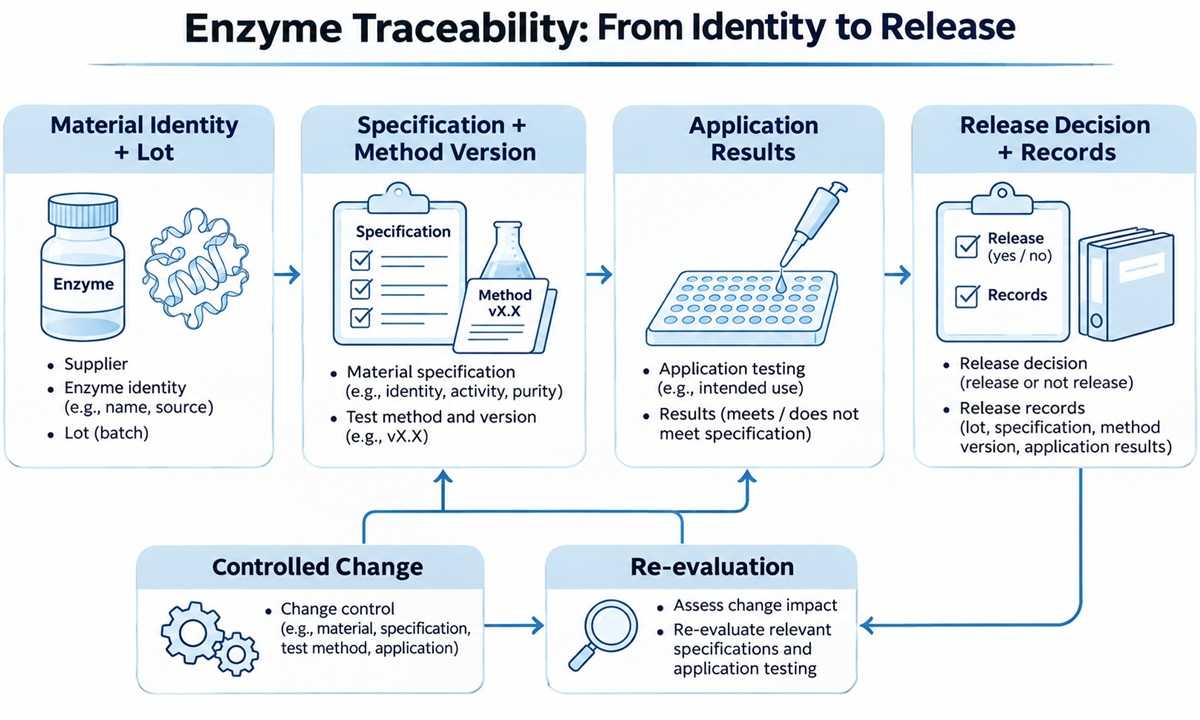
Agree on potentially relevant changes in identity, source, production, purification, formulation, test methods, specification, packaging or manufacturing site. Assess the likely effect rather than assuming that every change needs identical work. Record the rationale and any bridging evidence. The approved material definition provides the reference against which the proposed change can be judged.
What should a change-notification arrangement specify?
Define the changes covered, information expected, notification route, review responsibilities and the handling of affected inventory. Agree on timing that supports evaluation before implementation where appropriate. Include a route for urgent or unplanned changes. A statement that changes will be notified is less useful than a process that identifies who receives and resolves them.
Does a second source need independent qualification?
Yes, its suitability needs evidence. Matching the enzyme name and nominal activity does not establish identical formulation or application behavior. Compare against the established material using relevant criteria, and review documentation and supply controls. Keep an alternative’s approval status current so that an emergency substitution does not become the first meaningful test of compatibility.
Can incoming testing be reduced after successful experience?
Consider this through a documented, risk-based review rather than an automatic schedule. Examine supplier performance, material variability, method reliability and the consequences of a missed defect. Specify what evidence supports the reduced plan and what would restore additional testing. Retain sufficient traceability to investigate problems even when the routine testing scope changes.
How should a transport excursion affect lot acceptance?
Review the actual exposure, package condition, material state and available stability evidence. Compare the event with the conditions supported for that preparation. If the evidence does not cover it, determine the additional assessment needed before disposition. Neither a normal appearance nor the presence of cooling material proves that the required conditions were maintained.
What should the qualification record allow a reviewer to reconstruct?
It should identify the material, intended application, approved specification, evidence reviewed, test methods, deviations and decision authority. Link the conclusion to the lots and versions actually assessed. Include limitations and maintenance triggers. A reviewer should be able to understand why the material was accepted and when that acceptance would need reconsideration.
Keep the three decisions separate
| Decision | Key evidence |
|---|---|
| Approve the supplier | Relevant capability, quality information and ongoing support. |
| Qualify the material | Defined preparation and demonstrated application suitability. |
| Accept the received lot | Lot identity, required records and the approved acceptance checks. |
For a broader evidence framework, see Diagnostic Enzyme QC Checklist. For alternate supply, use Second-Source Qualification Guide for Diagnostic Enzymes. The FAQ directory links related questions.
Sources and further reading
- International Organization for Standardization. ISO 13485:2016 — Medical devices: Quality management systems. Accessed October 20, 2026.
- US Food and Drug Administration. Quality Management System Regulation (QMSR). Accessed October 20, 2026.
- US Food and Drug Administration. Distribution of In Vitro Diagnostic Products Labeled for Research Use Only or Investigational Use Only. Accessed October 20, 2026.
- Clinical and Laboratory Standards Institute. EP26: User Evaluation of Acceptability of a Reagent Lot Change. Accessed October 20, 2026.
- Clinical and Laboratory Standards Institute. EP25: Evaluation of Stability of In Vitro Medical Laboratory Test Reagents. Accessed October 20, 2026.