

A diagnostic reagent shelf-life failure is a loss of specified performance during a defined storage or use period. A declining signal may reveal that failure, but it does not establish which component deteriorated, when the change occurred or whether the measurement system itself has shifted.
Start with the failed requirement, the product presentation and its exposure history. Then separate genuine aging from preparation errors, reference-material drift and damage associated with opening, transport or use. The investigation should explain both the cause and the scope of the affected claim.
Identify the failed endpoint and the relevant stability claim
State the requirement that was not met: blank response, calibration behavior, sensitivity, precision, recovery, reaction rate or another defined performance characteristic. Record the actual result, acceptance criterion and method version. A visual change is valuable evidence, but an unchanged appearance does not establish retained analytical performance.
Distinguish a genuine specification failure from an early warning trend. A reagent can remain within its limits while steadily losing margin. Conversely, an isolated result outside a limit can arise from measurement variation or a handling error. Both require investigation, but neither should be relabeled to fit a preferred conclusion.
CLSI EP25 addresses shelf-life and in-use stability claims. ISO 23640 covers stability evaluation of IVD reagents and associated materials. Their public scopes support treating the product and its use conditions as a defined system; this guide does not substitute for the complete standards or establish compliance.
| Question | Relevant product state | Common interpretation error |
|---|---|---|
| Unopened shelf-life | Final packaged reagent stored under specified conditions. | Using evidence from an opened container to infer unopened stability. |
| Open-vial or on-board stability | Reagent exposed to the defined opening or instrument-use pattern. | Ignoring evaporation, repeated access or time on the instrument. |
| Post-reconstitution stability | Prepared reagent after the specified reconstitution procedure. | Treating the dry storage period and the prepared-use period as interchangeable. |
| Transport or excursion effect | Product subjected to a documented distribution or deviation history. | Assuming every deviation produces the same damage as ordinary aging. |
Reconstruct the timeline and preserve the remaining evidence
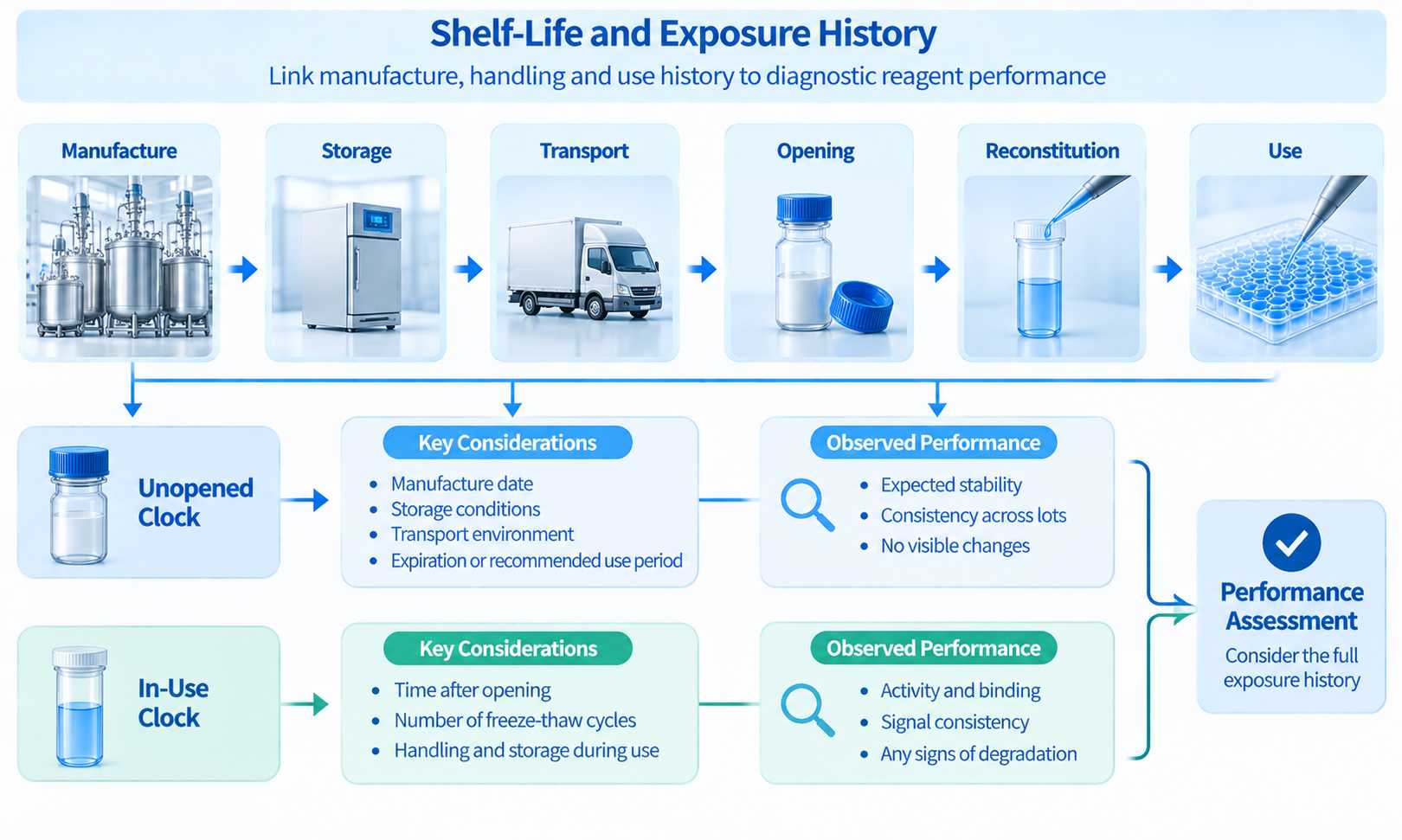
Trace manufacture, release, shipment, receipt, storage, opening and use. Retain the relevant packaging, labels and available aliquots according to the investigation plan. Record temperature data, container condition, opening frequency, light exposure and any freeze-thaw events that could distinguish affected from unaffected material.
Separate recorded exposure from assumptions. A nominal refrigerator setting is not a continuous product-temperature history. Missing records do not prove an excursion, but they limit conclusions about its absence. Likewise, a shipment delay is not evidence of thermal damage without information about the packaging and actual conditions.
Compare affected units with retained material from the same lot and with an appropriate qualified comparison. Note differences in container size, closure, fill volume and use history. A laboratory retain may have been protected from the repeated access experienced by the field unit, so agreement or disagreement must be interpreted in that context.
Build a timeline that places observations alongside events. A sudden change after opening suggests a different investigation from a gradual decline in unopened units. Lot-wide deterioration suggests a different scope from a small number of compromised containers. These patterns guide the next experiment; they do not establish the mechanism on their own.
Rule out a changing measurement or reference system
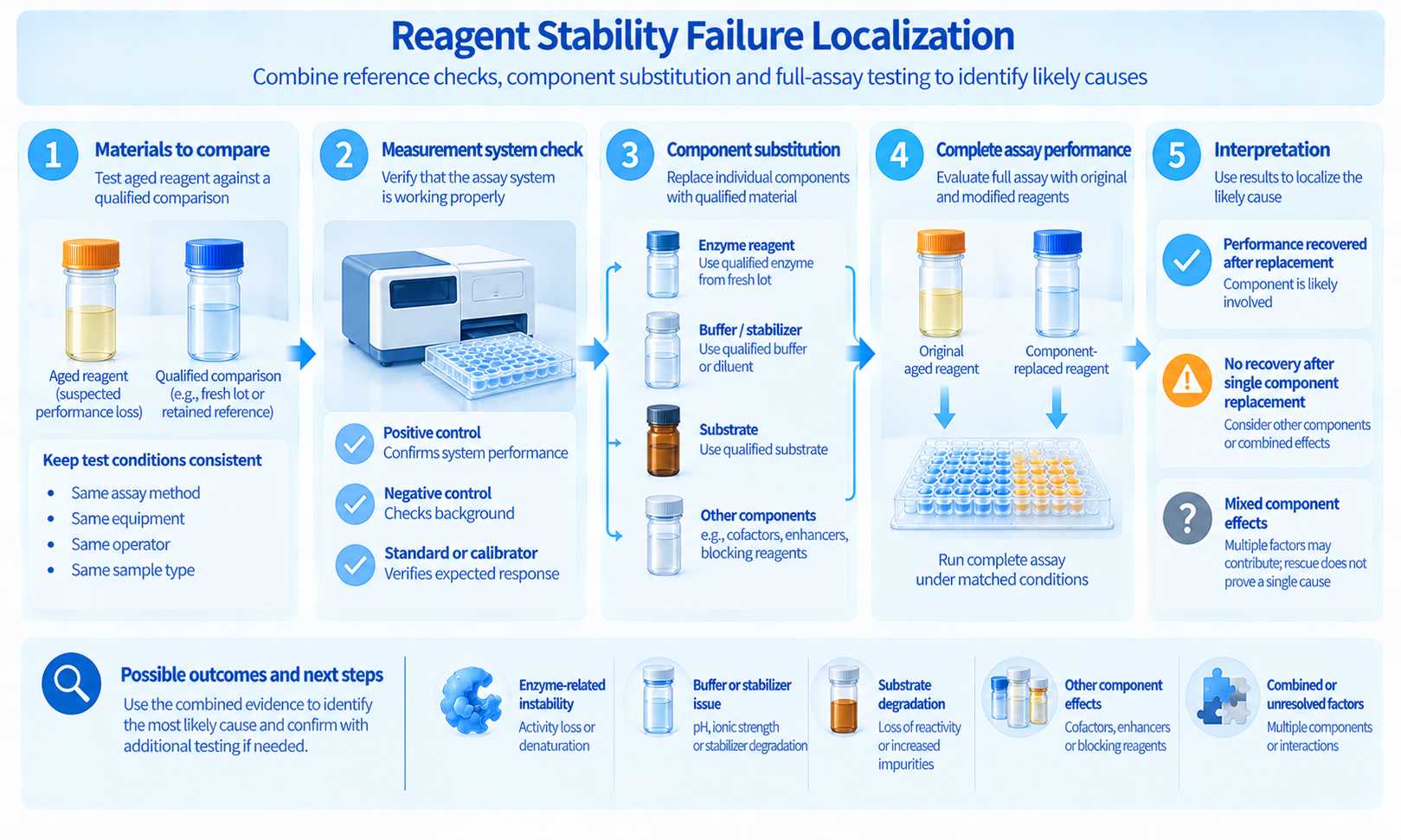
Review the instrument, calibration, analytical method, controls and test specimens used at each stability time point. If all aged samples were tested after a method or calibrator change, the observed step may reflect that change rather than product deterioration. Check original signals and calibration information as well as the reported concentrations.
Use comparison materials whose suitability and storage history are documented. A reference reagent that ages alongside the test product may conceal common deterioration. A changing specimen panel may instead create apparent reagent drift. Where feasible, use qualified retained aliquots or a planned bridging comparison to connect measurements across time.
Repeat testing should answer a stated question. A fresh preparation can investigate a suspected preparation error, while a different unit can investigate container-to-container variability. Preserve the original failure and record why any result is excluded. Repeating until a passing result appears does not resolve the cause.
Examine whether recalibration compensates for one change while another performance property worsens. A corrected high-level response may coexist with deteriorating low-level detection or increasing blank. Evaluate the endpoints relevant to intended performance rather than using calibration recovery as the sole evidence of stability.
If the initial loss occurred immediately after drying rather than during storage, follow the Performance Drop After Lyophilization investigation first. Establishing a credible initial baseline is necessary before interpreting a later aging trend.
Locate the deteriorating component without overinterpreting rescue
When the complete system fails, separate plausible contributors: enzyme or conjugate function, substrate or cofactor integrity, recognition reagents, buffer conditions, packaging and preparation behavior. Select measurements that discriminate among these explanations. Measuring total protein alone cannot show that a stored enzyme retains its relevant catalytic function.
Compare aged and qualified components in controlled combinations when the assay architecture permits. Replace one component while keeping final concentrations, volumes and handling comparable. Include suitable controls for any formulation introduced with the replacement. Adding a fresh stock may change more than the suspected active ingredient.
A restored signal identifies a useful lead, not necessarily the only damaged component. Several components may deteriorate together, and increasing one can compensate for another. Confirm the candidate explanation with an appropriate component-level measurement and then return to the complete assay.
Investigate packaging when deterioration clusters by container or closure history. For dried reagents, moisture exposure may be relevant; for liquid systems, evaporation or repeated access may be relevant. Choose physical or chemical measurements based on the observed pattern rather than assuming every shelf-life failure is caused by moisture.
The original work by Klatser and colleagues evaluated a defined freeze-dried PCR preparation at specified storage temperatures using target detection. It illustrates the need to connect storage observations with functional performance. Its reported duration is evidence for that preparation, not an expiration period for a different enzyme, formulation or package.
Interpret the time course before extrapolating it
Plot the relevant endpoint against actual elapsed time and retain individual-unit or lot information. Pooling all observations can hide a vulnerable lot or a packaging-dependent failure. Inspect the baseline, direction of change and variation before selecting a model.
If a unit passes at one scheduled observation and fails at the next, the exact onset generally lies somewhere between those observations under a monotonic deterioration assumption. Do not describe the second measurement date as the proven moment of failure. Irregular behavior requires investigation of measurement variation, handling or a more complex mechanism.
Accelerated storage can help compare candidates and expose weaknesses, but translating high-stress behavior into an intended-use lifetime requires justification. NIST's reliability guidance emphasizes dependence on appropriate acceleration and lifetime models. A good fit to a small accelerated dataset is not evidence that the same mechanism governs ordinary storage.
Different stresses may change the limiting mechanism. A temperature challenge can reveal one weakness while closure performance or repeated opening controls the actual use period. Do not apply an arbitrary temperature multiplier or combine incompatible failure modes into a single shelf-life estimate.
Use real-time evidence in the final product presentation to support the intended claim. The Accelerated and Real-Time Stability Testing for Diagnostic Reagents guide develops the study-planning distinction. Failure analysis should identify what the existing data establish and which unanswered question requires additional observation.
Confirm the correction and revise the claim only with supporting evidence
Link the corrective action to the supported cause. A closure change should be evaluated for the relevant exposure pathway; a formulation change should be evaluated for its effect on the complete assay. Improving one storage endpoint may alter reconstitution, background or performance in challenging samples.
WHO TGS 2 emphasizes relevant performance characteristics and the finalized product presentation in its prequalification context. Apply that discipline when confirming a correction: test the version intended for use, with the packaging and handling conditions that the resulting conclusion will describe.
Define the confirmation study before interpreting new results, including the affected performance endpoints, relevant lots, comparison materials and time points. If a shortened use period or a changed storage condition is proposed, substantiate that specific boundary. Successful component rescue does not by itself authorize an expiration-date extension.
Close the investigation with the affected lots or presentations, the evidence for the cause, unresolved limitations and the confirmation status. Keep immediate containment decisions separate from the final shelf-life conclusion. Where the pattern tracks batch changes rather than storage exposure, the Diagnostic Enzyme Lot Variation Troubleshooting guide provides the complementary investigation.
Sources and further reading
- Clinical and Laboratory Standards Institute. EP25: Evaluation of Stability of In Vitro Medical Laboratory Test Reagents. Published April 26, 2023..
- International Organization for Standardization. ISO 23640:2011: Evaluation of stability of in vitro diagnostic reagents. Official catalogue; revision under development at review..
- World Health Organization. TGS 2: Establishing stability of in vitro diagnostic medical devices. WHO/BS/2017.2304. Revised guidance..
- NIST/SEMATECH. How do you project reliability at use conditions?. e-Handbook of Statistical Methods, section 8.4.3..
- Klatser PR, Kuijper S, van Ingen CW and Kolk AHJ. Stabilized, freeze-dried PCR mix for detection of mycobacteria. Journal of Clinical Microbiology. 1998;36:1798-1800..